Plot Explained Spoilers guaranteed!
Plot Explained

Browse by genre

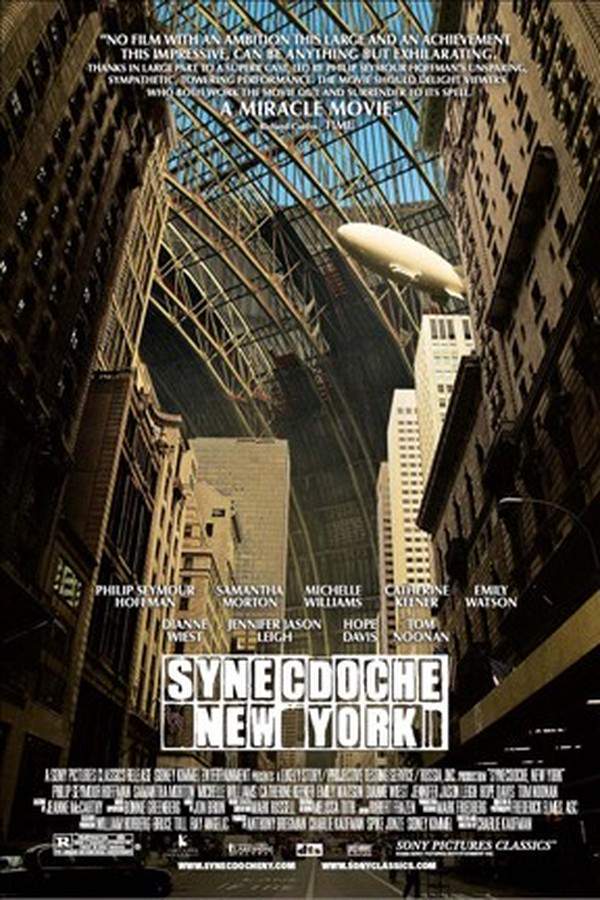
Synecdoche, New York (2008) movie poster

Plot Summary

Synecdoche, New York (2008) Plot Summary Explained

Release, runtime and language
2008 · 124 min · English
JustWatch #4,069 22
Directed by
Charlie Kaufman
Starring
Philip Seymour Hoffman, Michelle Williams, Samantha Morton
Budget
$20M

Caden Cotard, a theater director grappling with personal and professional struggles, begins an ambitious project to construct a meticulously detailed replica of New York City within a warehouse. He populates this miniature world with actors portraying people from his own life, blurring the lines between reality and performance. As Caden delves deeper into his creation, he confronts his own mortality and the complexities of human relationships, exploring themes of existence, loss, and the search for meaning in a chaotic world.

On this page (6)
  1. 1 Where to watch
  2. 2 What happens: full plot
  3. 3 Plot questions answered
  4. 4 Movie threads
  5. 5 Movies like Synecdoche, New York
  6. 6 Every angle

Where to watch

Where to Watch Synecdoche, New York (2008)

Where can you watch Synecdoche, New York? Stream, rent or buy it in the US, including on Fawesome, Amazon Video and Apple TV Store: current JustWatch availability with up-to-date prices.

Streaming availability powered by JustWatch

Full plot summary · contains spoilers

What Happens in Synecdoche, New York: Full Plot Summary

The whole story of Synecdoche, New York (2008) explained, from the opening scene to the final frame: every key event, every twist and what it all adds up to. Read it as a quick recap before the sequel, to check a scene you missed, or to finally understand what really happened.

Theater director Caden Cotard finds his world disintegrating around him. Struggling with various physical ailments, he becomes increasingly isolated from his artist wife, Adele. Things take a turn for the worse when Adele decides to leave him for a new beginning in Berlin, taking their four-year-old daughter, Olive, along with her.

Following the success of his production of Death of a Salesman, Caden is unexpectedly awarded a MacArthur Fellowship, providing him the financial freedom to delve into his artistic endeavors. He resolves to create a profoundly honest and brutal artistic piece, channeling his entire essence into it. He assembles an ensemble cast in a vast warehouse situated in Manhattan's Theater District, where he orchestrates a tribute to the ordinary. He assigns the cast to live out their constructed lives as the mock-up within the warehouse increasingly reflects the bustling city outside. Amidst this chaos, Caden grapples with his personal struggles. The weight of realization hits him as he learns that Adele has become a renowned painter in Berlin, while Olive is growing up under the dubious care of Adele's friend, Maria.

After an unsuccessful romantic encounter with Hazel, the box office attendant, Caden marries Claire, an actress from his cast, with whom he has a daughter. However, their relationship soon crumbles, leading Caden to maintain an awkward bond with Hazel, who is now married with children and serving as his assistant. Meanwhile, an unidentified ailment begins to nag at him, gradually shutting down his autonomic nervous system.

As time slips away, the warehouse becomes a sanctuary, detached from the decay ravaging the outside world. Caden immerses himself further into his magnum opus, blending the lines between reality and the performance by incorporating doppelgängers into the production. Notably, Sammy Barnathan, an actor with an unsettling obsession with Caden, is cast to play him in the play, while a lookalike fills Sammy's original role. Sammy's interest in Hazel rekindles her relationship with Caden, prompting Sammy to take a tragic turn and ultimately end his own life. Just as Caden and Hazel find solace in each other, tragedy strikes again when Hazel succumbs to smoke inhalation in her perpetually burning house.

As he pushes the boundaries of both his personal and artistic relationships, Caden allows an actress to take over his directing role while he adopts her former position as Ellen, Adele's caretaker. He spends his days in a replica of Adele's apartment under the new director's guidance, as unexplained disasters unfold in the warehouse, leaving devastation and casualties in their wake. Eventually, he readies himself for death, resting his head on the shoulder of an actress who once played Ellen's mother, the seemingly last living soul in the warehouse. As this poignant scene fades to gray, Caden begins to share his newfound vision for the play, only to be interrupted by the director's final cue in his ear:

> "Die."
Last updated: November 15, 2024 at 17:46

Was this helpful?

Plot questions answered

Synecdoche, New York Plot Explained: Your Questions Answered

The questions people ask most about Synecdoche, New York (2008): what happens in the confusing scenes, why the characters do what they do, the twists, hidden details and what the ending means. Each answer contains spoilers.

Q1

Why does Caden build a replica of New York City in a warehouse?

Caden builds the replica after receiving a MacArthur Fellowship, which gives him the financial freedom to pursue his artistic vision. He wants to create something profoundly honest and brutal, his magnum opus that explores ordinary life. The warehouse becomes both a sanctuary from his decaying world outside and a canvas where he can control every aspect of existence, blurring the lines between performance and reality as the boundaries between the play and the world collapse.

Foreshadowing: Early in the film, Caden's obsession with observing life and his theatrical background set the stage for this grand artistic undertaking.

  • Caden Cotard
  • warehouse
  • replica
  • New York
  • MacArthur Fellowship
  • artistic creation
Q2

Why does Adele leave Caden and take Olive to Berlin?

Adele leaves Caden because their marriage has deteriorated due to his increasing isolation, health issues, and emotional unavailability. She seeks a new beginning in Berlin, taking their daughter Olive with her. The departure represents Caden's profound loss, not just of his wife, but of his family and any remaining connection to normal life, which fuels his descent into artistic obsession.

Foreshadowing: The timeline establishes Caden's growing isolation and emotional detachment as key factors that strain the relationship before Adele's departure.

  • Adele
  • Berlin
  • Olive
  • marriage
  • departure
  • abandonment
Q3

What is Sammy's role in the production and why is he obsessed with Caden?

Sammy Barnathan is an actor in Caden's production who becomes fixated on playing Caden himself. His obsession with Caden stems from a deep desire to understand and become him, reflecting the film's exploration of identity dissolution. Sammy is cast as Caden, while a lookalike fills Sammy's original role, creating a recursive mirror of identity that parallels Caden's own blurring between self and creation.

Foreshadowing: Sammy's fixation on Caden is established early through his unsettling presence and intense gaze during rehearsals.

  • Sammy Barnathan
  • doppelganger
  • obsession
  • actor
  • identity
Q4

Why does Hazel's house keep burning?

Hazel's house burns continuously throughout the film as a recurring motif rather than a literal event. It symbolizes the unstable, destructive nature of her existence and serves as a metaphor for the internal chaos affecting all characters. Hazel ultimately dies from smoke inhalation in this perpetually burning house, representing how she, along with Caden, is consumed by the emotional and artistic turmoil surrounding them.

Foreshadowing: The burning house appears as a persistent visual element early in Hazel's storyline, foreshadowing its eventual tragic consequence.

  • Hazel
  • house fire
  • smoke inhalation
  • death
  • burning house
Q5

What happens to Caden at the end and what does 'Die' mean?

At the end, Caden accepts his mortality after experiencing profound personal losses, Hazel's death, the destruction of his artistic world, and his own physical decline. When he rests his head on the actress who played Ellen's mother, he begins sharing his final artistic vision, but the director's cue 'Die' interrupts him. This ending represents Caden's transition from creator to creation, completing the recursive loop where he must finally 'die' both as a character and as the director of his own life, blurring the distinction between art and reality one last time.

Foreshadowing: Caden's progressive illness and his relinquishment of directing duties signal his approach toward this final acceptance of death.

  • Caden Cotard
  • ending
  • Die
  • death
  • director
  • final scene
Q6

Why does Caden become Ellen's caretaker?

Caden relinquishes his directing role to an actress and assumes her previous position as Ellen's caregiver, a reversal that represents his complete surrender to the recursive nature of his creation. He retreats into a replica of Adele's apartment, living as a character within his own production rather than its director. This transformation reflects his abandonment of control and his submission to the artistic process, blurring all boundaries between the creator and his creation.

Foreshadowing: The growing sophistication of the warehouse and the increasing presence of doppelgangers hint at Caden's eventual dissolution of his directorial authority.

  • Ellen
  • caretaker
  • Adele's apartment
  • reversal
  • role swap
Q7

What is the play-within-a-play structure in the film?

The production within the film operates as a play-within-a-play where Caden directs actors to live out their constructed lives in a warehouse replica of New York City. As the production evolves, Caden introduces doppelgängers, actors playing both themselves and other characters, including casting Sammy to play Caden while another actor plays Sammy. This recursive structure reflects the film's central theme of identity dissolution, where the boundaries between director, actor, character, and real person become impossible to distinguish.

Foreshadowing: The early scenes of Caden directing 'Death of a Salesman' establish his fascination with life as performance, setting up the meta-theatrical structure.

  • play-within-a-play
  • theater
  • director
  • actors
  • replica
  • warehouse
  • reality vs performance
Q8

What happens to Caden's body as his illness progresses?

Caden suffers from an unidentified ailment that progressively shuts down his autonomic nervous system, representing the literal deterioration of his body mirroring the collapse of his world. This illness serves as both a physical manifestation of his existential crisis and a metaphor for how his grip on reality, identity, and life itself is slipping away. The decay parallels the destruction unfolding in the warehouse and his growing inability to maintain control over his artistic creation.

Foreshadowing: Caden's various physical ailments at the film's opening establish the pattern of bodily decay that will intensify throughout the narrative.

  • illness
  • autonomic nervous system
  • health decline
  • deterioration
  • physical decay
Q9

Why do disasters and casualties occur in the warehouse?

The warehouse disasters, unexpected fires, collapses, and deaths, occur as Caden loses control over his creation. As he abandons his directorial role and retreats into playing a character within the production, the warehouse descends into chaos. These catastrophic events reflect Caden's deteriorating mental state and the collapse of the boundary between his artistic world and reality. The more he blurs the lines between performance and life, the more his creation mirrors the entropy and decay of the world outside.

Foreshadowing: The progressive sophistication of the warehouse and the introduction of doppelgangers signal the unraveling of Caden's controlled environment.

  • warehouse disasters
  • casualties
  • chaos
  • destruction
  • mental collapse
Q10

What does the title 'Synecdoche, New York' mean in relation to the film?

A synecdoche is a literary device where a part represents the whole or vice versa. The title reflects the film's core theme: Caden's warehouse replica of New York City is a small part that stands in for the entire world. Similarly, the actors within the production represent the real people in Caden's life, and Caden himself represents all of humanity's struggle with mortality and meaning. The film explores how we use parts to understand wholes, and how that attempt ultimately fails when confronting the chaos of existence.

Foreshadowing: The very concept of building a replica, creating a part to represent the whole, embodies the synecdoche concept from the film's inception.

  • synecdoche
  • title meaning
  • New York
  • replica
  • part and whole
  • literary device
Q11

What happens to Caden and Hazel's relationship?

Caden's relationship with Hazel follows a tragic arc: after an unsuccessful initial romantic encounter, Hazel marries someone else and becomes Caden's assistant. Sammy's obsession with Hazel rekindles her connection to Caden, leading them to find solace in each other. However, their happiness is short-lived, Hazel dies from smoke inhalation in her perpetually burning house. This loss devastates Caden, intensifying his grief and further cementing his retreat into the artificial world of his production.

Foreshadowing: Sammy's reappearance in the production and his renewed interest in Hazel directly trigger the rekindling of her relationship with Caden.

  • Hazel
  • Caden
  • relationship
  • Sammy
  • death
  • romance
Q12

What happens to Caden's daughter Olive?

Olive is taken to Berlin by Adele when she leaves Caden, and she grows up under the care of Adele's friend Maria. Caden remains separated from his daughter throughout the film, with Adele achieving success as a painter while Olive remains abroad. This separation represents another profound loss in Caden's life, the failure of his family and the inability to maintain meaningful human connections, which drives his further immersion into his artistic creation as a substitute for real relationships.

Foreshadowing: Adele's departure with Olive establishes the loss of family as a central wound that propels Caden's artistic obsession.

  • Olive
  • daughter
  • Adele
  • Berlin
  • Maria
  • separation
  • family

Movie threads

More Movies Like Synecdoche, New York, by Mood & Story

Curated lists built around what makes Synecdoche, New York tick: the same mood, the same kind of story or the same emotional payoff. Each list explains why these movies belong together.

Movies about artistic obsession and existential dread like Synecdoche, New York

Stories of creators whose ambition leads them into profound personal and philosophical turmoil. If you were fascinated by the meta-narrative and creative collapse in Synecdoche, New York, this list is for you. Discover movies like this that delve into the minds of obsessive artists, where the creative process becomes a vessel for exploring heavy themes of mortality, identity, and the blurred lines between reality and performance.

  • existential
  • obsessive
  • metaphysical
  • reflective
  • lonely
  • oppressive
  • Tone: melancholic, bleak
  • Pacing: slow, meditative
Why these movies?

The story pattern: Narratives in this thread often follow a creator who embarks on an increasingly ambitious and all-consuming project. As the work grows, it begins to eclipse their real life, leading to a recursive examination of their own psyche, failures, and fears. The story structure itself may become complex and self-referential, mirroring the protagonist's unraveling mental state.

Why they belong together: These films are grouped by their shared focus on the psychological toll of creation. They share a melancholic, often bleak tone, a slow, contemplative pacing that allows dread to build, and a high emotional intensity rooted in profound philosophical questioning.

Mind-bending movies about reality and identity like Synecdoche, New York

Films where the boundaries of reality dissolve, forcing characters to question their own existence. For fans of the recursive, dreamlike world-building in Synecdoche, New York. This collection features similar films that challenge perception and explore identity collapse. If you like stories with very complex narratives, bleak tones, and themes of isolation within shifting realities, you'll find compelling recommendations here.

  • dreamlike
  • surreal
  • unsettling
  • psychological
  • disorienting
  • metaphysical
  • Tone: bleak, anxious
  • Pacing: slow, dreamlike
Why these movies?

The story pattern: The narrative pattern involves a protagonist navigating a reality that is constantly shifting, folding in on itself, or being constructed. This could be a dream, a simulation, a theatrical production, or a psychological breakdown. The plot structure is non-linear or recursive, designed to disorient both the character and the viewer, leading to a climactic confrontation with the fragility of the self.

Why they belong together: These movies are connected by their postmodern approach to storytelling, their focus on themes of identity and reality, and their creation of an oppressive, anxious mood. They share a slow, deliberate pacing that allows the surreal atmosphere to build and a high intensity derived from psychological unease.

If you liked this

Movies Like Synecdoche, New York

Similar movies to Synecdoche, New York: the same genre, themes or kind of story. Each one comes with its own plot summary, timeline and ending explained.

Browse all movie summaries

Every angle

Synecdoche, New York (2008) Explained: Plot, Timeline & Characters

Everything about Synecdoche, New York in one place: what happens in the plot summary, the timeline in chronological order, the characters and meaning and a spoiler-free summary. What's After the Movie adds the cast, box office and post-credit scenes.

Coming soon on iOS and Android

The Plot Explained Movie Summary App

Plot summaries, endings explained and timelines on your phone. Catch up on any movie in minutes, save your favorites and never miss a twist again.

Be the first to know when we launch. Your email stays private, always.

Learn more about the app