Plot Explained Spoilers guaranteed!
Plot Explained

Browse by genre

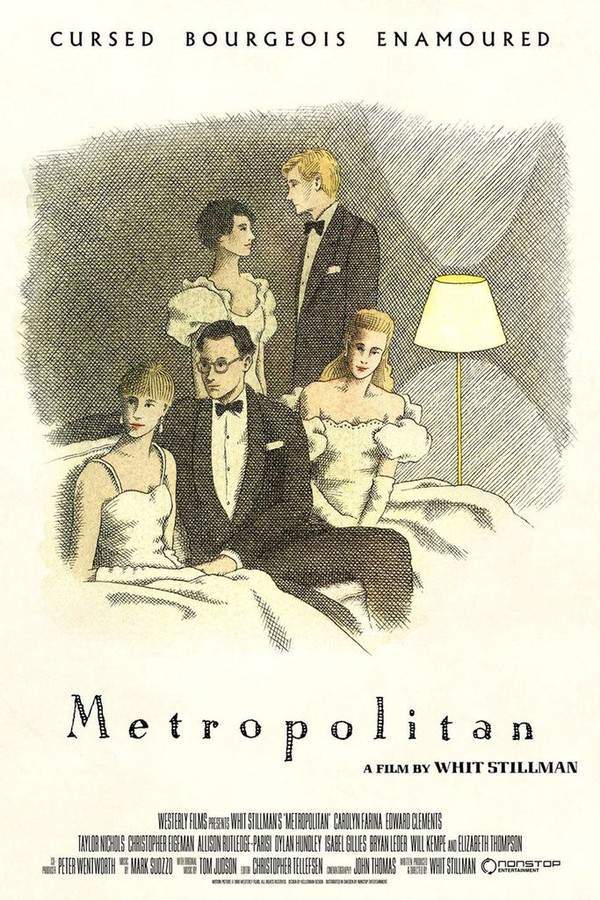
Metropolitan (1990) movie poster

Plot Summary

Metropolitan (1990) Plot Summary Explained

Release, runtime and language
1990 · 98 min · English
JustWatch #28,972 6
Directed by
Whit Stillman
Starring
Carolyn Farina, Chris Eigeman, Edward Clements
Budget
$230K

A provocative outsider disrupts the established routines of a group of wealthy friends in Manhattan. Their privileged world is challenged as unexpected connections emerge and long-held beliefs are questioned. The arrival of this newcomer sparks a journey of self-discovery and social change within their uptown circle, leading to transformative encounters and a re-evaluation of their place in society.

On this page (6)
  1. 1 Where to watch
  2. 2 What happens: full plot
  3. 3 Plot questions answered
  4. 4 Movie threads
  5. 5 Movies like Metropolitan
  6. 6 Every angle

Where to watch

Where to Watch Metropolitan (1990)

Where can you watch Metropolitan? Stream, rent or buy it in the US, including on HBO Max, Amazon Video and Apple TV Store: current JustWatch availability with up-to-date prices.

Streaming availability powered by JustWatch

Full plot summary · contains spoilers

What Happens in Metropolitan: Full Plot Summary

The whole story of Metropolitan (1990) explained, from the opening scene to the final frame: every key event, every twist and what it all adds up to. Read it as a quick recap before the sequel, to check a scene you missed, or to finally understand what really happened.

In New York City, the lives of affluent socialites intertwine as they return from college just in time for the festive Christmas break, coinciding with the debutante ball season. After attending an extravagant ball, Princeton student Tom Townsend finds himself unwittingly introduced to a group of friends known as the "Sally Fowler Rat Pack," led by the charming Nick Smith. Their night takes a turn when Nick mistakenly assists Tom into a taxi, leading to an impromptu invitation to an after-party hosted at the Upper East Side apartment of Sally Fowler.

At the party, Tom reveals his preference to avoid taxis, prompting Nick to jest that Tom is merely a "public transportation snob." This fun banter transforms into a deeper conversation as Tom opens up about his family's struggles—his wealthy father's hasty remarriage and the impact it has had on him. Amidst laughter and lively discussions, Tom crosses paths with Audrey Rouget (Carolyn Farina) and her best friend Jane Clarke. They reminisce about Tom's ex-girlfriend, Serena Slocum, who is notorious for being the belle of the ball, even sharing embarrassing stories about love letters from her suitors.

As Tom navigates the complexities of the social elite, he encounters critiques about his ideals from Charlie Black, an intellectual who seems to relish finding faults in Tom’s beliefs. Tensions flare when they debate political ideologies, with Tom professing a peculiar admiration for the theories of French philosopher Charles Fourier. Yet, amidst the revelry, Tom’s interests lie more with Audrey than Serena, despite the latter’s promising allure. A series of social misadventures lead Tom to an important party where Serena arrives with her aristocratic new partner, igniting jealousy and tension within his friend group.

As the festive season progresses, Tom juggles his feelings for both women, grappling with romantic decisions amid Christmas Eve solitude spent at his mother’s apartment. Meeting up with the "SFRP" post-Christmas, the dynamics shift as deep-seated emotions surface during a candid game of truth. The game reveals Tom's lingering affections for Serena, leaving Audrey in turmoil.

As Tom strives to mend his relationships and explore his true feelings, the end of the holiday draws near. He embarks on a quest to reconnect with Audrey, navigating a series of obstacles including transportation troubles. With Charlie by his side, they sneak into the beach house of Rick Von Sloneker to check on Audrey and her friend Cynthia. Contention brews as Tom confronts Von Sloneker, leading to a tense standoff.

The film culminates as Tom reconciles his affections, suggesting a future visit to France with Audrey, illuminating an ironic twist as the trio resorts to hitchhiking back to Manhattan, a fittingly humble end to a season dominated by lavish expectations and profound realizations.
Last updated: November 08, 2024 at 00:14

Was this helpful?

Plot questions answered

Metropolitan Plot Explained: Your Questions Answered

The questions people ask most about Metropolitan (1990): what happens in the confusing scenes, why the characters do what they do, the twists, hidden details and what the ending means. Each answer contains spoilers.

Q1

Why does Tom refuse to take taxis throughout the film?

Tom avoids taxis because they represent the wealthy lifestyle he feels conflicted about. His father's hasty remarriage after his mother's death has left Tom financially uncomfortable with his family's wealth. Taking the subway or walking becomes a small act of rebellion against the privilege that now feels hollow to him. This preference is first mentioned at Sally's party when Nick jokes about Tom being a public transportation snob.

  • tom townsend
  • taxis
  • subway
  • class conflict
  • wealth
Q2

Why does Audrey become upset during the truth game?

During the post-Christmas truth game, Tom admits he still has feelings for Serena rather than Audrey. This revelation humiliates Audrey in front of the group, especially since she'd hoped Tom reciprocated her interest. The game forces a honesty that damages their relationship temporarily, leaving Audrey feeling hurt and rejected after believing there was a mutual attraction.

Foreshadowing: Earlier party scenes show Audrey and Tom connecting romantically, making this revelation more painful.

  • audrey rouget
  • truth game
  • serena slocum
  • feelings
  • rejection
Q3

What is Tom's fascination with Charles Fourier about?

Tom cites Fourier's utopian socialist theories during debates with Charlie, using them to critique capitalism and social inequality. This intellectual stance aligns with Tom's discomfort about wealth and his desire to distance himself from his privileged background. The reference highlights Tom as an outsider within his own social class, someone who has access to money but intellectually rejects its values.

  • charles fourier
  • socialism
  • charlie black
  • philosophy
  • debate
Q4

What happens when Tom and Charlie confront Rick Von Sloneker?

Tom and Charlie sneak into Rick Von Sloneker's beach house to check on Audrey and her friend Cynthia, whom they suspect may be in trouble. A tense standoff erupts between Tom and the aggressive Von Sloneker. This confrontation demonstrates Tom's willingness to act on his feelings for Audrey, moving beyond passive romantic indecision to assertively pursue her despite the risks.

  • rick von sloneker
  • beach house
  • confrontation
  • audrey
  • cynthia
Q5

Why does Tom end up hitchhiking at the film's conclusion?

The hitchhiking ending is ironic because it directly reverses Tom's earlier stance against taxis. After a holiday season of navigating elite social circles and questioning his relationship to wealth, Tom now travels humbly with Audrey and Charlie. This choice symbolizes his personal growth, he's moved from rejecting wealth to finding contentment in simpler, more authentic experiences.

Foreshadowing: Tom's taxi avoidance sets up this reversal throughout the film.

  • hitchhiking
  • ending
  • irony
  • manhattan
  • transformation
Q6

Who are the Sally Fowler Rat Pack members?

The Sally Fowler Rat Pack (SFRP) is a close-knit group of affluent young socialites who spend Christmas break together in Manhattan. Led by the charming Nick Smith, the group includes Audrey Rouget, Jane Clarke, Charlie Black, and others. They navigate debutante balls, parties, and romantic entanglements while debating philosophy and social issues. Tom becomes inadvertently inducted into the group after meeting them at a ball.

  • sally fowler rat pack
  • sfrp
  • nick smith
  • party
  • social circle
Q7

Why is Tom affected by his father's remarriage?

Tom reveals at Sally's party that his wealthy father remarried quickly after Tom's mother's death, which has deeply affected Tom. This family upheaval explains his conflicted feelings about wealth and privilege. He's surrounded by opulence yet feels emotionally distant from it, creating the internal tension that drives much of his character arc throughout the holiday season.

  • tom's father
  • remarriage
  • family
  • mother
  • emotional conflict
Q8

Why is Serena Slocum such a prominent figure among the group?

Serena Slocum is portrayed as the belle of the ball, the most coveted young woman in their social circle. She's notorious for receiving love letters from numerous suitors and arrives at parties with an aristocratic new partner during the film. Both Tom and other members of the group are drawn to her, creating romantic tension that complicates Tom's relationship with Audrey.

  • serena slocum
  • debutante
  • popularity
  • love letters
  • social elite
Q9

Why does Charlie Black criticize Tom's ideals?

Charlie Black serves as the group's intellectual who actively seeks flaws in Tom's beliefs. Their debates about politics and philosophy create recurring tension, with Charlie representing cynical intellectualism while Tom offers more idealistic perspectives. Despite their conflicts, Charlie ultimately helps Tom during the beach house confrontation, showing their rivalry masks a genuine friendship.

  • charlie black
  • debate
  • intellectual
  • rivalry
  • friendship

Movie threads

More Movies Like Metropolitan, by Mood & Story

Curated lists built around what makes Metropolitan tick: the same mood, the same kind of story or the same emotional payoff. Each list explains why these movies belong together.

Movies with Witty Social Commentary like Metropolitan

Smart films where characters connect and clash through sharp, philosophical dialogue. Discover movies like Metropolitan that explore social dynamics through sharp, intellectual dialogue. If you enjoyed the philosophical banter and sophisticated wit, these similar comedy-dramas focus on characters connecting through conversation and questioning their worldviews.

  • witty
  • conversational
  • sophisticated
  • observational
  • reflective
  • intellectual
  • Tone: witty, observational, light
  • Pacing: steady, conversation-driven
Why these movies?

The story pattern: The narrative unfolds through a series of social gatherings and encounters, driven by character interactions rather than high-stakes plot. Conflicts are intellectual and interpersonal, often resolving through conversation and a reevaluation of beliefs, leading to hopeful or ironically satisfying conclusions.

Why they belong together: These films are grouped by their shared focus on dialogue as the primary engine for both character development and entertainment. They deliver a light, thoughtful experience through witty observations and philosophical debates within a specific social milieu.

Movies about an Outsider Disrupting a Social Circle like Metropolitan

A newcomer challenges the dynamics and beliefs of a tight-knit, established group. Find films similar to Metropolitan where a newcomer challenges a privileged or insular group. If you liked the dynamic of an outsider sparking change, these stories explore the tensions and transformations that occur when established routines are disrupted.

  • reflective
  • gentle
  • sophisticated
  • young adulthood
  • romantic
  • social dynamics
  • Tone: reflective, gentle, hopeful
  • Pacing: steady, character-driven
Why these movies?

The story pattern: The story follows a protagonist, often an observer or critic, who is reluctantly or intentionally drawn into a closed community. Their integration or rejection creates ripples, exposing hypocrisies and facilitating unexpected connections, ultimately leading the group and the outsider to re-evaluate their place in the world.

Why they belong together: These movies share a core narrative structure where an external character serves as a disruptive force, creating compelling interpersonal drama and thematic exploration of class, belonging, and identity within a specific, often privileged, setting.

If you liked this

Movies Like Metropolitan

Similar movies to Metropolitan: the same genre, themes or kind of story. Each one comes with its own plot summary, timeline and ending explained.

Browse all movie summaries

Every angle

Metropolitan (1990) Explained: Plot, Timeline & Characters

Everything about Metropolitan in one place: what happens in the plot summary, the timeline in chronological order, the characters and meaning and a spoiler-free summary. What's After the Movie adds the cast, box office and post-credit scenes.

Coming soon on iOS and Android

The Plot Explained Movie Summary App

Plot summaries, endings explained and timelines on your phone. Catch up on any movie in minutes, save your favorites and never miss a twist again.

Be the first to know when we launch. Your email stays private, always.

Learn more about the app