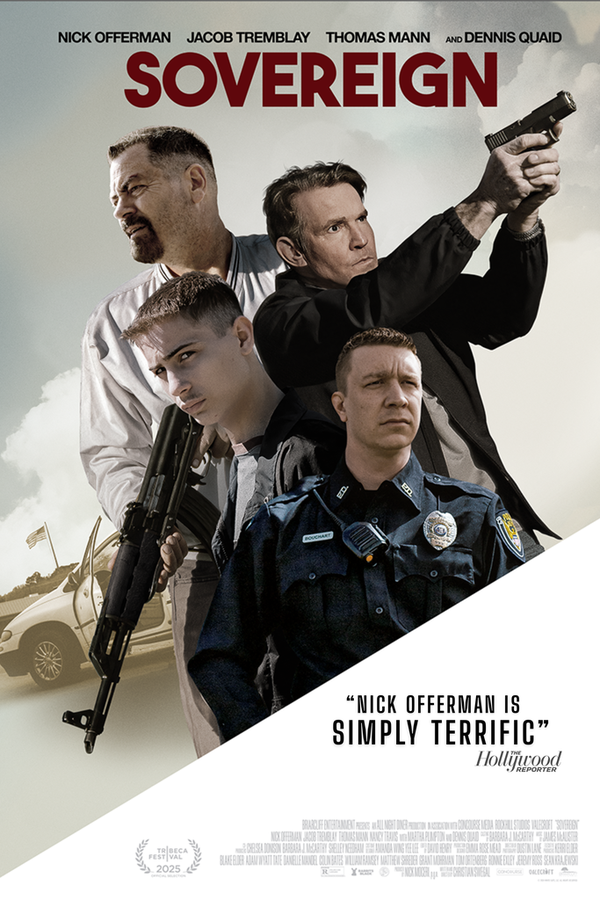
Sovereign

Sovereign

Year: 2025

Runtime: 1 h 40 m

Language: english

Director: Christian Swegal

Echo Score: 70
crimedramathriller

A father and his teenage son, Jerry and Joseph Kane (played by Nick Offerman and Jacob Tremblay), adhere to the Sovereign Citizen belief system, a worldview characterized by distrust of government authority and a rejection of legal norms. They travel extensively across the country, delivering self-taught legal seminars and actively challenging systems they believe are unjust. The film explores their complex relationship and the impact of their extreme ideology.

Warning: spoilers below!

Haven’t seen Sovereign yet? This summary contains major spoilers. Bookmark the page, watch the movie, and come back for the full breakdown. If you're ready, scroll on and relive the story!

Sovereign (2025) – Ending Explained & Final Scene Breakdown

Still thinking about how Sovereign (2025) ended? Here’s a full breakdown of the ending, key final moments, major twists, and the deeper meaning behind the film’s conclusion.

The ending of Sovereign is deeply tragic and symbolizes the devastating consequences of fanaticism and delusion. As Jerry and Joe escalate their rebellion against the system, they become increasingly consumed by their belief that they are above the law. Their shootout with the officers results in the death of Joe and Jerry, marking the destructive culmination of their unwavering conviction in their sovereign identity. Throughout the movie, Jerry’s refusal to accept reality and his belief that he could manipulate the legal system and evade justice lead to his downfall. His delusions about winning court cases and his rejection of authority foster a dangerous mindset that ultimately culminates in violence. The final scene, where the police shoot Jerry and find Joe dead from his wounds, leaves a haunting impression. It suggests that their obsession with independence and rejection of legal authority has only led to tragedy, not freedom.

The death of Joe, a young boy manipulated into violence by his father’s radical beliefs, underscores how fanaticism corrupts innocence. Meanwhile, the police officers, including Sergeant Adam Bouchart, suffer their own pain—especially Adam’s father, John—who mourns the loss of his son in a moment of fragile reflection. The concluding moments, with John holding his grandson and grieving the loss of both his son and grandson, serve as a heartbreaking reminder of the cycle of violence and the toll of refusing to accept the rule of law. The film ultimately paints a somber picture: rebellion rooted in delusion and hatred only results in tragedy and loss, leaving behind a legacy of broken lives and shattered hopes.

Last updated: July 21, 2025 at 10:30

Was this helpful?

Sovereign (2025) Ending Questions Answered – Ending FAQ

Read frequently asked questions about the ending of Sovereign (2025), including final-scene interpretation, twist explanations, character outcomes, and the deeper meaning behind the conclusion. This ending explained FAQ is designed for viewers searching for clear spoiler-heavy answers and ending breakdown insights.

Q1

Why do Jerry and Joe die in the final shootout?

A.

Jerry and Joe die because they escalate their sovereign citizen rebellion into open violence against law enforcement. Throughout the film, Jerry's delusional belief that he could manipulate the legal system and evade justice leads him to resist arrest. When police confront them, Jerry refuses to surrender and opens fire, resulting in a deadly shootout where both father and son are killed. Their deaths symbolize the catastrophic consequence of believing one is above the law.

Earlier scenes show Jerry confidently claiming he can win court cases through self-taught legal arguments, establishing his dangerous delusion.

jerry kanejoe kaneshootoutdeathpolice confrontation
Q2

What happens to Joe Kane at the end of the movie?

A.

Joe Kane is killed in the shootout alongside his father Jerry. The young boy, who was manipulated into his father's radical ideology, dies from wounds sustained during the violent confrontation with police. His death underscores the film's theme about how fanaticism corrupts innocence, Joe had no choice but to follow his father's dangerous path into violence.

Joe's compliance with his father's increasingly extreme actions throughout the film hints at his tragic fate.

joe kanedeathsonfather son relationship
Q3

Who is John Bouchart and why is he important in the ending?

A.

John Bouchart is the father of Police Sergeant Adam Bouchart, who is killed in the confrontation with Jerry and Joe. In the final scene, John is seen holding his grandson, Adam's infant child, grieving the loss of both his son and his grandson Joe (who was John’s grandson through Adam, making this a multi-generational tragedy). His presence completes the cycle of violence, showing how the consequences ripple through both families.

Adam's relationship with his father is briefly shown earlier, establishing John's role as a grieving parent.

john boucheradam boucherpolice officergrandfathergrandson
Q4

What happens to Sergeant Adam Bouchart?

A.

Police Sergeant Adam Bouchart is killed during the shootout with Jerry and Joe. As one of the officers attempting to arrest the Kanes, he becomes a victim of the violence that Jerry's delusional rebellion incites. His death transforms the story from a case of ideological extremism into a tragedy affecting two families, the Kanes and the Boucharts.

Adam is shown as a dedicated officer doing his duty, which makes his death more impactful.

adam boucherpolice sergeantkilledshootout
Q5

What does the ending say about sovereign citizen ideology?

A.

The ending presents a stark condemnation of sovereign citizen ideology, showing it as a dangerous delusion that leads to tragedy. Jerry's belief that he could manipulate courts and evade legal consequences ultimately brings destruction, not freedom. The film argues that rebellion without basis in reality, rooted in hatred and delusion, only results in loss of life and broken families. Neither Jerry nor Joe achieve any form of liberation; their defiance ends in death.

Jerry's confident but delusional courtroom performances throughout the film set up the false promise of his ideology working.

sovereign citizenideologydelusionrebellionlaw
Q6

Why is the ending so bleak with no hope or redemption?

A.

The filmmakers chose an unambiguously bleak ending to emphasize the real-world consequences of radical extremism. Unlike films that offer redemption arcs, Sovereign shows that Jerry's years of delusion and manipulation create an inevitable path to violence. There is no last-minute reversal because Jerry is too far gone in his beliefs. The film prioritizes realism over Hollywood redemption, arguing that the damage done by radicalizing someone like Joe cannot be undone.

The steady pacing from minor skirmishes to major conflict foreshadows the unavoidable nature of the climax.

bleak endingno redemptiontragedyfinal scene
Q7

What is the significance of the baby in the final scene?

A.

The baby, Adam Bouchart's infant child, represents the innocent life left behind by the cycle of violence. John Bouchart holding the child while grieving his son creates a powerful image of generational loss. The baby symbolizes both the future that Adam will never see and the fragile new life that must now grow up without a father, highlighting the collateral damage of Jerry and Joe's violent rebellion.

Adam mentions having a family earlier, establishing his role as a father.

babyinfantgrandsoncycle of violenceinnocence
Q8

How does Jerry's delusion lead to the family's downfall?

A.

Jerry's downfall stems from his absolute conviction that he could outsmart the legal system through sovereign citizen arguments. He genuinely believed he could win court cases and evade consequences, which prevented him from recognizing when retreat was possible. This delusion fostered an increasingly dangerous mindset where refusing to back down became a point of pride. When police finally confronted him, Jerry's inability to accept reality transformed a legal matter into a deadly shootout.

Jerry's courtroom confidence and his belief that he can 'beat the system' are established early.

jerry kanedelusionlegal systemcourtcognitive distortion
Q9

What does the film say about the cycle of violence?

A.

The film portrays a devastating cycle where Jerry's radical ideology destroys two families, his own and the Boucharts. Joe, raised in his father's worldview, follows Jerry into violence. Simultaneously, Adam's death leaves his own child fatherless. John, now holding his grandchild, represents the continuation of grief across generations. The film suggests that extremist beliefs don't just harm the extremists themselves but create cascading trauma that affects innocents for years to come.

The parallel portrayals of Jerry-Joe and Adam-John relationships establish the dual family dynamics early.

cycle of violencegenerational traumaconsequencesfamily
Q10

Why does Joe follow Jerry into violence despite being a child?

A.

Joe follows Jerry because he has been raised entirely within his father's ideology and has no outside perspective to challenge it. As a teenager, Joe has been homeschooled and traveling with Jerry his entire life, making Jerry his primary influence. The film portrays how radical parents can manipulate children into adopting extreme beliefs without consent. Joe isn't making a free choice, he's been conditioned to believe sovereign citizen ideology is righteous and that resistance to authority is a moral duty.

Joe's dependence on Jerry and lack of other relationships are shown throughout the film.

joe kanemanipulationbrainwashingfather sonradicalization
Mobile App Preview

Coming soon on iOS and Android

The Plot Explained Mobile App

From blockbusters to hidden gems - dive into movie stories anytime, anywhere. Save your favorites, discover plots faster, and never miss a twist again.

Sign up to be the first to know when we launch. Your email stays private, always.

Explore Movie Threads

Discover curated groups of movies connected by mood, themes, and story style. Browse collections built around emotion, atmosphere, and narrative focus to easily find films that match what you feel like watching right now.

Movies about ideological extremism leading to tragedy like in Sovereign

Stories of radical beliefs clashing with society, with devastating consequences.If you were gripped by the tragic collision of beliefs in Sovereign, explore these movies that also feature characters whose extreme ideologies lead to devastating confrontations. These films share a heavy emotional weight and a tense, bleak tone, often ending in sorrow.

tragictensedesperategrittyoppressivesomber

Narrative Summary

These stories typically follow a straightforward but powerful arc: characters adopt a radical worldview, which brings them into escalating conflict with authority or society. The narrative builds steadily towards an unavoidable, often violent climax that highlights the tragic flaws and human cost of their ideology.

Why These Movies?

Movies are grouped here based on their shared focus on a single, powerful theme: the destructive path of extremism. They connect through a tense tone, high intensity, and a bleak, emotionally devastating conclusion that leaves little room for hope.

Movies with intense father-son relationships like in Sovereign

Intense dramas exploring the powerful, complicated relationship between fathers and sons.If the powerful, tragic bond between Jerry and Joseph Kane in Sovereign resonated with you, discover other films that explore the complexities of father-son dynamics under extreme pressure. These dramas and thrillers are heavy, tense, and focus on familial love amidst crisis.

tensetragicgrittyemotionaldesperatesomber

Narrative Summary

The narrative pattern revolves around the dual character arcs of a father and son, whose relationship is the emotional core of the film. External pressures—be it crime, survival, or belief systems—force them to rely on each other while also exposing the cracks in their bond, often leading to a somber or tragic resolution.

Why These Movies?

These films are united by their primary focus on the father-son dynamic as the source of both strength and tragedy. They share a heavy emotional weight, a tense atmosphere, and a gritty, realistic feel that makes the familial struggle deeply impactful.

Unlock the Full Story of Sovereign

Don't stop at just watching - explore Sovereign in full detail. From the complete plot summary and scene-by-scene timeline to character breakdowns, thematic analysis, and a deep dive into the ending - every page helps you truly understand what Sovereign is all about. Plus, discover what's next after the movie.

Sovereign Summary

Read a complete plot summary of Sovereign, including all key story points, character arcs, and turning points. This in-depth recap is ideal for understanding the narrative structure or reviewing what happened in the movie.

Sovereign Summary

Sovereign Timeline

Track the full timeline of Sovereign with every major event arranged chronologically. Perfect for decoding non-linear storytelling, flashbacks, or parallel narratives with a clear scene-by-scene breakdown.

Sovereign Timeline

Characters, Settings & Themes in Sovereign

Discover the characters, locations, and core themes that shape Sovereign. Get insights into symbolic elements, setting significance, and deeper narrative meaning - ideal for thematic analysis and movie breakdowns.

Characters, Settings & Themes in Sovereign

Sovereign Spoiler-Free Summary

Get a quick, spoiler-free overview of Sovereign that covers the main plot points and key details without revealing any major twists or spoilers. Perfect for those who want to know what to expect before diving in.

Sovereign Spoiler-Free Summary

More About Sovereign

Visit What's After the Movie to explore more about Sovereign: box office results, cast and crew info, production details, post-credit scenes, and external links - all in one place for movie fans and researchers.

More About Sovereign

Similar Movies to Sovereign

Discover movies like Sovereign that share similar genres, themes, and storytelling elements. Whether you’re drawn to the atmosphere, character arcs, or plot structure, these curated recommendations will help you explore more films you’ll love.