Plot Explained Spoilers guaranteed!
Plot Explained

Browse by genre

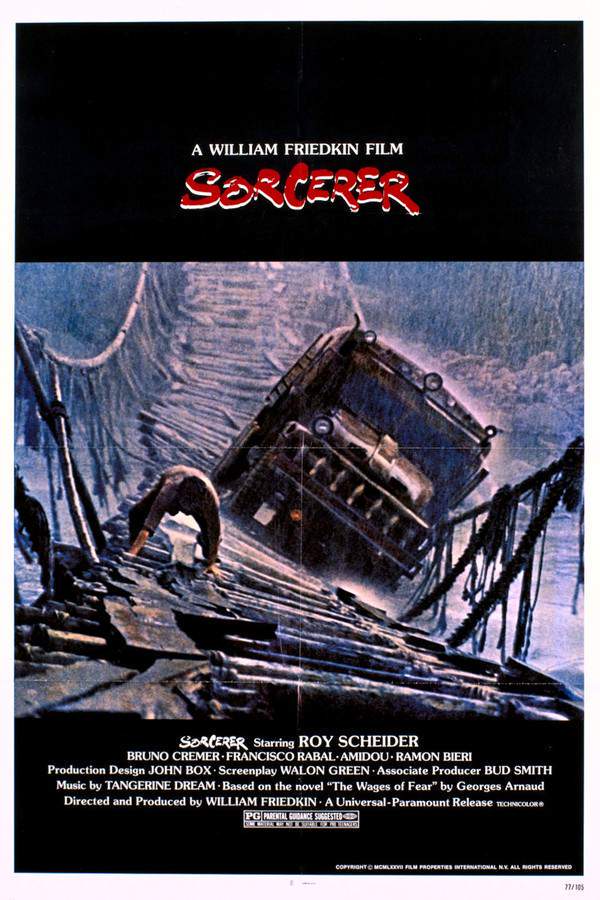
Sorcerer (1977) movie poster

Plot Summary

Sorcerer (1977) Plot Summary Explained

Release, runtime and language
1977 · 121 min · English
Directed by
William Friedkin
Starring
Roy Scheider, Bruno Cremer
Budget
$22M

In South America, four desperate men are given a dangerous opportunity: a chance at a new life if they can successfully transport a shipment of nitroglycerin across a perilous 200-mile journey. Led by the enigmatic Jackie Scanlon, they face a grueling test of endurance, battling treacherous roads, unstable bridges, and hostile guerrilla forces in their fight for survival and the promise of redemption.

On this page (5)
  1. 1 Where to watch
  2. 2 What happens: full plot
  3. 3 Plot questions answered
  4. 4 Movie threads
  5. 5 Every angle

Where to watch

Where to Watch Sorcerer (1977)

Where can you watch Sorcerer? Stream, rent or buy it in the US, including on Amazon Video, Apple TV Store and Fandango At Home: current JustWatch availability with up-to-date prices.

Streaming availability powered by JustWatch

Full plot summary · contains spoilers

What Happens in Sorcerer: Full Plot Summary

The whole story of Sorcerer (1977) explained, from the opening scene to the final frame: every key event, every twist and what it all adds up to. Read it as a quick recap before the sequel, to check a scene you missed, or to finally understand what really happened.

The film unfolds through a prologue built from four world-spanning vignettes that hinge on hidden backstories and the quiet, uneasy fates of its central figures. Each fragment frames a life at a crossroads, hinting at the interconnected pressures that will pull them toward an ultimate, shared reckoning.

In Veracruz, the story threads into the experience of a man named Nilo. Dressed with a poised, almost ceremonial restraint, he enters a quiet flat and immediately ends the tenant’s life with a silenced revolver. The act is delivered with cold ease, and after the deed, he steps back into the bustling street and dissolves into the crowd, moving with the same deliberate calm that marks a man who has just erased an interval of another’s life. The moment establishes a tone of cold efficiency and detachment, where violence is a currency spent with practiced economy.

The scene shifts to the heart of Jerusalem, where a group of resistance fighters—these men disguised as Jews—detonate an explosion near the Damascus Gate. They scatter, seize shelter, and assemble weaponry with a practiced rhythm, hoping to escape the city’s tightening net. When the Israeli forces close in, the group is torn apart: two are killed, one captured, while the youngest, Kassem, manages to slip away into the crowd, his face a mask of stunned helplessness as he watches the fate of his companion unfold from a distance. The segment examines the fragility of escape plans under the pressure of pursuit and the way fear can become a perpetual companion.

The film then follows Victor Manzon in a cosmopolitan, high-stakes orbit centered on a watch gifted for an anniversary and on the sharp sting of a fraud accusation. After a tense encounter at the Paris Stock Exchange where he is pressured to post collateral within twenty-four hours, Victor circles through a web of influence and debt. He pleads with his partner and brother-in-law, Pascal, for financial rescue, returning to his wife and a glamorous dinner that glitters with wealth yet hums with unease. When Pascal is found waiting outside and the conversation turns to family wealth, motive, and leverage, the situation spirals as Pascal’s father refuses aid. The night ends with Victor driving Pascal to a car, only to witness Pascal’s suicide and the certainty that his own fate is now bound to a precarious, precariously balanced future. With the pressure mounting, Victor chooses to abandon his wife and his country, a decisive step born of desperation and fear.

In Elizabeth, New Jersey, the narrative opens another brutal interlink: an Irish gang robs a Catholic church that is tied to a rival Italian Mafia faction, its proceeds fueling a network of cash games. A priest is wounded during the heist, and the tension between rival powers flares into a deadly collision. The driver, Jackie Scanlon, survives a catastrophic crash caused by the gang’s recklessness, but only after enduring grave injuries. The wounded priest is revealed to be the brother of Carlo Ricci, a formidable Mafia chief who commands the church’s financial lifeblood and who vows to eliminate Jackie at all costs. Jackie’s escape plan is shaped by a tense alliance with his friend Vinnie and the grim realism of criminal retribution, setting up a mood where loyalty is fragile and danger lurks at every turn.

From these disparate origins, Kassem, Victor Manzon, and Jackie converge in Porvenir, a remote Central American village whose economy is dominated by a distant American oil company. The local reality is stark: poverty is pervasive, and the men must confront a world that values survival over reputation. A shadowy figure named Márquez, rumored to be a Nazi war criminal, becomes a reluctant companion in the shared venture, while the arrival of Nilo raises fresh suspicion. The company insists on moving a volatile cargo—nitroglycerin stored in a remote depot that has become dangerously unstable over time. The plan to transport dynamite across a long, difficult 218-mile route hinges on assembling two trucks with scrap parts and enlisting four drivers who can keep pace under pressure. As the group forms a fragile alliance, the tension between their pasts, their fears, and the promise of potential salvation deepens.

The journey itself becomes a crucible. The convoy faces a succession of perilous trials: a crumbling, rotten bridge that must be crossed amid a violent thunderstorm; a desperate need to use one of the dynamite boxes to blast a fallen tree from the road; a near-catastrophic tire blowout that sends one truck tumbling over a cliff, fracturing the group’s fragile unity. The accident costs Kassem and Victor their lives in a single, brutal moment, a stark reminder of how fragile hope can be when the odds are stacked so high. When Nilo and Jackie reach the scene, they contend with bandits who attempt to rob them, and Nilo is mortally wounded in the fight that follows. Stranded and exhausted, Jackie must carry the last of the dynamite on foot as his truck finally fails just short of the destination, his body and mind pushed to the edge by fatigue and fear. He collapses at the very threshold of completion, his fate left suspended in a moment of ambiguous consequence.

Back in Porvenir, the aftermath blends relief with the intoxicating lure of payment and opportunity. Jackie receives a Colombian passport and compensation for the grueling work, along with an invitation for another assignment. The bar becomes a stage for a final, unsettling tableau: as he pauses to share a dance with a charwoman, the doors open to reveal Carlo Ricci’s henchmen and Vinnie moving toward him with guns drawn—a stark cue that the nightmare may not be over, and that the question of Jackie’s fate remains unresolved. The film closes on a note of quiet suspense, leaving the audience to weigh the costs of escape against the price of staying alive in a world where violence, power, and profit are in constant, precarious flux.

Through its mosaic structure, the movie casts doubt on the possibility of a clean exit. It dramatizes how personal histories—fraud, vendettas, ideological battles, and colonial-era logics of resource extraction—interweave to push ordinary people toward extraordinary danger. The tone remains cool and observational even as it follows characters who are cornered by circumstance, revealing how dignity can persist in the face of systemic coercion, and how the pursuit of opportunity can pin individuals against one another in a shared, perilous voyage.

Last updated: October 09, 2025 at 15:42

Was this helpful?

Plot questions answered

Sorcerer Plot Explained: Your Questions Answered

The questions people ask most about Sorcerer (1977): what happens in the confusing scenes, why the characters do what they do, the twists, hidden details and what the ending means. Each answer contains spoilers.

Q1

Why is Jackie Scanlon in Porvenir?

Jackie Scanlon ended up in Porvenir because he was fleeing New Jersey after a church heist gone wrong. He was the driver for an Irish gang that robbed a Catholic church in Elizabeth, New Jersey, which was tied to the Italian Mafia. During the getaway, the truck crashed and the priest was wounded. That priest turned out to be the brother of Carlo Ricci, a powerful Mafia boss who promised to kill Jackie for the transgression. With Vinnie's help, Jackie escaped and took a fake identity to hide in the remote Central American village.

Foreshadowing: Earlier scenes establish Jackie's criminal past in New Jersey, showing his alliance with Vinnie and his desperate flight from Ricci's vengeance.

  • jackie scanlon
  • porvenir
  • carlo ricci
  • church heist
  • new jersey
  • mafia
Q2

Why do the characters agree to transport nitroglycerin?

The four men agree to transport nitroglycerin because the American oil company offers them a substantial payment that represents a chance at a completely new life. Each man is a fugitive with a damaged past: Jackie is running from the Mafia, Victor Manzon fled Paris after fraud accusations led to his brother-in-law's suicide, Kassem escaped Israeli capture in Jerusalem, and Nilo is a hitman hiding from his own troubles. The job pays enough to obtain fake papers and start over elsewhere, making the dangerous journey worth the risk.

Foreshadowing: The prologue vignettes establish each character's desperate circumstances and need for escape.

  • nitroglycerin
  • dynamite
  • transport
  • payment
  • redemption
  • oil company
Q3

Who dies when the truck goes over the cliff?

Kassem and Victor Manzon die in the catastrophic truck crash. While navigating a treacherous cliff-side road, the truck loses control and plummets over the edge, killing both men instantly in the explosion. Their deaths occur suddenly and brutal, leaving Jackie and Nilo as the only survivors to complete the journey. This tragedy marks the turning point where the mission's hope collapses into loss.

Foreshadowing: The perilous mountain road and overloaded truck hint at the disaster waiting to happen.

  • truck crash
  • kassem
  • victor manzon
  • cliff
  • deaths
  • explosion
Q4

Why does Nilo kill Márquez and take his place?

Nilo kills Márquez and assumes his identity to secure a spot on the nitroglycerin transport mission. Márquez is revealed to be a rumored Nazi war criminal who has been living in Porvenir under an alias. Nilo, being a professional hitman, sees an opportunity: eliminating Márquez gives him a legitimate reason to take the dead man's place on the crew without raising suspicion. The job offers the payment and papers Nilo needs to disappear, so he acts coldly and efficiently, as established in his Veracruz opening scene.

Foreshadowing: Nilo's opening scene establishes his character as a calculated, efficient killer who operates without hesitation.

  • nilo
  • marquez
  • kills
  • substitution
  • nazi war criminal
Q5

What happens to Kassem in Jerusalem?

Kassem is a young Palestinian resistance fighter who participates in an explosion near the Damascus Gate in Jerusalem. During the Israeli Defense Forces' crackdown that follows, his group is ambushed: two fighters are killed and one is captured. Kassem manages to escape into the crowd, but he is left traumatized and helpless as he watches his companion's capture. This event sets him on the path to Porvenir, where he assumes a new identity seeking escape from his past.

Foreshadowing: The Jerusalem sequence establishes the futility and fear that characterize Kassem throughout the film.

  • kassem
  • jerusalem
  • damascus gate
  • resistance
  • escape
  • capture
Q6

Why does Pascal commit suicide in Paris?

Pascal commits suicide because he faces financial ruin and humiliation. Victor Manzon, his brother-in-law, had been accused of fraud at the Paris Stock Exchange and needed 24 hours to post collateral. Pascal's father, who controlled the family wealth, refused to help Victor. When Pascal confronted his father about helping his brother-in-law, he was rejected, leaving him with no way to save Victor or restore his honor. Overwhelmed by shame and unable to bear the disgrace, Pascal kills himself outside Victor's home, which drives Victor to abandon his wife and France entirely.

Foreshadowing: The dinner scene in Paris establishes the mounting pressure on Victor and the strained family dynamics.

  • pascal
  • suicide
  • paris
  • fraud
  • stock exchange
  • victor manzon
Q7

What happens at the rotten bridge during the journey?

The convoy encounters a crumbling, rotten bridge during a violent thunderstorm. The bridge is in such disrepair that it barely holds the weight of the trucks carrying nitroglycerin. The storm makes the crossing even more treacherous, with the wooden structure groaning under the strain. This scene represents one of the journey's most nerve-wracking moments, where a wrong move could detonate the volatile cargo and kill everyone aboard.

Foreshadowing: The earlier establishing shots emphasize the harsh, neglected infrastructure of the region.

  • rotten bridge
  • thunderstorm
  • crossing
  • danger
  • nitroglycerin
Q8

Why do they need to use dynamite on the road?

The group uses dynamite to blast a massive fallen tree that blocks their path on the mountain road. After the storm and bridge crossing, a tree has fallen across the narrow pass, preventing the trucks from proceeding. With no alternative route and the nitroglycerin cargo making the situation too dangerous to move the tree manually, they decide to use one of the dynamite boxes to destroy the obstacle. This desperate solution demonstrates how the mission forces them to risk the very cargo they're transporting.

Foreshadowing: The fallen tree appears after the storm, forcing an impossible choice.

  • dynamite
  • fallen tree
  • blast
  • road block
  • explosion
Q9

Does Jackie survive at the end of the movie?

Jackie Scanlon successfully delivers the nitroglycerin and reaches Porvenir, where he receives his payment and a Colombian passport. He shares a brief moment of humanity dancing with a charwoman in the bar, appearing to have escaped his past. However, the film ends ambiguously with Carlo Ricci's henchmen entering the bar along with Jackie's former friend Vinnie, both carrying guns. Whether they kill him or offer another job remains unclear, leaving his ultimate fate uncertain.

Foreshadowing: The final scene mirrors the beginning: Jackie in a precarious situation with violence about to unfold.

  • jackie survival
  • ending
  • ambiguous
  • ricci
  • vinnie
  • bar scene
Q10

Why is the wounded priest important to the Mafia storyline?

The wounded priest is crucial because he is the brother of Carlo Ricci, the formidable Mafia chief who controls the church's financial operations. When the Irish gang robs the church, they inadvertently attack Ricci's own family and revenue stream. This personal connection transforms a simple heist into a vendetta. Ricci vows to kill Jackie Scanlon, the driver, specifically because the priest is his brother, making the threat against Jackie deeply personal rather than just criminal.

Foreshadowing: The heist sequence establishes both the church's Mafia ties and the priest's family connection.

  • priest
  • carlo ricci
  • brother
  • mafia
  • church
  • heist
  • vendetta
Q11

What does the title Sorcerer refer to?

The title Sorcerer refers to Jackie Scanlon, who becomes the guiding force for the dangerous mission. Like a sorcerer commanding something volatile and potentially deadly, Jackie leads the nitroglycerin transport across treacherous terrain. The name also suggests illusion or deception, fitting for a film about men assuming fake identities and trying to escape their pasts. The nitroglycerin itself, which must be handled with extreme caution, can be seen as the 'sorcerer's element', a substance that appears ordinary but carries immense destructive power.

Foreshadowing: Jackie emerges as the leader who holds the group together through sheer will and experience.

  • title
  • sorcerer
  • meaning
  • jackie
  • nitroglycerin
  • leader

Movie threads

More Movies Like Sorcerer, by Mood & Story

Curated lists built around what makes Sorcerer tick: the same mood, the same kind of story or the same emotional payoff. Each list explains why these movies belong together.

Grueling Survival Journeys like in Sorcerer

Desperate characters pushed to their absolute limits by a hostile environment. If you enjoyed the nerve-wracking transport mission in Sorcerer, explore more movies like it. These films feature desperate characters on perilous journeys where survival hinges on overcoming a harsh, unforgiving environment and incredible physical hardship.

  • tense
  • desperate
  • exhausting
  • perilous
  • grim
  • claustrophobic
  • Tone: tense, grim, desperate
  • Pacing: variable, building to relentless
Why these movies?

The story pattern: Stories in this thread typically follow a linear, goal-oriented structure: a group or individual must traverse a dangerous landscape to reach safety or accomplish a mission. The plot is driven by a series of escalating environmental and logistical obstacles, creating a relentless sense of danger and exhaustion.

Why they belong together: These films are grouped by their shared focus on survival as a visceral, immediate struggle. They deliver a high-tension experience defined by the raw confrontation between human vulnerability and an indifferent, often brutal, world.

Movies about Bleak Redemption like Sorcerer

Damaged men seeking a second chance through a high-stakes, violent endeavor. For viewers who liked the theme of desperate fugitives seeking a new life in Sorcerer, this collection highlights similar movies about morally compromised characters. These stories explore the grim and often ambiguous pursuit of redemption through extreme, high-risk situations.

  • bleak
  • desperate
  • grim
  • paranoid
  • ominous
  • redemption
  • Tone: dark, bleak, ambiguous
  • Pacing: variable, character-driven
Why these movies?

The story pattern: The narrative pattern often involves introducing characters at their lowest point, haunted by past failures or crimes. They are presented with a dangerous 'one last job' that promises freedom or cleansing. The journey forces them to confront their past sins while grappling with the new moral compromises required to survive, leading to an ending that questions whether true redemption was ever possible.

Why they belong together: These films are united by their dark, existential exploration of redemption. They share a heavy emotional weight, a tone of grim desperation, and a focus on characters whose fight for a future is inextricably linked to the sins of their past.

Every angle

Sorcerer (1977) Explained: Plot, Timeline & Characters

Everything about Sorcerer in one place: what happens in the plot summary, the timeline in chronological order, the characters and meaning and a spoiler-free summary. What's After the Movie adds the cast, box office and post-credit scenes.

Coming soon on iOS and Android

The Plot Explained Movie Summary App

Plot summaries, endings explained and timelines on your phone. Catch up on any movie in minutes, save your favorites and never miss a twist again.

Be the first to know when we launch. Your email stays private, always.

Learn more about the app