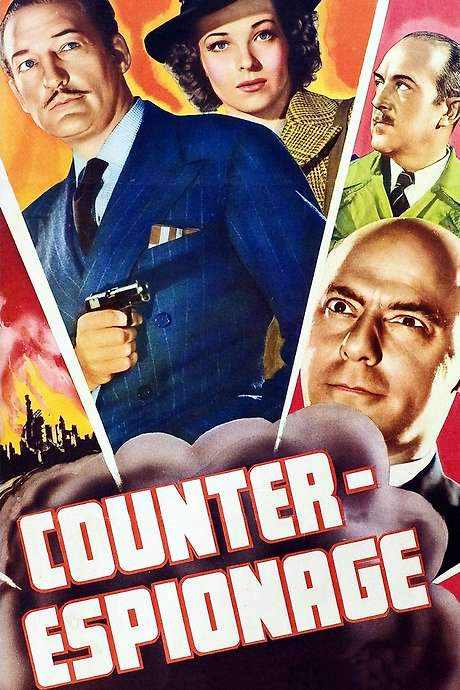
Holmes [Basil Rathbone] and Watson [Nigel Bruce] are summoned by the Inner Council of British Intelligence, led by Sir Evan Barham, to tackle a shadowy Nazi sabotage operation sweeping across Britain. The danger grows when one of Holmes’s trusted operatives, Gavin, is found dead in Limehouse, his back pierced by a German dagger, and his last whispered clue is the name “Christopher.” With that fragment, Holmes pieces together a perilous puzzle that connects coded radio broadcasts to a carefully staged invasion threat.
To crack the case, Holmes turns to a precise, almost scientific method: using an oscilloscope to compare sound wave patterns from live radio voices against pre-recorded voices. His analysis suggests that the ominous “Voice of Terror” is not a homegrown menace but a German operation broadcast from abroad, disguised as veiled broadcasts across the United Kingdom. Kitty, Gavin’s widow, provides a crucial lead that points them toward Christopher Docks, where Holmes, Watson, and Sir Anthony Lloyd of the council move with caution—but are soon overwhelmed by a band of Nazi spies led by the elusive Meade. The trio is captured, yet a determined assault by East End locals frees them, and Meade slips away down a trap door to a waiting speedboat.
Kitty goes undercover, presenting herself as a thief on the run to infiltrate Meade’s circle. Her investigation reveals Meade’s plan to move a crucial package to Sir Evan’s country estate in Kent that very night. Meanwhile, Holmes and Sir Evan observe a German plane touch down on the coast; Sir Evan fires at it, but Meade swiftly passes the package to the pilot, allowing the mission to proceed even as Meade disappears back into the shadows.
Following a trail that leads to the south coast of England, Holmes secures the council’s cooperation and orders a field operation supported by British troopers. They corner Meade and a squad of German soldiers in an abandoned church, and in the tense moments that follow, Holmes exposes the startling truth behind the Voice of Terror. Sir Evan Barham is revealed to be an impostor: in World War I, the real Barham was a prisoner in a German camp and bore a genuine scar, while his German doppelgänger—Heinrich Von Bock, a member of the German Secret Service—had undergone plastic surgery and studied English mannerisms to perfectly imitate him for two and a half decades.
Holmes explains how the deception was carried out, and how the ruse depended on the unrealistically close resemblance to Barham, including a childhood scar that would betray the impersonator’s true identity. With the ringleader’s deception unmasked, the German invasion force is neutralized. Yet the victory is tinged with tragedy: Meade shoots Kitty in a final act of desperation, and is killed as he attempts to flee. The council gathers around Kitty’s body, honoring her sacrifice and vowing that her courage will not be in vain.
Throughout the investigation, the film threads together brisk detective work, wartime espionage, and a tense cat-and-mouse chase across docks, estates, and the coastline, all while maintaining a restrained, procedural tone. The performances—Holmes’s methodical brilliance, Watson’s steady companionship, and the shadowy menace of the German agents—drive a narrative that emphasizes intellect over brute force. The resolution offers a stark reminder of the era’s peril and the quiet bravery of those who faced it, even as the villains are unmasked and the plot’s web begins to unravel.
- Inspector Lestrade [Dennis Hoey] plays a supporting role in the investigation, assisting in the network of clues and the eventual confrontation with the saboteurs.
- Mrs. Hudson [Mary Gordon] quietly anchors the Baker Street vicinity, offering a steady home front amid the international intrigue.