Plot Explained Spoilers guaranteed!
Plot Explained

Browse by genre

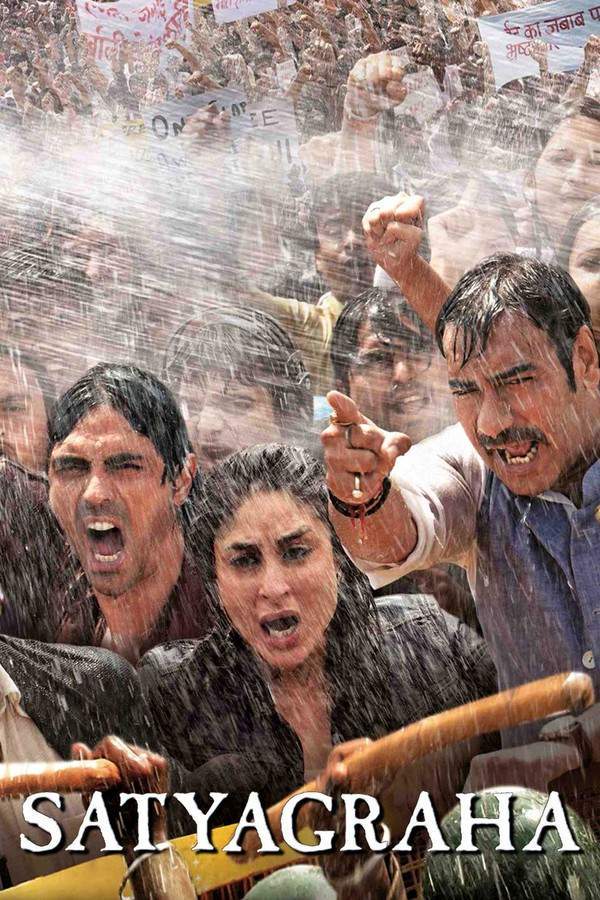
Satyagraha (2013) movie poster

Timeline

Satyagraha (2013) Timeline Explained – Every Event in Order

Release, runtime and language
2013 · 152 min · Hindi
Loading streaming availability…
Directed by
Prakash Jha

A son's yearning for his father initiates a wave of emotional challenges. A grieving father's suffering intensifies his desperation, while a passionate young woman rediscovers her ability to love. Simultaneously, a leader's determination to enact change clashes with the ruthless goals of a powerful ruler, igniting widespread resistance and rebellion. The resulting conflict explores themes of loss, love, and the fight for justice.

On this page (5)
  1. 1 Where to watch
  2. 2 Events in order (13)
  3. 3 Timeline questions answered
  4. 4 Movie threads
  5. 5 Every angle
Loading streaming availability…

13 events in order · contains spoilers

Satyagraha Timeline: Events in Chronological Order

Every key event of Satyagraha (2013) in order, scene by scene, with when and where it takes place. Use it to untangle flashbacks, time jumps and parallel storylines, to refresh your memory before the sequel or to find the exact scene you are thinking of.

  1. Dwarka Anand's idealistic life in Ambikapur

    Dwarka Anand is a retired teacher and ex-principal who lives in Ambikapur with his engineer son Akhilesh and daughter-in-law Sumitra. He is portrayed as a principled idealist who cares deeply about social justice and public welfare. His values set the emotional ground for the events to come.

    When
    Present-day Ambikapur
    Where
    Ambikapur
  2. Akhilesh's death engineered on the road

    Akhilesh, the friend of Manav, dies in a road accident that is maliciously engineered by Sangram Singh. Balram Singh is revealed as the mastermind behind Akhilesh's murder. Manav begins to suspect a larger conspiracy that implicates powerful interests.

    When
    Shortly before investigation
    Where
    Ambikapur roads
  3. Compensation promised but out of reach

    Balram Singh announces compensation for Akhilesh's family, but Sumitra cannot obtain it despite submitting daily applications. The bureaucratic hurdles and political maneuvering highlight the system's inefficiency. The injustice fuels public outrage and personal desperation.

    When
    Immediately after death
    Where
    District government office
  4. Dwarka slaps the DM and is imprisoned

    Dwarka Anand publicly slaps the District Magistrate in protest of the perceived injustice and bureaucratic impotence. As a consequence, he is imprisoned, turning a moment of moral stand into a political flashpoint. The arrest galvanizes his supporters and heightens the tension in Ambikapur.

    When
    Days after arrest
    Where
    DM's office, Ambikapur
  5. Manav launches a campaign to free Dwarka

    Manav starts a social-media driven campaign to secure Dwarka's release, leveraging online activism and public sympathy. He allies with Arjun Singh and journalist Yasmin to broaden the movement's reach. The campaign reframes the issue as a fight against corruption and political oppression.

    When
    Soon after imprisonment
    Where
    Online and media networks
  6. Mass mobilization across the district

    Hopeful students, hungry laborers, and angry middle-class citizens rally to support Dwarka and demand accountability. Politicians begin to panic as the movement grows beyond a single protest. The agitation illustrates the sustained demand for systemic change.

    When
    During the campaign
    Where
    Across the district
  7. Dwarka's release under pressure

    Under pressure from Balram Singh, the DM withdraws the complaint and Dwarka Anand is released. The victory is framed as a procedural concession, but it fuels a broader push to reform the district’s governance. The community sees the result as a partial triumph that comes with costs.

    When
    After protests
    Where
    DM's office
  8. Notice to clear pending claims district-wide

    Dwarka issues a 30-day ultimatum to the government to clear all pending claims in the entire district. The demand signals a shift from individual grievances to structural redress. It also sets the stage for further escalation if demands are not met.

    When
    Following release
    Where
    Entire district
  9. Hunger strike and ordinance demand

    Dwarka undertakes a hunger strike, pressing the government to pass an ordinance to address the district's grievances. The move heightens the symbolic weight of the movement and draws broader public attention. The tactic underscores his willingness to sacrifice personal comfort for collective reform.

    When
    After the 30-day notice
    Where
    Ambikapur
  10. Lal Bahadur's suicide and the deadly cortege

    Lal Bahadur, a youth supporting the agitation, commits suicide to symbolize solidarity. During his cortege, four policemen are killed by the mob, escalating the violence and widening the cycle of retaliation. The tragedy intensifies public fear and outrage across the district.

    When
    During the unrest
    Where
    District city
  11. Riots erupt and the crackdown tightens

    Riots erupt across parts of the district as crowds clash with security forces. Balram Singh orders a paramilitary deployment to quell the protests and reassert control. The confrontation tests the resilience of the protesters and the capacity of the state to manage chaos.

    When
    As unrest escalates
    Where
    District-wide
  12. Dwarka is shot; he dies in Manav's arms

    Balram Singh's henchman shoots Dwarka Anand as the violence peaks. He dies in Manav's lap, muttering a plea for the people to stop the riots. The death becomes a defining moment that cements the demand for systemic change.

    When
    During the riot
    Where
    Scene of shooting
  13. A new political path emerges

    Balram Singh is ultimately captured, and Manav with Arjun Rampal commits to building a regional party aimed at eliminating corruption and reconstructing the system for the common welfare. The film closes with this strategic political realignment as the next phase of the movement begins.

    When
    After the shooting
    Where
    District/State political arena

Last updated: October 09, 2025 at 16:13

Was this helpful?

Timeline questions answered

Satyagraha Timeline Explained: Your Questions Answered

When does it happen, and why in that order? The questions people ask about the chronology of Satyagraha (2013): time jumps, flashbacks, cause and effect between scenes and the correct order of events, each answered with spoilers.

Q1

Why did Balram Singh order Akhilesh's murder?

Balram Singh, the powerful minister, orchestrated Akhilesh's murder because he wanted to suppress a legal case related to a mining scam. Akhilesh, an engineer, was preparing to testify as a witness against Balram in court. To silence this threat, Balram had his brother Sangram Singh engineer the road accident that killed Akhilesh.

Foreshadowing: Earlier scenes establish Balram's political influence and hint at his involvement in illegal mining operations.

  • balram singh
  • akhilesh death
  • mining scam
  • murder motive
  • witness
Q2

Why did Dwarka Anand slap the District Magistrate?

Dwarka Anand slapped the DM out of frustration with the relentless bureaucratic delays preventing his daughter-in-law Sumitra from receiving the compensation that Balram Singh had promised after Akhilesh's death. After months of daily visits to government offices being met with evasion, Dwarka publicly confronted the DM and physically assaulted him as a dramatic act of protest against the systemic injustice.

Foreshadowing: The earlier scenes of Sumitra's frustrating daily attempts to secure compensation set up this breaking point.

  • dwarka anand
  • dm slap
  • protest
  • compensation
  • bureaucracy
Q3

How did Dwarka's personal protest turn into a mass movement?

Dwarka's imprisonment after slapping the DM became the catalyst. His friend Manav launched a social media campaign using online platforms to mobilize support, joining forces with Arjun Singh and journalist Yasmin to amplify the cause. The movement drew in students, laborers, and the middle class who related to Dwarka's fight against corruption, transforming a personal grievance into a broader demand for systemic change.

Foreshadowing: Manav's character was established as an ambitious capitalist with influence, preparing his role as a campaign organizer.

  • mass movement
  • social media campaign
  • manav
  • dwarka release
  • protest mobilization
Q4

Why did Lal Bahadur kill himself during the protests?

Lal Bahadur, a young supporter of Dwarka's movement, committed suicide to demonstrate his unwavering commitment to the cause and to intensify pressure on the government. His death was meant to serve as a powerful symbol of sacrifice, showing the depths to which ordinary citizens were willing to go for justice and reform.

Foreshadowing: The growing desperation among supporters and escalating tensions foreshadowed extreme acts of protest.

  • lal bahadur
  • suicide
  • protest sacrifice
  • movement escalation
Q5

Who shot and killed Dwarka Anand?

Dwarka Anand was shot by Balram Singh's henchman during the violent riots that erupted after Lal Bahadur's funeral procession. As the violence peaked, a shooter sent by Balram Singh targeted Dwarka, who died in Manav's arms while pleading for the crowd to stop the riots and restore peace.

Foreshadowing: Balram Singh's escalating response to the movement throughout the film hinted at his willingness to use violence.

  • dwarka death
  • balram singh
  • henchman
  • shooting
  • assassination
Q6

What happened to Balram Singh after Dwarka's death?

After Dwarka Anand was shot and killed in Manav's arms, public outrage reached its peak and led to swift police action. Balram Singh was eventually arrested for his crimes, including orchestrating Akhilesh's murder and ordering Dwarka's assassination. His political downfall marked the end of his reign of corruption in the district.

Foreshadowing: The massive public reaction to Dwarka's death was positioned as the turning point that would bring Balram down.

  • balram singh arrest
  • corruption
  • justice
  • political downfall
Q7

Why were four policemen killed during Lal Bahadur's funeral procession?

During Lal Bahadur's funeral cortege, the mob that had gathered became violent and attacked the police escort. Four policemen were killed by the angry crowd in the chaos that followed Lal Bahadur's suicide, which escalated the situation from peaceful protest to violent confrontation. This tragedy provided Balram Singh with justification to deploy paramilitary forces.

Foreshadowing: The rising tension and emotional intensity of the supporters pointed toward potential violence.

  • policemen killed
  • cortege
  • lal bahadur funeral
  • riot escalation
Q8

What was the 30-day ultimatum Dwarka Anand issued?

After his release from prison, Dwarka Anand issued a 30-day ultimatum demanding that the government clear all pending compensation claims in the district. This ultimatum shifted the movement from focusing on his personal case to demanding systemic reform across the entire district's governance.

Foreshadowing: The ultimatum was positioned as the next escalation after Dwarka's partial victory in securing his own release.

  • 30 day ultimatum
  • pending claims
  • district reform
  • government demand
Q9

Why was Sumitra unable to receive the compensation promised by Balram Singh?

Despite Balram Singh publicly announcing compensation for Akhilesh's family, Sumitra couldn't obtain it because of deliberate bureaucratic delays and political maneuvering. Government officials continuously postponed her applications, and no one in the system acted on her claims. This reflected the very corruption Dwarka fought against, promises made by powerful politicians that the system deliberately fails to fulfill.

Foreshadowing: The early scenes showing Sumitra's daily visits to government offices established the frustration that would drive Dwarka's protest.

  • sumitra
  • compensation
  • bureaucratic delays
  • balram singh promise
Q10

Why did Manav decide to form a new political party at the end?

Manav and Arjun Singh decided to form a new regional political party after witnessing the power of organized citizen protest and the costs paid by Dwarka Anand. They wanted to channel the momentum and public sentiment into institutional political change, creating a party dedicated to eliminating corruption and reconstructing the system to serve ordinary people's welfare.

Foreshadowing: Manav's earlier role as a campaign organizer and his business acumen positioned him to lead a political effort.

  • manav
  • arjun singh
  • new political party
  • corruption reform
Q11

What ordinance was Dwarka Anand demanding through his hunger strike?

Dwarka Anand undertook a hunger strike to pressure the government into passing an ordinance that would reorganize the district's governance structure to better serve the public. The ordinance was meant to address systemic issues in local administration and ensure that government institutions worked for citizen welfare rather than political elites.

Foreshadowing: The hunger strike was the culmination of escalating protests following the 30-day ultimatum deadline.

  • hunger strike
  • ordinance
  • governance reform
  • district administration
Q12

Why did Balram Singh deploy paramilitary forces against the protesters?

Balram Singh ordered paramilitary forces to quell the escalating protests after the riots and police killings during Lal Bahadur's funeral procession. The widespread unrest threatened his political control, and he used the violence as justification to deploy heavy-handed security measures to suppress the movement and reassert his authority.

Foreshadowing: Balram's earlier responses to the movement showed his pattern of using force to maintain power.

  • paramilitary
  • balram singh
  • crackdown
  • riot suppression

Movie threads

More Movies Like Satyagraha, by Mood & Story

Curated lists built around what makes Satyagraha tick: the same mood, the same kind of story or the same emotional payoff. Each list explains why these movies belong together.

Movies about civic anger sparked by personal grief like Satyagraha

A personal tragedy ignites a crusade against systemic corruption and injustice. If you were moved by how Satyagraha connects a father's grief to a national protest, you'll find similar powerful dramas here. These movies feature protagonists whose personal tragedies compel them to challenge corrupt institutions, blending heavy emotional journeys with urgent political stakes.

  • grieving
  • angry
  • political
  • determined
  • urgent
  • moral conflict
  • Tone: tense, angry, determined
  • Pacing: steady, building escalation
Why these movies?

The story pattern: Stories typically begin with a profound personal loss that exposes a wider societal flaw. The protagonist's journey of grief transforms into a determined quest for accountability, often pitting them against a seemingly unbeatable establishment. The plot follows the escalation from private sorrow to public confrontation, exploring the heavy costs of activism.

Why they belong together: They are grouped by their powerful fusion of intimate emotional weight—specifically grief and loss—with high-stakes political conflict. The shared experience is one of righteous anger, where a character's personal vendetta evolves into a principled stand for justice, creating a tense, morally charged atmosphere.

Bittersweet protest movement dramas with costly victories like Satyagraha

Stories where the fight for justice is noble, but the final victory comes at a great personal cost. For viewers who appreciated the complex, bittersweet ending of Satyagraha, this list features similar movies about social justice. These films focus on nonviolent resistance and political change, but emphasize the heavy personal toll and tragic sacrifices that make the victory feel poignant and incomplete.

  • hopeful
  • tragic
  • determined
  • political
  • moral conflict
  • somber
  • Tone: bittersweet, hopeful, tragic
  • Pacing: steady, methodical
Why these movies?

The story pattern: The narrative follows the rise of a mass movement challenging an oppressive power. The focus is on the strategic and moral dimensions of the struggle, often highlighting nonviolent resistance. The climax typically involves a major sacrifice—such as the death of a key figure—that galvanizes the movement but renders the ultimate success deeply sorrowful.

Why they belong together: They share a specific emotional arc: a determined, hopeful fight for a righteous cause that concludes not with pure triumph, but with a somber, bittersweet resolution. The central theme is the price of change, creating a unified vibe of solemn hope and the weight of sacrifice.

Every angle

Satyagraha (2013) Explained: Plot, Timeline & Characters

Everything about Satyagraha in one place: what happens in the plot summary, the timeline in chronological order, the characters and meaning and a spoiler-free summary. What's After the Movie adds the cast, box office and post-credit scenes.

Coming soon on iOS and Android

The Plot Explained Movie Summary App

Plot summaries, endings explained and timelines on your phone. Catch up on any movie in minutes, save your favorites and never miss a twist again.

Be the first to know when we launch. Your email stays private, always.

Learn more about the app