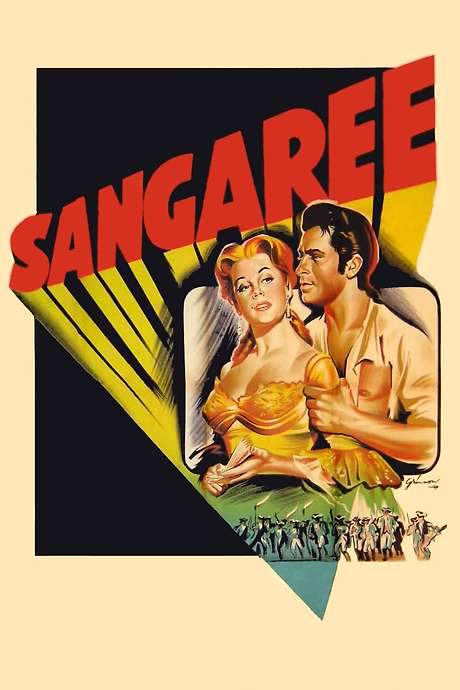
On his death bed, the aging Revolutionary War general Darby, Lester Matthews, bequeaths his Georgia estate, Sangaree, to Dr. Carlos Morales Fernando Lamas with a clear charge: use the property to grant freedom to the enslaved people and servants who call Sangaree home. Morales accepts, aware that the transfer is as much political as personal, and that the ghosts of Sangaree's past will complicate his work. The will sets up a fragile balance between tradition and reform, inviting both support and resistance from the Darby heirs. The land itself becomes a test case for a community trying to redefine who belongs and who decides.
Roy Darby Tom Drake supports Morales's mission in principle, but his sister Nancy Darby Arlene Dahl opposes any change that would loosen Sangaree's grip on family control. Nancy, allied with her fiancé, the attorney Harvey Bristol John Sutton, makes it clear that Morales will face a determined opponent in this fight. The strained dynamic within the family adds tension to every decision Morales makes, from freeing workers to negotiating local authority. In the background, Roy's own life intersects with different loyalties, and the future of Sangaree hangs on how far each side is willing to go.
Morales runs a free clinic on the estate, tending to those who would otherwise fall through the cracks. The outbreak of plague adds a deadly urgency to his mission, turning Sangaree's labor of emancipation into a public health crisis. Morales uncovers troubling links between the Bristol faction and Felix Pagnol, a French pirate raiding the Savannah coast, and learns that the real intrigue is not about Nancy but about who controls the flow of goods and people. Martha Darby [Patricia Medina], Roy's wife, who once carried old affections for Morales, becomes a key figure in deciphering the tangled loyalties.
Evidence mounts that Bristol—one of the Darby faction's strongest allies—has a business connection with Pagnol, complicating Morales's attempt to bring order to Sangaree's shadows. The discovery shifts the center of gravity from petty family squabbles to larger questions of crime, piracy, and the responsibilities of landowners toward those who serve them. Morales acts decisively when he learns that the source of the plague can be traced to Bristol's warehouse, a place where stolen goods are stored. He burns the warehouse to the ground, signaling a new, if precarious, turn in the fight for Sangaree's soul.
The confrontation carries deadly consequences: Martha contracts the plague and ultimately dies after shooting Bristol, a violent end that reverberates through Sangaree's halls and lanes. Nancy, confronted with the collapse of the patriarchal plan to keep Sangaree in the family and the sobering costs of the conflict, begins to re-evaluate her stance. In the aftermath, she chooses to join Morales, seeking a future on Sangaree that is rooted in shared responsibility rather than inherited power. With the estate's future suddenly open, Morales and Nancy begin to chart a path that may redefine Sangaree's legacy for generations to come.
Across the plantation, the various strands of loyalty—the Darbys' pride, Morales's ideals, the workers' longing for freedom, and the pirates' predatory schemes—entangle in a web that is as much about survival as it is about justice. The story culminates in a fragile settlement: Sangaree survives as a symbol and a home, and Morales's dream of a community where freedom is realized on practical terms becomes a real, if contested, possibility. The tale invites readers to consider the cost of emancipation in a Southern landscape where power, love, and betrayal collide, leaving behind a complex portrait of a family, a clinic, and a forgotten corner of Georgia under threat from both disease and human greed.