Plot Explained Spoilers guaranteed!
Plot Explained

Browse by genre

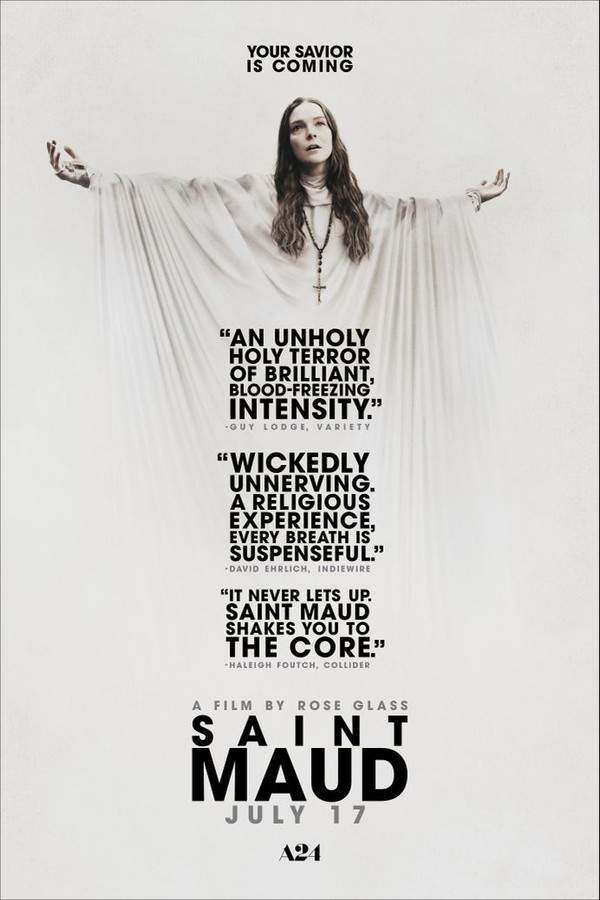
Saint Maud (2019) movie poster

Plot Summary

Saint Maud (2019) Plot Summary Explained

Release, runtime and language
2019 · 85 mins · English
Echo score 75
Directed by
Rose Glass
Starring
Jennifer Ehle, Carl Prekopp, Faith Edwards, Lily Frazer, Lily Knight, Marcus Hutton
Budget
$1.8M

Having recently turned to faith, the shy and unassuming nurse Maud takes a position caring for Amanda, a former dancer now weakened by a debilitating illness. As Maud attends to Amanda’s needs in her opulent home, a chance meeting with a past colleague reveals unsettling details about Maud’s history. The encounter sparks a disturbing psychological descent, blurring the lines between devotion and obsession, and suggesting a hidden darkness beneath Maud’s gentle exterior.

On this page (5)
  1. 1 What happens: full plot
  2. 2 Plot questions answered
  3. 3 Movie threads
  4. 4 Movies like Saint Maud
  5. 5 Every angle

Full plot summary · contains spoilers

What Happens in Saint Maud: Full Plot Summary

The whole story of Saint Maud (2019) explained, from the opening scene to the final frame: every key event, every twist and what it all adds up to. Read it as a quick recap before the sequel, to check a scene you missed, or to finally understand what really happened.

Maud, a young woman portrayed by Morfydd Clark, begins her journey in a hospital, where she is shown sitting quietly in a darkened room, her face streaked with blood. On the other side of the room, her patient lies dead, and Maud is fixated on a roach crawling on the ceiling above her. This haunting opening sets a tone of darkness and emotional turmoil that pervades the film. Sometime later, Maud decides to leave that disturbing environment behind and packs her belongings, offering a prayer before starting a new chapter as a caretaker for Amanda Kohl, played by [Jennifer Ehle], a woman suffering from stage 4 lymphoma that has spread to her spinal column. Amanda is a former dancer and choreographer, and her condition is terminal, with her remaining days seemingly limited.

Maud’s first interactions with Amanda are marked by a mixture of curiosity and reverence. She meets Amanda’s last nurse, who bluntly describes her as “a bit of a cunt,” a remark that hints at the complex and strained relationships Amanda has with those around her. As Maud settles into her caregiving role, she begins to experience a profound spiritual connection, often talking to God and feeling an otherworldly presence that grants her feelings of ecstasy. Amanda, despite her illness, confides in Maud about her own fears of death, revealing the depth of her vulnerability. During her time with Amanda, Maud observes her refined manners and hinting at her past vitality, which starkly contrasts her current frailty.

Maud’s caregiving duties are complicated when Amanda receives visits from a male visitor and is seen paying Carol, a young woman who is also a sex worker, for companionship. Maud becomes visibly uncomfortable with Carol’s presence, feeling that the relationship might interfere with Amanda’s chance at salvation and spiritual peace. This concern demonstrates Maud’s intense religious convictions and her desire to protect Amanda’s soul.

A brief reunion occurs when Maud encounters Joy, a friend who calls her by her real name, Katie. They share a tense but meaningful conversation where Joy provides her with a phone number, hinting at Maud’s troubled past and the help she might need. When Carol visits again, Maud sternly instructs her to stay away from Amanda, fearing the influence of her company. Despite her protests, Maud remains firm, believing she is trying to save Amanda from losing her faith and heading toward damnation.

Amanda throws a birthday party involving several guests, including Carol, which deeply frustrates Maud. During the celebration, Amanda publicly mocks Maud’s faith, causing her to lash out and physically confront her, which results in Maud losing her job. This act emphasizes the clash between Maud’s devout beliefs and Amanda’s rebellious, cynical attitude.

In her despair over her perceived abandonment by God, Maud seeks out companionship at a local pub. Her attempts at connection lead her to briefly engage in sexual activity in the bathroom with a man, showcasing her loneliness and need for human contact. However, she struggles to integrate into social groups, and her hallucinations worsen—she perceives swirling beer glasses and encounters a larger man named Christian. Their encounter becomes intense, with Maud experiencing disturbing hallucinations of performing CPR and crushing Christian’s chest, revealing her fragile mental state. Christian, played by [Turlough Convery], hints at Maud’s past as a party girl when mentioning her history as Katie and her past promiscuity.

Later, Maud approaches Esther, Amanda’s new nurse, played by [Rosie Sansom], seeking information about Amanda’s relationship with her. When Esther storms off, Maud is left feeling more isolated. Throughout the night, Maud experiences supernatural phenomena—cloud formations speaking in foreign languages and possessing her in her room—pointing toward a spiritual or demonic influence that seeks to communicate with her and give her a task.

Her mental state deteriorates further when she visits Amanda’s house alone. Amanda, now appearing softer and more repentant, admits she faked her earlier spiritual experiences, mocking Maud’s faith by declaring that God isn’t real. Enraged, Maud lunges and stabs Amanda to death in a violent outburst fueled by her unraveling psyche. This tragic act encapsulates her descent into madness and her inability to reconcile her faith with her reality.

The film culminates in a harrowing, symbolic scene where Maud, dressed in a white robe, walks to the beach. She douses herself with acetone, igniting herself with a lighter. As flames engulf her, she appears to grow wings of fire, and a radiant light shines down upon her. The crowd around her looks on in horror and awe, and she seems to ascend in a divine or demonic transformation. The final shot reveals Maud burning and screaming in agony, a stark and powerful conclusion to her tumultuous spiritual journey.

Throughout this haunting story, themes of faith, mental health, and the supernatural intertwine with unsettling imagery and intense emotional rawness. The film leaves viewers contemplating whether Maud’s experience is divine, demonic, or a manifestation of her fractured mind, cementing its place as a disturbing meditation on hope, despair, and the search for meaning.

Last updated: August 19, 2025 at 05:12

Was this helpful?

Plot questions answered

Saint Maud Plot Explained: Your Questions Answered

The questions people ask most about Saint Maud (2019): what happens in the confusing scenes, why the characters do what they do, the twists, hidden details and what the ending means. Each answer contains spoilers.

Q1

Why does Maud become so obsessed with saving Amanda's soul?

Maud's obsession stems from her own fragile mental state and recent religious conversion. After a traumatic experience at the hospital (her patient died while she was present), Maud latched onto religion as a source of purpose and meaning. She sees Amanda's terminal illness as an opportunity for spiritual redemption, both for Amanda and herself. Her fixation intensifies because she views protecting Amanda's soul as proof of her own worthiness and connection to God. The more unstable Maud becomes, the more she clings to this mission as justification for her existence.

Foreshadowing: Earlier scenes show Maud experiencing ecstatic sensations while praying, suggesting her spiritual convictions are deeply personal but potentially fragile.

  • maud
  • amanda
  • religious obsession
  • faith
  • salvation
  • caretaker
Q2

What happened in the opening scene with the dead patient?

The film opens with Maud sitting in a dark hospital room beside a dead patient while blood stains her face. A roach crawls on the ceiling above her. This traumatic event appears to be the catalyst for Maud's breakdown and subsequent religious conversion. The exact circumstances remain ambiguous, whether she witnessed the death, was present when it occurred, or somehow participated is unclear. This opening establishes her fragile psychological state and sets the tone for her journey toward religious extremism.

  • opening scene
  • dead patient
  • hospital
  • roach
  • maud
Q3

Why does Maud lose her job after the birthday party?

Maud loses her job because she physically assaults Amanda during her birthday party. When Amanda publicly mocks Maud's faith and taunts her in front of guests, including Carol (the sex worker Maud had warned to stay away), Maud snaps and slaps Amanda. This violent outburst, fueled by her intense religious convictions and frustration over Amanda's perceived spiritual waywardness, results in Amanda firing her immediately. The confrontation represents the complete breakdown of their relationship and marks Maud's final rejection from the household.

Foreshadowing: Earlier tension between Maud and Amanda about Carol's visits foreshadows this explosive confrontation.

  • birthday party
  • maud fired
  • amanda
  • assault
  • job
Q4

What causes Maud to kill Amanda?

Maud kills Amanda after discovering she was faking her spiritual experiences all along. When Maud visits Amanda's house alone, a seemingly softer Amanda confesses that she never genuinely believed in God, she was only performing faith to appease Maud. She cruelly declares that God isn't real, mocking Maud's entire belief system. This betrayal shatters Maud's remaining grip on reality, triggering a psychotic break. Enraged and devastated that her sacred mission was based on a lie, Maud stabs Amanda to death in a violent outburst representing the complete collapse of her psyche.

Foreshadowing: Amanda's earlier cynical attitude and hints that she was manipulating Maud foreshadow this revelation.

  • amanda killed
  • stabbing
  • maud murder
  • reason
Q5

What is the significance of Maud's self-immolation at the end?

Maud's self-immolation represents the tragic climax of her spiritual delusion. After killing Amanda, Maud dons a white robe, symbolizing purity or a wedding garment, and walks to the beach. She douses herself with acetone and sets herself on fire. The film shows her appearing to grow wings of fire while a radiant light shines down, suggesting she believes she is ascending to heaven like an angel. However, the final shot reveals her screaming in agony as she burns, making it clear this is not a divine ascension but a horrifying death born from her fractured mind. The ambiguous imagery leaves viewers questioning whether she experienced transcendence or simply perished in agony.

Foreshadowing: Maud's earlier hallucinations and intense religious fantasies foreshadow this extreme act of self-sacrifice.

  • self immolation
  • beach ending
  • fire wings
  • ascension
  • death
Q6

Is Maud's religious experience real or a symptom of mental illness?

The film deliberately leaves this ambiguous, but evidence suggests Maud's experiences are delusional. Throughout the film, Maud experiences ecstatic sensations, hallucinations (swirling beer glasses, foreign languages from clouds, a supernatural presence), and violent outbursts, all consistent with a psychological break. Her past as Katie, a party girl mentioned by Christian, indicates a dramatic personality shift. The film frames her religious fervor as a coping mechanism that evolved into a dangerous obsession. Whether her experiences are divine, demonic, or purely psychological remains the central mystery, though the tragic ending suggests madness rather than genuine spirituality.

  • mental illness
  • delusion
  • hallucination
  • religious experience
  • psychosis
Q7

What was revealed about Maud's past as Katie?

Maud's past as Katie, a party girl with a promiscuous lifestyle, was revealed during her encounter with Christian at the pub. When Christian recognizes her, he mentions her history as Katie and her past behavior, contrasting sharply with her current devout persona. This revelation suggests Maud underwent a dramatic transformation, possibly in response to trauma (the opening hospital scene) or as a radical break from her previous identity. Her friend Joy also calls her by the name Katie and offers a phone number for help, hinting that Maud's support network views her religious conversion as concerning rather than genuine.

  • katie
  • maud past
  • party girl
  • christian
  • identity
Q8

What do Maud's supernatural visions represent?

Maud's supernatural visions, including clouds speaking foreign languages, a possessing presence in her room, and hallucinations of performing CPR on her dead patient, represent her deteriorating mental state rather than genuine spiritual communication. These visions intensify as her obsession with saving Amanda grows, suggesting they are manifestations of her guilt, trauma, and psychological fracture. The film uses supernatural imagery to blur the line between divine revelation and mental illness, keeping viewers uncertain whether her experiences are real or products of a broken mind. The ambiguous approach is intentional, forcing audiences to interpret what they witness.

Foreshadowing: The roach and dead patient in the opening scene return as hallucinations, connecting her trauma to her religious delusions.

  • visions
  • hallucinations
  • supernatural
  • paranormal
  • psychological
Q9

Why does Amanda mock Maud's faith?

Amanda mocks Maud's faith primarily as a defense mechanism and expression of her own fears. As a terminally ill former dancer facing death, Amanda rejects religion because it forces her to confront her mortality and past choices. She finds Maud's earnest devotion uncomfortable and perhaps threatening, as it highlights her own spiritual emptiness. At the birthday party, Amanda publicly ridicules Maud to maintain her facade of control and cynicism. Later, when she admits to faking all spiritual experiences, it becomes clear she never believed, she was merely tolerating Maud's proselytizing. Her mockery is both a coping mechanism and a cruel manipulation of Maud's vulnerabilities.

  • amanda mocks faith
  • atheism
  • cynicism
  • birthday party
Q10

Why does Maud engage in sexual activity with Christian?

Maud's sexual encounter with Christian represents her profound loneliness and desperate need for human connection despite her religious convictions. After being fired from Amanda's home and feeling abandoned by God, Maud seeks comfort at a pub. The encounter is brief and impersonal, she sleeps with a stranger in the bathroom, highlighting her social isolation and inability to form genuine relationships. The fact that this occurs after her faith crisis suggests she is trying to fill an emotional void. Christian's recognition of her as Katie and mention of her past as a party girl further destabilizes her, as it contradicts the new identity she has built around religious devotion.

  • christian
  • sex scene
  • loneliness
  • maud past
  • pub
Q11

What is Carol's role in the story?

Carol serves as a catalyst for the conflict between Maud and Amanda. She is a sex worker whom Amanda pays for companionship, creating moral outrage from Maud, who sees this relationship as spiritually damning. Maud's intense opposition to Carol stems from her belief that Amanda's soul is at stake, she views the sexual relationship as incompatible with salvation. The tension escalates when Carol appears at Amanda's birthday party, pushing Maud over the edge. Carol represents the secular world and moral corruption that Maud fears, making her a focal point for Maud's religious fervor and ultimate breakdown.

  • carol
  • sex worker
  • amanda relationship
  • conflict
Q12

What do the fire wings in the final scene symbolize?

The fire wings Maud appears to grow during her self-immolation symbolize her delusional belief that she is ascending to heaven as a divine being. In her fractured mind, she likely interprets her act as martyrdom or spiritual transcendence, a final sacrifice that will grant her salvation and angelic status. The imagery draws on traditional religious iconography of angels ascending to heaven in radiant light. However, the film undercuts this interpretation by showing her screaming in agony, grounding the scene in horrifying physical reality rather than spiritual elevation. The symbolism reflects Maud's distorted perception of herself as a holy figure chosen by God.

  • fire wings
  • angel
  • ascension
  • symbolism
  • beach scene

Movie threads

More Movies Like Saint Maud, by Mood & Story

Curated lists built around what makes Saint Maud tick: the same mood, the same kind of story or the same emotional payoff. Each list explains why these movies belong together.

Slow burn psychological thrillers like Saint Maud

Stories where quiet tension slowly suffocates the characters from within. For viewers who appreciated the deliberate, creeping tension of Saint Maud, this section highlights movies with a similar slow burn vibe. These stories build psychological unease methodically, often featuring isolated characters and a descent into madness, creating a deeply unsettling and intense viewing experience. If you liked the atmospheric dread of Saint Maud, you'll find similar compelling narratives here.

  • slow burn
  • psychological
  • claustrophobic
  • unsettling
  • anxious
  • disturbing
  • Tone: dark, tense, unsettling
  • Pacing: slow burn, deliberate
Why these movies?

The story pattern: Narratives in this thread typically follow a linear but intensely focused path, charting a character's growing obsession or paranoia. The conflict is often internal, pitting the protagonist's fragile mind against a reality that may be distorted by their own delusions, leading to an inevitable and often devastating climax.

Why they belong together: These films are grouped together because they share a specific pacing and mood: a slow, deliberate build-up of tension, a claustrophobic point-of-view, and a central theme of psychological fragility. They create a similar visceral feeling of unease that lingers long after the film ends.

Movies about obsession and fanaticism like Saint Maud

Character-driven stories about devotion curdling into dangerous, all-consuming obsession. If you were captivated by Saint Maud's harrowing portrayal of religious obsession, this collection features similar stories about characters consumed by a single, overpowering belief. These films delve into the psychology of fanaticism, showcasing how devotion can spiral into delusion and self-destruction. Find other intense dramas and thrillers that explore this dark thematic territory.

  • obsessive
  • disturbing
  • harrowing
  • desperate
  • psychological
  • fanatical
  • Tone: dark, harrowing, bleak
  • Pacing: steady, character-driven
Why these movies?

The story pattern: The narrative pattern involves a character latching onto an idea or person as their sole purpose. As their grip on reality weakens, their actions become increasingly extreme and detached from conventional morality, leading to a climax that is typically bleak and confirms the tragic cost of their obsession.

Why they belong together: These movies are united by their exploration of a specific character arc: the journey from devotion to destructive obsession. They share a heavy emotional weight, a dark tone, and a focus on the internal turmoil that leads to external catastrophe.

If you liked this

Movies Like Saint Maud

Similar movies to Saint Maud: the same genre, themes or kind of story. Each one comes with its own plot summary, timeline and ending explained.

Browse all movie summaries

Every angle

Saint Maud (2019) Explained: Plot, Timeline & Characters

Everything about Saint Maud in one place: what happens in the plot summary, the timeline in chronological order, the characters and meaning and a spoiler-free summary. What's After the Movie adds the cast, box office and post-credit scenes.

Coming soon on iOS and Android

The Plot Explained Movie Summary App

Plot summaries, endings explained and timelines on your phone. Catch up on any movie in minutes, save your favorites and never miss a twist again.

Be the first to know when we launch. Your email stays private, always.

Learn more about the app