Plot Explained Spoilers guaranteed!
Plot Explained

Browse by genre

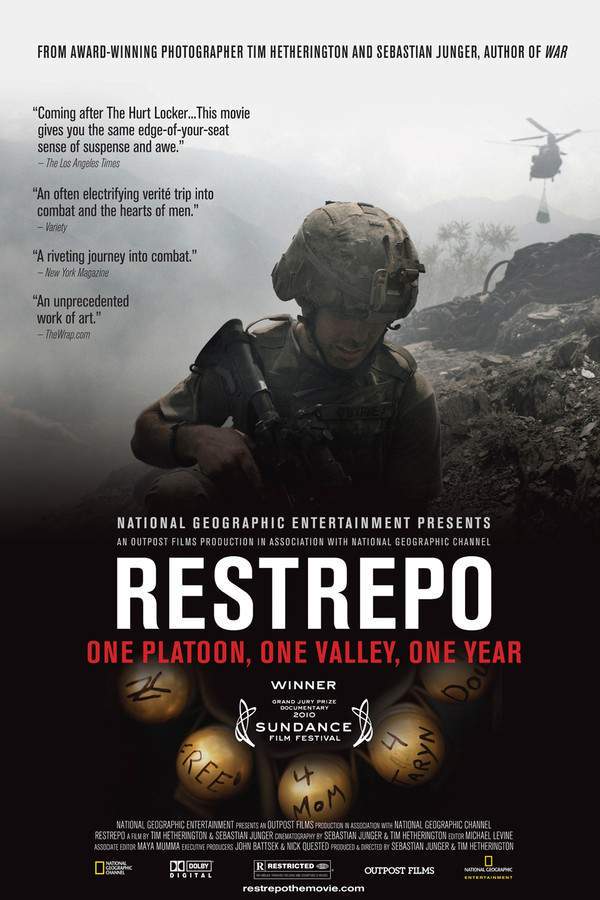
Restrepo (2010) movie poster

Plot Summary

Restrepo (2010) Plot Summary Explained

Release, runtime and language
2010 · 93 min · English
Directed by
Sebastian Junger, Tim Hetherington

In Afghanistan’s Korengal Valley, a small US platoon establishes Restrepo, an isolated outpost dedicated to a fallen medic. The film offers an immersive and unfiltered look at their experiences, placing viewers directly into the harsh realities of combat. Through intimate camera work, audiences witness the constant threat and unrelenting intensity of life in the valley, with no safe haven from the ongoing conflict. It's a raw and visceral portrayal of war, focusing solely on the soldiers’ day-to-day struggles.

On this page (6)
  1. 1 Where to watch
  2. 2 What happens: full plot
  3. 3 Plot questions answered
  4. 4 Movie threads
  5. 5 Movies like Restrepo
  6. 6 Every angle

Where to watch

Where to Watch Restrepo (2010)

Where can you watch Restrepo? Stream, rent or buy it in the US, including on Apple TV Store: current JustWatch availability with up-to-date prices.

Streaming availability powered by JustWatch

Full plot summary · contains spoilers

What Happens in Restrepo: Full Plot Summary

The whole story of Restrepo (2010) explained, from the opening scene to the final frame: every key event, every twist and what it all adds up to. Read it as a quick recap before the sequel, to check a scene you missed, or to finally understand what really happened.

Restrepo chronicles the men of Second Platoon, Battle Company, as they spend a grueling 15-month deployment in the Korengal Valley of eastern Afghanistan. The film opens with raw footage of four soldiers filmed by PFC Juan Sebastián Restrepo, and a written note places their mission in May 2007, highlighting the Korengal as one of the U.S. military’s most dangerous postings. The landscape is rugged and unforgiving, with the Korengal flowing into the Pech and then toward the Kunar River Valley along Afghanistan’s porous border with Pakistan. American troops and supplies move into the remote Combat Outpost (COP) Korengal via Chinook helicopters, underscoring the logistical challenges of operating in such harsh terrain. The opening sequence also introduces an early firefight on a narrow mountain road when a military Hummer is disabled by an IED, foreshadowing the constant danger that will define the soldiers’ days.

The film then tracks the platoon from several months after their arrival to their eventual return home, focusing on the real-life experiences and routines that shape life in a high-stakes war zone. Early in the deployment, Pfc. Timothy R. Vimoto, only 19, is killed in action, and soon after the unit suffers the loss of PFC Restrepo, their medic, whose memory motivates the naming of an advanced outpost as OP Restrepo. At this outpost, the soldiers come under fire nearly every day, sometimes multiple times daily, as enemy positions shift across the surrounding terrain. The narrative emphasizes their daily commitment to security operations, including interrupting Taliban movement and safeguarding the construction of a road, all while attempting to win the trust of local leaders and civilians. The interactions with residents vary in tone, ranging from cordial exchanges to obvious antagonism, painting a nuanced picture of the complex relationships in the valley.

A substantial portion of the second half centers on Operation Rock Avalanche, conducted in October 2007, a dangerous mission aimed at rooting out Taliban fighters. During this operation, Staff Sergeant Larry Rougle is killed in an ambush that tests the unit’s resolve and leadership. Rougle, a Purple Heart recipient who served multiple tours in both Iraq and Afghanistan, is memorialized as his unit secures a position in the aftermath of the assault, with his sacrifice underscoring the high cost of the fight. The film does not merely present the action; it memorializes the personal cost of war and the way a unit depends on one another for survival.

Throughout Restrepo, the director frames the story around a central idea of brotherhood: the deep bond that forms among soldiers who share danger, responsibility, and trust. Intercut with on-the-ground footage are interviews conducted after Second Platoon returned to the 173rd Airborne Brigade Combat Team’s base near Vicenza, Italy, where the men candidly reflect on their experiences, acknowledge the wounds—both physical and emotional—and consider the lasting impact of what they endured, including memories of those who were wounded or killed. The film thus offers not only a record of specific battles and missions but also a meditation on friendship, duty, and the psychological weight of combat.

Before the credits, the film situates the broader historical context by noting that in April 2010 the United States withdrew from the Korengal Valley, and that nearly 50 American soldiers died fighting there. Restrepo is presented as a documentary that transcends a simple chronicle of events; it is a close, unflinching portrait of a unit under pressure, the strategies they pursue to achieve their objectives, the personal costs of their mission, and the enduring ties that bind them together long after they leave the valley.

Last updated: October 09, 2025 at 15:47

Was this helpful?

Plot questions answered

Restrepo Plot Explained: Your Questions Answered

The questions people ask most about Restrepo (2010): what happens in the confusing scenes, why the characters do what they do, the twists, hidden details and what the ending means. Each answer contains spoilers.

Q1

Why was the outpost named Restrepo?

The outpost was named OP Restrepo in honor of PFC Juan Sebastián Restrepo, the unit's medic who was killed in action. Captain Dan Kearney initiated construction of the advanced outpost, and the soldiers chose to name it after their fallen medic as a way to memorialize him and keep his memory present during their deployment.

Foreshadowing: Earlier in the film, the soldiers express their grief over losing Restrepo, establishing the emotional motivation for naming the outpost.

  • restrepo
  • outpost
  • medic
  • memorial
  • fallen soldier
Q2

What happened during Operation Rock Avalanche?

Operation Rock Avalanche was a major offensive in October 2007 aimed at rooting out Taliban fighters from the Korengal Valley. During this operation, Staff Sergeant Larry Rougle was killed in an ambush while at the point of the advance. He sacrificed himself to allow his soldiers to secure a position and continue the fight, enabling the unit to achieve their objective despite the loss.

Foreshadowing: The film builds tension leading to this mission, showing the platoon preparing for a significant assault on enemy positions.

  • operation rock avalanche
  • ambush
  • rouhle
  • taliban
  • offensive
Q3

How did soldiers cope with constant firefights at Restrepo?

At OP Restrepo, the men came under fire nearly every day, sometimes multiple times daily. The film shows them developing routines around security operations and maintaining their commitment to mission objectives despite the relentless danger. The constant exposure to combat became part of their daily reality, with the soldiers relying on training, camaraderie, and their mission objectives to maintain focus.

Foreshadowing: The opening scene depicting the IED attack on a Hummer establishes the persistent danger that defines their experience.

  • firefights
  • combat
  • daily attacks
  • survival
  • routine
Q4

What was the relationship between soldiers and local villagers?

The soldiers' interactions with local residents varied in tone, ranging from cordial exchanges to obvious antagonism. One of their objectives was to win the trust of local leaders and civilians while interrupting Taliban movement. The film portrays these negotiations as complex, with some locals friendly and others hostile, reflecting the complicated dynamics of trying to secure a population in an active war zone.

Foreshadowing: Early scenes show both cooperative and tense encounters with villagers, foreshadowing the ongoing challenge of building trust.

  • locals
  • villagers
  • taliban
  • trust
  • population
  • afghanistan
Q5

Why did the United States withdraw from the Korengal Valley?

The film notes that in April 2010, the United States withdrew from the Korengal Valley, nearly three years after the events shown. The text states that nearly 50 American soldiers died fighting there. The withdrawal represented a strategic decision to end one of the most dangerous and costly postings in the Afghanistan war, despite the sacrifices made by units like Second Platoon.

Foreshadowing: The film's narrative emphasizes the constant casualties and high cost of maintaining the outpost throughout the 15-month deployment.

  • withdrawal
  • korengal valley
  • us army
  • april 2010
  • troops
Q6

How did the deaths of Vimoto and Restrepo affect the platoon?

Pfc. Timothy R. Vimoto, only 19, was killed in action within months of arriving, followed shortly by PFC Restrepo, the unit's medic. These losses compounded the emotional and operational strain on Second Platoon. Restrepo's death was particularly significant as he was the unit's medic, a role that involved caring for the soldiers daily, making his loss deeply personal and motivating the naming of OP Restrepo in his honor.

Foreshadowing: The opening sequence introduces the soldiers through Restrepo's own camera work, making his eventual death more impactful.

  • vimoto
  • restrepo
  • killed
  • medic
  • casualty
  • death
Q7

What happened to the soldiers after they returned home?

After the 15-month deployment ended, the soldiers returned to the 173rd Airborne Brigade base near Vicenza, Italy, and eventually to the United States. The film includes interviews conducted after their return, revealing candid reflections on their experiences, including physical wounds and emotional distress. The narrative illustrates how the experience continued to shape their lives and friendships long after leaving Afghanistan, highlighting the lasting psychological impact of combat.

Foreshadowing: The film intercuts combat footage with interview segments, showing the contrast between their experiences in the valley and their reflections afterward.

  • home
  • return
  • veterans
  • psychological impact
  • vicenza
  • reflections
Q8

How does the film portray the theme of brotherhood?

The director frames the story around the deep bond that forms among soldiers who share danger, responsibility, and trust. The film shows how the men depend on each other for survival in extreme circumstances. This theme of brotherhood is reinforced through interviews where soldiers candidly discuss their experiences and acknowledge the wounds, both physical and emotional, they carry, emphasizing the enduring ties that bind them together even after leaving the valley.
Foreshadowing: From the opening footage of soldiers together, the film establishes the camaraderie that becomes central to the narrative.

  • brotherhood
  • camaraderie
  • bonds
  • trust
  • soldiers
  • unit
Q9

What was the significance of the road construction project?

One of the major objectives shown in the film was securing a road project in the Korengal Valley. The soldiers were tasked with interrupting Taliban supply flow while also working on this road construction. Building the road represented a strategic goal to improve logistics and mobility for American forces, while simultaneously attempting to win trust from the local population by improving infrastructure.

Foreshadowing: Early mentions of supply logistics and the difficulty of moving troops and materials foreshadow the importance of the road.

  • road
  • construction
  • taliban supply
  • logistics
  • mission objective
Q10

Why did the soldiers continue fighting despite constant danger?

The soldiers continued their mission despite near-constant threat because of their sense of duty, commitment to their unit, and the brotherhood that developed among them. The film shows them maintaining daily security operations, interrupting Taliban movement, and pursuing objectives like the road construction project. Their refusal to abandon the outpost, even after suffering significant casualties, reflects the military culture of completing the mission and not leaving fellow soldiers behind.

Foreshadowing: The relentless daily firefights establish the danger, while interviews reveal the internal motivations that kept them going.

  • duty
  • mission
  • sacrifice
  • commitment
  • military
  • resolve

Movie threads

More Movies Like Restrepo, by Mood & Story

Curated lists built around what makes Restrepo tick: the same mood, the same kind of story or the same emotional payoff. Each list explains why these movies belong together.

Raw and Unflinching War Documentaries like Restrepo

Firsthand, visceral accounts of conflict that offer an immersive soldier's-eye view. Movies like Restrepo that provide a firsthand, immersive look at the realities of war. These documentaries are often shot on the front lines, offering a tense and unfiltered perspective on combat, survival, and the bonds of brotherhood. If you appreciated the visceral intensity of Restrepo, you'll find similar films here.

  • immersive
  • unflinching
  • tense
  • visceral
  • raw
  • gritty
  • Tone: tense, bleak
  • Pacing: steady, immersive
Why these movies?

The story pattern: These documentaries typically follow a linear, chronological structure centered on a specific unit or location. The narrative is not about grand strategy but the day-to-day reality of survival, punctuated by moments of intense combat and psychological strain. The journey is one of enduring extreme stress and forming deep bonds under fire.

Why they belong together: They are grouped by their shared commitment to an immersive, observational style. The high intensity, tense tone, and heavy emotional weight create a cohesive viewing experience defined by its authenticity and emotional impact, rather than traditional storytelling.

High-Stakes Survival Stories like Restrepo

Groups isolated in hostile settings, fighting for survival against overwhelming odds. If you liked the intense survival narrative of Restrepo, these movies capture a similar vibe. They feature groups isolated in extreme environments—whether war zones, wilderness, or space—facing constant danger. The stories are tense, gritty, and explore the deep bonds forged under severe pressure.

  • tense
  • gritty
  • claustrophobic
  • brotherhood
  • anxious
  • relentless
  • Tone: tense, anxious, grim
  • Pacing: steady, relentless
Why these movies?

The story pattern: The narrative pattern involves a group being cut off in a hostile environment, forcing them to rely on each other to overcome external threats and internal friction. The plot is driven by a steady pace of escalating challenges, leading to a climax that tests their resolve and often results in a bittersweet or heavy conclusion.

Why they belong together: They share a core experience of high-intensity survival, a tense and anxious tone, and a focus on the dynamics of a group under duress. The pacing is often steady, building a sense of inescapable pressure, and the emotional weight is consistently heavy.

If you liked this

Movies Like Restrepo

Similar movies to Restrepo: the same genre, themes or kind of story. Each one comes with its own plot summary, timeline and ending explained.

Browse all movie summaries

Every angle

Restrepo (2010) Explained: Plot, Timeline & Characters

Everything about Restrepo in one place: what happens in the plot summary, the timeline in chronological order, the characters and meaning and a spoiler-free summary. What's After the Movie adds the cast, box office and post-credit scenes.

Coming soon on iOS and Android

The Plot Explained Movie Summary App

Plot summaries, endings explained and timelines on your phone. Catch up on any movie in minutes, save your favorites and never miss a twist again.

Be the first to know when we launch. Your email stays private, always.

Learn more about the app