






Plot Explained Spoilers guaranteed!
Plot Explained

Browse by genre

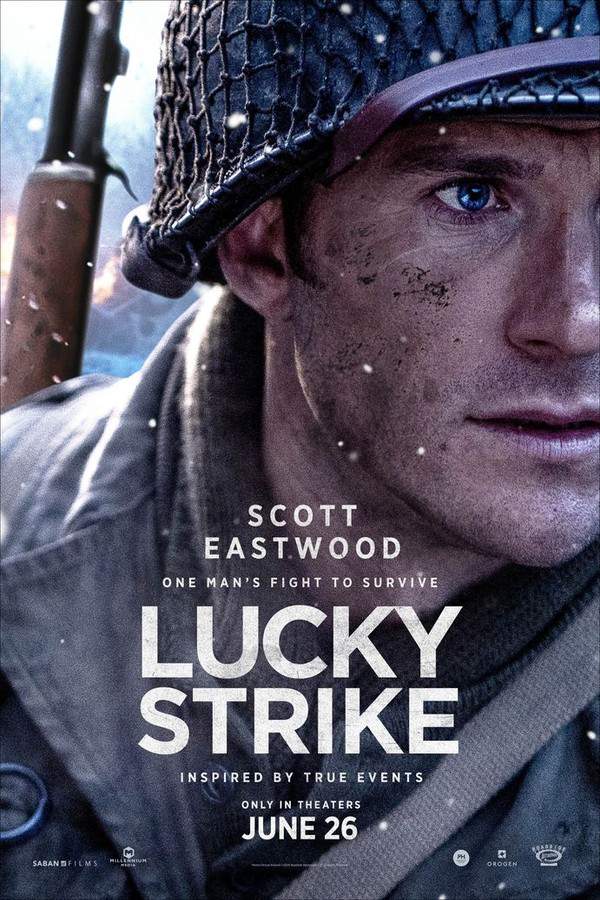
Lucky Strike (2026) movie poster

Plot Summary

Lucky Strike (2026) Plot Summary Explained

Release, runtime and language
2026 · 1 h 42 m · English
Echo score 61
Directed by
Rod Lurie, Todor Kotzev
Starring
Scott Eastwood, Lorne MacFadyen, Atanas Srebrev, Ori Pfeffer, Colin Hanks, Jonathan Yunger
Budget
$10M

Inspired by true events, Lucky Strike follows a lone American soldier trapped behind German lines during the Battle of the Bulge, the last major German offensive of World War II. Armed only with a Motorola SCR‑300 radio, he must use cunning, improvisation and basic espionage to disrupt enemy communications and survive the harsh winter battlefield.

On this page (5)
  1. 1 Where to watch
  2. 2 What happens: full plot
  3. 3 Plot questions answered
  4. 4 Movie threads
  5. 5 Every angle

Where to watch

Where to Watch Lucky Strike (2026)

Where can you watch Lucky Strike? Stream, rent or buy it in the US, including on Amazon Video, Apple TV Store and Fandango At Home: current JustWatch availability with up-to-date prices.

Streaming availability powered by JustWatch

Full plot summary · contains spoilers

What Happens in Lucky Strike: Full Plot Summary

The whole story of Lucky Strike (2026) explained, from the opening scene to the final frame: every key event, every twist and what it all adds up to. Read it as a quick recap before the sequel, to check a scene you missed, or to finally understand what really happened.

In December 1944, amid the brutal cold of the Battle of the Bulge, US Captain Castle [Scott Eastwood], commanding the 324th Engineering Battalion of Charlie Company, and his small team—including the wounded Cash [Jonathan Yunger], who is forced to resign due to combat injuries—are ordered to block a critical road. Their goal is simple in theory: prevent the 1st SS Panzer Division from seizing American fuel depots while the rest of the company pulls back to safety. As they lay explosive charges and fortify their position, fate turns sharply against them. A well-placed machine gun nest, aided by a passing SS half-track crew, wipes out the squad, leaving Castle as the lone survivor, badly wounded but still fighting for his life.

With the objective completed, Castle must trudge back to friendly lines on foot, carrying a field radio nicknamed “Lassie” and a pack of Lucky Strike cigarettes. He is forced to move through a landscape roamed by roving SS units that kill on sight, all while dodging artillery blasts and the constant threat of discovery. His lone trek finally brings him into contact with a wary ally, Sgt. Bellingham [Taylor John Smith], who claims to be transporting secret battle plans to the headquarters of the 99th Infantry Division. The two men camp for the night and establish radio contact with the 324th, who promise a rescue patrol. Yet Castle’s instincts prick at him when he notices something off about Bellingham’s routine, including a cigarette habit that doesn’t quite align with American custom.

Castle records a standard operation instructions (SOI) code in a note he has kept, and when Bellingham cannot decipher it, Castle realizes he has been deceived: Bellingham is a German posing as an American. A tense gunfight erupts, and though Castle is wounded, he manages to kill Bellingham before losing consciousness.

When he regains consciousness, Castle finds himself in a U.S. field hospital at Elsenborn. There he meets General Lauer [Atanas Srebrev], commander of the 99th, who explains that Castle’s perilous return journey has created confusion among the German forces, stalling their attacks for hours and giving American troops precious time to organize their defenses and keep Lauer’s position secure. Despite Castle’s protests and guilt over the loss of his men, Lauer awards him a Silver Star for the survival and resilience he demonstrated.

During his recovery, Castle reconnects with Cash, who helps restore his confidence and shares a bottle, offering a moment of camaraderie that recalls the bonds formed in the crucible of war.

Years later, now a colonel, Castle returns home and visits Rose Caldwell—the factory worker who helped assemble Lassie. He recounts his ordeal and, in a gesture of gratitude, helps secure a pension for her that had been denied by her former employers. This act of recompense marks a quiet but meaningful closure, underscoring how Lassie’s unseen contribution saved Castle’s life. As he reunites with his family, Castle gazes fondly at Lassie, clinging to the memory of the radio that kept him alive through the longest night of his life, a steadfast keepsake of a war that tested every limit.

Last updated: August 28, 2026 at 07:33

Was this helpful?

Plot questions answered

Lucky Strike Plot Explained: Your Questions Answered

The questions people ask most about Lucky Strike (2026): what happens in the confusing scenes, why the characters do what they do, the twists, hidden details and what the ending means. Each answer contains spoilers.

Q1

Why was Castle's entire squad wiped out at the roadblock?

Castle's squad was caught in the open while planting explosives when a concealed German machine gun nest and a passing SS half-track opened fire on them simultaneously. Charlie Company was an engineering unit with no infantry support to suppress that fire, and the Germans had pre-positioned killing positions along the route, so the ambush annihilated the team within seconds and left Castle as the sole survivor.

  • castle squad ambush
  • roadblock
  • machine gun nest
  • ss half-track
  • charlie company
Q2

How did Castle figure out Bellingham was a German spy?

Castle grew suspicious when Bellingham handled the Lucky Strike cigarettes in ways that did not match how American GIs typically behaved, but the decisive test came when he transmitted a standard SOI code over Lassie. A genuine U.S. sergeant should have recognized and decoded it instantly; Bellingham's inability to do so proved he had no legitimate access to American communications and exposed him as a German plant.

Foreshadowing: Earlier in the trek Castle had already started cataloguing small inconsistencies in Bellingham's story, so the failed code test only confirmed what his instincts had been telling him.

  • bellingham spy
  • german impostor
  • castle detection
  • soi code
  • lucky strike
Q3

Why did the cigarette habit give Bellingham away?

Castle offered Bellingham Lucky Strikes from his own pack and watched how he responded. Bellingham avoided or handled them in a way that did not match how American soldiers typically smoked, a subtle behavioral tell that flagged him as not one of their own. Castle, trained to watch for such inconsistencies during the retreat, used the shared cigarettes as a low-pressure loyalty test before escalating to the SOI code check.

  • lucky strike cigarettes
  • bellingham tell
  • american soldiers smoking
  • behavioral clue
Q4

Why was Castle's solo return so important to the American defense?

By moving through unexpected terrain and using Lassie to make scattered radio contact, Castle created the impression of a larger, disorganized American force operating behind German lines. That ambiguity forced the 1st SS Panzer Division to slow its advance and divert attention, buying General Lauer's 99th Infantry Division precious hours to organize its defenses around Elsenborn and the fuel depots the Germans were trying to seize.

Foreshadowing: The Germans had expected a clean breakthrough after wiping out Charlie Company, and Castle's unexplained signals were exactly the kind of friction that disrupted their timetable.

  • castle solo trek
  • 99th infantry division
  • german advance delayed
  • elsenborn defense
Q5

Why did Castle feel guilty about receiving the Silver Star?

Castle survived while every other man in his squad was killed by the ambush at the roadblock, so the medal felt like recognition paid for with his men's lives. Even though his lone trek helped delay the German advance, he saw it as a hollow honor, and General Lauer had to remind him that his actions had bought critical time the division would not otherwise have had.

  • silver star
  • castle guilt
  • survivor guilt
  • general lauer
  • charlie company losses
Q6

How did the SCR-300 radio "Lassie" actually keep Castle alive?

Lassie let Castle maintain sporadic contact with the 324th, so American operators could guide him toward safer routes, warn him about German patrols, and eventually arrange a rescue back to friendly lines. The radio also gave him a way to transmit the SOI code that exposed Bellingham, turning a single piece of equipment into his lifeline, his deception detector, and his only link to friendly command during the trek.

  • scr-300 radio
  • lassie
  • motorola
  • field radio
  • castle survival
Q7

Why did Castle visit the factory worker who built Lassie years after the war?

Castle traced Rose Caldwell, the woman who had assembled his radio on the production line, to thank her personally for the device that had saved his life. After learning her former employers had denied her a pension, he pressured them into paying it, treating the radio's maker as an unsung participant in his survival rather than just an anonymous factory hand.

  • rose caldwell
  • lassie radio maker
  • factory worker pension
  • postwar gratitude
Q8

What was the SOI code that exposed Bellingham?

The SOI, or Signal Operating Instructions, was the changing cipher U.S. forces used to authenticate friendly radio traffic. Castle transmitted a fragment of it through Lassie as a test; a real American sergeant should have recognized and decoded it immediately, while Bellingham's inability to do so proved he had no legitimate access to U.S. communications and confirmed he was a German impostor.

  • soi code
  • signal operating instructions
  • bellingham authentication
  • american military codes
Q9

Why was blocking that single road so critical during the Battle of the Bulge?

The road led toward the American fuel depots at Elsenborn, which the 1st SS Panzer Division needed to capture to keep its tanks and vehicles moving through the Ardennes winter. Losing those depots would have collapsed the American logistical backbone and let the German offensive push deeper into Belgium, so Charlie Company's roadblock was meant to be a cheap, high-impact delay on a route the Germans had to take.

  • battle of the bulge
  • roadblock mission
  • 1st ss panzer division
  • fuel depots elsenborn
Q10

Why did Cash leave the squad right before the ambush?

Cash was forced to resign from combat duty because of wounds he had already taken in earlier fighting, so he was pulled off the line just before Charlie Company deployed to the roadblock. That medical removal, which seemed routine at the time, ended up saving his life, since every man who took his place in the roadblock squad was killed in the German ambush.

  • cash resignation
  • charlie company
  • combat injuries
  • 324th engineering battalion
Q11

What does Castle gazing at Lassie at the end of the film symbolize?

In the final scene, the retired Colonel Castle looks at the SCR-300 radio now displayed in his home as a keepsake from the Battle of the Bulge. It works as a quiet memorial to the men of Charlie Company who died at the roadblock, a reminder that his survival came at a cost he still carries, and a tribute to Rose Caldwell and the factory workers whose craftsmanship turned out to be as decisive as any soldier's courage.

  • lassie keepsake
  • castle postwar
  • radio symbolism
  • battle of the bulge ending

Movie threads

More Movies Like Lucky Strike, by Mood & Story

Curated lists built around what makes Lucky Strike tick: the same mood, the same kind of story or the same emotional payoff. Each list explains why these movies belong together.

Lone warrior behind enemy lines movies like Lucky Strike

One soldier, overwhelming odds, and only wits to keep him alive. Movies like Lucky Strike where one soldier is cut off from his unit and must survive alone in enemy territory. These films follow a lone warrior using radio contact, espionage, and battlefield cunning to outmaneuver patrols, disrupt communications, and find a way back. Perfect for fans of gritty, behind-the-lines military thrillers with high tension and resourceful protagonists facing impossible odds.

  • tense
  • suspenseful
  • gritty
  • lone survivor
  • desperate
  • resourceful
  • Tone: tense, gritty
  • Pacing: variable, breath between bursts
Why these movies?

The story pattern: A lone protagonist, often wounded or cut off from his unit, is forced to operate in enemy territory with minimal resources. The arc typically moves through initial shock, adaptation, dangerous encounters that test ingenuity, a moment of critical deception or violence, and finally either extraction or escape. Internal monologue and small actions, like radioing for help, avoiding detection, and gathering intelligence, carry as much weight as combat. The hero emerges transformed, marked by what he endured and the friends he lost along the way.

Why they belong together: These films share a common engine: a single skilled but vulnerable protagonist against a vast, threatening system of enemy forces. Pacing is often variable, alternating between quiet tension and explosive action. The emotional register is heavy and tense, with heroism defined by endurance and cleverness rather than glory. Viewers experience sustained suspense punctuated by visceral combat or near-capture, and the central character's resourcefulness becomes the audience's main anchor.

Bittersweet war movies with survivor's guilt like Lucky Strike

Hard-won victory paired with quiet, lasting grief for the fallen. Movies like Lucky Strike that explore what it means to come home when so many did not. If you liked Lucky Strike's reflective, somber finale where a soldier reunites with his family but glances at the radio reminding him of fallen comrades, these films will resonate. They blend heroic survival with quiet grief, sacrifice, and the lasting psychological weight of war.

  • somber
  • reflective
  • bittersweet
  • survivor's guilt
  • grief
  • sacrifice
  • Tone: bittersweet, somber, reflective
  • Pacing: slow reflective final act
Why these movies?

The story pattern: The narrative builds toward a moment of recognition or reunion, but the camera lingers on absences. A character receives an honor, returns to family, or steps into a quiet life, and the audience is asked to feel the cost. Flashbacks, single symbolic objects, and reflective dialogue anchor the emotional weight in what was lost rather than what was won. The arc resolves outwardly but aches inwardly.

Why they belong together: These stories share a commitment to emotional honesty over triumphalism. War films and survival dramas in this group all close with a note of melancholy, where medals, homecomings, or victories cannot erase what preceded them. Pacing in the final act slows to give grief room to breathe. Viewers looking for catharsis without false comfort will find it here, alongside thoughtful examinations of trauma, gratitude, and the lasting price of survival.

Every angle

Lucky Strike (2026) Explained: Plot, Timeline & Characters

Everything about Lucky Strike in one place: what happens in the plot summary, the timeline in chronological order, the characters and meaning and a spoiler-free summary. What's After the Movie adds the cast, box office and post-credit scenes.

Coming soon on iOS and Android

The Plot Explained Movie Summary App

Plot summaries, endings explained and timelines on your phone. Catch up on any movie in minutes, save your favorites and never miss a twist again.

Be the first to know when we launch. Your email stays private, always.

Learn more about the app