Plot Explained Spoilers guaranteed!
Plot Explained

Browse by genre

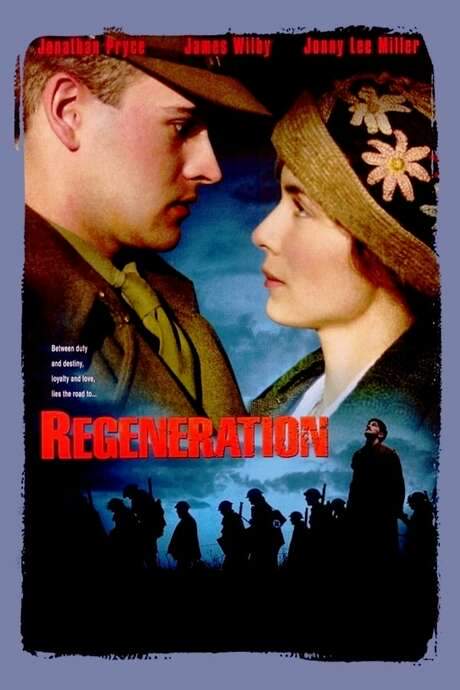
Regeneration (1997) movie poster

Timeline

Regeneration (1997) Timeline Explained – Every Event in Order

Release, runtime and language
1997 · 114 mins · English
Loading streaming availability…
Directed by
Gillies MacKinnon
Starring
Kevin McKidd, Paul Young, Jonny Lee Miller, Jonathan Pryce, James Wilby, James McAvoy

Wilfred Owen and Siegfried Sassoon, two of England’s most celebrated World War I poets, are transferred with other battle‑scarred soldiers to a rest home where they confront the psychological fatigue and emotional trauma of fighting in no‑man’s‑land, navigating duty, destiny, loyalty and love. Doctors try to mend wounds, offering a faint hope.

On this page (6)
  1. 1 Where to watch
  2. 2 Events in order (12)
  3. 3 Timeline questions answered
  4. 4 Movie threads
  5. 5 Movies like Regeneration
  6. 6 Every angle
Loading streaming availability…

12 events in order · contains spoilers

Regeneration Timeline: Events in Chronological Order

Every key event of Regeneration (1997) in order, scene by scene, with when and where it takes place. Use it to untangle flashbacks, time jumps and parallel storylines, to refresh your memory before the sequel or to find the exact scene you are thinking of.

  1. Sassoon's July 1917 open letter published

    The film opens with Siegfried Sassoon's open letter, Finished with the War: A Soldier's Declaration, published in The Times. It denounces political errors and the sacrifices of fighting men. The letter elevates Sassoon as a war hero yet signals his impending clash with military authorities.

    When
    July 1917
    Where
    The Times, London
  2. Sassoon is sent to Craiglockhart War Hospital

    Following his letter and guidance from Robert Graves, the army sends Sassoon to Craiglockhart War Hospital instead of court-martial. At the facility, doctors treat him as a wounded mind rather than a criminal, using a therapeutic setting. The move marks the start of the interwoven stories at the hospital.

    When
    July 1917
    Where
    Craiglockhart War Hospital, Edinburgh
  3. Rivers begins therapy with Sassoon

    Dr. William Rivers begins working with Sassoon, encouraging him to articulate his war memories as therapy. The scenes establish him as a care-focused physician while Sassoon's skepticism about the war remains. Their dynamic becomes central to the film's exploration of trauma and recovery.

    When
    Autumn 1917
    Where
    Craiglockhart War Hospital
  4. Owen enters as a companion and poet in progress

    Wilfred Owen, a secondary character, befriends Sassoon and aspires to be a poet. Sassoon offers mentorship as Owen seeks to refine his own war poetry. Their bond adds an artistic dimension to the hospital's rehabilitation setting.

    When
    Autumn 1917
    Where
    Craiglockhart War Hospital
  5. Prior's initial hostility and romance

    Billy Prior, initially unsympathetic, challenges Rivers to uncover the root of his muteness. He soon begins a relationship with Sarah, a munitions worker, highlighting class tensions and the social divide within the wounded. The plot threads interweave with Prior's ambition and skepticism of authority.

    When
    Autumn 1917
    Where
    Craiglockhart War Hospital and nearby town
  6. Prior's hypnosis reveals a fatal memory

    During hypnosis, Prior's trauma is revealed as the death of one of his men killed by a bomb. He had assumed his condition stemmed from personal fault, only to discover it was trauma from losing a comrade. He regains speech but remains eager to return to active duty to prove himself.

    When
    Autumn 1917
    Where
    Craiglockhart War Hospital
  7. Rivers confronts brutal electrotherapy in London

    To care for his own mental strain, Rivers travels to London and witnesses the brutal, machine-driven therapy used by Lewis Yealland. The electric stimulation sessions are used to try to force speech from mutism, a practice Rivers finds inhumane. He leaves with a renewed commitment to compassionate care.

    When
    Winter 1917–1918
    Where
    London, Yealland's clinic
  8. Rivers returns to Craiglockhart and nurtures gentle miracles

    Rivers returns to Craiglockhart and continues helping his patients, pursuing what Sassoon calls gentle miracles. The care remains intense and emotionally costly for Rivers, who begins to suffer his own mental strain. The hospital environment becomes a cradle for healing through storytelling and empathy.

    When
    Winter 1917–1918
    Where
    Craiglockhart War Hospital
  9. Sassoon seeks to return to war during the Review Board

    Sassoon insists he has not changed his mind about continuing the war and is determined to return to France to care for his men. During the Review Board, Rivers is surprised by this stance, as Sassoon appears to still oppose the war in principle. The Board ultimately deems him fit for service.

    When
    Early 1918
    Where
    Review Board in Britain (Craiglockhart / London)
  10. Sassoon is deemed fit and returns to action

    The Review Board's assessment confirms Sassoon as fit for duty, allowing him to return to the front lines. He endures a new injury, but is seen laughing in the face of death. The moment underscores the tension between mental health labels and wartime courage.

    When
    Early 1918
    Where
    Front lines, France
  11. Prior is assigned to home duties and grows closer to Sarah

    Prior is reassigned to home duties, likely due to asthma, which leaves his immediate future uncertain. He is last seen in bed with Sarah, suggesting a continued personal life despite his medical limits. His arc remains hopeful yet unresolved as the hospital timeline moves toward its end.

    When
    1918
    Where
    Craiglockhart / home
  12. Owen's fate and the canal dream resolved

    The concluding scenes show Wilfred Owen's body in a French waterway during the war's final days, with Rivers grieving a lost friend. Rivers reads Owen's The Parable of the Old Man and the Young, which provides emotional closure. The canal tunnel motif, Owen's dream, is resolved as a premonition of his own death.

    When
    Final days of World War I (1918)
    Where
    French waterways; canal imagery

Last updated: October 05, 2025 at 12:39

Was this helpful?

Timeline questions answered

Regeneration Timeline Explained: Your Questions Answered

When does it happen, and why in that order? The questions people ask about the chronology of Regeneration (1997): time jumps, flashbacks, cause and effect between scenes and the correct order of events, each answered with spoilers.

Q1

Why was Siegfried Sassoon sent to a war hospital instead of facing a court-martial?

Sassoon was sent to Craiglockhart War Hospital because Robert Graves intervened on his behalf. Rather than charging Sassoon with treason for his blistering anti-war letter, the army chose an expedient path of care. Graves helped steer the system toward treating Sassoon as a psychologically wounded officer rather than a criminal, which allowed the military to avoid a public scandal while still removing him from active duty.

  • siegfried sassoon
  • craiglockhart
  • robert graves
  • court martial
  • war hospital
  • soldier's declaration
Q2

What causes Billy Prior to lose his ability to speak?

Prior's mutism is caused by trauma from witnessing a fellow soldier's death. During hypnosis, it is revealed that a soldier under his command was killed by a bomb, and Prior was forced to pick up the man's eyeball. This horrific experience left him speechless. Importantly, he had incorrectly blamed himself for his condition, believing it stemmed from personal fault, when it was actually trauma from losing a comrade.

  • billy prior
  • mutism
  • shell shock
  • trauma
  • hypnosis
  • soldier death
Q3

Why does Dr. Rivers travel to London to observe Dr. Yealland's treatment methods?

Rivers travels to London to observe Yealland's methods because he is struggling with his own mental strain from treating patients. He seeks to find a more effective approach to helping men with trauma and mutism. However, he is horrified by what he witnesses, electric stimulation therapy applied to a patient's mouth to force speech. The brutal, mechanistic treatment shocks Rivers and reinforces his commitment to his own compassionate, talk-based approach at Craiglockhart.

  • dr rivers
  • dr yealland
  • electric therapy
  • london
  • shell shock treatment
Q4

Why does Siegfried Sassoon decide to return to the front lines after treatment?

Sassoon decides to return to France because he feels compelled to care for his men, despite still opposing the war in principle. During his Review Board evaluation, he surprises Rivers by stating he has not changed his mind about the war, only his assessment of whether he can serve. The Board deems him fit for duty, and he returns to be with his soldiers, even enduring a new injury. His decision reflects a complex mix of moral conviction and loyalty to his men.

  • siegfried sassoon
  • return to war
  • review board
  • france
  • duty
  • officers
Q5

How does Wilfred Owen die in the film?

Wilfred Owen is killed in the final days of World War I. His body is shown floating in a French waterway, the same canal tunnel that had appeared as a recurring dream motif throughout the film. This premonition imagery gains tragic significance as the dream of the canal tunnel, which Owen had described as a path through memory, becomes a literal pathway to his death.

Foreshadowing: The canal tunnel appears as Owen's recurring dream throughout the film, foreshadowing his death in French waterways.

  • wilfred owen death
  • canal
  • french waterway
  • war
  • poem
Q6

Why does Billy Prior want to return to active duty despite his trauma?

Prior wants to return to active duty to prove his competence to himself and to the military system that elevated him from the lower ranks to officer status. As a working-class man who achieved officer status, he feels pressure to demonstrate his worth. His eagerness to return stems from a desire to validate his leadership abilities and escape the stigma of being deemed unfit, even though returning to the front would mean confronting the trauma that caused his mutism.

  • billy prior
  • officer
  • class
  • active duty
  • leadership
  • working class
Q7

What does the phrase gentle miracles refer to in the film?

The phrase gentle miracles refers to Dr. Rivers' therapeutic approach at Craiglockhart, believing that the most effective healing comes from giving patients a voice to recount and reframe their war memories. Sassoon uses this term to describe Rivers' patient-centered care, contrasting it with brutal methods like Yealland's electric therapy. The phrase becomes a guiding principle of the film, though Rivers personally pays a heavy emotional cost for this compassionate work.

  • gentle miracles
  • dr rivers
  • therapy
  • compassion
  • craiglockhart
Q8

What is the relationship between Siegfried Sassoon and Wilfred Owen?

Sassoon and Owen develop a mentoring friendship at Craiglockhart. Owen, a gifted but anxious young poet, deeply respects Sassoon's established work and seeks his guidance to refine his own poetry. Sassoon agrees to help Owen develop his voice as a poet, and their bond grows as they share the trauma of trench warfare. This relationship provides an artistic counterpoint to the hospital's clinical setting, with Sassoon's influence remaining significant even after Owen's death.

  • siegfried sassoon
  • wilfred owen
  • poetry
  • mentorship
  • friendship
  • poet
Q9

What is the nature of Billy Prior's relationship with Sarah?

Billy Prior enters a romantic relationship with Sarah, a munitions worker he meets in the town near the hospital. Their relationship develops as Prior seeks affection and companionship following his traumatic experience. Sarah becomes his confidante and lover, providing emotional support during his recovery. The class divide between Prior, a working-class officer, and Sarah highlights the social dynamics of the era. At the film's end, Prior is shown in bed with Sarah, suggesting a fragile but hopeful personal future away from frontline pressures.

  • billy prior
  • sarah
  • munitions worker
  • relationship
  • romance
  • class
Q10

Why does Dr. Rivers himself begin to suffer mentally during treatment?

Dr. Rivers suffers mentally because absorbing his patients' traumatic stories takes a heavy emotional toll. As he listens to, witnesses, and translates the pain of soldiers dealing with shell shock, he bears witness to their suffering while his own mental stability erodes. His visit to Yealland's clinic further destabilizes him as he confronts the brutality of other treatment approaches. The film shows that Rivers' commitment to compassionate care comes at a significant personal cost to his own psychological wellbeing.

  • dr rivers
  • mental strain
  • shell shock
  • therapist
  • burnout
  • compassion

Movie threads

More Movies Like Regeneration, by Mood & Story

Curated lists built around what makes Regeneration tick: the same mood, the same kind of story or the same emotional payoff. Each list explains why these movies belong together.

Movies about the psychological trauma of war like Regeneration

Movies that explore the deep psychological wounds inflicted by combat. If you were moved by Regeneration's unflinching look at shell shock, explore more movies like it that focus on the psychological scars of war. These similar films examine PTSD, military psychiatry, and the heavy emotional toll on soldiers, offering thoughtful and harrowing dramas.

  • somber
  • traumatic
  • clinical
  • thoughtful
  • harrowing
  • psychological
  • Tone: melancholic, thoughtful, harrowing
  • Pacing: slow, deliberate, introspective
Why these movies?

The story pattern: Stories in this thread typically follow characters, often soldiers or veterans, as they grapple with severe psychological trauma from their wartime experiences. The narrative revolves around their attempts to heal, confront their memories, and find a way to live with their invisible wounds, often through therapy or supportive relationships.

Why they belong together: These movies are grouped together because they share a primary focus on the internal, psychological impact of war rather than just its external battles. They create a similar experience through their heavy emotional weight, melancholic tone, and thoughtful examination of trauma, morality, and recovery.

Slow-burn melancholic character studies like Regeneration

Character-driven stories steeped in a quiet, reflective sadness. For viewers who appreciated the slow, thoughtful pace and melancholic depth of Regeneration, this selection features similar character-driven dramas. These movies like Regeneration share a heavy emotional tone, a focus on psychological realism, and a bittersweet sensibility that lingers long after the credits.

  • somber
  • thoughtful
  • poetic
  • resigned
  • heavy
  • introspective
  • Tone: melancholic, bittersweet, somber
  • Pacing: slow, reflective, deliberate
Why these movies?

The story pattern: The narrative pattern is centered on the gradual unraveling of a character's psyche or the evolution of their emotional state. There is minimal external action; the drama comes from internal conflict, memory, and dialogue. The journey is often one of coming to terms with a painful reality rather than achieving a clear victory.

Why they belong together: These films are connected by their shared atmospheric and structural qualities: a slow pacing that encourages reflection, a dominantly melancholic tone, and a primary focus on the nuanced emotional journeys of their characters. They provide a similarly immersive and emotionally resonant viewing experience.

If you liked this

Movies Like Regeneration

Similar movies to Regeneration: the same genre, themes or kind of story. Each one comes with its own plot summary, timeline and ending explained.

Browse all movie summaries

Every angle

Regeneration (1997) Explained: Plot, Timeline & Characters

Everything about Regeneration in one place: what happens in the plot summary, the timeline in chronological order, the characters and meaning and a spoiler-free summary. What's After the Movie adds the cast, box office and post-credit scenes.

Coming soon on iOS and Android

The Plot Explained Movie Summary App

Plot summaries, endings explained and timelines on your phone. Catch up on any movie in minutes, save your favorites and never miss a twist again.

Be the first to know when we launch. Your email stays private, always.

Learn more about the app