Plot Explained Spoilers guaranteed!
Plot Explained

Browse by genre

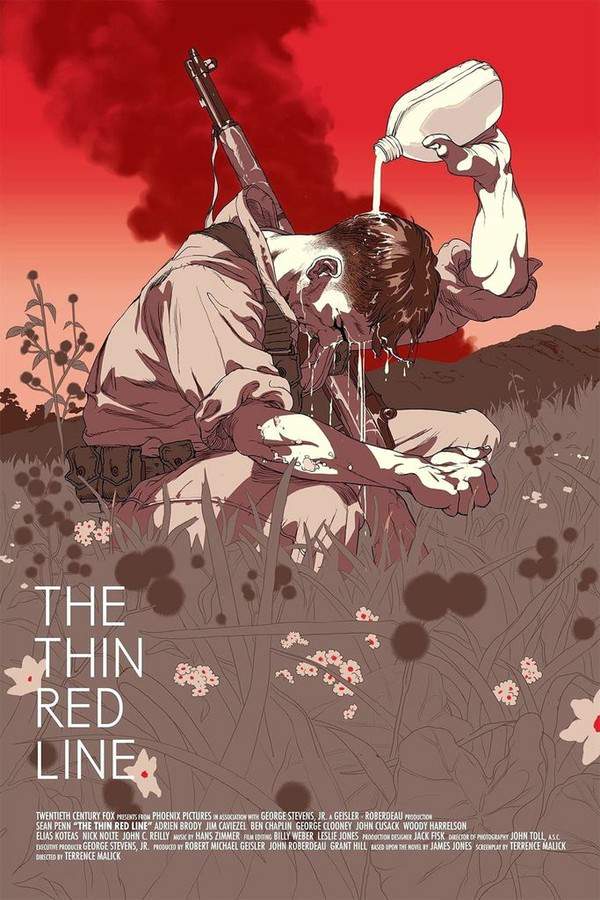
The Thin Red Line (1999) movie poster

Plot Summary

The Thin Red Line (1999) Plot Summary Explained

Release, runtime and language
1999 · 170 min · English
Directed by
Terrence Malick
Starring
Nick Nolte, Sean Penn, James Caviezel
Budget
$52M

During World War II, on a peaceful South Pacific island in 1942, Private Witt is drawn back into the conflict by his commanding officer, disrupting his solitary life. He rejoins his unit and confronts the harsh realities of war as they participate in the fierce fighting on Guadalcanal. The film explores the varied emotional and psychological responses of soldiers facing intense combat and the ever-present threat of death. It's a study of courage, fear, and the human condition amidst the chaos of war.

On this page (7)
  1. 1 Where to watch
  2. 2 What happens: full plot
  3. 3 Plot questions answered
  4. 4 The book behind the movie
  5. 5 Movie threads
  6. 6 Movies like The Thin Red Line
  7. 7 Every angle

Where to watch

Where to Watch The Thin Red Line (1999)

Where can you watch The Thin Red Line? Stream, rent or buy it in the US, including on Amazon Video, Apple TV Store and Fandango At Home: current JustWatch availability with up-to-date prices.

Streaming availability powered by JustWatch

Full plot summary · contains spoilers

What Happens in The Thin Red Line: Full Plot Summary

The whole story of The Thin Red Line (1999) explained, from the opening scene to the final frame: every key event, every twist and what it all adds up to. Read it as a quick recap before the sequel, to check a scene you missed, or to finally understand what really happened.

In the summer of 1942, against the backdrop of the South Pacific, two American Army privates find themselves stranded on an island in Micronesia, living among the Melanesian natives. Both are AWOL from their unit, C Company. One fateful morning, an American naval vessel arrives, leading to their capture. Among these soldiers is Private Witt, who encounters his sergeant, Welsh. Welsh expresses concern that Witt's laissez-faire approach will not contribute positively to the Army's struggle against the advancing Imperial Japanese Army, which poses a significant threat to Australia. Welsh informs Witt that he will be reassigned to a stretcher-bearer's unit ahead of the impending invasion of Guadalcanal—a pivotal move that underscores the strained relationship between the two men.

Onboard a Navy cruiser, Lt. Colonel Tall discusses the upcoming assault on Guadalcanal with Brigadier General Quintard. Through Tall's voiceover, we learn about his long-standing service in the Army and the frustration of being overlooked for promotion to colonel. The impending battle may finally yield the recognition he has sought, as securing an airfield on the island is crucial. Meanwhile, the personnel of C Company wait anxiously for orders, with tensions running high as they prepare for the mission ahead. Pvt. Doll steals a .45 caliber pistol from a fellow soldier, while Pvt. Train philosophizes about death as an unchanging certainty in life.

As the invasion commences, the soldiers descend into the amphibious landing vehicles, landing on the beach to find no immediate resistance. After initial reports indicating the absence of Japanese troops inland, the battalion embarks on a strenuous trek towards Hill 210, a key strategic position held by the Japanese forces. The valley below reveals a fortified bunker brimming with enemy machine guns, making any direct attempt to seize the hill a dangerous venture.

The morning begins with an artillery bombardment ordered by Tall, who believes it will bolster the soldiers' morale. However, the troopers, hiding from the barrage and on edge, remain filled with dread. One of the men, Seco, unable to cope with his anxiety, is replaced by Welsh, who recognizes that Seco's emotional distress could negatively affect the morale of the unit. Once the shelling subsides, Welsh's unit is ordered by Staros to charge at the hill's peak, but they are met with fierce resistance, leading to devastating casualties. A desperate scene unfolds when Pvt. Tella, severely wounded, is left behind in the field, forcing Welsh to make troubling choices as he grapples with the chaotic aftermath.

Amid escalating conflict, C Company's luck begins to shift when satisfaction is drawn from a flanking maneuver, and Lt. Colonel Tall orders a five-man team to infiltrate the enemy bunker discreetly. Leading this operation is Private Bell, who successfully exposes the hidden Japanese gunner positions, allowing for the victory that Tall so desperately seeks. Following a climactic engagement at the bunker, the soldiers of Charlie Company manage to subdue the enemy position and capture several prisoners, marking a significant achievement for the unit.

In the following days, Charlie Company makes headway into the Japanese encampment, easily overpowering an enemy weakened by starvation and thus gaining control of their territory. However, the brutal reality of war begins to take its toll as the psychological strain of combat weighs heavily on the men. Private Dale, caught in a moment of moral conflict, apprehensively steals gold teeth from deceased Japanese soldiers, reflecting the dehumanizing effects of war. The personal cost of survival becomes evident as Private Bell faces a heart-wrenching divorce notice from his wife, while Witt questions Welsh about feelings of isolation amidst camaraderie.

As the reconnaissance mission unfolds, the stakes continue to rise when Witt, Fife, and another soldier uncover a vast number of Japanese troops readying to attack C Company. In a selfless act, Witt distracts the enemy to ensure that vital communication reaches their commanding officer. Ultimately, Witt meets his tragic end—shot while defying capture—his sacrifice highlighting the courage embodied within the chaos of war.

The narrative concludes as the surviving members of C Company return to camp and are introduced to their new commanding officer, Capt. Bosche. As the remnants of Charlie Company board the Navy ships, they reflect on their harrowing experiences, having completed their grueling tour, leaving behind a path marked by both tragedy and resilience.

Last updated: May 23, 2025 at 08:18

Was this helpful?

Plot questions answered

The Thin Red Line Plot Explained: Your Questions Answered

The questions people ask most about The Thin Red Line (1999): what happens in the confusing scenes, why the characters do what they do, the twists, hidden details and what the ending means. Each answer contains spoilers.

Q1

Why does Private Witt go AWOL and live with the native islanders?

Witt is AWOL from C Company and chooses to live among the Melanesian natives on a remote Micronesian island. He is drawn back into the conflict when an American naval vessel arrives and takes him into custody. His commanding officer, Sergeant Welsh, expresses concern that Witt's laissez-faire, detached approach will not contribute positively to the Army's fight against the Japanese advance.

  • private witt
  • AWOL
  • Melanesian natives
  • desertion
Q2

Why does Sergeant Welsh reassign Witt to a stretcher-bearer's unit?

Welsh reassigns Witt to a stretcher-bearer's unit ahead of the Guadalcanal invasion because he believes Witt's carefree, unmotivated attitude will not help the Army's cause. Their relationship is adversarial throughout the film, with Welsh representing military discipline and order while Witt embodies a more philosophical, detached perspective on war and existence.

  • sergeants welsh
  • private witt
  • stretcher bearer
  • reassignment
Q3

Why is the battle for Guadalcanal so critical to the war effort?

Guadalcanal is strategically vital because the Japanese are rapidly constructing an airfield on the island. Securing this airfield would allow the Allies to prevent Japanese advancement and protect Australia from invasion. Lt. Colonel Tall sees the upcoming assault as his opportunity to gain long-sought recognition and promotion after years of being overlooked for colonel.

  • guadalcanal
  • airfield
  • japanese
  • strategic importance
  • australia
Q4

Why does Captain Staros defy Lt. Colonel Tall's orders during the hill assault?

Captain Staros defies Tall's order for a direct frontal assault on Hill 210 because he recognizes it would result in devastating casualties. The hill is heavily fortified with Japanese machine guns, and a straight-ahead charge would be suicidal. Staros instead proposes a flanking maneuver to outflank the enemy position, showing moral courage to challenge his superior's orders despite the risk of being accused of insubordination.

  • captain staros
  • lt colonel tall
  • frankish assault
  • defying orders
  • hill 210
Q5

Why does Sergeant Keck sacrifice himself by throwing himself on a grenade?

Sergeant Keck heroically throws himself onto a grenade to save his fellow soldiers during a fierce encounter on Hill 210. His act of self-sacrifice exemplifies the extreme courage and brotherhood among soldiers. Keck is mortally wounded and shortly thereafter dies, insisting that his men contact his wife to inform her of his sacrifice.

  • sergeant keck
  • grenade
  • sacrifice
  • bravery
  • death
Q6

Why does Private Dale steal gold teeth from dead Japanese soldiers?

Private Dale steals gold teeth from deceased Japanese soldiers, an act that exposes the dehumanizing effects of war on the soldiers' psychology. This morally ambiguous moment reflects how the brutal nature of combat can corrupt human instincts and reduce enemies to objects rather than people. It illustrates the dark psychological toll the conflict takes on the men.

  • private dale
  • gold teeth
  • looting
  • dehumanization
  • japanese soldiers
Q7

Why does Witt sacrifice himself to warn the company about the Japanese attack?

During a reconnaissance mission, Witt, Fife, and another soldier discover a large Japanese force preparing to attack C Company. In a selfless act, Witt distracts the enemy to ensure vital communication reaches their commanding officer. He is shot while defying capture, sacrificing his life so his unit can prepare for the attack. His death represents the ultimate expression of courage amidst war's chaos.

  • private witt
  • sacrifice
  • death
  • japanese attack
  • reconnaissance
Q8

Why does Private Bell receive a divorce notice from his wife?

Private Bell faces the personal cost of war when he receives a heart-wrenching divorce notice from his wife while the company is in the field. This reflects how wartime service strains and destroys relationships back home, adding emotional trauma to the physical dangers of combat. The divorce highlights the human toll of war extends beyond the battlefield.

  • private bell
  • divorce
  • marriage
  • personal cost
  • wartime
Q9

Why does the commando unit's flanking maneuver succeed where the frontal assault failed?

The commando unit led by Private Bell succeeds by sneaking back up to the Japanese bunker discreetly rather than attacking head-on. They expose the hidden Japanese gunner positions, allowing the American forces to target the enemy before launching a coordinated assault. This tactical change from frontal assault to covert flanking maneuver proves decisive in capturing the position.

  • commando unit
  • private bell
  • flanking maneuver
  • bunker attack
  • tactical success
Q10

Why are the Japanese soldiers found in such weakened condition at their encampment?

When Charlie Company advances to the Japanese encampment, they find the enemy soldiers demoralized and starved. The Japanese forces had been cut off from supplies and reinforcements, weakening them significantly. This allows for an easy capture of the position and several prisoners, providing a morale boost to the American troops.

  • japanese encampment
  • starvation
  • weakened
  • demoralized
  • capture
Q11

What does the title 'The Thin Red Line' refer to in the movie?

The title 'The Thin Red Line' refers to the famous phrase describing the thin boundary between civilization and barbarism, order and chaos. In military history, it references a historic battle. In the film, it symbolizes the fragile distinction between sanity and madness, courage and cowardice, life and death that soldiers must navigate during combat, exploring the psychological margins of human experience under extreme pressure.

  • thin red line
  • title meaning
  • civilization
  • chaos
  • metaphor
Q12

Why is Lt. Colonel Tall so desperate for a victory at Guadalcanal?

Lt. Colonel Tall has served a long time in the Army and is frustrated at being overlooked for promotion to colonel. He sees the Guadalcanal invasion as his opportunity to finally gain the recognition and advancement he has sought throughout his career. His personal ambition for promotion drives his aggressive tactics and his desire for a decisive victory, even at high casualties.

  • lt colonel tall
  • promotion
  • recognition
  • ambition
  • victory

Movie threads

More Movies Like The Thin Red Line, by Mood & Story

Curated lists built around what makes The Thin Red Line tick: the same mood, the same kind of story or the same emotional payoff. Each list explains why these movies belong together.

Philosophical War Films Like The Thin Red Line

War stories that use combat to delve into deep questions of life, death, and the soul. If you liked the reflective, existential depth of The Thin Red Line, explore more movies like it. These films use the context of war to ask big questions about humanity, mortality, and the nature of good and evil, creating a somber and intellectually stimulating experience.

  • philosophical
  • somber
  • existential
  • poetic
  • meditative
  • tragic
  • Tone: melancholic, philosophical, somber
  • Pacing: slow, deliberate, meditative
Why these movies?

The story pattern: Narratives in this thread often unfold as a series of vignettes or reflections rather than a linear mission. The central conflict is internal, wrestling with fear, morality, and the loss of innocence, while external combat serves as the catalyst for this deep character study.

Why they belong together: Movies are grouped here because they share a primary interest in the philosophical and psychological dimensions of conflict. They prioritize mood, internal monologue, and thematic weight over plot-driven action, resulting in a similarly meditative and heavy viewing experience.

Movies with a Mood of Existential Dread Like The Thin Red Line

Stories where a pervasive sense of unease builds into a profound contemplation of life's meaning. Discover films that capture the slow burn existential dread found in The Thin Red Line. These movies share a similar vibe, using a meditative pace and heavy themes to create a powerful, somber mood that lingers long after the credits roll.

  • existential dread
  • meditative
  • somber
  • psychological
  • philosophical
  • tragic
  • Tone: somber, melancholic, bleak
  • Pacing: slow burn, deliberate, meditative
Why these movies?

The story pattern: The narrative journey is often internal and cyclical, following characters as they grapple with fundamental questions in the face of overwhelming forces. The plot may be minimal, serving as a framework for exploring themes of isolation, meaning, and the inevitability of loss.

Why they belong together: These films are connected by their shared core experience: a heavy, contemplative mood built through slow pacing and a focus on existential themes. They appeal to viewers seeking a thoughtful, emotionally resonant, and psychologically intense experience.

If you liked this

Movies Like The Thin Red Line

Similar movies to The Thin Red Line: the same genre, themes or kind of story. Each one comes with its own plot summary, timeline and ending explained.

Browse all movie summaries

Every angle

The Thin Red Line (1999) Explained: Plot, Timeline & Characters

Everything about The Thin Red Line in one place: what happens in the plot summary, the timeline in chronological order, the characters and meaning and a spoiler-free summary. What's After the Movie adds the cast, box office and post-credit scenes.

Coming soon on iOS and Android

The Plot Explained Movie Summary App

Plot summaries, endings explained and timelines on your phone. Catch up on any movie in minutes, save your favorites and never miss a twist again.

Be the first to know when we launch. Your email stays private, always.

Learn more about the app