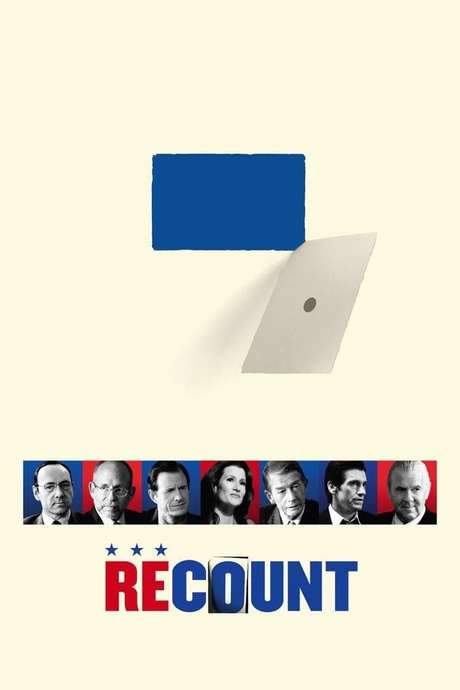
Recount chronicles the 2000 U.S. presidential election, centered on the Bush v. Gore showdown between Governor George W. Bush Brent Mendenhall and U.S. Vice President Al Gore Grady Couch. The film unfolds from the election night of November 7 through a long, high-stakes legal saga that culminates in the Supreme Court’s December 12 ruling halting the Florida recount. It presents a meticulous, behind-the-scenes look at how a national election can hinge on both the arithmetic of vote counts and the ethics of legal strategy, journalism, and political maneuvering.
As the initial results tighten into a near dead heat, the story dives into the tactical decisions on both sides. Gore and his advisers push for hand recounts in Democratic-leaning counties where irregularities are alleged, arguing that the rudimentary machine counts do not capture the true vote. This move opens a cascade of courtroom battles, media scrutiny, and partisan pressure that keeps the nation riveted through a winter of legal drama. The film carefully shows how every counting method, every deadline, and every courtroom filing becomes a focal point for a broader political argument about legitimacy and the will of the voters.
Katherine Harris [Laura Dern] is depicted at the center of a political and legal storm, as Republicans press for timely, legally mandated action from Florida’s Secretary of State in the handling of the ballot counts. The narrative underscores how her responsibilities become a battleground, influencing how the state’s votes are interpreted and recalled. The growing attention from the media, the political parties, and the public amplifies the pressure on every decision maker, turning procedure into spectacle and every error into a potential turning point.
The movie also highlights the role of a tight circle of advisers and legal teams who shape strategy and framing. Ron Klain [Kevin Spacey], Monica Klain [Eve Gordon], Michael Whouley [Denis Leary], and a broader roster of political and legal minds navigate the competing interests at stake. Veterans of campaigns and the courtroom—James Baker [Tom Wilkinson], Mac Stipanovich [Bruce McGill], Ben Ginsberg [Bob Balaban], and David Boies [Ed Begley Jr]—are shown crafting arguments, weighing deadlines, and debating the best path forward in a process that blends law, politics, and media image. The film also shows the involvement of other key figures like Clay Roberts [Gary Basaraba], Mitchell Berger [Bruce Altman], and Jeremy Bash [Derek Cecil], whose actions help drive the legal narratives on both sides. The personal stakes are underscored by scenes with Theresa LePore [Jayne Atkinson] and Bill Daley [Mitch Pileggi], among others, whose roles illuminate how individual decisions ripple outward into national consequences. In addition, the portrayal includes figures such as George W. Bush (voiced by Chris Cox and portrayed by Brent Mendenhall) and Al Gore, reminding viewers that the drama spans both the political and the ceremonial faces of the election.
Two landmark moments drive the chronology: the Florida Supreme Court’s late-November and December actions that extended deadlines and ordered a statewide recount, and the eventual intervention by the United States Supreme Court that superseded those state rulings. Craig Waters, the Florida Supreme Court spokesman, features in the background of these pivotal moments, illustrating how rapid, public-facing statements can shape the pacing and framing of a legal battle of this scale. The film does not shy away from the tension and dissent that mark many high-court decisions, highlighting the adversarial postures of both Florida’s judicial system and the U.S. Supreme Court, along with the dissenting opinions that color the competing legal narratives.
Throughout, the film emphasizes the human dimension behind the headlines: the clerks counting ballots, the campaign staff calibrating messages, and the voters who waited as counties, courts, and congress debated the meaning of every vote. The result is a careful, balanced portrayal that remains faithful to the core events described in the original recount while expanding the texture with character-driven storytelling, courtroom drama, and media dynamics. The final act makes clear how a single Supreme Court ruling in a single state could redefine a nation’s sense of its own democratic process, leaving viewers with a nuanced view of how elections are conducted, contested, and interpreted in the public eye.