Plot Explained Spoilers guaranteed!
Plot Explained

Browse by genre

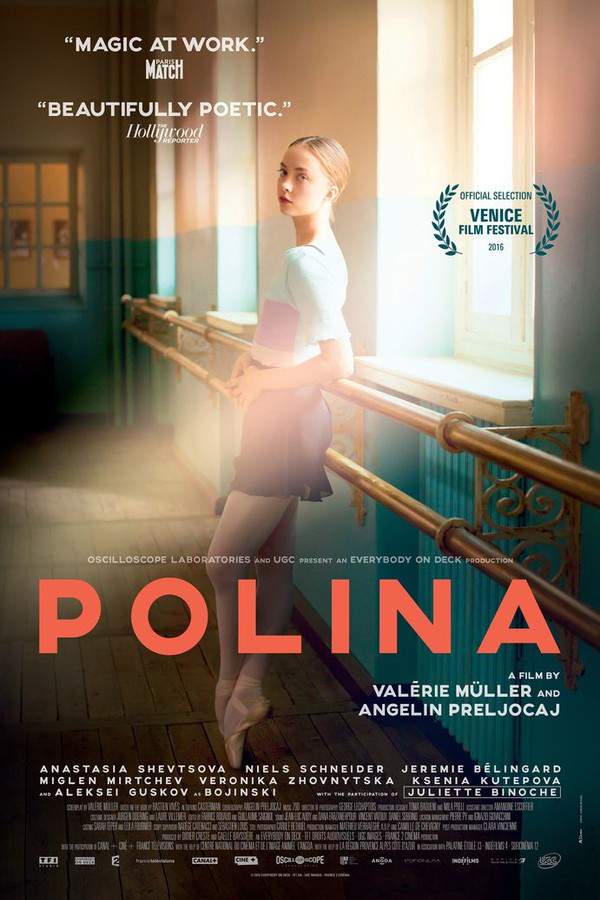
Polina (2017) movie poster

Characters & Themes

Polina (2017) Characters, Setting & Themes Explained

Release, runtime and language
2017 · 108 min · French
Echo score 68
Loading streaming availability…
Directed by
Angelin Preljocaj, Valérie Müller
Starring
Juliette Binoche, Aleksei Guskov, Niels Schneider, Anastasia Shevtsova, Jeremie Belingard, Kseniya Kutepova

Driven by a desire for perfection, a young ballerina's rigorous classical dance training leads her towards a promising career at the Bolshoi Ballet. However, an unexpected encounter with contemporary dance sparks a personal and artistic crisis, challenging her established path. Ultimately, she makes a daring choice, leaving behind her former life to journey to France and explore a new creative direction. There, she grapples with finding her place and defining her artistic identity.

On this page (8)
  1. 1 Where to watch
  2. 2 Characters explained (9)
  3. 3 Where & when it takes place
  4. 4 Themes & meaning (4)
  5. 5 Character & meaning questions
  6. 6 Movie threads
  7. 7 Movies like Polina
  8. 8 Every angle
Loading streaming availability…

9 main characters · contains spoilers

Polina Characters Explained: Who Is Who

The main characters of Polina (2017), heroes and villains: what drives them, how they change over the course of the story and what each of them reveals about the film's bigger ideas.

  • Polina (Anastasia Shevtsova)

    A talented but conflicted dancer who wrestles with the rigidity of classical ballet and her own urge to express freely. Polina's journey is defined by resilience, impulsive decisions, and a longing for belonging through dance.

    • 💃 Protagonist
    • 🎯 Determined
    • 🧠 Reflective
  • Bojinski

    played by Aleksei Guskov

    The head teacher and choreographer whose exacting standards push Polina to her limits. He embodies the pressure of elite training and the cost of artistic perfection.

    • 🎭 Authority
    • 🎯 Demanding
    • 🧊 Stoic
  • Adrien

    played by Niels Schneider

    Polina's boyfriend, a fellow dancer who shares her dream but is drawn into the complications of touring and romance. His choices impact Polina's confidence and path.

    • 💑 Relationship
    • 🌟 Ambition
    • 🔄 Complication
  • Liria

    played by Juliette Binoche

    The choreographer or figure who rejects Polina's emotional readiness, representing the gatekeeping in contemporary dance.

    • 🎭 Gatekeeper
    • 🧭 Artistic vision
    • 👁️‍🗨️ Insight
  • Sonia

    played by Kseniya Kutepova

    Polina's understudy who seizes an opportunity, embodying jealousy and upheaval within a company setting.

    • ⚡ Rivalry
    • 🩰 Aspiration
    • 🕰️ Change
  • Karl

    played by Miglen Mirtchev

    A dancer who teaches improv and helps Polina reconnect with joy in movement, representing second chances and collaboration.

    • 🤝 Collaboration
    • 🕺 Improvisation
    • 🎨 Creative
  • Polina's father

    Her father’s death marks a turning point, reminding Polina of her family’s dream and the price of pursuing art.

    • 🕊️ Loss
    • 👨‍👧 Family
    • 💪 Resolve
  • Polina's mother

    Her mother influences her sense of duty to live up to her father’s dream, underscoring themes of parental pressure.

    • 👩‍👧 Family
    • 🎭 Duty
    • 💭 Reflection
  • Programmer

    A figure who books Polina and Karl into the Montpellier Festival, representing the gatekeepers who identify artistic potential.

    • 🎟️ Gatekeeper
    • 🎯 Opportunity
    • 🌐 Festival

Last updated: October 03, 2025 at 19:45

Was this helpful?

Setting

Where and When Does Polina Take Place?

The setting of Polina (2017): the year and time period, the places and locations, and how they shape the characters, the mood and the tension of the story.

Time period

Location

Moscow, Aix-en-Provence, Antwerpen, Montpellier

Polina's story spans across Moscow, Aix-en-Provence, Antwerpen, and Montpellier, tracing her evolution from strict classical training to contemporary dance exploration. Moscow anchors the narrative in the Bolshoi's rigorous discipline and prestige. Aix-en-Provence introduces a freer, modern-dance sensibility encountered at a festival, challenging Polina's preconceptions. Antwerpen and Montpellier present the harsh realities of a dancer's life, including auditions, relationships, and a final festival moment that tests her resolve.

  • 🎭 Ballet hubs
  • 🗺️ City hopping
  • 🏛️ Dance culture
  • 🎬 Film setting

Last updated: October 03, 2025 at 19:45

Was this helpful?

4 major themes

Polina Meaning: Themes & Message Explained

What is Polina (2017) really about? The emotional, social and philosophical themes the film keeps returning to, its symbolism and the message beneath the surface.

  • Self-Discovery

    Polina’s journey is as much about discovering who she is as a dancer as it is about mastering steps. The strict expectations of classical ballet collide with her instinct to express freely. The film follows her attempts to reconcile technique with personal expression, revealing how identity drives artistic choice.

  • Ambition and Pressure

    Polina faces the demanding, sometimes punitive, environment of elite training. Injuries, replacements, and criticism test her resilience and threaten to derail her ambitions. The tension between dedication to craft and emotional well-being is a constant undercurrent.

  • Journey and Belonging

    Her travels across Europe expose her to new forms of dance and new communities, yet leave her homeless at times. She searches for a place where art and life align, learning to reinvent herself after setbacks. The story frames dance as both a path to belonging and a solitary pursuit.

  • Artistic Expression

    The narrative contrasts classical choreography with modern dance, pushing Polina to choreograph with a partner and to embrace collaboration. The final performance at the Montpellier Festival symbolizes a synthesis of training, experimentation, and personal growth. Dance is shown as a language through which Polina processes loss, love, and hope.

Last updated: October 03, 2025 at 19:45

Was this helpful?

Character & theme questions

Polina Characters & Meaning: Your Questions Answered

The questions people ask about Polina (2017): who the characters really are, their relationships, what the symbols mean, where it takes place and what the movie is really about. Each answer contains spoilers.

Q1

Where is Polina set?

The film unfolds across four European cities: Moscow, where Polina trains at the prestigious Bolshoi Ballet; Aix-en-Provence, where she encounters contemporary dance; and Antwerpen and Montpellier, where she navigates the practical challenges of a dancer's life while seeking artistic renewal.

  • moscow
  • aix-en-provence
  • antwerpen
  • montpellier
  • bolshoi
  • setting
  • cities
Q2

What is Moscow's role in Polina's story?

Moscow represents the foundation of Polina's classical training and the demanding world of elite ballet. The Bolshoi Ballet symbolizes both opportunity and rigid discipline, establishing the constraints she later seeks to escape.

  • moscow
  • bolshoi
  • classical ballet
  • training
  • russia
Q3

What are the main themes in Polina?

Polina explores self-discovery through artistic upheaval, the tension between ambition and personal well-being, the search for belonging across different dance communities, and the contrast between classical technique and contemporary expression. The film examines what it means to define one's own artistic identity.

  • self-discovery
  • ambition
  • belonging
  • artistic expression
  • identity
  • dance
Q4

What does Polina say about self-discovery?

Polina's journey reveals that self-discovery in art requires questioning established paths. Her departure from classical ballet and exploration of contemporary dance demonstrates that artistic identity emerges from reconciling technical mastery with personal expression rather than simply following tradition.

  • self-discovery
  • identity
  • artistic choice
  • personal expression
Q5

How does the film contrast classical and contemporary dance?

The film presents classical ballet as demanding, precise, and emotionally restrained, while contemporary dance becomes a vehicle for personal freedom and emotional release. This contrast drives Polina's artistic crisis and ultimately leads her to synthesize both forms in her own choreography.

  • classical ballet
  • contemporary dance
  • choreography
  • artistic expression
Q6

What does Polina say about the cost of pursuing dance?

The film depicts the physical and emotional toll of elite dance: injuries, being replaced, criticism from mentors, and the isolation that comes with dedicating one's life to art. Polina's father's death reminds her of the family's sacrificed dreams, underscoring the theme that artistic pursuit demands profound personal sacrifice.

  • sacrifice
  • injury
  • pressure
  • dedication
  • artistic pursuit
  • dancer life
Q7

Who is Polina as a character?

Polina is a talented but conflicted Russian ballerina portrayed by Anastasia Shevtsova. Throughout the film, she wrestles with the rigidity of classical ballet against her urge to express herself freely. Her journey is defined by resilience, impulsive choices, and a deep longing to find belonging through dance.

  • polina
  • ballerina
  • protagonist
  • dancer
  • character
  • russia
Q8

Who is Bojinski and what role does he play?

Bojinski, played by Aleksei Guskov, is the head teacher and choreographer at the Bolshoi Ballet. He represents the demanding, sometimes punitive environment of elite training, pushing Polina to her limits while embodying the pressure and cost of artistic perfection.

  • bojinski
  • mentor
  • teacher
  • choreographer
  • bolshoi
  • elite training
Q9

Who is Liria in Polina?

Liria, portrayed by Juliette Binoche, is a choreographer in the contemporary dance world who represents the gatekeeping in modern dance. She rejects Polina's emotional readiness, highlighting the challenges dancers face when transitioning between different artistic worlds.

  • liria
  • juliette binoche
  • choreographer
  • contemporary dance
  • gatekeeping
Q10

Who is Karl and how does he help Polina?

Karl, played by Miglen Mirtchev, is a dancer who teaches improvisation and helps Polina reconnect with the joy of movement. He represents second chances and collaboration, ultimately performing with her at the Montpellier Festival.

  • karl
  • improv
  • dance teacher
  • collaboration
  • montpellier festival
Q11

How do the different cities reflect Polina's artistic evolution?

Each city represents a stage in Polina's development: Moscow signifies rigorous classical discipline, Aix-en-Provence introduces the liberating yet challenging world of contemporary dance, and Antwerpen and Montpellier represent the harsh realities of making it as a dancer, auditions, relationships, homelessness, culminating in her synthesis of both styles.

  • european journey
  • cities
  • artistic evolution
  • montpellier festival
Q12

What does Polina say about finding your own artistic voice?

The film argues that artistic identity emerges from experimentation and reinvention rather than rigid adherence to tradition. Polina's journey, from classical training through rejection to her final Montpellier performance, shows that true artistic expression requires blending technical foundation with personal risk and emotional honesty.

  • artistic identity
  • voice
  • choreography
  • synthesis
  • personal expression
  • artistic growth

Movie threads

More Movies Like Polina, by Mood & Story

Curated lists built around what makes Polina tick: the same mood, the same kind of story or the same emotional payoff. Each list explains why these movies belong together.

Artistic Journeys of Self-Discovery like in Polina

Stories of artists who must redefine their craft to find their true voice. If you enjoyed Polina, you'll appreciate these movies about artists and performers on transformative journeys. Discover similar drama stories where characters undergo a creative crisis, leave their old lives behind, and struggle to build a new artistic identity from the ground up.

  • introspective
  • hopeful
  • inspiring
  • arduous
  • solitary
  • melancholic
  • Tone: hopeful, introspective
  • Pacing: steady, character-driven
Why these movies?

The story pattern: Stories in this thread typically follow a linear progression from mastery in a traditional form to a period of disillusionment and crisis. The protagonist then embarks on a physical and emotional journey, often involving a mentor or a new environment, to rebuild their artistry on their own terms, culminating in a moment of self-realization.

Why they belong together: These movies are grouped together because they share a focus on the creative process as a path to self-knowledge. They balance the melancholy of sacrifice with the hopefulness of rebirth, featuring steady-paced narratives with medium emotional weight that are driven by character development rather than external plot.
Hopeful Transformations Through Sacrifice like in Polina

Characters who endure great personal loss to emerge transformed and hopeful. Find movies like Polina that explore the theme of hopeful rebirth after significant sacrifice. These drama films follow protagonists who leave everything familiar behind, endure a period of struggle and isolation, and ultimately find a renewed sense of purpose and happiness.

  • hopeful
  • bittersweet
  • solitary
  • arduous
  • inspiring
  • melancholic
  • Tone: bittersweet, hopeful
  • Pacing: steady, linear
Why these movies?

The story pattern: The narrative pattern involves a decisive break from the protagonist's past, leading to a challenging transitional phase marked by failure, loneliness, and doubt. This 'dark night of the soul' is not punitive but transformative, forcing the character to shed external validation and discover inner strength, culminating in a happy or hopeful resolution that feels earned.

Why they belong together: These films share a specific emotional arc: the bittersweet pain of leaving things behind is balanced by the hopeful promise of a new future. They maintain a steady pace to chronicle the transformation authentically and carry a medium emotional weight, making the hopeful ending feel genuinely satisfying and not saccharine.

If you liked this

Movies Like Polina

Similar movies to Polina: the same genre, themes or kind of story. Each one comes with its own plot summary, timeline and ending explained.

Browse all movie summaries

Every angle

Polina (2017) Explained: Plot, Timeline & Characters

Everything about Polina in one place: what happens in the plot summary, the timeline in chronological order, the characters and meaning and a spoiler-free summary. What's After the Movie adds the cast, box office and post-credit scenes.

Coming soon on iOS and Android

The Plot Explained Movie Summary App

Plot summaries, endings explained and timelines on your phone. Catch up on any movie in minutes, save your favorites and never miss a twist again.

Be the first to know when we launch. Your email stays private, always.

Learn more about the app