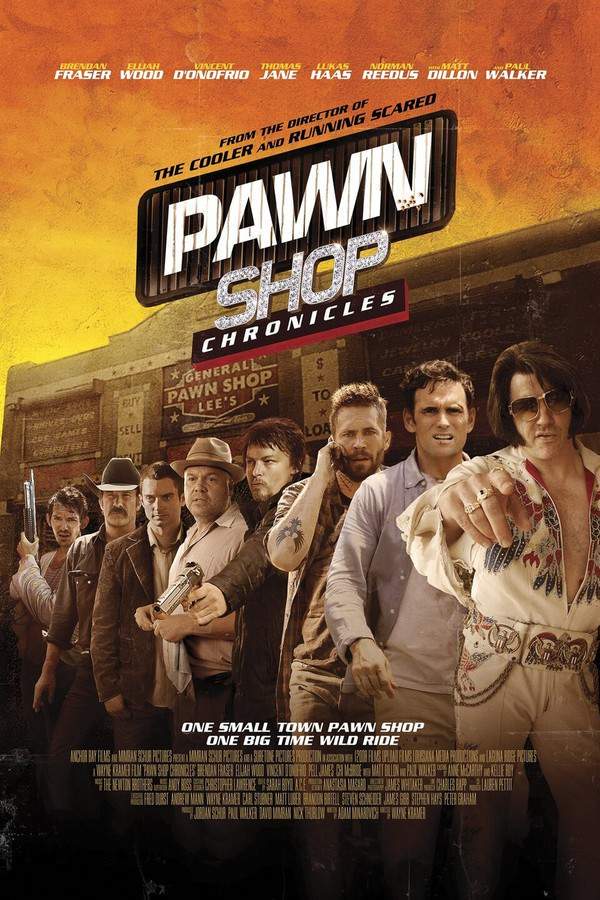
Pawn Shop Chronicles stitches together three interwoven stories centered around a humble pawn shop and the items that pass through its counter, each trinket stirring up trouble, memory, and moral darkness. The film keeps a grounded, procedural tone even as it drifts between grit and warped whimsy, showing how desperate choices ripple outward and pull strangers into shared danger.
In the first thread, a man named Vernon pawns his shotgun for a mere twenty dollars, and the day quickly spirals into a chain of misjudgments and violent miscalculations. Vernon’s decision to part with the weapon sets off a cascade: a brutal, mistaken confrontation with a rival, Raw Dog, who believes Vernon owes him money and won’t rest until he has a gun in hand. A tense confrontation in a field precedes a chaotic accident in which Randy—who arrives amid the chaos—plows into Vernon with his truck, leaving him for dead and intensifying the sense that the town’s violence is both casual and fatal. Raw Dog and Randy then seek a weapon to threaten Stanley, the local drug dealer, but their attempts around Lamar’s shop fail, and their momentum is stalled by a roadside encounter with Richard and Cyndi that nearly sends them off into the woods. A hunter’s bow becomes a makeshift instrument of threat, heightening the precariousness of the characters’ fates. The narrative then pivots to a sudden arrival: The Man’s car appears seemingly out of nowhere, and Vernon is armed with a fresh shotgun. The attempt to rob Stanley escalates into a blazing, fatal gunfight when Vernon and the others reach Stanley’s domain. The pharmacy of catastrophe explodes in a chemical blaze—Stanley’s drug lab erupts—killing Stanley, Raw Dog, Randy, and Vernon in a destructive, almost mythic end to the chapter. The lovers of chaos, chance, and sudden violence are left to reckon with the debris of what was supposed to be a simple pawned item.
The second thread turns inward toward the pawnshop’s owner, Alton, who becomes a focal point in a web of coercion, deception, and vengeance. Alton is chased by a looming black truck after a gesture as small as a flick of a finger—he flips the driver off—and to avoid further trouble, he contemplates selling his car. The plot tightens around Richard, a schemer who tries to pawn his fiancée Sandy’s wedding ring, claiming he has lost his wallet. Yet his plan is disrupted when he spots his former wife Cyndi’s wedding ring in the pawnshop’s display case, triggering a cascade of coercion and manipulation. Richard insinuates that Cyndi was kidnapped years earlier, then pressures Alton for information that would allow him to swap Sandy’s ring for Cyndi’s, along with Alton’s car and a path to the truth behind who gave Alton Cyndi’s ring. This leads to the startling revelation that JJ holds a key to the mystery and connections stretch toward Johnny Shaw, a figure tied to horrific acts of control. Richard tortures JJ at his restaurant to uncover the truth, and JJ’s uncle admits that he won Cyndi’s ring in a dispute with Johnny Shaw. A confrontation follows, culminating in Richard forcing a confession from Johnny, who is exposed as a sexual predator who kidnaps and enslaves women. Richard sems to kill Johnny, but the truth of the victims remains; he frees many of Johnny’s captives, who appear traumatized and fragile as they wander the town in withdrawal and fear. As Richard drives away with Cyndi, the sense of twisted justice darkens: Cyndi, caught in a dangerous Stockholm-syndrome bond, fatally stabs Richard, and the car crash that follows claims both their lives. The consequences of manipulation and control are laid bare, with the pawnshop acting as a vault of secrets that explode into brutal truth.
The third thread follows Ricky, a down-on-his-luck Elvis impersonator hoping for a big break at the fair. His fortunes hinge on a small, earned sacrifice: selling his authentic gold Elvis medallion to Alton to fund gas for the road to the gig. The day’s decisions quickly become a carnival of choice and consequence as Ricky faces a bizarre crossroad: he must pick between two barber shops—Doc’s and Cooks—as a crowd gathers to witness his hesitation about an uneven sideburn. Ricky first chooses Doc’s, but Doc’s act worsens his haircut, forcing him to switch to Cooks. The choice triggers a riot outside the two shops, with Cook cutting the back of Ricky’s neck after learning Ricky has already visited Doc’s, and Ricky retreats into the evening’s confusion. The show approaches, and the mood shifts to a dreamlike turn: an old blues-playing musician in a liquor store catches Ricky’s ear as Virgil, a street preacher, tempts him with a Faustian bargain—offer his soul in exchange for the fame that could resurrect his career. Ricky initially resists but eventually sells his soul as the fair crowd cheers, and his performance suddenly soars. When the show ends, the spectacle continues to expand as Johnny’s victims reappear draped in American flags and become part of the act, transforming the stage into a surreal procession of memory and retribution. A new contract for national gigs seems to promise a bright future for Ricky, but Johnny—now appearing as a corpse—reappears to reclaim his victims, signaling the perilous cost of the bargain. The film closes with a brutal coda: Alton is beaten by the black-truck driver who hounded him earlier, and JJ reappears with a small act of rescue, having recovered Cyndi’s ring and trading it back to Alton for a modest sum of money, a final reminder that the pawnshop’s items carry weight beyond their monetary value.
Throughout, the film treats objects as vessels of human history—each item at the pawnshop a catalyst for desire, danger, regret, or redemption. The three stories fold into one another through coincidence and consequence, painting a portrait of a town where people bend, break, and sometimes heal under the pressure of poverty, temptation, and the hope of a second chance. The tone remains restrained and observational, allowing the violence to speak for itself while the film’s quirks—its odd sailors of fate, its almost parable-like set pieces—give the narrative a mythic edge. By the end, the pawnshop stands as a quiet witness to how fragile lives are—how quickly a single choice about a simple item can pivot a person’s fate toward catastrophe or toward a hard-won, fragile redemption.