Year: 2015
Runtime: 126 min
Language: Korean
Director: Youn Jk
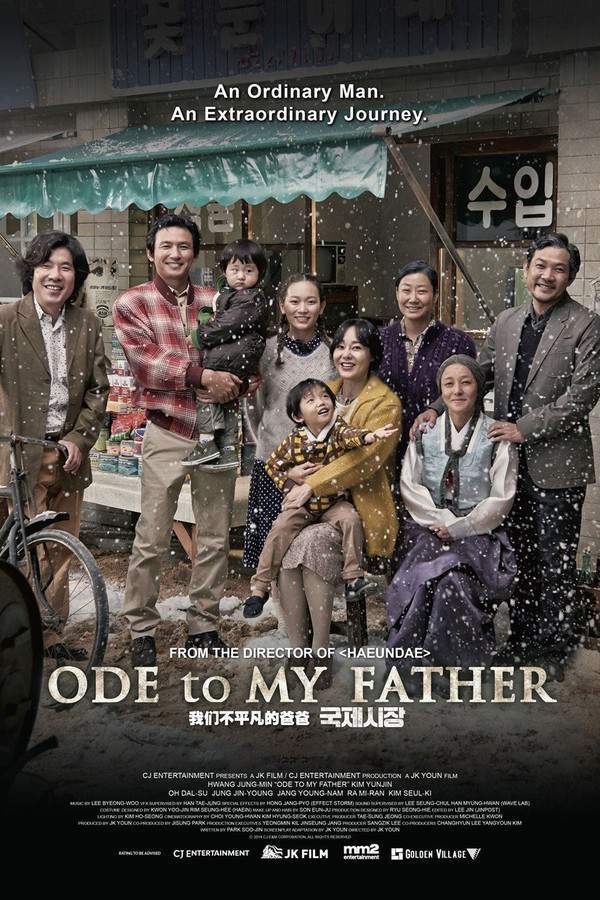
This moving drama chronicles Duk-soo’s difficult life, beginning with his childhood during the Korean War and following him as he strives to provide for his family. Driven by a desire to understand his father's past and the sacrifices made for their survival, Duk-soo embarks on a journey of discovery, confronting painful memories and searching for a deeper connection to his heritage. It's a story of resilience, family, and the enduring power of love across generations.
Warning: spoilers below!
Haven’t seen Ode to My Father yet? This summary contains major spoilers. Bookmark the page, watch the movie, and come back for the full breakdown. If you're ready, scroll on and relive the story!
Read the complete plot breakdown of Ode to My Father (2015), including all key story events, major twists, and the ending explained in detail. Discover what really happened—and what it all means.
As the Hungnam Evacuation of 1950 unfolds against the chaotic backdrop of the Korean War, a young boy named Deok-soo faces a life-altering tragedy with the disappearance of his sister, Mak-soon. His father, consumed by desperation to find her, makes the agonizing choice to entrust his family’s fate to Deok-soo, assigning him the crucial task of guiding his mother and two younger siblings to safety in Busan.
With the weight of such responsibility resting heavily on his shoulders, Deok-soo becomes the primary provider for his family from a very young age, taking on numerous odd jobs just to make ends meet. As time goes on, the financial strain compels Deok-soo to embark on a dangerous journey to Germany alongside his loyal friend Dal-goo, where they work as Gastarbeiter in the hazardous coal mines of Hamborn.
Amidst the relentless challenges of their labor, Deok-soo finds comfort and love with Yeong-ja, a nurse whose warmth ignites a passionate romance between them, illuminating even their darkest days. However, fate intervenes when Deok-soo survives a near-fatal mining accident and must return to Korea due to the expiration of his visa. Reuniting with Yeong-ja, they begin to construct a new life together, filled with hopes and dreams.
Their modest wedding is quickly followed by the joyful arrival of two sons, bringing a renewed sense of purpose to their lives. Yet, tragedy strikes when Deok-soo’s aunt passes away, prompting a series of events that dramatically change his trajectory. When his uncle sells their family store, the opportunity to fulfill his childhood aspiration of becoming a sea captain slips through his fingers, leading Deok-soo to enlist in the Korean army during the turbulent 1970s.
While serving in the war-torn landscapes of Vietnam, he is caught in the struggle between his duties as a soldier and the needs of his family back home. In the midst of chaos, Deok-soo learns the profound nature of sacrifice as he returns to Korea, bearing the physical and emotional scars of combat. With a leg injured from enemy fire, he reclaims his role at the family store alongside Yeong-ja, where they strive to forge a hopeful future together.
As we reach 1983, the major broadcast stations in the nation touching hearts with stories of reunification from the Korean War draw Deok-soo into an unexpected opportunity: to star in one of these uplifting programs, spurred by the wishes of an elderly man from his hometown who claims to be his long-lost father. This twist of fate opens the door for Deok-soo to rediscover his familial connections, as he and Mak-soon come to learn about their biological bond. An American woman adopted during the war unwittingly holds the key to the family’s past; despite the barriers of language — with Deok-soo unable to speak English and Mak-soon struggling with Korean — they achieve a heartwarming reunion when she returns to Korea.
However, life’s unfortunate timing strikes again when Deok-soo’s mother passes away shortly thereafter, deepening the sorrow and complexity of his journey. Fast forward to the present, Deok-soo, now an elderly figure, faces the emotional turmoil of potentially leaving behind the family store that has been in his hands for decades, grappling with the memories and promises made long ago. As he prepares to part with this significant piece of his life, he confides in his wife about the likelihood that his father may no longer be alive to return home. This poignant farewell serves as a bittersweet reminder of the transient nature of life, leaving Deok-soo to confront the impermanence of memories and the fleeting bonds we share with those we love.
Last Updated: November 18, 2024 at 20:12
Discover curated groups of movies connected by mood, themes, and story style. Browse collections built around emotion, atmosphere, and narrative focus to easily find films that match what you feel like watching right now.
Sweeping stories that chart the lives and sacrifices of a family over decades.If you liked the multi-generational scope of Ode to My Father, you'll appreciate these movies that chart a family's journey through history. Discover similar Korean drama stories and other epic family narratives filled with duty, sacrifice, and the enduring bonds that time cannot break.
Stories in this thread typically unfold chronologically, spanning several decades to show the full arc of a family's history. They often use historical events as a backdrop for personal struggles, focusing on the sacrifices parents make for their children and how those choices echo through time.
Movies are grouped here for their shared focus on the intergenerational family unit as the central subject, their use of a long timeframe, and their exploration of themes like heritage, duty, and the cost of providing a better future for the next generation.
Character-driven dramas about looking back on a life of sacrifice and memory.Find movies similar to Ode to My Father that explore a character's reflective journey through their own past. These poignant dramas share a melancholic tone and a focus on memory, sacrifice, and the bittersweet feeling of evaluating one's life and the choices that shaped it.
The narrative pattern involves a character, often in their later years, revisiting pivotal moments from their youth and adulthood. The story is driven by memory and introspection, weaving past and present to uncover the emotional truth of a lifetime of experiences, frequently centered on themes of survival and duty.
This thread groups movies that share a specific emotional mix: a melancholic tone, a steady, reflective pace, and a narrative structure built around memory. They all deliver a heavy emotional weight and conclude with a bittersweet feeling, making the viewer contemplate the complexity of a life fully lived.
Don't stop at just watching — explore Ode to My Father in full detail. From the complete plot summary and scene-by-scene timeline to character breakdowns, thematic analysis, and a deep dive into the ending — every page helps you truly understand what Ode to My Father is all about. Plus, discover what's next after the movie.
Track the full timeline of Ode to My Father with every major event arranged chronologically. Perfect for decoding non-linear storytelling, flashbacks, or parallel narratives with a clear scene-by-scene breakdown.
Discover the characters, locations, and core themes that shape Ode to My Father. Get insights into symbolic elements, setting significance, and deeper narrative meaning — ideal for thematic analysis and movie breakdowns.
Get a quick, spoiler-free overview of Ode to My Father that covers the main plot points and key details without revealing any major twists or spoilers. Perfect for those who want to know what to expect before diving in.
Visit What's After the Movie to explore more about Ode to My Father: box office results, cast and crew info, production details, post-credit scenes, and external links — all in one place for movie fans and researchers.