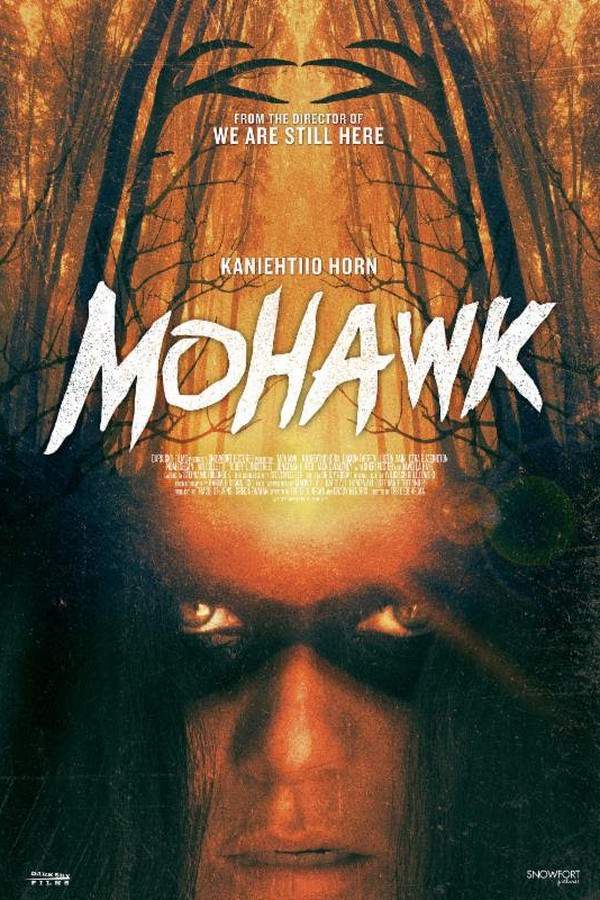
Late one night in 1814, a young Mohawk woman named Okwaho or "Oak" Kaniehtiio Horn and one of her lovers, Calvin Justin Rain, clash with her mother Wentahawi Sheri Foster over whether their neutral tribe, who are being slaughtered by new Americans, should take part in the War of 1812. The family tension is sharp, weighing tradition against the urge to defend their people, and Oak tries to hold a line between stubborn lineage and the fear for unborn life she carries. The atmosphere is tense, the forest around them murky with night sounds, and the question of retaliation hangs over everything like a falling shadow.
Her two lovers — a Mohawk warrior named Calvin Justin Rain and a British soldier named Joshua Eamon Farren — push for retaliation, insisting that delay only invites more slaughter. The debate spirals until Calvin slips away later that same night and lights a nearby American encampment on fire, killing 22 sleeping soldiers. The blaze becomes a brutal spark that sets off a deadly chain of vendettas, turning a quiet frontier night into a pursuit of revenge across the dark, moonlit woods.
Six soldiers and their civilian translator Yancy Noah Segan escape the fire and, wounded by grief and anger, set out to track Oak and the men, driven by a blood feud of their own making. A skirmish breaks out, and in its wake, Wentahawi falls, along with the American Commander, Colonel Charles Hawkes Jack Gwaltney. The loss pushes the Americans into a harsher, more brutal response and plants the seed for a ruthless escalation of violence. The force is led by the brutal Captain Hezekiah Holt Ezra Buzzington, whose hunger for retribution blinds him to the cost of his orders and darkens the mission with a self-serving urgency.
Chasing Oak and the two men, the Americans capture, torture, and kill Calvin, exacting a heavy price in the process, including the death of Holt’s own son Myles Ian Colletti. The pursuit becomes personal and uncomfortably intimate, as the war’s machinery grinds away at the human costs that fuel it. When Oak and Joshua are finally captured at a desolate French-Canadian mission (where Holt and his men have already murdered Oak’s uncle and cousins), Holt slays Joshua with his sabre and shoots Oak in the chest, leaving her for dead as the group retreats to their base at Fort George.
Oak survives, though, and she does something astonishing: she shaves her head into a bloody Mohawk and fashions armor from the remains of a pregnant deer and its unborn fawn. With nothing but grit and tenacity, she becomes a solitary force in the forest, stalking the last three Americans — Holt, Yancy, and Private Lachlan Allsopp Jonathan Huber — through the growing darkness. She defeats Yancy and Allsopp in grisly, quiet confrontations before finally revealing herself to Holt. The officer grows disoriented and, in a dreamlike, almost supernatural moment, finds himself back at his burnt-out camp, confronted by the consequences of his own brutal decisions. Oak, having discarded pistol and sword in the forest, engages Holt in a savage hand-to-hand struggle, and she emerges victorious by driving him onto the charred remains of a tree, impaling him through the heart.
Walked away from the burning scene, Oak is left battered and scarred, yet unbroken. As she trudges away from Holt’s body, a Mohawk family witnesses the moment and—almost reverently—sees in her a figure of unparalleled strength and ancestral power. The finale leaves a stark, haunting impression: survival sometimes demands a ferocity that reshapes not only the victim, but the hunter as well, and Oak’s transformation becomes a powerful, mythic moment that resonates long after the fire is gone.