Year: 1996
Runtime: 88 mins
Language: Spanish
Director: Gustavo Mosquera R.
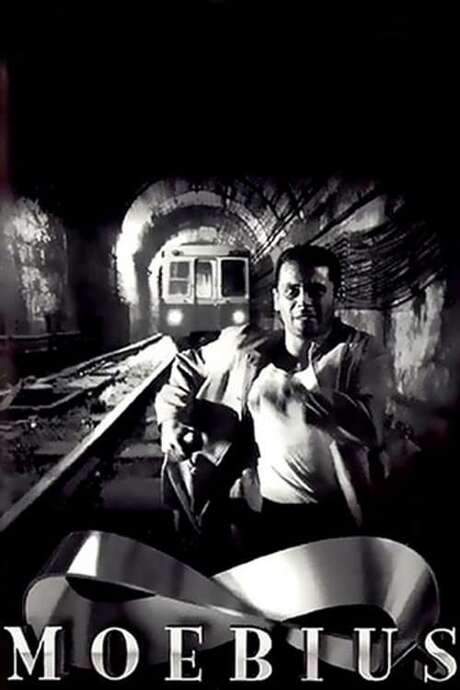
A disquieting metaphor of recent stories, fears and oblivion unfolds beneath Buenos Aires. When a subway train carrying thirty passengers vanishes in the sprawling, maze‑like tunnels, officials enlist topographer Daniel Pratt to locate it. The labyrinth’s size forces Pratt to seek his missing mentor, Hugo Mistein, whose own disappearance adds mystery.
Warning: spoilers below!
Haven’t seen Moebius yet? This summary contains major spoilers. Bookmark the page, watch the movie, and come back for the full breakdown. If you're ready, scroll on and relive the story!
Trace every key event in Moebius (1996) with our detailed, chronological timeline. Perfect for unpacking nonlinear stories, spotting hidden connections, and understanding how each scene builds toward the film’s climax. Whether you're revisiting or decoding for the first time, this timeline gives you the full picture.
Last updated: October 09, 2025 at 09:23
Find frequently asked questions about the Moebius (1996) timeline, including chronological order, nonlinear jumps, cause-and-effect links, and scene sequence clarifications. This timeline FAQ helps explain when key events happen, how moments connect, and why the story unfolds in that specific order.
The engineering firm deliberately sent Daniel Pratt as a calculated move to avoid accountability. Since the disappearance could become a public scandal, the firm likely chose an inexperienced investigator hoping he would fail or produce inconclusive results. This allowed the company to appear cooperative while protecting senior engineers from potential professional consequences if the investigation went wrong.
Pratt theorizes that the underground network's construction has twisted the tunnels into a Möbius strip, a one-sided surface. Under specific conditions, this geometric anomaly could channel the missing train UM-86 into another dimension or temporal loop. The theory suggests the train still exists within the network but in a folded space that makes it undetectable to conventional search methods.
When Pratt finally locates UM-86, he finds all 30 passengers in a tranquil trance, apparently unharmed but unaware of their circumstances. They are described as being in a peaceful state rather than panicked or harmed. By the next day, when the train reappears at the station, the passengers are gone entirely, leaving behind only an empty train.
Mistein had been secretly studying the tunnel network's anomalous geometry for years. He deliberately positioned himself on UM-86 to prove, or perhaps complete, Pratt's theory. When Pratt discovers him in the conductor's cabin, Mistein confirms the theory's validity through direct observation of whatever lies beyond the Möbius fold in the network.
Pratt enters the tunnels, boards what appears to be UM-86, and finds Mistein waiting in the conductor's cabin. The film never shows Pratt's physical return. When the train reappears the next day, it is empty with only Pratt's journal remaining. Whether Pratt also crossed into the other dimension, was absorbed into the network, or chose to stay is deliberately left ambiguous.
The train materializes at a station the following day, completely empty of passengers and Pratt. The only item left behind is Pratt's journal in the conductor's cabin, documenting his theory. This suggests that whatever dimensional or temporal fold swallowed the train eventually released it, but by then both the passengers and Pratt had been drawn deeper into whatever lies beyond the network's geometry.
The ending reveals that UM-86 was not an isolated incident. The phone call reporting another missing train suggests the phenomenon is cyclical and ongoing. The Buenos Aires Underground network, with its Möbius-like geometry, continues to claim trains. This reinforces the film's theme that the mystery is unsolvable and the pattern will repeat indefinitely.
The film establishes early that the search has found no trace of UM-86, implying something beyond normal detection.
Borges Station is deliberately named after Argentine writer Jorge Luis Borges, whose work often explores infinite libraries, labyrinths, and reality-bending concepts. This naming is the director's intentional reference connecting the film's geometric mystery to Borges's themes of impossible spaces and recursive structures, directly echoing the Möbius strip concept.
The committee rejected Pratt's theory because it was unconventional and threatened their understanding of the tunnel system. Suggesting the network had warped into a non-Euclidean shape implied the engineering and construction were fundamentally flawed. Additionally, the officials were under pressure to contain the incident quietly, making them unwilling to consider explanations that might invite further scrutiny.
When Pratt enters the conductor's cabin of what he believes is UM-86, he discovers his former professor Hugo Mistein sitting in the chair, alive and waiting. Mistein confirms Pratt's theory is correct and explains what he has witnessed in the other dimension or state the train entered. The two engage in philosophical dialogue about the nature of reality and the network.
Discover curated groups of movies connected by mood, themes, and story style. Browse collections built around emotion, atmosphere, and narrative focus to easily find films that match what you feel like watching right now.
Sci-fi stories where theoretical concepts unlock profound, unsettling urban mysteries.For viewers who enjoyed the methodical mystery of Moebius, this thread gathers movies like it that explore complex theories and scientific inquiry within an urban or societal puzzle. These similar sci-fi stories often feature ambiguous endings and a tense, intellectual atmosphere.
Stories in this thread typically follow a protagonist, often a specialist or academic, who is called upon to investigate a seemingly impossible phenomenon. The plot unfolds through research, deduction, and the application of non-traditional logic, with the solution challenging the characters' and audience's perception of reality.
These movies are grouped by their focus on a cerebral, scientific approach to a central mystery. They share a tone of intellectual dread, a slow-to-steady pacing that allows for contemplation, and narratives that prioritize complex ideas over straightforward action, often resulting in ambiguous or unsettling conclusions.

Stories where sprawling cities conceal dark secrets and disorienting spaces.If you liked the ominous subway labyrinth and urban isolation in Moebius, explore these movies with a similar feel. These films use dense cityscapes and subterranean environments to create a disquieting, claustrophobic mood where the location is central to the mystery.
The narrative pattern involves characters being drawn into the hidden, often decaying, underbelly of a city. Their journey is as much about physical navigation through confined, confusing spaces as it is about solving a mystery, with the environment actively contributing to the psychological tension and sense of isolation.
These films are united by their use of an oppressive, labyrinthine urban environment to generate a specific mood. They share a disquieting and ominous atmosphere, a slow-burning pacing that builds dread, and a focus on the psychological impact of navigating claustrophobic, man-made spaces.
Don't stop at just watching - explore Moebius in full detail. From the complete plot summary and scene-by-scene timeline to character breakdowns, thematic analysis, and a deep dive into the ending - every page helps you truly understand what Moebius is all about. Plus, discover what's next after the movie.
Read a complete plot summary of Moebius, including all key story points, character arcs, and turning points. This in-depth recap is ideal for understanding the narrative structure or reviewing what happened in the movie.
Discover the characters, locations, and core themes that shape Moebius. Get insights into symbolic elements, setting significance, and deeper narrative meaning - ideal for thematic analysis and movie breakdowns.
Discover movies like Moebius that share similar genres, themes, and storytelling elements. Whether you’re drawn to the atmosphere, character arcs, or plot structure, these curated recommendations will help you explore more films you’ll love.
Moebius (1996) Plot Summary & Movie Recap
Moebius (1996) Scene-by-Scene Movie Timeline
Moebius (1996) Spoiler-Free Summary & Key Flow
Movies Like Moebius – Similar Titles You’ll Enjoy
Cities of Last Things (2019) Spoiler-Packed Plot Recap
Metropolis (2002) Full Movie Breakdown
Kafka (1991) Film Overview & Timeline
Metropia (2010) Spoiler-Packed Plot Recap
Cube (1998) Detailed Story Recap
Mute (2018) Story Summary & Characters
Altered States of Plaine (2014) Spoiler-Packed Plot Recap
Man Underground (2017) Full Summary & Key Details
Meteo (1990) Spoiler-Packed Plot Recap
Subway to the Stars (1987) Complete Plot Breakdown
Magnética (2020) Ending Explained & Film Insights
Existir (2021) Detailed Story Recap
Mostro (2021) Spoiler-Packed Plot Recap
Galaxy (1967) Story Summary & Characters
Metropolis (1927) Film Overview & Timeline