Plot Explained Spoilers guaranteed!
Plot Explained

Browse by genre

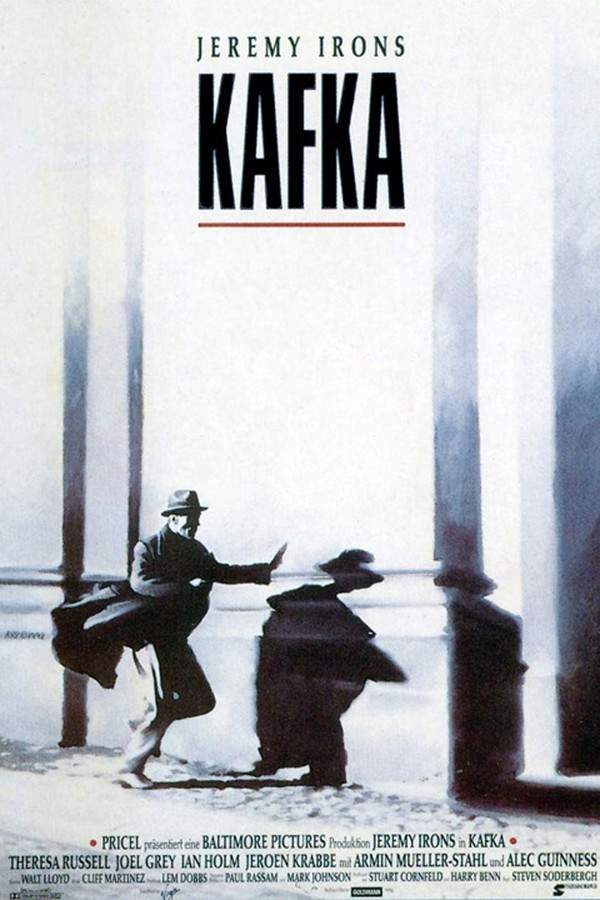
Kafka (1991) movie poster

Plot Summary

Kafka (1991) Plot Summary Explained

Release, runtime and language
1991 · 98 min · English
Directed by
Steven Soderbergh
Starring
Jeremy Irons, Ian Holm, Joel Grey, Jeroen Krabbé, Armin Mueller-Stahl, Theresa Russell

In early 20th-century Prague, a solitary insurance clerk finds himself drawn into a perplexing and unsettling situation. He is compelled to enter a mysterious, foreboding castle to investigate a cryptic matter. As he navigates the labyrinthine corridors and encounters enigmatic figures, he becomes entangled in a web of darkness and deception, struggling to uncover the truth behind the castle’s secrets.

On this page (5)
  1. 1 What happens: full plot
  2. 2 Plot questions answered
  3. 3 Movie threads
  4. 4 Movies like Kafka
  5. 5 Every angle

Full plot summary · contains spoilers

What Happens in Kafka: Full Plot Summary

The whole story of Kafka (1991) explained, from the opening scene to the final frame: every key event, every twist and what it all adds up to. Read it as a quick recap before the sequel, to check a scene you missed, or to finally understand what really happened.

In 1919 Prague, Franz Kafka leads a seemingly ordinary life as an insurance adjuster, quietly nourishing a passion for writing while his days follow a predictable routine. That quiet, methodical world is upended when a coworker is found murdered under murky, unresolved circumstances, and Kafka’s natural curiosity and sense of justice push him to seek the truth behind the death.

As he delves deeper, Kafka uncovers an underground anarchist group working in secrecy. This faction is determined to expose and dismantle a powerful, enigmatic organization that seems to pull the strings behind many of society’s most significant events. Their methods—bombings and other acts of sabotage—signal a willingness to disrupt the established order in pursuit of a greater cause. Kafka’s investigation pulls him further into this shadowy network, and he forms a bond with Gabriela Rossman, a fervent and resolute member who guides him through the group’s aims and operations.

The search for answers leads Kafka into a maze of conspiracies and unsettling truths. His path brings him to a foreboding castle that serves as the headquarters for the secret organization, a place where secrets are stored and power is exercised with terrifying efficiency. Inside the castle, Kafka encounters horrifying experiments and glimpses of the organization’s far-reaching influence over society. The building itself feels like a labyrinth, a physical manifestation of the impenetrable, oppressive control the group wields.

As Kafka infiltrates the castle and confronts the organization’s leaders and their methods, he is forced to grapple with deep questions about morality, freedom, and the nature of resistance. The narrative highly leans into themes that echo Kafka’s own literary world, blending stark reality with nightmarish, surreal elements that blur the line between what is and what could be.

In the climactic moments, Kafka faces a pivotal choice: accept his role as an unwitting hero or resist the overwhelming forces arrayed against him. The confrontation with the organization becomes a personal and philosophical reckoning, testing his courage, resolve, and belief in the possibility of change within an oppressive system. The story remains centered on the tension between individual conscience and a sprawling, powerful machinery, inviting readers to consider what it means to stand up to unseen powers and what freedom truly requires.

Last updated: October 09, 2025 at 15:43

Was this helpful?

Plot questions answered

Kafka Plot Explained: Your Questions Answered

The questions people ask most about Kafka (1991): what happens in the confusing scenes, why the characters do what they do, the twists, hidden details and what the ending means. Each answer contains spoilers.

Q1

Why does Kafka investigate his coworker's murder?

Kafka investigates the murder because he feels a natural sense of justice and curiosity that he cannot ignore. The mysterious death unsettles him deeply, and his methodical nature compels him to seek answers where others see only confusion. This investigation ultimately pulls him into the dangerous world of conspiracy and resistance.

Foreshadowing: Early scenes establish Kafka's routine life and his quiet passion for writing, hinting at his inner drive to seek truth.

  • coworker murder
  • investigation
  • justice
  • Prague
Q2

What is the secret organization operating from the castle?

The secret organization is a powerful, enigmatic group that appears to manipulate significant societal events from behind the scenes. Their headquarters are located in a foreboding castle that serves as both a physical and symbolic center of their control. Inside, they conduct horrific experiments and exercise terrifying efficiency in maintaining their influence over society.

Foreshadowing: The castle is introduced early in Kafka's investigation as a place where secrets are stored and power is exercised.

  • secret organization
  • castle
  • headquarters
  • conspiracy
Q3

What does Kafka discover inside the castle?

Inside the castle, Kafka uncovers horrifying experiments and evidence of the organization's far-reaching influence over society. The labyrinthine structure itself embodies the impenetrable and oppressive power he must confront. The discoveries reveal a chilling network that manipulates events on a broad scale, blurring the line between reality and nightmare.

Foreshadowing: The castle is described as a labyrinth from the moment Kafka's path leads him there.

  • castle experiments
  • discovery
  • oppression
  • labyrinth
Q4

What are the underground anarchists fighting against?

The underground anarchist group is dedicated to exposing and dismantling the powerful, enigmatic organization that controls significant societal events. They see this organization as an oppressive force shaping society from the shadows. Their methods include bombings and sabotage to disrupt what they perceive as a corrupt system.

Foreshadowing: The anarchists are introduced as a shadowy network working in secrecy against a larger hidden power.

  • anarchists
  • resistance
  • sabotage
  • expose organization
Q5

Why does Gabriela help Kafka enter the group?

Gabriela Rossman becomes Kafka's guide because she sees potential in him to understand and potentially join their cause. Her resolve and charisma pull him deeper into the dangerous world they inhabit. She believes Kafka's curiosity and sense of justice align with the anarchists' goals of exposing the truth.

Foreshadowing: Gabriela enters Kafka's orbit specifically as a connection to the shadowy world he is discovering.

  • Gabriela Rossman
  • guide
  • anarchist group
  • connection
Q6

What kinds of experiments does the organization perform?

The summary mentions horrifying experiments conducted within the castle, though specific details are not elaborated in the provided text. These experiments represent the organization's extreme methods of maintaining control and advancing their mysterious agenda. The horror of these experiments underscores the depth of corruption and the stakes of Kafka's investigation.

Foreshadowing: The organization's capacity for harm is hinted at from the beginning through their willingness to operate in secrecy.

  • experiments
  • horror
  • castle
  • secret methods
Q7

Does Kafka accept or resist the organization in the ending?

The ending presents Kafka with a pivotal choice: accept his role as an unwitting hero or resist the overwhelming forces arrayed against him. The story describes a personal and philosophical reckoning, testing his courage, resolve, and belief in the possibility of change. However, the outcome remains ambiguous, leaving whether he embraces or rejects the role open to interpretation.

Foreshadowing: Throughout the story, Kafka weighs his safety and moral questions against the pursuit of truth.

  • choice
  • hero
  • resistance
  • ending
  • moral dilemma
Q8

What does the castle represent in the story?

The castle serves as both a literal headquarters and a powerful symbol of the impenetrable, oppressive control the secret organization wields. Its labyrinthine corridors mirror the complex conspiracy Kafka must navigate. The building physically manifests the nightmarish bureaucracy and faceless power that defines Kafka's literary world.

Foreshadowing: The castle is introduced as a foreboding place where secrets are stored and power is exercised.

  • castle symbol
  • labyrinth
  • oppression
  • power
  • bureaucracy
Q9

How does the film blend reality with surrealism?

The narrative blends stark reality with nightmarish, surreal elements that blur the line between what is and what could be. Kafka's experiences inside the castle challenge his sense of truth, creating dreamlike sequences that invite interpretation. This blending echoes Kafka's own literary style, where oppressive bureaucracies take on nightmarish qualities.

Foreshadowing: The story notes that experiences blur the boundary between Kafka's waking life and the surreal themes of his writings.

  • surrealism
  • nightmare
  • reality
  • dream
  • Kafka style
Q10

What happens to Gabriela by the end of the film?

Gabriela's influence deepens the stakes throughout the story, as personal connections intertwine with political conflict and danger. Her bond with Kafka adds emotional weight to the mission and amplifies the risks they face together. While the summary emphasizes her importance to Kafka's journey, the specific details of her fate are not fully detailed in the provided text.

Foreshadowing: Gabriela's entry into Kafka's life is marked by her passion and resolve, making her central to the escalating danger.

  • Gabriela fate
  • romantic bond
  • danger
  • mission
Q11

What moral dilemma does Kafka face in the climax?

Kafka must decide whether to embrace his role as an unwitting hero fighting the secret organization or resist the overwhelming forces arrayed against him. This choice represents a test of his courage, ethics, and willingness to challenge opaque power. The confrontation forces him to reconcile his personal conscience with the sprawling, powerful machinery he has uncovered.

Foreshadowing: Throughout his investigation, Kafka constantly weighs his safety and moral questions against the pursuit of truth.

  • moral dilemma
  • choice
  • courage
  • conscience
  • resistance
Q12

How does the story connect to Kafka's actual literary themes?

The narrative heavily echoes Kafka's own literary world, particularly his themes of oppressive bureaucracy, faceless authority, and the individual's struggle against incomprehensible systems. The castle functions like the courts and offices in his novels, places where power operates without accountability. The blend of reality with nightmarish elements reflects his signature style of making bureaucratic horror feel surreal and inescapable.

Foreshadowing: The story explicitly mentions it leans into themes that echo Kafka's own literary world.

  • Kafka themes
  • bureaucracy
  • oppression
  • literary
  • surreal

Movie threads

More Movies Like Kafka, by Mood & Story

Curated lists built around what makes Kafka tick: the same mood, the same kind of story or the same emotional payoff. Each list explains why these movies belong together.

Paranoid bureaucratic nightmares like Kafka

Stories where oppressive systems and surreal conspiracies trap lone investigators. If you liked the oppressive, surreal atmosphere of Kafka, explore more movies like it. This section features films with similar themes of labyrinthine conspiracies, individual vs. system struggles, and a dark, intellectually heavy tone. Find other complex thrillers and dramas that capture a Kafkaesque sense of existential dread and bureaucratic alienation.

  • paranoid
  • claustrophobic
  • oppressive
  • unsettling
  • surreal
  • anxious
  • Tone: dark, paranoid
  • Pacing: steady, methodical
Why these movies?

The story pattern: The narrative typically follows an ordinary individual who is drawn into investigating a seemingly straightforward anomaly, only to discover they are pawns in a vast, incomprehensible system. The plot unfolds methodically, revealing layers of deception and surreal logic, often culminating in an ambiguous or pyrrhic resolution that leaves the central mystery partially intact.

Why they belong together: Movies in this thread are grouped by their shared focus on the psychological horror of modern bureaucracy and unseen power structures. They create a cohesive experience through a dark tone, steady pacing that builds unease, and a high-intensity feeling of intellectual dread, rather than physical danger.

Movies with slow burn intellectual dread like Kafka

Films where philosophical inquiry leads to heavy, unsettling truths. For fans of Kafka's heavy emotional weight and complex themes, this section collects movies with a similar feel. Discover other steady-paced, dark-toned films that explore morality, freedom, and political corruption through a lens of intellectual dread. If you liked the challenging, ambiguous ending of Kafka, you'll find similar thought-provoking stories here.

  • somber
  • anxious
  • unsettling
  • philosophical
  • heavy
  • thought-provoking
  • Tone: dark, somber
  • Pacing: steady, slow burn
Why these movies?

The story pattern: Stories in this thread center on a protagonist's investigation that becomes a profound personal and philosophical journey. The conflict is internal as much as external, with the plot serving to challenge the character's core beliefs. The narrative arc is less about a clear victory and more about a difficult, often inconclusive, reckoning with overwhelming truths.

Why they belong together: These films share a specific mix of high psychological intensity, heavy emotional weight, and a steady, deliberate pacing that allows dread to simmer. They are united by a focus on complex ideas and a dark, somber tone that prioritizes intellectual and moral challenges over conventional thriller payoffs.

If you liked this

Movies Like Kafka

Similar movies to Kafka: the same genre, themes or kind of story. Each one comes with its own plot summary, timeline and ending explained.

Browse all movie summaries

Every angle

Kafka (1991) Explained: Plot, Timeline & Characters

Everything about Kafka in one place: what happens in the plot summary, the timeline in chronological order, the characters and meaning and a spoiler-free summary. What's After the Movie adds the cast, box office and post-credit scenes.

Coming soon on iOS and Android

The Plot Explained Movie Summary App

Plot summaries, endings explained and timelines on your phone. Catch up on any movie in minutes, save your favorites and never miss a twist again.

Be the first to know when we launch. Your email stays private, always.

Learn more about the app