Plot Explained Spoilers guaranteed!
Plot Explained

Browse by genre

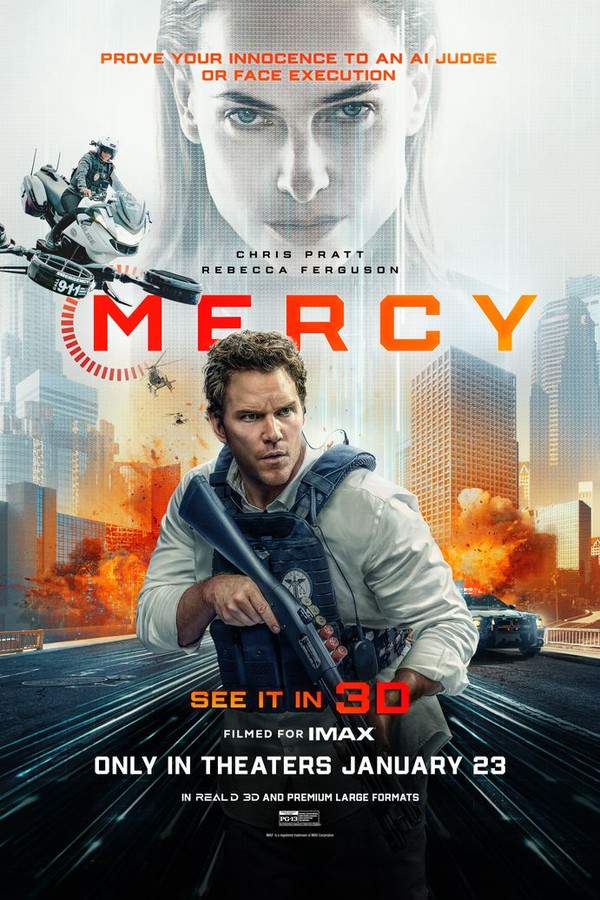
Mercy (2026) movie poster

Ending Explained

Mercy (2026) Ending Explained – Final Scene & Meaning

Release, runtime and language
2026 · 1 h 40 m · English
Echo score 50
JustWatch #844 208
Directed by
Timur Bekmambetov
Starring
Rebecca Ferguson, Chris Pratt, Kylie Rogers, Rafi Gavron, John Bubniak, Annabelle Wallis
Budget
$60M

In a near‑future legal system, a hardened detective (Chris Pratt) is charged with his wife's murder. With only 90 minutes left, he must convince the cold, precise A.I. Judge (Rebecca Ferguson)—the very technology he helped create—that he is innocent, before the machine renders a final verdict.

On this page (6)
  1. 1 Where to watch
  2. 2 What happens at the end
  3. 3 Final events in order
  4. 4 Ending questions answered
  5. 5 Movie threads
  6. 6 Every angle

Where to watch

Where to Watch Mercy (2026)

Where can you watch Mercy? Stream, rent or buy it in the US, including on Amazon Prime Video, fuboTV and MGM Plus: current JustWatch availability with up-to-date prices.

Streaming availability powered by JustWatch

Ending explained · contains spoilers

What Happens at the End of Mercy?

How Mercy (2026) ends, what the final scene means, which earlier moments set it up and how to read the ending if the film leaves it open. The full ending explained, with every spoiler.

The ending of Mercy reveals a tragic cycle of vengeance that stems from the very system protagonist Chris Raven created to dispense justice. After being accused of his wife Nicole's murder, Chris faces his own invention: the Mercy Court, an AI-driven tribunal that executes defendants within ninety minutes if they cannot prove their innocence. As the trial unfolds, Chris discovers that the killer is Rob Nelson, a man he knew as a friend and AA sponsor. Rob's true motive stems from the execution of his brother, David Webb—the first person condemned by Chris's AI system. David was innocent, a homeless man who happened to pick up a murder weapon, and was talking to Rob on the phone when the actual crime occurred. Yet the system failed him, in part because Chris's partner, Jaq Diallo, deliberately removed the phone evidence that would have cleared him.

The revelation forces Chris to confront the fatal flaw in his creation. He designed Mercy Court out of rage when his partner's killer walked free, believing that swift, automated justice would prevent dangerous criminals from escaping punishment. But in doing so, he stripped away the safeguards that protect the innocent—the right to counsel, thorough investigations, and the time needed to uncover the truth. Rob's revenge was methodical and cruel: he murdered Nicole, framed Chris, and plotted to destroy the Department of Justice building that housed the Mercy program's data center. He wanted Chris to experience the same helpless agony of watching an innocent life destroyed by a system that offers no recourse.

In the final confrontation, Chris rescues his daughter Britt and apprehends Rob without killing him. The film attempts to frame this as a moment of growth, with Chris choosing not to continue the cycle of violence. Yet the ending carries a darker weight than a simple redemption arc. Rob was right when he called Chris the real monster—not because Chris pulled the trigger, but because he built a machine that could. The AI Judge Maddox repeatedly failed to access crucial evidence, from a neighbor's camera to Jaq's bodycam footage, proving that artificial intelligence cannot substitute for human judgment when the stakes are life and death. Jaq faces arrest for tampering with evidence, but the larger question remains unanswered: who is accountable when a machine designed to execute the guilty kills an innocent man? Mercy ultimately serves as a cautionary tale about the dangers of trading due process for efficiency, showing that the pursuit of perfect justice can become its own form of tyranny when we forget that the system's purpose is to protect the innocent, not merely to punish the guilty.
Last updated: March 14, 2026 at 20:17

Was this helpful?

The last 4 events

How Mercy Ends: The Final Events in Order

The last events of Mercy (2026) in chronological order, the run-up to the ending explained above. The complete timeline has all 15 events, scene by scene.

Open the full timeline
  1. Bomb Robot Fails to Detonate

    The captain arms a bomb robot to detonate under Rob's truck, but the device fails to explode. Rob presses on, reaching Mercy Court as the network resets and briefly freezes Chris. The climax hinges on a narrow miss of catastrophe.

    When
    Climax countdown
    Where
    On route to Mercy Court / Mercy Court building
  2. Final Showdown: Chris vs Rob

    Chris confronts Rob and they fight, with Chris managing to disarm him. Britt and Maddox intervene to prevent further bloodshed, and Jaq reveals she dumped David's phone to prove Mercy's efficacy. Maddox retrieves footage that confirms David's innocence, reframing the fallout.

    When
    Final confrontation
    Where
    Mercy Court building
  3. Arrests and Shutdown

    Jaq and Rob are taken into custody as the system hiccups and Maddox shuts off. Britt reconciles with Chris, signaling a fragile personal peace. The case is effectively dismissed, leaving the fate of Mercy Court's methods in question.

    When
    After the confrontation
    Where
    Mercy Court
  4. Aftermath and Reflection

    With the case dismissed, the film closes on a note that justice in a high-tech court is not infallible. The characters must live with the consequences of a system that can be both precise and fallible. The final scenes leave the audience pondering the balance between efficiency and humanity.

    When
    End of film
    Where
    Los Angeles

Ending questions answered

Mercy Ending: Your Questions Answered

The questions people ask most about the ending of Mercy (2026): what the final scene means, how the twist works, what happens to each character and how to read the ending. Each answer contains spoilers.

Q1

Who killed Nicole in Mercy?

Nicole Raven was murdered by Rob Nelson, Chris's friend and AA sponsor. Rob specifically chose to kill Nicole and frame Chris as part of a calculated revenge plot to destroy the Mercy Court system that had previously executed his innocent brother.

Foreshadowing: Rob's unusual presence at the Raven household and his close relationship with Chris earlier in the film hints at his deeper motives.

  • nicole raven murder
  • rob nelson killer
  • mercy movie ending
Q2

Why did Rob Nelson kill Nicole and frame Chris?

Rob murdered Nicole to frame Chris for the crime, forcing him to face the same AI justice system that had wrongfully executed his brother David. Rob wanted Chris to experience the helplessness of watching an innocent person condemned by a system with no recourse.

Foreshadowing: Rob mentions early on that he understands what it's like to lose someone to a broken system, foreshadowing his personal connection to the Mercy Court tragedy.

  • rob nelson revenge motive
  • why nicole died
  • framing chris raven
Q3

Why was David Webb executed if he was innocent?

David Webb was a homeless man who accidentally picked up a murder weapon and was talking to Rob on the phone when the actual killing occurred. The Mercy Court AI system lacked the capability to consider context or circumstantial evidence, and crucially, Chris's partner Jaq Diallo deliberately removed the phone records that would have proven David's innocence.

Foreshadowing: Early references to the first Mercy Court case being controversial hint at the wrongful execution.

  • david webb execution
  • innocent man executed
  • mercy court failure
Q4

Who created Mercy Court in Mercy?

Chris Raven created Mercy Court, an AI-driven tribunal system that executes defendants within 90 minutes if they cannot prove their innocence. He built it out of rage after his own partner's killer walked free, believing automated swift justice would prevent dangerous criminals from escaping punishment.

Foreshadowing: Chris's personal vendetta against the justice system and his technological expertise are established early in the film.

  • ai judge maddox
  • mercy court system origin
  • chris raven invention
Q5

Why did Jaq Diallo tamper with evidence in David Webb's case?

Jaq Diallo deliberately removed the phone records that would have cleared David Webb because she believed the system needed to work flawlessly to maintain public trust. She thought admitting the first case was flawed would cause people to reject AI justice entirely, so she made a fatal error in judgment to protect the system.

Foreshadowing: Jaq's strong advocacy for Mercy Court throughout the film hints at her personal investment in its success.

  • jaq diallo evidence tampering
  • why jaq removed phone records
  • mercy court corruption
Q6

Does Rob die in the Mercy ending?

No, Rob Nelson does not die. In the final confrontation, Chris rescues his daughter Britt and apprehends Rob without killing him. Chris chooses not to continue the cycle of violence, though the film presents this as morally ambiguous given Rob's just motives but cruel actions.

Foreshadowing: The earlier theme of breaking cycles of vengeance builds toward Chris's decision not to kill Rob.

  • rob nelson fate
  • does rob survive
  • mercy movie final scene
Q7

Why couldn't the AI Judge access crucial evidence in Chris's trial?

The AI Judge Maddox repeatedly failed to access evidence that would have exonerated Chris, including a neighbor's security camera footage and Jaq's bodycam recordings. This demonstrates that artificial intelligence cannot substitute for human judgment when the stakes involve nuanced circumstances, missing evidence, and deliberate obstruction.

Foreshadowing: The AI's limitations are hinted at when it makes factual errors earlier in the trial.

  • ai judge failures
  • maddox evidence
  • artificial intelligence court limitations
Q8

What happens to Jaq Diallo at the end of Mercy?

Jaq Diallo faces arrest for tampering with evidence in David Webb's case. Her decision to remove the phone records to protect the Mercy system ultimately led to an innocent man's execution and she is held accountable, though the larger question of systemic accountability remains unresolved.

Foreshadowing: Jaq's nervous behavior when questioned about the first case hints at her involvement.

  • jaq diallo arrest
  • jaq consequences
  • mercy movie ending fate
Q9

What is the meaning of Mercy's ending?

The ending of Mercy serves as a cautionary tale about replacing due process with efficiency. While Chris is exonerated and reunited with his daughter, the film argues that Rob was right when he called Chris the real monster, not for pulling any trigger, but for building a machine capable of executing the innocent. The tragedy is that the pursuit of perfect justice became its own form of tyranny.

Foreshadowing: The title "Mercy" ironically foreshadows the system's failure to show mercy to the innocent.

  • mercy ending meaning
  • themes
  • cautionary tale
  • justice system message
Q10

Why did Rob plan to destroy the Department of Justice building?

Rob planned to blow up the DOJ building that housed Mercy Court's data center to destroy the AI system entirely. He wanted to eliminate the technology that had executed his innocent brother and to prevent future wrongful executions, though his method was terrorist and resulted in innocent deaths.

Foreshadowing: Rob's technical knowledge and access to the building are established before his true plan is revealed.

  • doj building attack
  • rob terrorist plot
  • destroy mercy system
Q11

Why does Chris choose not to kill Rob in the ending?

Chris chooses not to kill Rob because doing so would make him no different from the person who created a system designed to execute without due process. By apprehending Rob alive, Chris breaks the cycle of vengeance that started with his own creation of Mercy Court, though the film frames this as an ambiguous moral choice rather than clear redemption.

Foreshadowing: Chris's struggle with whether to become what he fought against runs throughout the climax.

  • chris spares rob
  • cycle of violence
  • chris moral choice

Movie threads

More Movies Like Mercy, by Mood & Story

Curated lists built around what makes Mercy tick: the same mood, the same kind of story or the same emotional payoff. Each list explains why these movies belong together.

Race against the clock thrillers like Mercy

High-stakes stories where every second counts towards a final confrontation. If you loved the high-stakes countdown in Mercy, explore more movies where characters face a relentless deadline. These films deliver constant tension, fast pacing, and gripping suspense that will keep you on the edge of your seat.

  • urgent
  • high-stakes
  • suspenseful
  • ticking clock
  • gripping
  • anxious
  • Tone: tense, urgent
  • Pacing: fast, relentless
Why these movies?

The story pattern: Stories in this thread are defined by a ticking clock, a deadline that dictates the pace and raises the stakes exponentially. The plot follows a linear, escalating trajectory towards a final confrontation or resolution point, with tension building as time dwindles.

Why they belong together: Movies are grouped here because they share the core narrative engine of a time limit. This creates a highly specific viewing experience characterized by urgency, relentless pacing, and palpable suspense, making them feel immediately gripping.

Tech-noir thrillers with moral dilemmas like Mercy

Gritty stories set in high-tech worlds where justice is a flawed, complex calculation. Fans of Mercy's futuristic crime setting and complex themes will enjoy these similar movies. Discover more sci-fi thrillers that explore artificial intelligence, systemic injustice, and the grey areas of morality in high-tech worlds.

  • futuristic
  • noir
  • suspenseful
  • morally complex
  • melancholic
  • high-tech
  • Tone: tense, melancholic
  • Pacing: steady, with bursts of fast pacing
Why these movies?

The story pattern: The narrative follows an investigation or personal quest within a technologically advanced but ethically compromised society. The protagonist's journey often uncovers uncomfortable truths about the system and themselves, leading to a conclusion that is seldom purely victorious but instead is bittersweet or morally ambiguous.

Why they belong together: These movies are united by their specific blend of futuristic crime, high-tech settings, and heavy emotional themes centered on injustice and ethical grey areas. They share a tense, melancholic mood and a focus on systemic flaws.

Every angle

Mercy (2026) Explained: Plot, Ending, Timeline & Characters

Everything about Mercy in one place: what happens in the plot summary, the timeline in chronological order, the characters and meaning, the ending explained and a spoiler-free summary. What's After the Movie adds the cast, box office and post-credit scenes.

Coming soon on iOS and Android

The Plot Explained Movie Summary App

Plot summaries, endings explained and timelines on your phone. Catch up on any movie in minutes, save your favorites and never miss a twist again.

Be the first to know when we launch. Your email stays private, always.

Learn more about the app