Plot Explained Spoilers guaranteed!
Plot Explained

Browse by genre

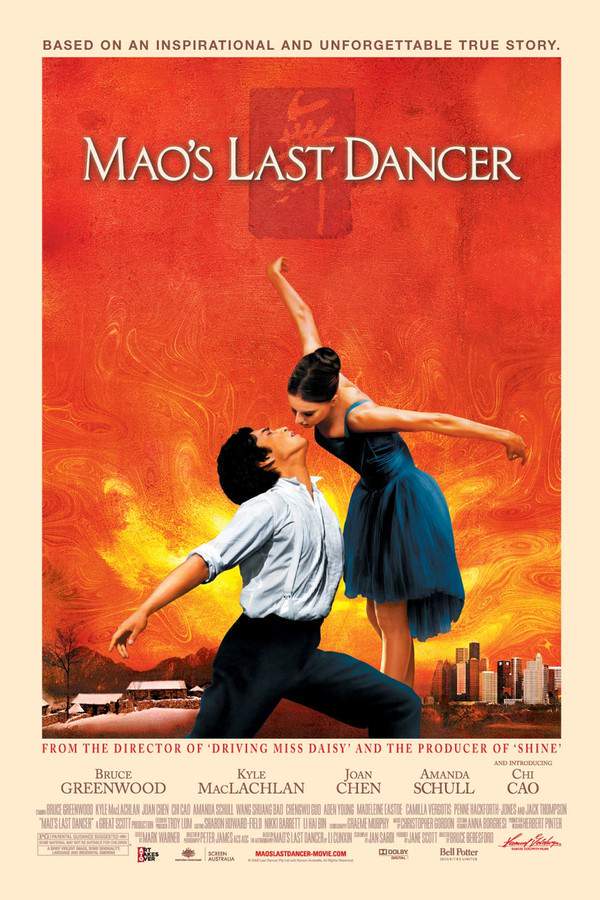
Mao’s Last Dancer (2009) movie poster

Plot Summary

Mao’s Last Dancer (2009) Plot Summary Explained

Release, runtime and language
2009 · 117 mins · English
Loading streaming availability…
Directed by
Bruce Beresford
Starring
Joan Chen, Kyle MacLachlan, Bruce Greenwood, Jack Thompson, Barbara Bush, Aden Young

At 11, Li, a boy from a poor Chinese village, is selected by Madame Mao’s cultural program and taken to Beijing to train as a ballet dancer. After years of rigorous study, he joins a 1979 cultural exchange in Texas, where he falls for an American woman. Two years later he defects, eventually becoming a principal dancer with the Houston Ballet and later a principal artist with the Australian Ballet, fulfilling his dream of artistic freedom.

On this page (6)
  1. 1 Where to watch
  2. 2 What happens: full plot
  3. 3 Plot questions answered
  4. 4 Movie threads
  5. 5 Movies like Mao’s Last Dancer
  6. 6 Every angle
Loading streaming availability…

Full plot summary · contains spoilers

What Happens in Mao’s Last Dancer: Full Plot Summary

The whole story of Mao’s Last Dancer (2009) explained, from the opening scene to the final frame: every key event, every twist and what it all adds up to. Read it as a quick recap before the sequel, to check a scene you missed, or to finally understand what really happened.

During Mao's Cultural Revolution, an 11-year-old Chinese boy Li Cunxin grows up in a rural Shandong commune where daily life centers on farm work and collective life. When officials sweep through schools to recruit candidates for centralized training, he is initially overlooked but is ultimately chosen after his teacher's plea, and he travels to the provincial capital in Qingdao for screening. From there, he is sent to Beijing for an audition at Madame Mao's Dance Academy, and, after a series of rigorous physique and flexibility tests, he earns admission to ballet training.

Years of demanding practice follow, with Li's talent gradually crystallizing. A senior teacher champions classical Russian ballet, a path that contrasts with the politically charged style required by the regime, and this tension helps fuel the teacher’s eventual ostracism. During a pivotal cultural visit to China, an American-based English ballet director, Ben Stevenson, is struck by Li's extraordinary gifts and enlists him as an exchange student at the Houston Ballet, opening the door to a three-month stay in the United States.

In America, Li is confronted with life beyond the village and begins to question the strict dictates he has known. He forms a bond with an aspiring American dancer, Elizabeth Mackey Elizabeth Mackey, whose presence attracts Li to the local ballet scene. Li and Stevenson press for a longer stay, but the Chinese government denies the extension. Driven by opportunity and love, Li decides to pursue his future in the United States, and he and Mackey marry in a bid to anchor their life together and to navigate the complexities of international residency.

Li’s decision triggers a sharp clash with authorities. A Chinese resident diplomat at the Houston consulate forcibly detains him to compel his return, while media and high-level officials in both countries monitor the crisis. Li resists repatriation, and although the government eventually agrees to release him, it revokes his citizenship and bars him from ever returning to his homeland. The upheaval strains Li and Mackey’s relationship, and their marriage falters as Li remains in the United States to advance his ballet career, while Elizabeth’s own prospects in dance wane.

Five years later, a gesture of goodwill allows Li’s parents to visit him in the U.S. to witness his artistry, including a performance of The Rite of Spring, and to share a family reunion on stage. Li is eventually granted permission to visit China again, this time returning with his new wife, Australian dancer Mary McKendry. The couple comes back to Li’s village, reconnects with his former teacher, and performs an impromptu outdoor ballet to the cheers of the community.

The closing credits sketch the broader arc of Li Cunxin’s life: he danced with the Houston Ballet in 1995, an achievement broadcast to a global audience, and he and Mary McKendry settle in Australia with their three children. Ben Stevenson remains a towering figure in the ballet world, continuing his work as a director at the Texas Ballet Theater. The narrative also notes that Li’s circle extends into the professional world—Elizabeth Mackey’s path includes years with the Oklahoma Ballet and a later career as a speech therapist—while Li, Mary, and their family carry forward the legacy of their remarkable journey.

Last updated: October 05, 2025 at 11:35

Was this helpful?

Plot questions answered

Mao’s Last Dancer Plot Explained: Your Questions Answered

The questions people ask most about Mao’s Last Dancer (2009): what happens in the confusing scenes, why the characters do what they do, the twists, hidden details and what the ending means. Each answer contains spoilers.

Q1

Why was Li Cunxin selected for Madame Mao's Dance Academy?

Li was initially overlooked during the school recruitment, but his teacher advocated for him, persuading officials to give the boy a chance. He was then sent to Qingdao for screening and subsequently to Beijing for an audition, where his exceptional physique and flexibility impressed evaluators enough to earn him admission to the prestigious academy.

Foreshadowing: Earlier in the film, Li's natural coordination and grace are hinted at during village life, setting the stage for his discovery.

  • Li Cunxin
  • Madame Mao
  • Dance Academy
  • recruitment
  • Beijing
  • Qingdao
Q2

Why was Chan's Russian ballet teaching style controversial in Mao's China?

Teacher Chan championed classical Russian ballet techniques, which clashed with the politically charged, revolutionary style demanded by Madame Mao's regime. The government required dance that served political propaganda rather than traditional European art forms, making Chan's approach ideologically suspect and leading to his eventual ostracism from the academy.

Foreshadowing: The tension between artistic expression and political control runs throughout Li's training years.

  • Chan
  • Russian ballet
  • Madame Mao
  • political ballet
  • cultural revolution
Q3

Why did the Chinese government deny Li's request to extend his stay in Houston?

The Chinese government refused to extend Li's three-month exchange program because allowing a talented dancer to remain in America longer would mean losing that talent to a capitalist country. The regime viewed maintaining control over its citizens, especially those with valuable skills, as a political necessity during the post-Cultural Revolution period.

Foreshadowing: The tension between Li's growing fame and government control builds after Stevenson's initial invitation.

  • China government
  • extension
  • Houston Ballet
  • denial
  • cultural exchange
Q4

Why did Li Cunxin decide to stay in America instead of returning to China?

Li chose to remain in America because he had fallen in love with both Elizabeth Mackey and the artistic freedom available in the United States. The denied extension request hardened his resolve, and he saw an opportunity to pursue his dream of becoming a principal dancer without the political constraints imposed in China. The combination of romantic love and artistic aspiration motivated his decision to defect.

Foreshadowing: Li's growing attraction to American culture and his questions about the strict dictates he grew up with foreshadow his choice.

  • Li Cunxin
  • defect
  • stay
  • America
  • Elizabeth Mackey
  • freedom
  • Houston Ballet
Q5

What happened when Li visited the Chinese Consulate in Houston?

When Li visited the consulate to accept responsibility for his decision to stay, a Chinese resident diplomat detained him in an attempt to coerce his return to China. The incident escalated into an international crisis involving media coverage and high-level negotiations between American and Chinese governments, making Li's situation highly public and politically charged.

Foreshadowing: The earlier denial of his extension request directly led to this confrontation.

  • Chinese Consulate
  • Houston
  • detention
  • diplomat
  • Li Cunxin
  • repatriation
Q6

Why was Li Cunxin's Chinese citizenship revoked?

After Li resisted repatriation and chose to remain in America, the Chinese government revoked his citizenship as punishment for his defiance. This was a severe measure meant to demonstrate the consequences of rejecting the homeland, and it barred him from ever returning to China, effectively cutting him off from his family and country.

Foreshadowing: Li's refusal to return directly triggers this harsh governmental response.

  • citizenship revoked
  • China
  • exile
  • defection
  • punishment
  • Li Cunxin
Q7

Why did Li and Elizabeth's marriage fail?

Li and Elizabeth's marriage crumbled because after defecting, Li remained in America to advance his ballet career while Elizabeth's own dance prospects diminished. The distance and the pressure of Li's rising career, combined with the collapse of Elizabeth's professional aspirations, created an unbridgeable gap. Stevenson's influence also pushed Li to focus on his career, further straining the relationship.

Foreshadowing: The marriage was partly a strategic move to secure residency in America, which foreshadows its fragility.

  • Elizabeth Mackey
  • marriage
  • divorce
  • Houston Ballet
  • career
  • Li Cunxin
Q8

How did Li Cunxin get permission for his parents to visit him in America?

Five years after his defection, the Chinese government made a gesture of goodwill and granted permission for Li's parents to visit him in the United States. This marked a significant thaw in relations and allowed Li to share his artistic achievements with his family, including performing The Rite of Spring and reuniting on stage.

Foreshadowing: The government's earlier harsh stanceSoftens as political winds shift.

  • parents visit
  • America
  • Rite of Spring
  • reunion
  • Chinese government
  • Li Cunxin
Q9

Why did Li return to China with his Australian wife Mary McKendry?

Li was finally granted permission to visit China again and chose to return with his new wife, Australian dancer Mary McKendry. The return represented a full reconciliation with his homeland, allowing him to reconnect with his family and former teacher Chan in his village, demonstrating that despite years of exile, his Chinese roots remained central to his identity.

Foreshadowing: The earlier reunion with his parents paved the way for this homecoming.

  • Li Cunxin
  • return to China
  • Mary McKendry
  • village
  • teacher Chan
  • Shandong
Q10

What was the significance of the outdoor ballet performance in Li's village?

Li and Mary gave an impromptu outdoor ballet performance for the village crowd, celebrating his journey from a rural Shandong child to an international dancer. This moment symbolized his full-circle return, he had left as a bewildered boy and came back as a world-renowned artist, yet remained connected to the community that launched his destiny.

Foreshadowing: The performance completes the arc that began when Li left the village for training.

  • outdoor ballet
  • village
  • Shandong
  • performance
  • return
  • Li Cunxin
  • Mary McKendry

Movie threads

More Movies Like Mao’s Last Dancer, by Mood & Story

Curated lists built around what makes Mao’s Last Dancer tick: the same mood, the same kind of story or the same emotional payoff. Each list explains why these movies belong together.

Against-the-Odds Triumphs like in Mao’s Last Dancer

Inspiring true stories of individuals overcoming immense obstacles to achieve their dreams. Discover movies like Mao’s Last Dancer that feature true stories of incredible personal triumph. If you enjoyed Li Cunxin's journey from oppression to artistic freedom, you'll appreciate these inspiring dramas about individuals overcoming enormous odds to achieve their dreams.

  • inspiring
  • triumphant
  • emotional
  • hopeful
  • dramatic
  • uplifting
  • Tone: hopeful, inspiring, triumphant
  • Pacing: steady, chronological
Why these movies?

The story pattern: Stories in this thread typically follow a linear biographical path, beginning with a protagonist facing significant limitation or oppression. Through a combination of unique talent, unexpected opportunity, and sheer willpower, they embark on a difficult journey that culminates in a public or personal victory, affirming the power of the human spirit.

Why they belong together: These movies are grouped by their shared core of inspiration derived from true events. They balance serious themes of struggle with an ultimately hopeful and triumphant tone, creating a powerful and emotionally satisfying viewing experience centered on real-world achievement.

Artistic Defection Dramas similar to Mao’s Last Dancer

Intense personal dramas where artists risk everything for creative and political liberty. Find films similar to Mao’s Last Dancer that explore the theme of artistic defection. These dramas focus on performers and creators who make the heart-wrenching choice to leave their homeland for artistic freedom, blending political tension with powerful personal stories.

  • tense
  • liberating
  • melancholic
  • emotional
  • political
  • artistic
  • Tone: tense, hopeful, melancholic
  • Pacing: steady, character-driven
Why these movies?

The story pattern: The narrative pattern involves an artist mastering their craft within a system that both trains and controls them. A pivotal moment abroad exposes them to artistic and personal freedom, creating an intense internal and external conflict. The story builds towards a high-stakes defection or escape, exploring the complex aftermath of choosing art over country and family.

Why they belong together: Movies are grouped here for their specific focus on the artist's dilemma under oppression. They share a mix of stunning artistic performance, tense political thriller elements, and deep emotional weight stemming from the sacrifices made for creative expression.

If you liked this

Movies Like Mao’s Last Dancer

Similar movies to Mao’s Last Dancer: the same genre, themes or kind of story. Each one comes with its own plot summary, timeline and ending explained.

Browse all movie summaries

Every angle

Mao’s Last Dancer (2009) Explained: Plot, Timeline & Characters

Everything about Mao’s Last Dancer in one place: what happens in the plot summary, the timeline in chronological order, the characters and meaning and a spoiler-free summary. What's After the Movie adds the cast, box office and post-credit scenes.

Coming soon on iOS and Android

The Plot Explained Movie Summary App

Plot summaries, endings explained and timelines on your phone. Catch up on any movie in minutes, save your favorites and never miss a twist again.

Be the first to know when we launch. Your email stays private, always.

Learn more about the app