








Plot Explained Spoilers guaranteed!
Plot Explained

Browse by genre

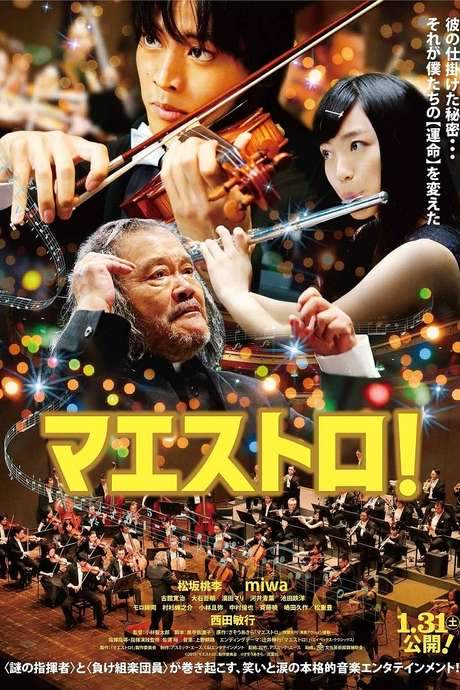
Maestro! (2015) movie poster

Characters & Themes

Maestro! (2015) Characters, Setting & Themes Explained

Release, runtime and language
2015 · 129 mins · Japanese
Directed by
Shotaro Kobayashi
Starring
Mari Hamada, Aoba Kawai, Kyûsaku Shimada, Yutaka Matsushige, Denden, Toshiyuki Nishida

Facing closure due to economic hardship, an orchestra finds itself disbanded. News arrives that the group might be reformed, prompting a reunion of some former members who haven't been rehired. Eager to play together again, they attempt a performance, but their sound is far from perfect. Suddenly, the conductor Tetsusaburo Tendou reappears, offering a chance to rediscover their musical harmony.

On this page (7)
  1. 1 Where to watch
  2. 2 Characters explained (8)
  3. 3 Where & when it takes place
  4. 4 Themes & meaning (3)
  5. 5 Character & meaning questions
  6. 6 Movie threads
  7. 7 Every angle

Where to watch

Where to Watch Maestro! (2015)

Where can you watch Maestro!? Stream, rent or buy it in the US, including on Hulu, Hoopla and DistroTV: current JustWatch availability with up-to-date prices.

Streaming availability powered by JustWatch

8 main characters · contains spoilers

Maestro! Characters Explained: Who Is Who

The main characters of Maestro! (2015), heroes and villains: what drives them, how they change over the course of the story and what each of them reveals about the film's bigger ideas.

  • Kosaka

    A young violinist who is offered a position in the re-formed prestigious orchestra. He arrives into a chaotic, rehearsal-driven environment and quietly assesses the power dynamics among the veteran players. His fresh perspective and dedication become a touchstone for the ensemble as they navigate chaos and ambition.

    • 🎻 Violinist
    • 🤝 Collaboration
    • 🧭 Ambition
  • Tetsusaburo Tendou

    played by Toshiyuki Nishida

    An erratic but results-driven conductor who arrives to galvanize the re-formed orchestra. His unconventional methods push players to test boundaries, straining relationships while delivering surprising musical cohesion. He embodies a paradox of inspiration and intimidation within the ensemble.

    • 🧭 Leadership
    • 🎯 Pressure
    • 🎶 Conducting
  • Amane Tachibana

    played by miwa

    An amateur yet gifted flute player who joins the orchestra amid the turmoil. Her presence heightens tensions between established members and pushes for a higher standard. Her talent and outsider status force others to reevaluate their roles within the group.

    • 🎶 Music
    • 🧠 Talent
    • 💫 Fresh perspective
  • Shuzo Shimaoka

    played by Kyûsaku Shimada

    The mysterious benefactor whose management style initiates the orchestra's revival. He exerts influence behind the scenes, shaping rehearsals and funding decisions, and his motives remain ambiguous to the players.

    • 💼 Manager
    • 🎭 Influence
    • 🧰 Behind-the-scenes
  • Shinichi Kousaka

    played by Tori Matsuzaka

    A musician in the ensemble whose ambition challenges norms and contributes to the evolving group dynamics. He navigates the pressures of the re-formed orchestra and the expectations of its leadership.

    • 🎺 Brass
    • 🚀 Ambition
    • 🧩 Rivalry
  • Toru Imaizumi

    played by Tetsuhiro Ikeda

    A steady-handed musician who helps keep the group on track during chaotic rehearsals. His practical approach provides a counterbalance to high drama, focusing on discipline and consistency.

    • 🧰 Reliability
    • 🎯 Focus
    • 🎵 Ensemble
  • Naoto Kabe

    played by Seminosuke Murasugi

    A pragmatic player who anchors the section and mediates tensions within the orchestra. He embodies the tension between artistic aspiration and practical limitations, often acting as a bridge between conflicting personalities.

    • 🧩 Role
    • 🧭 Navigation
    • 🧰 Layer
  • Isao Murakami

    played by Goro Oishi

    A veteran member grappling with the changes in the orchestra and the influx of new ideas. His experience anchors the group while also clashing with younger players eager to push boundaries.

    • 🎖 Veteran
    • 🧠 Experience
    • 🎶 Core sound

Last updated: March 04, 2026 at 15:03

Was this helpful?

Setting

Where and When Does Maestro! Take Place?

The setting of Maestro! (2015): the year and time period, the places and locations, and how they shape the characters, the mood and the tension of the story.

Time period

Location

Disused factory rehearsal hall

Rehearsals take place in a large, empty factory repurposed as a rehearsal hall for the re-formed orchestra. The stark, industrial environment with echoing rooms shapes the sound and mood of the performances. This setting underscores the film's theme of rebuilding an elite ensemble from chaos.

  • 🏭 Disused factory
  • 🎼 Rehearsal venue
  • 🧰 Transformation of space

Last updated: March 04, 2026 at 15:03

Was this helpful?

3 major themes

Maestro! Meaning: Themes & Message Explained

What is Maestro! (2015) really about? The emotional, social and philosophical themes the film keeps returning to, its symbolism and the message beneath the surface.

  • Egos

    Musicians guard their own turf, and the return of the orchestra rekindles old rivalries. Personal pride collides with the pursuit of a cohesive sound. The conductor's demands expose fragile alliances and test loyalties.

  • Leadership

    A mysterious benefactor reshapes the group through a controversial management style. The ensemble endures intense discipline and high expectations. The line between inspiration and pressure becomes blurred as progress is pursued.

  • Finances

    Financial troubles loom over the orchestra's future, influencing scheduling, staffing, and decisions. Sponsorship and resource management drive strategic choices more than musical ideals. The struggle to survive adds tension to every rehearsal.

Last updated: March 04, 2026 at 15:03

Was this helpful?

Character & theme questions

Maestro! Characters & Meaning: Your Questions Answered

The questions people ask about Maestro! (2015): who the characters really are, their relationships, what the symbols mean, where it takes place and what the movie is really about. Each answer contains spoilers.

Q1

Where does the story take place?

The story centers on rehearsals held in a large, disused factory that has been converted into a rehearsal hall for the re-formed orchestra. The stark, industrial environment with its echoing rooms shapes both the sound and mood of the performances, visually reinforcing the theme of rebuilding an elite ensemble from chaos.

  • setting
  • rehearsal location
  • factory
  • orchestra
Q2

What are the main themes explored?

The film explores three interconnected themes: Egos, as musicians' personal pride and rivalries clash with the pursuit of a cohesive sound; Leadership, examining the controversial management style of the conductor and the blurred line between inspiration and pressure; and Finances, showing how economic hardship and resource management drive strategic decisions and create tension throughout the orchestra's revival.

  • themes
  • ego
  • leadership
  • finances
  • rivalry
Q3

Who is Tetsusaburo Tendou?

Tetsusaburo Tendou is the erratic but results-driven conductor who arrives to galvanize the re-formed orchestra. His unconventional methods push players to test boundaries, straining relationships while ultimately delivering surprising musical cohesion. He embodies a paradox of inspiration and intimidation within the ensemble.

  • conductor
  • Tendou
  • leadership
  • character
Q4

What role does Kosaka play in the story?

Kosaka is a young violinist who is offered a position in the re-formed prestigious orchestra. He enters a chaotic, rehearsal-driven environment and quietly assesses the power dynamics among veteran players. His fresh perspective and dedication become a touchstone for the ensemble as they navigate chaos and ambition.

  • Kosaka
  • violinist
  • character
  • new member
Q5

Who is Shuzo Shimaoka?

Shuzo Shimaoka is the mysterious benefactor whose management style initiates the orchestra's revival. He exerts influence behind the scenes, shaping both rehearsals and funding decisions, and his motives remain ambiguous to the players throughout the story.

  • Shimaoka
  • benefactor
  • patron
  • funding
Q6

What is Amane Tachibana's role in the orchestra?

Amane Tachibana is an amateur yet gifted flute player who joins the orchestra amid its turmoil. Her talent and outsider status heighten tensions between established members while pushing for a higher standard, forcing others to reevaluate their roles within the group.

  • Tachibana
  • flute
  • outsider
  • talent
  • tension
Q7

How do financial troubles affect the orchestra?

Financial troubles loom over the orchestra's future, influencing scheduling, staffing, and major decisions. Sponsorship and resource management drive strategic choices more than musical ideals, and the struggle to survive adds persistent tension to every rehearsal and group interaction.

  • finances
  • budget
  • sponsorship
  • struggle
  • closure
Q8

What does the Egos theme represent in the movie?

The Egos theme represents how musicians guard their own turf, and the return of the orchestra rekindles old rivalries. Personal pride collides with the pursuit of a cohesive sound, as the conductor's demands expose fragile alliances and test the loyalties between players.

  • ego
  • rivalry
  • pride
  • conflict
  • alliances
Q9

How does the Leadership theme explore inspiration versus pressure?

The Leadership theme examines how a mysterious benefactor reshapes the group through controversial management, while the conductor's intense discipline and high expectations push the ensemble toward progress. The line between inspiration and pressure becomes blurred as the orchestra pursues improvement under extreme demands.

  • leadership
  • inspiration
  • pressure
  • discipline
  • conductor
Q10

What kind of world does the movie portray?

The movie portrays a professional music world in crisis, where artistic dedication battles against economic hardship and personal ambition. It depicts an environment where survival depends on balancing musical ideals with practical constraints, set against the industrial backdrop of a transformed factory rehearsal space.

  • world
  • setting
  • orchestra
  • professional
  • music
Q11

What is the emotional arc of the story?

The emotional journey moves from frustration and erratic performance toward harmony and shared purpose. The orchestra begins in chaos with far-from-perfect sound, but the conductor's push and the members' lingering passion for music gradually lead to progress and positive results, creating a hopeful trajectory overall.

  • emotional arc
  • hope
  • harmony
  • progress
  • journey

Movie threads

More Movies Like Maestro!, by Mood & Story

Curated lists built around what makes Maestro! tick: the same mood, the same kind of story or the same emotional payoff. Each list explains why these movies belong together.

Underdog Ensemble Rediscovering Their Groove like in Maestro!

Misfit groups reunite to face old conflicts and reclaim their shared passion. If you liked the hopeful reunion of flawed individuals in Maestro!, this collection features movies about misfit ensembles reforming to tackle shared goals. These stories capture the specific emotional journey of overcoming internal conflict and financial hardship to reclaim a collective identity and achieve imperfect but meaningful success.

  • hopeful
  • melancholic
  • determined
  • harmonious
  • frustrated
  • teamwork
  • Tone: hopeful, determined, melancholic
  • Pacing: steady, character-driven
Why these movies?

The story pattern: The narrative typically begins with a group that has fallen apart due to external pressures or internal strife. An opportunity for reunification forces members to confront unresolved conflicts and personal shortcomings. Through a process of shared struggle, guided by a strong leader, they slowly rebuild trust and rediscover their collective purpose.

Why they belong together: These films share a core theme of collective redemption. They aren't about easy victories, but the authentic struggle of flawed individuals learning to work together again, resulting in a deeply satisfying emotional arc from discord to harmony.


Movies about Artistic Passion vs. Financial Reality like Maestro!

Stories where financial pressures threaten to extinguish artistic dreams. For viewers who enjoyed the struggle of the orchestra against closure in Maestro!, this thread gathers movies where artistic integrity clashes with economic hardship. These films focus on the emotional toll of keeping a creative dream alive when the world seems indifferent, celebrating resilience and the transformative power of art.

  • frustrated
  • tense
  • hopeful
  • melancholic
  • economic hardship
  • artistic passion
  • Tone: melancholic, tense, hopeful
  • Pacing: steady
Why these movies?

The story pattern: The story follows artists or artistic institutions facing imminent collapse due to a lack of funding or public support. The plot revolves around their fight for survival, often involving a last-ditch effort to prove their worth. The journey explores the sacrifices required to preserve art and the meaning found in the struggle itself.

Why they belong together: This group is defined by a shared, high-stakes conflict between the desire to create and the need to pay the bills. The movies resonate with anyone who has fought for a passion project, blending the melancholy of potential loss with the hope of preservation.

Every angle

Maestro! (2015) Explained: Plot, Timeline & Characters

Everything about Maestro! in one place: what happens in the plot summary, the timeline in chronological order, the characters and meaning and a spoiler-free summary. What's After the Movie adds the cast, box office and post-credit scenes.

Coming soon on iOS and Android

The Plot Explained Movie Summary App

Plot summaries, endings explained and timelines on your phone. Catch up on any movie in minutes, save your favorites and never miss a twist again.

Be the first to know when we launch. Your email stays private, always.

Learn more about the app