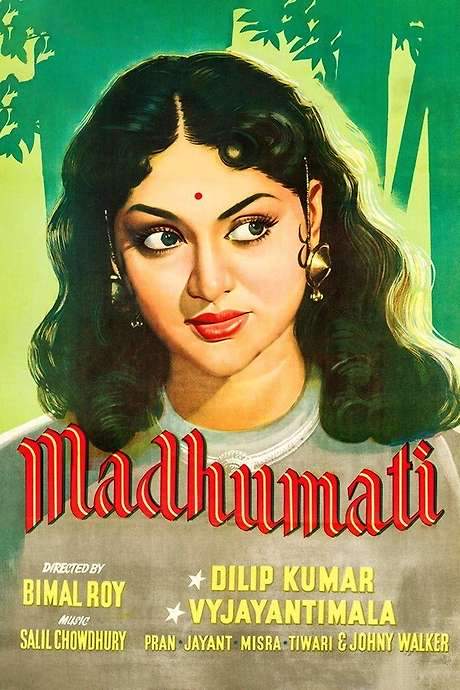
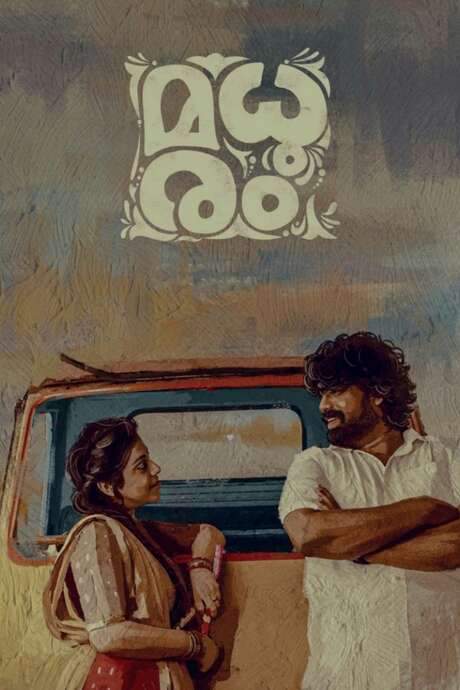
On a stormy night, engineer Devendra and his friend push forward along a treacherous hill road to reach a railway station and fetch his wife and child. A sudden landslide clauscs the way, forcing them to seek shelter in an old mansion that looms over the landscape. Inside the sprawling front room, Devendra discovers a venerable portrait that stirs something deep and uncanny within him. He is joined by his friend and the old caretaker, and as the storm rages outside, Devendra, overwhelmed by flashbacks of a life that feels borrowed from another era, sits down to tell his story and uncover the ties that bind these walls to a memory he cannot fully name.
In the present thread of the tale, Dilip Kumar plays [Anand] the new manager of Shyamnagar Timber Estate. An artist at heart, Anand escapes into the hills and finds himself drawn to Madhumati, a Kumaoni tribal singer whose haunting songs have followed him across miles. The formidable Raja Ugra Narayan, a ruthless employer, governs the estate with a sharp, unforgiving will; Pran Sikand embodies this stern, domineering figure who resents any challenge to his authority. Anand refuses to bow to such coercion, and his defiance earns him powerful enemies among the staff. After a tense errand, Anand returns to a chilling discovery: Madhumati has vanished, and the evidence points to her being taken to Ugra Narayan’s palace. When Anand confronts the tyrant, his men beat him unconscious, and the struggle seems to seal a grim fate.
As the palace moves his body away, a figure appears: Madhumati’s father, Jayant as Pawan Raja, who fights to halt the impending tragedy but dies on the road. In the commotion, Johnny Walker as Charandas emerges from the shadows, helping to conceal and transport Anand’s body to a hospital. The violent memory of this moment lingers as Anand survives, yet his mind begins to wander, his thoughts wandering through images of Madhumati and the life they might have shared.
Life takes another strange turn when Anand encounters a woman who looks exactly like Madhumati. She introduces herself as Madhavi, and, though Anand wants to believe, he cannot fully trust his own eyes. Madhavi’s companions manhandle him as he insists on the truth. Yet Madhavi, moved by the sketch of Madhumati she finds, understands that there is something real in Anand’s recollections, and she carries the sketch with her in a quiet, determined effort to learn his story. Meanwhile, the ghost of Madhumati visits Anand, whispering that Ugra Narayan bears responsibility for her death and urging him toward a reckoning.
To uncover the truth, Madhavi agrees to pose as Madhumati before Ugra Narayan and provoke a confession. The next evening, at the stroke of eight, the ruse unfolds: Madhavi, in the guise of Madhumati, confronts Ugra Narayan, who falters under the presented memory and the questions she asks about Madhumati’s burial place—details that he could not possibly know. The confession comes, and the police await outside as the truth unravels. The moment is heightened by a realization: the woman before him is Madhavi, yet Anand’s eyes have caught something else—he senses Madhumati’s presence in the room, not Madhavi. Madhavi, with a knowing smile, steps toward the stairs, while the real Madhumati, dressed as her, arrives late because her car broke down on the way. Anand races to the terrace, where the ghostly beckoning persists, and Madhumati, having fallen from that terrace in a desperate bid to escape Ugra Narayan, draws him into her spectral call. He follows and, in a fatal twist, dies on the terrace, joining the shade he believed to be only memory.
Back in the present, Devendra receives news that the train carrying his wife has been involved in an accident, yet the road clears and they hurry to the station. The moment of relief turns to wonder as Radha emerges from the train unharmed. Based on Devendra’s recollections, he shares a revelation with her: Radha is Madhumati’s reincarnation, and across several lifetimes they have traveled together, partners in love and fate, bound by a cycle that links the past to the present and hints at futures beyond.