Plot Explained Spoilers guaranteed!
Plot Explained

Browse by genre

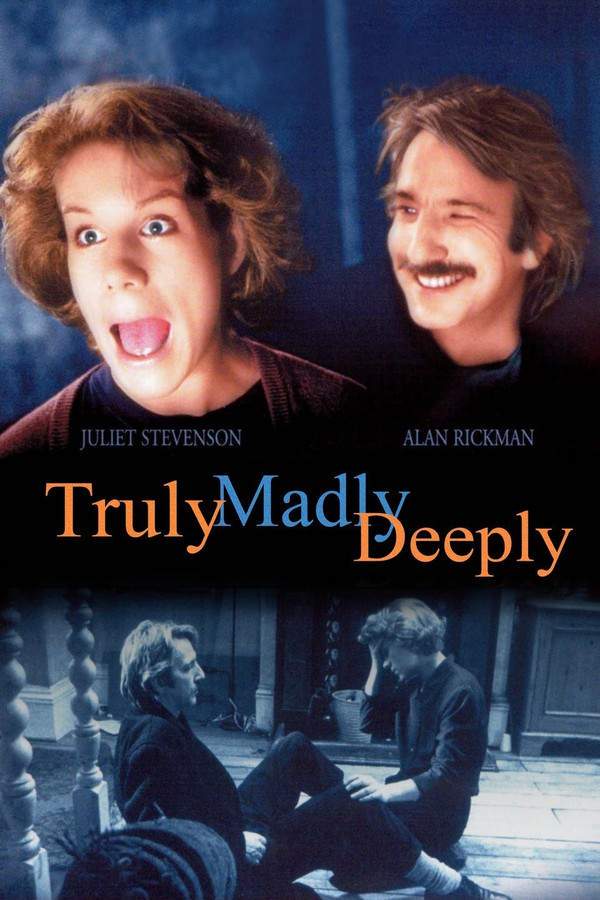
Truly Madly Deeply (1991) movie poster

Plot Summary

Truly Madly Deeply (1991) Plot Summary Explained

Release, runtime and language
1991 · 106 min · English
Directed by
Anthony Minghella
Starring
Alan Rickman, Juliet Stevenson

A grieving pianist in London is unexpectedly visited by the ghost of her former lover, a talented cellist. As he reappears in her life, she confronts unresolved emotions and navigates the complexities of love, loss, and the possibility of a connection that defies the boundaries of life and death. The poignant story explores themes of regret and the enduring power of the human heart.

On this page (6)
  1. 1 Where to watch
  2. 2 What happens: full plot
  3. 3 Plot questions answered
  4. 4 Movie threads
  5. 5 Movies like Truly Madly Deeply
  6. 6 Every angle

Where to watch

Where to Watch Truly Madly Deeply (1991)

Where can you watch Truly Madly Deeply? Stream, rent or buy it in the US, including on Amazon Video: current JustWatch availability with up-to-date prices.

Streaming availability powered by JustWatch

Full plot summary · contains spoilers

What Happens in Truly Madly Deeply: Full Plot Summary

The whole story of Truly Madly Deeply (1991) explained, from the opening scene to the final frame: every key event, every twist and what it all adds up to. Read it as a quick recap before the sequel, to check a scene you missed, or to finally understand what really happened.

Nina, an interpreter, is beside herself with grief after the recent death of her boyfriend, Jamie, a cellist. In her darkest moment, the bond they shared seems to defy the distance between life and death as Jamie returns as a ghost, and the two are unexpectedly reunited. The raw ache of loss gives way to a fragile, breath-held happiness as they navigate this impossible reunion, and the film uses their renewed closeness to explore what memory can and cannot preserve.

The reappearance is not a pure comfort. Jamie speaks from the margins of Nina’s life, carrying memories of their shared times into the present. He recounts his days while she’s at work, and his presence becomes a catalyst for reflection. One conversation in particular nudges Nina toward embracing the world around her again; it introduces a striking image of a memorial plaque in a park, dedicated to a dead child, and the idea that reading such a plaque can spark an immediate, almost instinctual urge to hug one’s own children. This moment frames the movie’s quiet meditation on love, loss, and the ways memory can shape present choices.

Yet the ghostly return also unsettles the rhythm of Nina’s life. Jamie’s behavior, though rooted in affection, is oddly self-centered and intrusive. He turns up the central heating to an almost suffocating heat, rearranges furniture, and even invites back “ghost friends” to watch videos, turning ordinary days into uneasy oscillations between tenderness and disruption. The juxtaposition of warmth and irritation tests Nina’s patience and her ability to hold onto the past while trying to move forward.

Amid this tension, Nina crosses paths with Mark, a psychologist who offers a different kind of support and a potential path toward healing. Her attraction to him grows, but the ghostly presence complicates her willingness to build something new. The question of whether she can let go of Jamie—while still loving him in memory—looms large, and she voices a stark, aching query: Was it always like this?

Despite the strain, Jamie’s love remains real, even as his behavior highlights the imperfections in the memory she has preserved. He eventually decides to leave, not out of malice, but to give Nina the opportunity to move on with her life. This choice marks a turning point in the film’s delicate balance between devotion and independence, memory and possibility.

As the story moves toward its quiet close, a moment of quiet resignation settles over the scene. Jamie watches Nina walk away, and in a final exchange with a fellow ghost, a simple question is asked: Well? And the answer comes softly, with a cautious smile: > I think so... Yes. The line signals that the central conceit—the ghost’s return—has fulfilled its purpose: to challenge Nina’s idealized memory of him and to push her toward a fuller, less perfect but more earned future.

What remains is a lucid portrait of grief processed through memory, love, and the awkward, hopeful space where letting go becomes an act of mercy. The film uses intimate, everyday details—the heat of a room, the pull of a memory, the presence of unseen company—to remind us that healing often arrives not as a dramatic breakthrough, but as a patient accumulation of small, truthful choices. It’s a story about how love can endure even when it is tempered by loss, and how sometimes a difficult, honest ending can open the door to a more genuine beginning.

Last updated: February 18, 2026 at 23:43

Was this helpful?

Plot questions answered

Truly Madly Deeply Plot Explained: Your Questions Answered

The questions people ask most about Truly Madly Deeply (1991): what happens in the confusing scenes, why the characters do what they do, the twists, hidden details and what the ending means. Each answer contains spoilers.

Q1

Why does Jamie act so selfishly after returning as a ghost?

Jamie deliberately acts in self-centered ways, cranking up the heat, rearranging furniture, and inviting ghost friends over, to disrupt Nina's idealized memory of him. This is part of his plan to help her move on. By showing her the imperfections in their relationship and making his presence uncomfortable, he forces her to see him as a real person rather than a perfect idealized version, which allows her to eventually let go.

Foreshadowing: Early scenes already show Jamie making minor intrusions that hint at his disruptive purpose.

  • jamie
  • ghost
  • memory
  • self-centered behavior
  • idealization
Q2

What is the significance of the memorial plaque scene?

During a conversation, Jamie points to a memorial plaque in a park dedicated to a dead child and suggests that reading it gives parents an instinctual urge to hug their own children. This moment serves as a catalyst for Nina to embrace life again, representing how confronting mortality can sharpen one's appreciation for living. It frames the film's meditation on how memory and loss shape present choices.

  • memorial plaque
  • park
  • children
  • embracing life
  • memory
Q3

Why does Jamie decide to leave?

Jamie leaves not out of malice but to give Nina the opportunity to move on with her life. His departure is framed as a sacrifice, it represents the culmination of his secret mission to help her heal. By removing himself, he allows her to build a future without the weight of romantic fantasy, enabling her to pursue a genuine connection with someone like Mark.

Foreshadowing: Jamie's earlier disruptive behavior plants the seeds for his eventual departure.

  • jamie leaves
  • departure
  • moving on
  • sacrifice
  • healing
Q4

What does the final exchange between Jamie and the other ghost mean?

At the end, a fellow ghost asks Jamie "Well?" and he responds "I think so... Yes." This exchange reveals that the ghosts were cooperating in a deliberate plan. The other specters were in on Jamie's mission to help Nina. His cautious, hopeful answer confirms that his task, tarnishing Nina's idealized memory to help her heal, is complete.

Foreshadowing: The presence of Jamie's ghost friends throughout the film hints at a larger ghostly community.

  • final scene
  • ghost friends
  • plan
  • closure
  • resolution
Q5

What is the central conceit of the movie?

The central conceit is that Jamie returned as a ghost specifically to help Nina get over him. Rather than coming back to rekindle their romance, his mission was to tarnish her perfect memory of him by acting imperfectly. This calculated strategy was designed to jolt her toward independence and allow her to embrace a new future beyond their relationship.

Foreshadowing: Jamie's increasingly irritating behavior foreshadows this reveal.

  • central conceit
  • twist
  • ghost mission
  • idealization
  • healing
Q6

What does Nina mean when she asks "Was it always like this?"

When Nina asks "Was it always like this?" she is questioning whether the problems in her relationship with Jamie were always present or if she simply overlooked them while he was alive. This moment marks her growing realization that she may have idealized Jamie, ignoring his flaws. It represents a turning point where she begins to see their relationship more clearly and honestly.

  • nina
  • doubt
  • relationship
  • idealization
  • self-reflection
Q7

Who is Mark and what role does he play in the story?

Mark is a psychologist whom Nina meets while seeking help. He represents a potential path toward healing and a new romantic connection. His presence complicates Nina's reluctance to move on, as she is attracted to him but held back by Jamie's lingering ghost. Mark symbolizes the living, forward-looking future that Nina must eventually choose.

  • mark
  • psychologist
  • new love
  • healing
  • future
Q8

Why did Jamie return as a ghost?

Jamie returned as a ghost to help Nina overcome her grief and move on with her life. His return was not meant to reunite them romantically but to challenge and ultimately dissolve her idealized memory of him. By disrupting her grief with his imperfect presence, he enabled her to find closure and embrace new possibilities.

Foreshadowing: The entire narrative arc builds toward this understanding.

  • jamie
  • return
  • ghost
  • purpose
  • closure
Q9

How does the film explore grief and memory?

The film presents grief as a process that can preserve idealized memories, making it both comforting and阻碍ing. Nina's grief initially traps her in a perfect memory of Jamie. The film shows how memory can shape present choices, and how confronting the imperfect reality of a lost loved one can paradoxically help healing. Jamie's ghost becomes a mirror reflecting both the value and limitations of preserved memory.

  • grief
  • memory
  • healing
  • loss
  • idealization
Q10

What does the ending mean for Nina's future?

The ending suggests Nina can now pursue a genuine future, not defined by romantic fantasy. With Jamie's mission complete, she sees him more clearly and can release idealized longing. The cautious hope at the close indicates she is ready to make her own choices, potentially including Mark, living a life informed by memory but not controlled by it.

  • ending
  • hope
  • future
  • closure
  • independence

Movie threads

More Movies Like Truly Madly Deeply, by Mood & Story

Curated lists built around what makes Truly Madly Deeply tick: the same mood, the same kind of story or the same emotional payoff. Each list explains why these movies belong together.

Gentle movies about grief and magic like Truly Madly Deeply

Stories where magic and memory gently help mend a broken heart. If you found 'Truly Madly Deeply' moving, explore these movies like it that blend grief with gentle fantasy. This collection features bittersweet stories where love lightly brushes against the supernatural, helping characters navigate loss in a comforting, hopeful way.

  • melancholic
  • comforting
  • magical
  • introspective
  • gentle
  • healing
  • Tone: bittersweet, melancholic, hopeful
  • Pacing: slow, reflective, gentle
Why these movies?

The story pattern: The narrative typically begins in deep sorrow, introducing a magical or supernatural element that directly addresses the protagonist's grief. This element serves not as a source of horror, but as a catalyst for introspection and healing, guiding the character through a slow, emotional journey from paralysis toward acceptance and the possibility of new beginnings.

Why they belong together: These films are grouped together because they share a specific emotional recipe: a foundation of genuine sadness softened by a touch of the fantastical. Their pacing is slow and reflective, their tone is more bittersweet than bleak, and their primary goal is to offer a cathartic, comforting experience around the theme of loss.

Romantic fantasies about love after death like Truly Madly Deeply

Romances where love defies the finality of death in quiet, powerful ways. Looking for movies similar to 'Truly Madly Deeply'? Discover romantic fantasies where love conquers death. These films explore the bittersweet connection between the living and the departed, blending drama and fantasy to tell deeply emotional stories about letting go and moving on.

  • romantic
  • wistful
  • supernatural
  • poignant
  • emotional
  • contemplative
  • Tone: romantic, bittersweet, wistful
  • Pacing: slow, character-driven
Why these movies?

The story pattern: The plot revolves around a profound romantic connection disrupted by death. The return of a lover's spirit or presence serves as both a comfort and a challenge, creating a complex dynamic that explores idealized memories versus reality. The central conflict is internal, as the protagonist must learn to honor the past while finding the strength to live fully in the present.

Why they belong together: These movies share a high romance score blended with fantasy elements and a deeply melancholic yet hopeful tone. They prioritize emotional authenticity over plot mechanics, featuring slow pacing that allows the characters' internal struggles with love, loss, and healing to take center stage.

If you liked this

Movies Like Truly Madly Deeply

Similar movies to Truly Madly Deeply: the same genre, themes or kind of story. Each one comes with its own plot summary, timeline and ending explained.

Browse all movie summaries

Every angle

Truly Madly Deeply (1991) Explained: Plot, Timeline & Characters

Everything about Truly Madly Deeply in one place: what happens in the plot summary, the timeline in chronological order, the characters and meaning and a spoiler-free summary. What's After the Movie adds the cast, box office and post-credit scenes.

Coming soon on iOS and Android

The Plot Explained Movie Summary App

Plot summaries, endings explained and timelines on your phone. Catch up on any movie in minutes, save your favorites and never miss a twist again.

Be the first to know when we launch. Your email stays private, always.

Learn more about the app