Plot Explained Spoilers guaranteed!
Plot Explained

Browse by genre

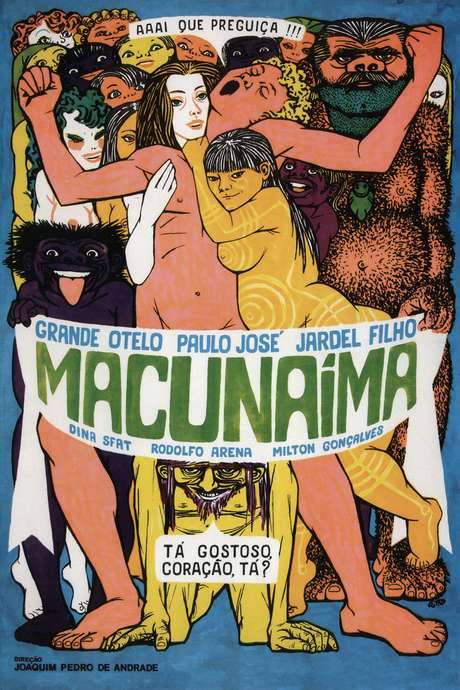
Macunaima (1969) movie poster

Characters & Themes

Macunaima (1969) Characters, Setting & Themes Explained

Release, runtime and language
1969 · 110 mins · Portuguese
Loading streaming availability…
Directed by
Joaquim Pedro de Andrade
Starring
Milton Gonçalves, Hugo Carvana, Joana Fomm, Maria Lúcia Dahl, Paulo José, Guará Rodrigues

Born as an adult black man in a remote Brazilian jungle village, Macunaíma magically transforms into a white man and travels to São Paulo. In the city he becomes a dandy, falls for the revolutionary Ci, who dies in an accidental bombing. After robbing an industrialist, he returns to his village to find his knowledge and riches of little use.

On this page (8)
  1. 1 Where to watch
  2. 2 Characters explained (6)
  3. 3 Where & when it takes place
  4. 4 Themes & meaning (3)
  5. 5 Character & meaning questions
  6. 6 Movie threads
  7. 7 Movies like Macunaima
  8. 8 Every angle
Loading streaming availability…

6 main characters · contains spoilers

Macunaima Characters Explained: Who Is Who

The main characters of Macunaima (1969), heroes and villains: what drives them, how they change over the course of the story and what each of them reveals about the film's bigger ideas.

  • Macunaíma (Grande Otelo)

    The adventurous antihero embodies the trickster archetype. Born in the Amazon with the heart of a playful child, he travels to Rio after a magical transformation that changes his skin color. His wily, irreverent view of social norms drives the misadventures that critique Brazilian society. He negotiates identity, class, and desire within a satirical frame.

    • 🗺️ Protagonist
    • 💫 Transformative
  • Jiguê (Milton Gonçalves)

    A cunning, loyal brother figure who navigates the perilous urban landscape alongside Macunaíma. He embodies resilience and street-smart pragmatism, often grounding the hero’s wilder schemes. Through his perspective, the film exposes class tensions and the complexities of Black Brazilian identity in the city.

    • 🛡️ Brother
    • ⚔️ Rival
  • Sofara (Joana Fomm)

    A central female figure who complicates Macunaíma’s journey with love, agency, and social tension. Her presence destabilizes assumptions about gender roles within the film’s satirical universe. She helps drive the plot while highlighting the era’s cultural and erotic politics.

    • 💃 Lover
    • 🔮 Ally
  • Ci (Dina Sfat)

    A guerrilla fighter whose affair with Macunaíma (the white variant) anchors the film’s political edge. She embodies resistance and danger, complicating the hero’s path and challenging power structures. Her presence sharpens the critique of violence and political allegory in the story.

    • 🗡️ Guerrilla
    • 💔 Lover
  • White Macunaíma (Paulo José)

    The white version of the hero, created by a magical spring, whose identity oscillates between two cultural selves. His transformation serves as a pointed satire of racial pretensions and social performance. He traverses both Indian mythic roots and urban modernity to expose hypocrisy in national identity.

    • 🌈 Identity
    • ⚡ Transformation
  • Venceslau Pietro Pietra (Jardel Filho)

    A wealthy patriarch representing elite power and capital, symbolizing the material forces behind cultural manipulation. He embodies the city’s economic and political upper crust, a target of the film’s satire on class and privilege. His interactions with other characters reveal the tensions between wealth, influence, and national myths.

    • 💼 Elite
    • 🏛️ Power

Last updated: February 03, 2026 at 07:28

Was this helpful?

Setting

Where and When Does Macunaima Take Place?

The setting of Macunaima (1969): the year and time period, the places and locations, and how they shape the characters, the mood and the tension of the story.

Time period

1960s Brazil

Set against the contemporary backdrop of 1960s Brazil, the narrative unfolds amid modernization and political upheaval following the 1964 coup. The urban journey mirrors the country’s social tensions, mobility, and class divisions of the era. The timing grounds the film’s allegory about race, culture, and national identity in a period of significant change.

Location

Amazon rainforest, Rio de Janeiro

From the lush Amazon rainforest where the story begins, the setting foregrounds myth and play. The action then shifts to the bustling streets of Rio de Janeiro, showcasing a clash between indigenous myth and urban modernity. These locations anchor the film’s satirical look at Brazilian society and its racial dynamics.

  • 🌳 Amazônia
  • 🏙 Rio de Janeiro
  • 🇧🇷 Brasil

Last updated: February 03, 2026 at 07:28

Was this helpful?

3 major themes

Macunaima Meaning: Themes & Message Explained

What is Macunaima (1969) really about? The emotional, social and philosophical themes the film keeps returning to, its symbolism and the message beneath the surface.

  • Identity

    The film uses the myth of Brazil’s three races to probe how national identity is constructed and contested. Macunaíma’s transformations become a satirical lens on how race, class, and culture are navigated in modern Brazil. The narrative moves between the Amazon and the city to show how identity is performative and fluid. Through humor and allegory, it questions essentialist notions of what it means to be Brazilian.

  • Magic Realism

    Folklore, miracles, and fantastical events are woven into a sharp social critique. The ‘spring turning him white’ and the quest for a magical stone insert myth into everyday life, lampooning both rural legends and urban pretensions. This magical layer exposes the contradictions of Brazilian modernity and power structures. The film uses fantasy to reveal uncomfortable truths about society.

  • Politics

    The work functions as an allegory of Brazil’s coup-era turmoil, using outrageous adventures to critique power, authority, and social order. It treats state violence and elite culture as elements of a broader cultural struggle. By lampooning nationalism and racial myths, it questions who benefits from such narratives. The journey from jungle to metropolis mirrors Brazil’s political awakening and resistance.

Last updated: February 03, 2026 at 07:28

Was this helpful?

Character & theme questions

Macunaima Characters & Meaning: Your Questions Answered

The questions people ask about Macunaima (1969): who the characters really are, their relationships, what the symbols mean, where it takes place and what the movie is really about. Each answer contains spoilers.

Q1

Where is the movie set?

The film takes place in two main locations: the Amazon rainforest where Macunaíma is born, and the bustling city of Rio de Janeiro where he travels after his transformation. These contrasting settings represent the clash between indigenous myth and urban modernity that drives the film's satirical exploration of Brazilian society.

  • amazon rainforest
  • rio de janeiro
  • setting
  • brazilian setting
Q2

When is the story set?

The film is set in 1960s Brazil, during a period of modernization and political upheaval following the 1964 military coup. This historical context grounds the film's allegory about race, culture, and national identity in a specific moment of significant social change in Brazil.

  • 1960s
  • brazil
  • historical context
  • era
Q3

What does the film say about identity?

Macunaíma uses the myth of Brazil's three races to examine how national identity is constructed and contested. The protagonist's magical transformation from black to white serves as a satirical lens on how race, class, and culture are navigated in modern Brazil, questioning essentialist notions of Brazilian identity.

  • identity
  • race
  • brazilian identity
  • transformation
  • national identity
Q4

How does the film use magic realism?

The film weaves folklore, miracles, and fantastical events like the magical spring that turns Macunaíma white into sharp social critique. This magical layer exposes the contradictions of Brazilian modernity, using fantasy to reveal uncomfortable truths about society, power structures, and racial dynamics.

  • magic realism
  • fantasy
  • myth
  • brazilian folklore
  • magical transformation
Q5

What is the political theme of the film?

The film functions as an allegory of Brazil's 1964 coup-era turmoil, using outrageous adventures to critique power, authority, and social order. It lampoons nationalism and racial myths, questioning who benefits from such narratives while the journey from jungle to metropolis mirrors Brazil's political awakening.

  • politics
  • military coup
  • allegory
  • power
  • social order
  • 1964
Q6

Who is the main character?

Macunaíma is an antiheroic trickster figure born in the Amazon as a black man who magically transforms into a white man. His wily, irreverent view of social norms drives the misadventures that critique Brazilian society, as he negotiates identity, class, and desire throughout his journey.

  • macunaima
  • protagonist
  • trickster
  • antihero
  • main character
Q7

Who is Ci and what is her role?

Ci is a guerrilla fighter who has a romantic affair with the white Macunaíma. She embodies resistance and political danger, anchoring the film's political edge and complicating the hero's path while challenging power structures through her revolutionary activities.

  • ci
  • guerrilla
  • revolutionary
  • resistance
  • love interest
Q8

What does the Amazon setting represent?

The Amazon rainforest represents myth, tradition, and indigenous cultural roots. The lush jungle setting where Macunaíma is born foregrounds folklore and play, serving as a contrast to the urban modernity he encounters in Rio de Janeiro.

  • amazon
  • rainforest
  • jungle
  • indigenous
  • tradition
  • mythology
Q9

Who is Sofara in the story?

Sofara is a central female figure who complicates Macunaíma's journey with love, agency, and social tension. Her presence destabilizes assumptions about gender roles within the film's satirical universe while highlighting the era's cultural and erotic politics.

  • sofara
  • female character
  • gender roles
  • love interest
Q10

How does Rio de Janeiro contrast with the jungle?

Rio de Janeiro represents urban modernity, class divisions, and the complexities of city life for Black Brazilians. The shift from the mythical Amazon to the bustling city streets showcases the clash between indigenous myth and urban pretensions that is central to the film's satire.

  • rio de janeiro
  • city
  • urban
  • jungle
  • contrast
  • modernization

Movie threads

More Movies Like Macunaima, by Mood & Story

Curated lists built around what makes Macunaima tick: the same mood, the same kind of story or the same emotional payoff. Each list explains why these movies belong together.

Satirical Magical Realism Movies like Macunaima

Stories that use fantasy and humor to deliver poignant cultural critiques. If you enjoyed the allegorical critique and whimsical tone of Macunaima, you'll find similar stories here. These movies use fantasy, satire, and a touch of melancholy to explore complex themes, offering a unique blend of humor and social commentary.

  • satirical
  • allegorical
  • whimsical
  • melancholic
  • playful
  • absurd
  • Tone: whimsical, satirical, melancholic
  • Pacing: variable, episodic
Why these movies?

The story pattern: Narratives in this thread often follow a protagonist on a surreal journey through a society in conflict with itself. The story uses symbolic characters and events to critique social structures, blending episodic, often absurd adventures with moments of genuine emotional weight, leading to a reflective, often bittersweet conclusion.

Why they belong together: These movies are grouped for their shared approach to storytelling: using a fantastical, humorous lens to examine real-world issues. They create a distinct vibe where laughter is intertwined with poignant insight, making the societal critique more digestible and memorable.
Movies about Transformation and Culture Shock like Macunaima

Protagonists undergo a physical or spiritual transformation into a new society. Fans of Macunaima's story of a magical transformation and a journey from jungle to city will appreciate these films. They explore the disorienting and illuminating experience of crossing between vastly different worlds, focusing on identity, adaptation, and the price of change.

  • transformative
  • culture shock
  • identity crisis
  • bittersweet
  • journey
  • allegorical
  • Tone: bittersweet, reflective, absurd
  • Pacing: variable, journey-based
Why these movies?

The story pattern: The narrative pattern involves a protagonist undergoing a significant transformation—literal or metaphorical—that transports them to a new environment. The core conflict arises from their attempt to navigate this unfamiliar world, leading to a journey of self-discovery that often ends with a sense of disillusionment or a changed perspective on their original home.

Why they belong together: These films share a core narrative structure and emotional arc centered on transformation and cultural displacement. They resonate with viewers interested in stories about identity, the dissonance between rural/urban life, and the bittersweet nature of gaining knowledge at a personal cost.

If you liked this

Movies Like Macunaima

Similar movies to Macunaima: the same genre, themes or kind of story. Each one comes with its own plot summary, timeline and ending explained.

Browse all movie summaries

Every angle

Macunaima (1969) Explained: Plot, Timeline & Characters

Everything about Macunaima in one place: what happens in the plot summary, the timeline in chronological order, the characters and meaning and a spoiler-free summary. What's After the Movie adds the cast, box office and post-credit scenes.

Coming soon on iOS and Android

The Plot Explained Movie Summary App

Plot summaries, endings explained and timelines on your phone. Catch up on any movie in minutes, save your favorites and never miss a twist again.

Be the first to know when we launch. Your email stays private, always.

Learn more about the app