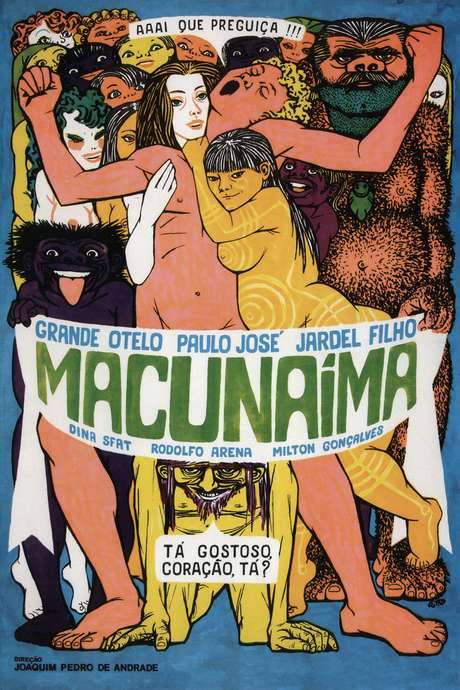
Based on Mário de Andrade's 1928 book, this modern-day parable follows the misadventures of a Black Macunaíma, Grande Otelo, born to an old woman, Paulo José, who is said to belong to Brazil’s Indigenous peoples in the Amazon. Though he arrives fully grown, he carries the heart of a playful child, mixing wit, charm, and a stubborn curiosity about the world around him. His early life in the jungle is marked by a blend of humor and mischief, as if the world itself is testing a spirit that refuses to be neatly categorized.
After the death of his mother, a spring appears and turns him white, an improbable transformation that propels him toward a new life beyond the forest. With this change, he and his two brothers set out for Rio de Janeiro, only to be met with suspicion and interrogation by street criminals and other forces of urban life as soon as they arrive. The city’s rough edges contrast sharply with the wild freedom of the Amazon, and the journey becomes a crucible where identity, luck, and circumstance collide.
The tale then threads in a romance that complicates his identity: an affair with Ci, the guerrilla killer played by Dina Sfat, and a union that yields a black boy. The drama of Ci’s presence and the birth of the child deepen Macunaíma’s wanderings, as he navigates love, loyalty, and the unpredictable turns of fate. When Ci and the child die, the hero is left to carry on with a new sense of purpose, venturing onward in search of a magical stone that he believes can change his fate. This quest drives him further into a world where magic, luck, and danger mingle in equal measure.
Throughout the odyssey, the film uses Macunaíma to dramatize a broader cultural conversation. The story frames an essentialist myth of the three Brazilian races—White, Black, and Indigenous—through the protagonist, his brothers, and his mother, turning personal exploits into a symbolic map of national identity. The tone remains steeped in satire and surreal humor, inviting viewers to read Brazil’s social fabric through the lens of a trickster figure who refuses to be pinned down by simple labels. As the adventures unfold, Macunaíma learns hard truths about Brazilian life and society, using his evolving identity to mirror the country’s contradictions, hopes, and upheavals.
In the end, the film presents a nuanced portrait of a nation in flux. It treats identity as a living, shifting mosaic rather than a fixed category, all while offering a cutting, lyrical commentary on the political tremors that followed Brazil’s military coup. The result is a saga that is as much about cultural memory and myth as it is about individual wanderings, inviting audiences to ponder how history, myth, and personal choice shape a country’s path.


![The Discreet Charm of the Bourgeoisie [re-release] movie poster](https://whats-after-the-movie-ti152.sevalla.storage/movies/the-discreet-charm-of-the-bourgeoisie.jpg)