Plot Explained Spoilers guaranteed!
Plot Explained

Browse by genre

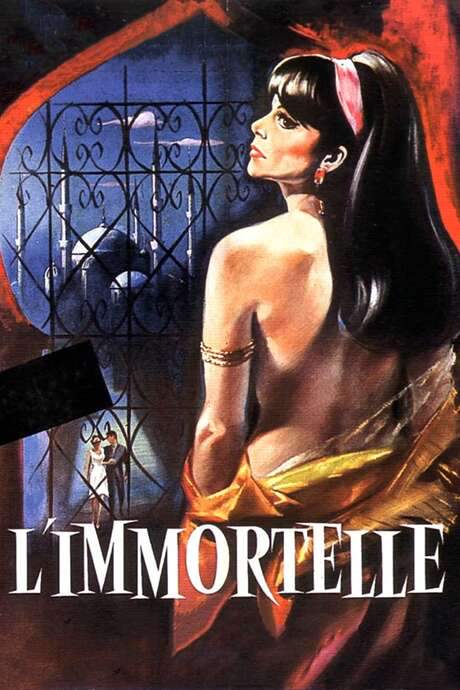
L’Immortelle (1963) movie poster

Plot Summary

L’Immortelle (1963) Plot Summary Explained

Release, runtime and language
1963 · 102 mins · French
Loading streaming availability…
Directed by
Alain Robbe-Grillet
Starring
Françoise Brion, Catherine Robbe-Grillet, Jacques Doniol-Valcroze, Sezer Sezin, Guido Celano, Ayfer Feray

While traveling, a melancholic man encounters a striking, enigmatic woman who may be tied to a prostitution ring. Their brief affair ends when she vanishes, and his attempts to find her are met with indifference, as those around him act as if they have never heard of her.

On this page (6)
  1. 1 Where to watch
  2. 2 What happens: full plot
  3. 3 Plot questions answered
  4. 4 Movie threads
  5. 5 Movies like L’Immortelle
  6. 6 Every angle
Loading streaming availability…

Full plot summary · contains spoilers

What Happens in L’Immortelle: Full Plot Summary

The whole story of L’Immortelle (1963) explained, from the opening scene to the final frame: every key event, every twist and what it all adds up to. Read it as a quick recap before the sequel, to check a scene you missed, or to finally understand what really happened.

Having taken a job in Istanbul, N, the Man, a melancholy Frenchman, rents a flat overlooking the Bosphorus. He sets out to explore the city, but he speaks only French, which makes communication difficult as he wanders through a landscape that feels both ancient and alive. The city’s sounds, smells, and distant chatter shape his mood, pulling him toward experiences he cannot fully articulate in words.

Early on, he meets L, the Woman in a white convertible who speaks both French and Turkish and is eager to show him around. She radiates a captivating mix of warmth and mystery, and she offers to guide him through neighborhoods he would otherwise miss. As they glide past mosques, markets, and stone stairways, their shared language creates a fragile bridge between two worlds, drawing him closer to a person who seems to understand his longing in ways no one else does. Their companionship has an undercurrent of secrecy, hinting at a discreet affair that could blur the lines between danger and desire.

Together they move through Istanbul’s sights, often finding themselves in deserted ruins and graveyards that give the city a hushed, cinematic silence. Yet their footsteps are seldom unobserved: sinister-looking men shadow them, sometimes with one or more ferocious dogs that punctuate the tension of each scene. The city feels both alluring and menacing, a backdrop that mirrors the Frenchman’s mounting fixation on the enigmatic woman who has entered his life so suddenly and intensely.

Then, the woman disappears. The Frenchman N, the Man is left with a growing obsession to understand who she really is and why he feels such a consuming pull toward her memory. He searches the streets and back alleys, hoping to find clues, but locals are unhelpful and offering little in the way of answers. His quest leads him to a crowded street where, for a fleeting moment, he sees her again, and she treats him to a sudden, urgent escape in her car. The thrill is quickly tempered by danger as she tries to dodge one of the shadowing dogs, and the car crashes. He emerges with barely a scratch, but the woman is dead in the wreck.

The loss deepens his fixation rather than dulling it. He remains haunted by what he experienced and who she might have been, speculating that she could have been a high-class prostitute among Istanbul’s hidden circles. The mystery intensifies as he continues to search for answers about her life and identity, insisting on piecing together the fragments of memory that linger after her death.

In a final, fatal echo of their first encounter, the man acquires the wrecked car once more, having it repaired and then taking to the same road where the tragedy began. The attempt to rewrite what happened—almost a re-enactment of that night—ends with both of them meeting their end on that same stretch of asphalt, sealing a circular, tragic romance that lingers long after the screen goes dark.

Last updated: March 05, 2026 at 18:41

Was this helpful?

Plot questions answered

L’Immortelle Plot Explained: Your Questions Answered

The questions people ask most about L’Immortelle (1963): what happens in the confusing scenes, why the characters do what they do, the twists, hidden details and what the ending means. Each answer contains spoilers.

Q1

Why does the woman vanish without any explanation?

The woman's disappearance is deliberate and mysterious. After their time together exploring Istanbul's ruins, she simply leaves without warning or farewell. The film never provides a clear reason for her departure, suggesting either she was involved in secretive activities (possibly prostitution as later speculated) or that her existence is more ambiguous than it appears. This vanishing sets the protagonist's obsessive search in motion, which becomes the engine of the entire narrative.

Foreshadowing: Their affair was described as "discreet," hinting at a relationship that existed outside normal social boundaries.

  • woman disappearance
  • istanbul
  • mystery
  • missing person
  • obsession
Q2

Who was the woman really? What was her identity?

The film deliberately keeps her identity ambiguous. The Frenchman later speculates she may have been a high-class prostitute operating within Istanbul's hidden circles, which would explain the sinister men who shadowed them and the secrecy surrounding her. However, this remains unconfirmed speculation. The oneiric quality of the film suggests her identity might be deliberately unknowable, possibly a projection of the protagonist's own desires and loneliness rather than a concrete person.

Foreshadowing: The presence of sinister men with dogs during their outings hinted at dangerous connections beyond their romantic encounter.

  • woman identity
  • prostitute
  • istanbul secret circles
  • who is she
Q3

Why do locals act as if they never heard of her when asked about the woman?

The locals' refusal to acknowledge the woman is one of the film's central mysteries. When the Frenchman searches for her, he encounters indifference and evasive responses, with people acting as if she never existed. This could suggest the woman was involved in illegal activities and those around her remain silent out of fear. Alternatively, the surreal tone implies this might reflect the protagonist's fractured perception, his obsession distorting reality or creating a memory of someone who was never truly there.

  • locals
  • denial
  • istanbul
  • indifference
  • search
  • memory distortion
Q4

Why does the Frenchman become so obsessed with finding this woman?

His obsession stems from multiple factors: his initial isolation in a foreign city where he cannot speak the language, the profound emotional connection he felt with someone who could bridge his linguistic and cultural gap, and the mystery surrounding her disappearance. The intensity of their brief encounter, set against the haunting backdrop of Istanbul's ruins, created an experience that felt transcendent to him. Her death does not end his fixation; it intensifies it, turning his search into a desperate quest to make sense of what he experienced.

Foreshadowing: The opening sequence established his profound melancholy and isolation before ever meeting her, making their connection feel like a lifeline.

  • obsession
  • love
  • loneliness
  • istanbul
  • fixation
  • frenchman
Q5

What is the significance of the sinister men and ferocious dogs that follow them?

The men with dogs appear throughout their sightings together, creating an atmosphere of persistent threat. They likely represent the dangerous world the woman inhabits, possibly connected to a prostitution ring or criminal network. The dogs can be read as symbols of pursuit, danger, and the primal instincts that shadow the protagonists. Their presence creates tension that contrasts with the romantic, atmospheric moments, suggesting the woman's world is fundamentally hazardous.

Foreshadowing: Their movements were 'seldom unobserved' from the earliest moments of their acquaintance.

  • men
  • dogs
  • threat
  • danger
  • pursuit
  • prostitution ring
  • surveillance
Q6

Why does the Frenchman buy the crashed car and recreate the accident that killed the woman?

After the crash that kills the woman, the Frenchman purchases the repaired vehicle and later drives the same route where the tragedy occurred, resulting in his own death. This final act represents his inability to let go of the memory and his desire to be reunited with her, even in death. It also suggests a fatalistic acceptance, he cannot exist in a world without her, so he chooses to follow her path. The circular structure of the film (repeating the accident on the same road) reinforces themes of obsession, inevitability, and self-destruction.

Foreshadowing: The crash site was described as 'where the tragedy began,' suggesting its significance would echo forward.

  • car crash
  • death
  • fate
  • recreation
  • reunion
  • suicide
  • obsession ending
Q7

Is the woman real or just a figment of the Frenchman's imagination?

The film deliberately leaves this ambiguous. The surreal quality, where locals deny her existence, where sinister figures appear and vanish, where the protagonist's memory seems to distort reality, suggests the woman could be a projection of his loneliness and desire. However, there are also concrete details: she speaks two languages, drives a specific car, is seen by others briefly. The most likely interpretation is that she was real but operating in a secretive, possibly illegal sphere that makes her difficult to trace, while the film uses this ambiguity to explore themes of memory, obsession, and the stories we create about people we've lost.

  • reality vs fantasy
  • memory
  • projection
  • surreal
  • oneiric
  • real or imagined
Q8

What does the ending mean? Why does he die on the same road?

The ending represents the fulfillment of the protagonist's obsessive quest. By driving the repaired car on the same road where the woman died, he essentially performs a reenactment that ends in his own death. This creates a tragic circularity, he began the story arriving in Istanbul and ends it leaving it the same way the woman did. The message appears fatalistic: his obsession was a form of self-destruction, and he could not survive without the mystery she represented. The film closes with the bleak realization that his search was never about finding answers but about surrendering to his longing.

Foreshadowing: The final act was described as 'a fatal echo of their first encounter,' making the tragic repetition inevitable.

  • ending
  • death
  • fate
  • circular story
  • tragedy
  • self-destruction
  • road crash
Q9

What does the title "L'Immortelle" mean and how does it relate to the story?

"L'Immortelle" is French for "the immortal one" or "the everlasting." The title likely refers to the woman's lasting hold on the protagonist's memory and psyche. Even after her death, she remains vividly present in his mind, driving his actions until he joins her in death. The immortality is not physical, she dies in the crash, but psychological and symbolic: his obsession makes her immortal in his obsession. Alternatively, it could suggest the eternal, unresolved nature of his search, which continues beyond death.

  • title meaning
  • immortal
  • symbolism
  • memory
  • eternal
  • everlasting
Q10

Why does the film feel so dreamlike and surreal?

The dreamlike quality is intentional, created through slow pacing, atmospheric imagery of ruins and graveyards, and the illogical behavior of characters (locals denying the woman's existence). This style reflects the protagonist's psychological state, his alienation, his obsessive fixation, and his inability to process loss rationally. The director uses these surreal elements to externalize his internal experience. The question of whether events are "real" or filtered through his mind remains unresolved, which is central to the film's mysterious, melancholic tone.

  • dreamlike
  • surreal
  • oneiric
  • atmosphere
  • psychological
  • style
  • mood

Movie threads

More Movies Like L’Immortelle, by Mood & Story

Curated lists built around what makes L’Immortelle tick: the same mood, the same kind of story or the same emotional payoff. Each list explains why these movies belong together.

Obsessive dreamlike quests like in L’Immortelle

A protagonist's obsessive search for a person or truth in a surreal, uncooperative world. If you were captivated by the obsessive search and dreamlike atmosphere of L’Immortelle, you'll find similar films here. These movies feature protagonists on melancholic quests for truth or a lost person, wrapped in a surreal, psychologically intense vibe.

  • obsessive
  • dreamlike
  • mysterious
  • melancholic
  • surreal
  • lonely
  • Tone: melancholic, mysterious, obsessive
  • Pacing: slow, deliberate
Why these movies?

The story pattern: The narrative follows a character driven by a singular, often futile, obsession—to find a person, uncover a truth, or solve a mystery. The world itself seems to resist their search, with characters who are elusive, memories that are unreliable, and a setting that feels like a labyrinth. The journey is internal as much as external, often ending in ambiguity or tragedy.

Why they belong together: Movies in this thread share a core narrative of obsession, a dreamlike or surreal tone that blurs reality, and a pacing that emphasizes psychological descent over action. They create a cohesive experience of melancholy, alienation, and the heavy emotional weight of a search that may be doomed from the start.

Atmospheric melancholy and psychological drama like in L’Immortelle

Slow-burn stories where mood and atmosphere dominate, exploring themes of isolation and grief. For viewers who loved the heavy, melancholic atmosphere and themes of alienation in L’Immortelle, this section highlights similar slow-burn dramas. These movies prioritize mood and psychological depth over plot, perfect for fans of somber, immersive cinema.

  • melancholic
  • atmospheric
  • oppressive
  • lonely
  • oneiric
  • contemplative
  • Tone: melancholic, bleak, oppressive
  • Pacing: slow, atmospheric
Why these movies?

The story pattern: The narrative in these films is often secondary to the exploration of mood and character psychology. The plot unfolds slowly, focusing on the protagonist's internal state and their relationship with an often isolating environment. Conflicts are internalized, and the climax is frequently emotional rather than action-oriented, leading to a bleak or bittersweet resolution.

Why they belong together: These films are grouped by their shared emphasis on a pervasive melancholic tone, a slow and deliberate pacing that builds atmosphere, and heavy emotional themes like grief and alienation. The viewing experience is defined by a somber, dreamlike, and psychologically immersive quality.

If you liked this

Movies Like L’Immortelle

Similar movies to L’Immortelle: the same genre, themes or kind of story. Each one comes with its own plot summary, timeline and ending explained.

Browse all movie summaries

Every angle

L’Immortelle (1963) Explained: Plot, Timeline & Characters

Everything about L’Immortelle in one place: what happens in the plot summary, the timeline in chronological order, the characters and meaning and a spoiler-free summary. What's After the Movie adds the cast, box office and post-credit scenes.

Coming soon on iOS and Android

The Plot Explained Movie Summary App

Plot summaries, endings explained and timelines on your phone. Catch up on any movie in minutes, save your favorites and never miss a twist again.

Be the first to know when we launch. Your email stays private, always.

Learn more about the app