





Plot Explained Spoilers guaranteed!
Plot Explained

Browse by genre

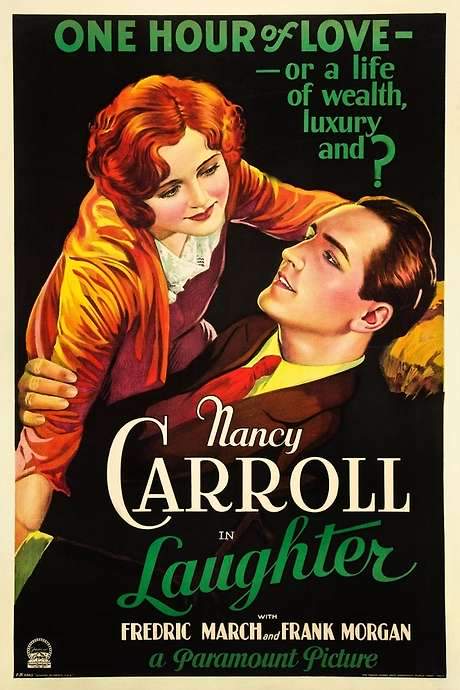
Laughter (1930) movie poster

Plot Summary

Laughter (1930) Plot Summary Explained

Release, runtime and language
1930 · 85 mins · English
Directed by
Harry d'Abbadie d'Arrast
Starring
Charles Halton, Fredric March, Eric Blore, Frank Morgan, Nancy Carroll, Diane Ellis

A modern woman, celebrated beauty Peggy of the Zeigfeld Follies, marries the older C. Morton Gibson but soon tires of their quiet life. She resists the advances of longtime friend Ralph Le Saint. When pianist Paul Lockridge arrives from Paris, he implores her to flee to France for adventure, yet Gibson’s alluring daughter complicates her choice.

On this page (6)
  1. 1 Where to watch
  2. 2 What happens: full plot
  3. 3 Plot questions answered
  4. 4 Movie threads
  5. 5 Movies like Laughter
  6. 6 Every angle

Where to watch

Where to Watch Laughter (1930)

Where can you watch Laughter? Stream, rent or buy it in the US, including on Artiflix, Amazon MX Player and Amazon Prime Video Free: current JustWatch availability with up-to-date prices.

Streaming availability powered by JustWatch

Full plot summary · contains spoilers

What Happens in Laughter: Full Plot Summary

The whole story of Laughter (1930) explained, from the opening scene to the final frame: every key event, every twist and what it all adds up to. Read it as a quick recap before the sequel, to check a scene you missed, or to finally understand what really happened.

Peggy Nancy Carroll Gibson is a Follies dancer who forsakes her carefree attachments in order to marry a millionaire. Her elderly husband, Frank Morgan C. Mortimer Gibson, is a well-meaning bore, and Peggy soon finds his conventional world stifling. Seeking something livelier than the dull routine of married life, she begins looking for entertainment elsewhere while still bound by marriage.

About a year after the wedding, three major developments unfold almost simultaneously: Peggy's former lover, Paul Lockridge, Fredric March, a witty composer and pianist, returns from Paris and offers companionship as a diversion from her stuffy life; Ralph Le Sainte, Glenn Anders, a young sculptor who is still in love with Peggy, plans his suicide in a mood of bitterness; and Mortimer's daughter Marjorie, Diane Ellis, returns from schooling abroad. Marjorie is soon paired with Ralph, and the romance that develops between them runs in parallel with the adult affair between Peggy and Paul, painting a portrait of longing, wealth, and the trouble those forces can cause in a household.

Ralph and Marjorie's escapades bring considerable trouble for Mortimer, while Paul implores Peggy to go to Paris with him, declaring:

> You are rich--dirty rich. You are dying. You need laughter to make you clean.

But Peggy refuses, torn between the security of wealth and the lure of genuine happiness. When Marjorie plans to elope with Ralph, Peggy exposes the sculptor as a fortune hunter; distraught, Ralph takes his own life. In the wake of these upheavals, Peggy confesses her unhappiness to Gibson, and ultimately decides to leave behind the stifling life she once thought would bring her contentment. She joins Paul and—amid laughter and the promise of Paris—begins a new chapter.

Last updated: February 20, 2026 at 12:26

Was this helpful?

Plot questions answered

Laughter Plot Explained: Your Questions Answered

The questions people ask most about Laughter (1930): what happens in the confusing scenes, why the characters do what they do, the twists, hidden details and what the ending means. Each answer contains spoilers.

Q1

Why did Peggy marry Mortimer Gibson when she knew he'd be boring?

Peggy married Mortimer for financial security. As a Follies dancer, she sought to escape her precarious lifestyle by marrying a wealthy man. However, she underestimated how suffocating the marriage would be. The summary shows she immediately began seeking excitement outside the marriage, revealing that wealth alone couldn't fulfill her.

Foreshadowing: Peggy's early ambition to 'marry a millionaire' directly foreshadows the emptiness she feels in her marriage.

  • Peggy Mortimer marriage
  • motivation
  • wealth
  • security
  • follies dancer
Q2

Why does Ralph commit suicide in Laughter?

Ralph kills himself after Peggy exposes him as a fortune hunter, destroying his plan to marry Marjorie for her money. Though he claimed to love Marjorie, his true motive was financial. When Peggy reveals his deceit to Mortimer and Marjorie, his prospects collapse completely, leaving him desperate and hopeless.

Foreshadowing: Ralph's earlier plan to commit suicide 'in a mood of bitterness' establishes his unstable emotional state.

  • Ralph suicide
  • fortune hunter
  • exposed
  • Marjorie
  • despair
Q3

What does Paul mean by 'dirty rich' and 'laughter' in Laughter?

Paul tells Peggy she is 'dirty rich' and 'dying' because wealth alone has made her spiritually empty. He argues that 'laughter', meaning joy, freedom, and genuine companionship, is what she needs to feel alive again. His plea encapsulates the film's theme that material security cannot replace emotional fulfillment.

  • Paul
  • Paris
  • laughter
  • freedom
  • wealth
  • joy
  • companionship
Q4

Why does Peggy expose Ralph as a fortune hunter?

Peggy reveals Ralph's true intentions when she learns he plans to elope with Marjorie solely for her money. Though Peggy herself is pursuing happiness outside her marriage, she cannot stomach Ralph's exploitation of Marjorie's innocence. Her exposure leads to tragic consequences but reflects her moral conflict about honesty and protecting the innocent.

Foreshadowing: Peggy's own affair with Paul creates tension with her judgment of Ralph's deceit.

  • Ralph fortune hunter
  • expose
  • Marjorie
  • moral conflict
  • deceit
Q5

How are Peggy and Paul's and Ralph and Marjorie's relationships similar?

Both relationships involve younger people pursuing older, wealthier partners. Peggy leaves her dull husband for Paul, while Ralph pursues Marjorie for her inheritance. The parallel highlights how money distorts love in this household, Peggy seeks genuine happiness while Ralph seeks financial gain, yet both relationships transgress social boundaries.

  • parallel romance
  • Margie
  • Ralph
  • comparison
  • love
  • money
Q6

Why does Peggy finally leave with Paul at the end of Laughter?

After Ralph's suicide and her confession of unhappiness to Mortimer, Peggy realizes her pursuit of wealth has brought her nothing but emptiness. Ralph's tragic end and her own moral crisis convince her that genuine happiness, the 'laughter' Paul promised, matters more than financial security. She chooses emotional fulfillment over material comfort.

Foreshadowing: Peggy's earlier refusal to go with Paul shows she wasn't ready to abandon security until she confront her own unhappiness.

  • Peggy Paul Paris
  • escape
  • freedom
  • new life
  • happiness
  • choice
Q7

What was Ralph's true motivation for pursuing Marjorie?

Ralph's primary motivation was financial gain, not genuine love. Though he initially appears as a romantic figure, the story reveals him as a 'fortune hunter' who targeted Marjorie for her inheritance. Peggy's exposure of his scheme confirms he planned to exploit the wealthy household rather than pursue an authentic relationship.

Foreshadowing: Ralph's earlier plan to commit suicide when Peggy rejects him shows his emotional instability and self-interest.

  • Ralph motivation
  • Marjorie
  • fortune hunter
  • money
  • inheritance
  • exploitation
Q8

Why does Peggy refuse Paul's first offer to go to Paris?

When Paul first pleads for Peggy to join him in Paris, she refuses because she isn't yet willing to fully abandon her comfortable life with Mortimer. She still values the security and status her marriage provides. Only after Ralph's suicide and her honest conversation with Mortimer does she feel ready to leave everything behind.

Foreshadowing: Peggy's initial refusal shows her conflict between safety and happiness, she eventually chooses happiness after sufficient emotional upheaval.

  • Paris refusal
  • choice
  • security
  • first offer
  • conflict
Q9

What causes Peggy's change of heart in Laughter?

Peggy's transformation occurs gradually. After her affair with Paul begins, she experiences both excitement and guilt. Ralph's suicide after being exposed hits her deeply, she sees the destructive power of dishonesty. Her confession to Mortimer marks a turning point where she admits her marriage has failed, finally freeing her to pursue genuine happiness with Paul.

Foreshadowing: The parallel between her affair and Ralph's exploitation creates her moral awakening.

  • Peggy transformation
  • confession
  • emotional change
  • growth
  • awakening
Q10

Why does Marjorie return from schooling abroad in Laughter?

Marjorie's return from schooling abroad serves as a catalyst for the story's parallel romances. Her arrival brings new energy to the household and creates the opportunity for her relationship with Ralph. She represents youthful innocence that contrasts with Peggy's world-weary cynicism, while also becoming a victim of the household's emotional manipulations.

  • Marjorie return
  • household
  • dynamic
  • romance
  • catalyst
Q11

Why is Mortimer Gibson portrayed as a bore in Laughter?

Mortimer is depicted as well-meaning but dull, a kind man whose conventional nature cannot satisfy Peggy's need for excitement and genuine connection. His characterization represents the empty life Peggy chose for money. The film uses his boring nature to justify (though not excuse) Peggy's search for fulfillment elsewhere, making her eventual departure feel inevitable.

  • Mortimer Gibson
  • bore
  • marriage
  • conventional
  • dullness

Movie threads

More Movies Like Laughter, by Mood & Story

Curated lists built around what makes Laughter tick: the same mood, the same kind of story or the same emotional payoff. Each list explains why these movies belong together.

Movies like Laughter about bittersweet escapes from marriage

Characters seek liberation from comfortable but suffocating circumstances at an emotional cost. If you enjoyed the sophisticated dilemma in Laughter, explore these movies about characters breaking free from stifling lives. These are glamorous but melancholic romantic dramas where freedom comes with a bittersweet cost, perfect for fans of complex emotional choices.

  • yearning
  • melancholic
  • glamorous
  • romantic
  • discontent
  • liberation
  • Tone: bittersweet, melancholic
  • Pacing: steady, deliberate
Why these movies?

The story pattern: These stories typically follow a protagonist disillusioned with their current life—often a secure marriage devoid of passion—who is tempted by an offer of adventure or romance. The narrative explores the tension between duty and desire, building towards a choice for liberation that is simultaneously triumphant and tinged with regret for the relationships left behind.

Why they belong together: Movies are grouped here because they share a core emotional conflict: the yearning for personal fulfillment against the backdrop of societal and marital obligations. They balance romantic idealism with the sobering reality of consequences, creating a sophisticated, bittersweet mood that resonates deeply.

Movies like Laughter with the glamorous melancholy of the Jazz Age

Sophisticated dramas set in the opulent 1920s-30s, where glamour masks emotional turmoil. For viewers who loved the theatrical glamour and melancholic romance of Laughter, this thread features films with a similar Jazz Age vibe. Discover stories of high society, forbidden love, and personal crises set against a backdrop of beautiful costumes and a bittersweet mood.

  • theatrical
  • glamorous
  • melancholic
  • romantic
  • sophisticated
  • historical
  • Tone: melancholic, bittersweet
  • Pacing: steady, atmospheric
Why these movies?

The story pattern: Narratives in this thread are often character-driven explorations of the upper class, focusing on romantic triangles, extramarital affairs, and the clash between societal expectations and personal desire. The pacing is steady, allowing for the nuanced development of relationships against a visually sumptuous historical setting that feels both enchanting and melancholic.

Why they belong together: These films are united by their specific historical atmosphere—the Jazz Age—and a consistent mood that blends high glamour with deep-seated melancholy. They offer a similar viewing experience of elegant costumes, dramatic romance, and a bittersweet reflection on the cost of living a gilded life.

If you liked this

Movies Like Laughter

Similar movies to Laughter: the same genre, themes or kind of story. Each one comes with its own plot summary, timeline and ending explained.

Browse all movie summaries

Every angle

Laughter (1930) Explained: Plot, Timeline & Characters

Everything about Laughter in one place: what happens in the plot summary, the timeline in chronological order, the characters and meaning and a spoiler-free summary. What's After the Movie adds the cast, box office and post-credit scenes.

Coming soon on iOS and Android

The Plot Explained Movie Summary App

Plot summaries, endings explained and timelines on your phone. Catch up on any movie in minutes, save your favorites and never miss a twist again.

Be the first to know when we launch. Your email stays private, always.

Learn more about the app