














Plot Explained Spoilers guaranteed!
Plot Explained

Browse by genre

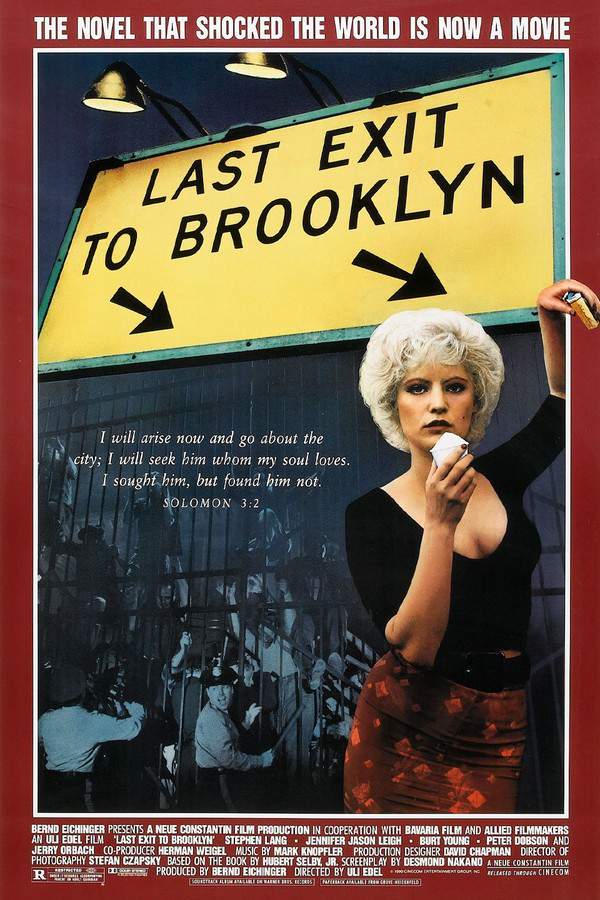
Last Exit to Brooklyn (1990) movie poster

Characters & Themes

Last Exit to Brooklyn (1990) Characters, Setting & Themes Explained

Release, runtime and language
1990 · 102 min · English
JustWatch #12,964 6
Directed by
Uli Edel
Starring
Stephen Lang, Burt Young, Jennifer Jason Leigh, Stephen Baldwin, Peter Dobson, Sam Rockwell

In 1950s Brooklyn, a closeted factory worker yearns for meaningful relationships but faces obstacles due to the social norms of the time. Simultaneously, a young teenager navigates a difficult life on the streets, highlighting the city’s underlying issues and the challenges faced by those living on the margins. Both stories explore themes of isolation, survival, and the search for acceptance in a changing society.

On this page (9)
  1. 1 Where to watch
  2. 2 Characters explained (8)
  3. 3 Where & when it takes place
  4. 4 Themes & meaning (4)
  5. 5 Character & meaning questions
  6. 6 The book behind the movie
  7. 7 Movie threads
  8. 8 Movies like Last Exit to Brooklyn
  9. 9 Every angle

Where to watch

Where to Watch Last Exit to Brooklyn (1990)

Where can you watch Last Exit to Brooklyn? Stream, rent or buy it in the US, including on Amazon Prime Video, Hoopla and Kanopy: current JustWatch availability with up-to-date prices.

Streaming availability powered by JustWatch

8 main characters · contains spoilers

Last Exit to Brooklyn Characters Explained: Who Is Who

The main characters of Last Exit to Brooklyn (1990), heroes and villains: what drives them, how they change over the course of the story and what each of them reveals about the film's bigger ideas.

  • Harry Black (Stephen Lang)

    Harry Black is a shrewd, self-serving union steward who relishes his role as strike secretary, using it to justify time away from his wife and to exercise influence over others. He navigates a double life, concealing his sexuality while courting Regina, which invites personal cost. After a riot at the factory, he earns temporary acclaim but is later fired for expense abuses and absence, leaving him broken.

    • 💼 Union leader
    • ❤️ Complex relationships
    • 🧭 Hidden identity
  • Big Joe (Burt Young)

    Big Joe is a protective, hot-tempered worker who faces a personal crisis when his daughter becomes pregnant by Tommy. He wrestles with loyalty to his family and to the strike, often clashing with others as he defends his kin. His arc exposes the brutal tensions of a community under economic stress.

    • 👨‍👦 Father
    • 🥊 Conflict
    • 🛡️ Protector
  • Tralala (Jennifer Jason Leigh)

    Tralala is a streetwise prostitute who lures sailors into danger and poverty, using her wits to survive in a hostile world. Her arc spans seduction, betrayal and trauma as she falls into a brutal gang rape and ends up catatonic, illustrating the perilous underbelly of the city. Her pursuit of affection leads her to moments of vulnerability and loss.

    • 💃 Prostitute
    • 🧭 Survivor
  • Georgette (Maia Danziger)

    Georgette is a young transgender woman who harbors a crush on Vinnie, revealing the film's thread of nontraditional love and social marginalization. She participates in the strife and personal drama of the strike, seeking connection in a rough urban world. Her presence highlights gender identity issues in 1950s Brooklyn.

    • 🧭 Transgender
    • ❤️ Unrequited love
  • Vinnie (Peter Dobson)

    Vinnie is an ex-convict and Tralala's pimp who profites from the sailors and the chaos of the strike. He manipulates people and orchestrates dangerous schemes around the trucks and strike actions. His actions drive much of the violence and exploitation in the story.

    • 💼 Pimp
    • 💥 Antagonist
  • Tommy (Stephen Baldwin)

    Tommy is a motorcycle-riding factory worker who becomes the fiancé (and eventual husband) of Joe's daughter, symbolizing a younger generation's hopes. He confronts Joe and other tensions but generally strives for resolution and family unity, including planning the wedding just as the strike's outcome is revealed. His arc ties personal ambition to communal conflict.

    • 🏍️ Worker
    • 👰 Family
    • 🕊️ Reconciliation
  • Boyce (Jerry Orbach)

    Boyce is the union leader who negotiates between management and workers, offering a pragmatic but sometimes harsh stance. He becomes entangled in the strike's politics and in the fallout from Harry's schemes, ultimately playing a pivotal role in the strike's direction.

    • 💼 Union
    • ⚖️ Negotiation
  • Regina

    Regina is a transgender woman who becomes Harry's love interest, offering him emotional connection amid his external battles. Her relationship with Harry adds a layer of longing and vulnerability to the film's social commentary.

    • ❤️ Love
    • 🧭 Identity

Last updated: October 01, 2025 at 12:15

Was this helpful?

Setting

Where and When Does Last Exit to Brooklyn Take Place?

The setting of Last Exit to Brooklyn (1990): the year and time period, the places and locations, and how they shape the characters, the mood and the tension of the story.

Time period

1952

The story takes place in the early 1950s, a postwar era defined by active labor organizing and economic struggle. The six-month strike provides the moral and physical storms around which the characters' lives turn. Social attitudes toward gender and sexuality reflect a rigid era that heightens the vulnerability of marginalized people.

Location

Brooklyn, New York

Set in 1952 Brooklyn, the film unfolds amid a prolonged factory strike that grips working-class neighborhoods and the waterfront. The area is crowded with tenements, bars, and street corners where alliances form and betrayals surface. The city atmosphere underscores a volatile mix of labor tension, economic precarity, and everyday violence.

  • 🏙️ Urban
  • 🏭 Industrial
  • 🧱 Tenement Neighborhood

Last updated: October 01, 2025 at 12:15

Was this helpful?

4 major themes

Last Exit to Brooklyn Meaning: Themes & Message Explained

What is Last Exit to Brooklyn (1990) really about? The emotional, social and philosophical themes the film keeps returning to, its symbolism and the message beneath the surface.

  • Exploitation

    The film exposes how vulnerable people—prostitutes, workers, and marginalized individuals—are exploited by those in power and by the chaotic structure of urban life. Relationships are transactional, and people use others to secure safety, money, or escape. This theme threads through Tralala's downfall and the cynical manipulations of Vinnie.

  • Conflict

    A strike escalates into riot as strikers confront strikebreakers and police, mirroring the broader clash between labor and capital. The violence punctuates daily life and shatters any illusion of control for the characters. Authority's use of force reveals the limits of the workers' solidarity.

  • Love

    Romance complicates survival as characters seek connection amid harsh conditions. Harry's romance with Regina and the precarious bonds between Tralala and others show how love can offer solace but also lead to vulnerability. The film juxtaposes tender moments with brutal realities.

  • Identity

    Georgette and Regina challenge conventional gender norms of the era, presenting non-normative identities against a backdrop of prejudice. Their experiences illuminate how the era constrains personal authenticity while also offering moments of tenderness. The characters' self-expression becomes a quiet act of resistance in a harsh city.

Last updated: October 01, 2025 at 12:15

Was this helpful?

Character & theme questions

Last Exit to Brooklyn Characters & Meaning: Your Questions Answered

The questions people ask about Last Exit to Brooklyn (1990): who the characters really are, their relationships, what the symbols mean, where it takes place and what the movie is really about. Each answer contains spoilers.

Q1

What is the setting of Last Exit to Brooklyn and why does it matter?

The film is set in 1952 Brooklyn, specifically in a working-class neighborhood marked by tenements, bars, and street corners. This setting is crucial because it places the story in a world defined by labor strife, economic precarity, and everyday violence. The prolonged factory strike creates the moral and physical storm around which the characters' lives turn, making the urban environment a character in itself rather than just a backdrop.

Foreshadowing: The opening scenes establish Brooklyn's gritty atmosphere through crowded living spaces and tense union meetings, setting the stage for the conflict to come.

  • brooklyn setting
  • 1952
  • labor strike
  • urban environment
  • tenement
Q2

When does Last Exit to Brooklyn take place?

The story takes place in 1952, during the early postwar era. This time period is significant because it was marked by active labor organizing and economic struggle, with the six-month strike providing the backdrop for the film's central conflict. The rigid social attitudes of the 1950s toward gender and sexuality also heighten the vulnerability of marginalized characters like Harry and Georgette.

  • 1950s
  • 1952
  • postwar era
  • labor movement
  • historical setting
Q3

What does the film say about exploitation?

The film exposes how vulnerable people, prostitutes, workers, and marginalized individuals, are exploited by those in power and by the chaotic structure of urban life. Relationships become transactional, with people using others to secure safety, money, or escape. This theme threads through Tralala's downfall and the cynical manipulations of Vinnie, showing how the system itself breeds exploitation.

Foreshadowing: Early scenes of Tralala working the streets and Vinnie orchestrating schemes hint at the transactional nature of relationships throughout the film.

  • exploitation
  • vulnerability
  • power dynamics
  • transactional relationships
  • survival
Q4

How does Last Exit to Brooklyn explore identity?

Through Georgette and Regina, the film challenges conventional gender norms of the 1950s, presenting non-normative identities against a backdrop of prejudice. Their experiences illuminate how the era constrains personal authenticity while also offering moments of tenderness. The characters' self-expression becomes a quiet act of resistance in a harsh city, highlighting the struggle for selfhood amid social rigidness.

Foreshadowing: Georgette's crush on Vinnie early in the film establishes her character's search for connection and acceptance.

  • identity
  • transgender
  • gender norms
  • self-expression
  • acceptance
Q5

Who is Harry Black and what role does he play?

Harry Black is a union steward and strike secretary who relishes his role as a way to exercise influence over others. He navigates a double life, concealing his homosexuality while courting Regina, which invites personal cost. Harry uses his position to justify time away from his wife, but his actions ultimately lead to his downfall when he is fired for expense abuses and absence after the riot.

Foreshadowing: Harry's secretive behavior around his true self and his enjoyment of union power early on foreshadow his eventual unraveling.

  • harry black
  • union steward
  • strike leader
  • closeted homosexuality
  • double life
Q6

Who is Tralala and what does she represent in the story?

Tralala is a streetwise prostitute who lures sailors into danger and poverty, using her wits to survive in a hostile world. She represents the perilous underbelly of the city and the extreme vulnerability of women on the margins. Her arc spans seduction, betrayal, and trauma, culminating in a brutal attack that leaves her catatonic. Her pursuit of affection leads to moments of vulnerability and loss, illustrating how love can become a liability in a brutal world.

Foreshadowing: Tralala's risky dealings with sailors from the beginning establish the danger inherent in her profession.

  • tralala
  • prostitute
  • survival
  • vulnerability
  • exploitation
Q7

Who is Georgette and what is her significance?

Georgette is a young transgender woman who harbors a crush on Vinnie, revealing the film's thread of nontraditional love and social marginalization. She participates in the strife and personal drama of the strike, seeking connection in a rough urban world. Her presence highlights gender identity issues in 1950s Brooklyn and serves as a quiet testament to the struggles faced by those who could not openly be themselves.

Foreshadowing: Georgette's interactions with Vinnie early establish her romantic interest and her vulnerability.

  • georgette
  • transgender woman
  • 1950s
  • gender identity
  • marginalization
Q8

What role does the labor strike play in the film?

The labor strike serves as the central conflict that drives the narrative. It escalates into riot as strikers confront strikebreakers and police, mirroring the broader clash between labor and capital. The violence punctuates daily life and shatters any illusion of control for the characters. Authority's use of force reveals the limits of workers' solidarity, while the strike's outcome affects all the interwoven storylines.

Foreshadowing: Early union meetings and tensions between workers and management establish the strike as the film's central tension.

  • labor strike
  • union conflict
  • workers
  • riots
  • class struggle
Q9

How does the film portray love and romance?

Romance complicates survival as characters seek connection amid harsh conditions. Harry's romance with Regina and the precarious bonds between Tralala and others show how love can offer solace but also lead to vulnerability. The film juxtaposes tender moments with brutal realities, suggesting that love in this environment is both a refuge and a potential weakness that can be exploited.

Foreshadowing: Harry and Regina's early encounters establish the potential for tenderness amidst the chaos.

  • love
  • romance
  • relationships
  • tenderness
  • vulnerability
Q10

Is the film set in Brooklyn or Manhattan?

The film is explicitly set in Brooklyn, specifically in working-class neighborhoods. The title itself, Last Exit to Brooklyn, signals that the story takes place entirely in Brooklyn, not Manhattan. The area is characterized by tenements, factories, and waterfront areas where the strike unfolds, contrasting with Manhattan's more commercial and professional spaces.

  • brooklyn
  • manhattan
  • setting
  • new york city
  • location

Movie threads

More Movies Like Last Exit to Brooklyn, by Mood & Story

Curated lists built around what makes Last Exit to Brooklyn tick: the same mood, the same kind of story or the same emotional payoff. Each list explains why these movies belong together.

Gritty Urban Ensemble Dramas like Last Exit to Brooklyn

Interconnected lives collide in a raw and decaying urban landscape. If you liked the interconnected stories and raw portrayal of city life in Last Exit to Brooklyn, you might enjoy these other movies. This list features similar ensemble dramas that explore the harsh realities and complex characters within a gritty urban environment.

  • gritty
  • oppressive
  • raw
  • tragic
  • desperate
  • urban decay
  • Tone: dark, raw, tragic
  • Pacing: steady, character-driven
Why these movies?

The story pattern: Stories in this thread follow a multi-protagonist structure, where separate but intersecting lives are examined against the backdrop of a single, oppressive urban setting. The narrative explores how poverty, violence, and societal neglect impact individuals from different walks of life, often culminating in a collective, somber reflection on survival.

Why they belong together: These movies are grouped together for their shared focus on a raw, unflinching look at urban decay and the complex web of lives within it. They share a dark tone, heavy emotional weight, and a steady pacing that allows for deep immersion into a difficult world.

Bleak Journeys of Social Outcasts like in Last Exit to Brooklyn

Characters on society's fringes face tragic fates in a hostile world. Movies like Last Exit to Brooklyn that center on characters pushed to the edges of society. If you were moved by the tragic stories of individuals grappling with their identity and place in a hostile world, these similar films explore themes of isolation, survival, and devastating outcomes.

  • tragic
  • desperate
  • lonely
  • oppressive
  • emotional
  • psychological
  • Tone: dark, tragic, desperate
  • Pacing: steady, psychological
Why these movies?

The story pattern: The narrative pattern follows a character, often grappling with a stigmatized identity or circumstance, as they navigate a world that is actively hostile or indifferent. Their journey is one of increasing desperation, with moments of tentative hope often crushed by harsh realities, resulting in a bittersweet or bleak ending that underscores their tragic isolation.

Why they belong together: These films are united by their heavy focus on the psychological and physical toll of being an outcast. They share a high intensity, a dark tone, and a deeply tragic emotional core, creating a powerful and harrowing viewing experience centered on marginalized perspectives.

If you liked this

Movies Like Last Exit to Brooklyn

Similar movies to Last Exit to Brooklyn: the same genre, themes or kind of story. Each one comes with its own plot summary, timeline and ending explained.

Browse all movie summaries

Every angle

Last Exit to Brooklyn (1990) Explained: Plot, Timeline & Characters

Everything about Last Exit to Brooklyn in one place: what happens in the plot summary, the timeline in chronological order, the characters and meaning and a spoiler-free summary. What's After the Movie adds the cast, box office and post-credit scenes.

Coming soon on iOS and Android

The Plot Explained Movie Summary App

Plot summaries, endings explained and timelines on your phone. Catch up on any movie in minutes, save your favorites and never miss a twist again.

Be the first to know when we launch. Your email stays private, always.

Learn more about the app