Plot Explained Spoilers guaranteed!
Plot Explained

Browse by genre

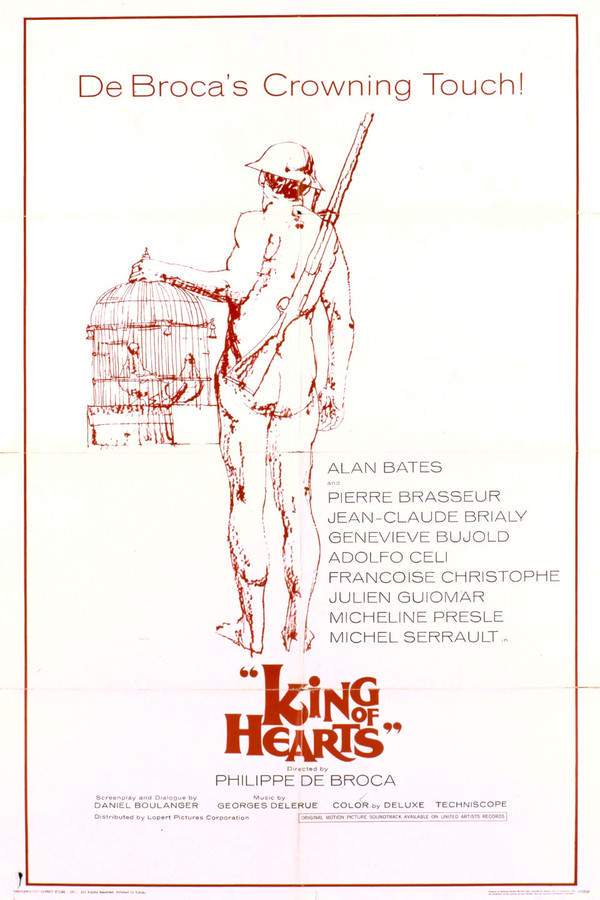
King of Hearts (1966) movie poster

Timeline

King of Hearts (1966) Timeline Explained – Every Event in Order

Release, runtime and language
1966 · 102 mins · French
Starring
Adolfo Celi, Alan Bates, Michel Serrault, Geneviève Bujold, Pier Paolo Capponi, Philippe de Broca

De Broca’s Crowning Touch! An ornithologist, mistaken for an explosives expert, is sent alone to a small French town late in World War I. He must untangle a garbled resistance report about a bomb the withdrawing German troops have set to demolish a weapons cache, navigating the confusion and danger of his unexpected mission.

On this page (7)
  1. 1 Where to watch
  2. 2 Events in order (14)
  3. 3 Timeline questions answered
  4. 4 Movie threads
  5. 5 Movies like King of Hearts
  6. 6 Categories
  7. 7 Every angle

Where to watch

Where to Watch King of Hearts (1966)

Where can you watch King of Hearts? Stream, rent or buy it in the US, including on Amazon Video: current JustWatch availability with up-to-date prices.

Streaming availability powered by JustWatch

14 events in order · contains spoilers

King of Hearts Timeline: Events in Chronological Order

Every key event of King of Hearts (1966) in order, scene by scene, with when and where it takes place. Use it to untangle flashbacks, time jumps and parallel storylines, to refresh your memory before the sequel or to find the exact scene you are thinking of.

  1. Bomb plan set in motion

    In October 1918, the German occupiers rig the town's automaton clock to detonate the ammunition magazine at midnight when the knight strikes the bell. The barber overhears the plan and races to warn the Allies, even as the town begins to evacuate. He is killed during the transmission, but the warning confirms the deadline.

    When
    October 1918, late in the day, before midnight
    Where
    Main square, village in France
  2. Plumpick chosen to disarm the bomb

    Signaller Charles Plumpick, a veteran of caring for war pigeons rather than explosives, is ordered by his colonel to disarm the bomb and decipher the phrase 'the knight strikes at midnight.' He must interpret the clue and locate the trigger before disaster strikes. Despite his lack of weapons expertise, he is sent to save the town.

  3. Plumpick arrives under cover with pigeons

    Plumpick reaches the town carrying two carrier pigeons and must slip past wary German soldiers. He avoids detection as he travels through streets that are tense with war outside. The town's strange calm is a prelude to the farce that will soon unfold.

    Where
    Town outskirts, France
  4. Inmates welcome Plumpick as King of Hearts

    Inside the asylum, Plumpick puts on pajamas and blends with inmates who introduce themselves as The Duke of Clubs and Monsignor Daisy. When he proclaims himself 'King of Hearts,' the inmates greet him with deference and the Germans overlook him. The surreal disguise allows him to operate while the true danger remains unseen.

    Where
    Insane asylum, town
  5. The town is occupied by the lunatics

    Plumpick regains consciousness to discover the asylum inmates have left and taken over the town, adopting the roles of the town's people. They perform a playful, theatrical life at odds with wartime fear. He must reckon with a new reality where danger is present but disguised as whimsy.

    Where
    Town center
  6. Password confusion and missing directions

    The barber fails to recognize the password 'the whiting likes to fly,' leaving him unhelpful to Plumpick's mission. General Geranium cannot direct him toward the ammunition magazine, so the trail goes cold. The lack of reliable guidance deepens Plumpick's isolation.

    Where
    Town
  7. Pigeon message misinterpreted by Germans

    One of Plumpick's pigeons is shot down by the Germans, who misinterpret its message as proof that the magazine has been dismantled. The miscommunication robs Plumpick of a quick lead on the bomb. The imminent explosion still hangs over the town.

    Where
    Town outskirts
  8. Plumpick realizes the town is occupied

    Returning to the town, Plumpick discovers the asylum empty and realizes the lunatics are occupying the streets. They crown him 'King of Hearts' with irony-filled pageantry as the madame introduces him to Poppy, a young girl eager to help forget the war. The scene marks a radical shift from grim wartime to carnival-like misrule.

    Where
    Town center and asylum vicinity
  9. Poppy warns but others dismiss the danger

    Poppy and the inmates urge a warning about midnight, but the townsfolk shrug it off as superstition. Plumpick persists in sounding the alarm, but the others treat it as a trivial concern. The countdown to disaster continues amid merriment.

    Where
    Town square
  10. Leading the inmates toward safety

    As 'king,' Plumpick tries to shepherd the inmates toward safety at the edge of town. They follow him partway, but refuse to go into the dangerous unknown beyond. The group faces an uncertain journey that could be their salvation or their doom.

    Where
    Edge of town
  11. Midnight countdown and clocktower climb

    Three minutes to midnight, Plumpick stands atop the clocktower with Poppy, awaiting the knight's fate. She insists the clockwork warrior will come out at midnight, and he finally understands the mechanism's danger. He climbs to stop the knight from striking the bell.

    When
    Three minutes to midnight
    Where
    Clocktower, town
  12. The knight strikes and the town is saved

    The knight nears; in the struggle, it strikes Plumpick's head instead of the bell and retreats. The explosion is averted and the town is saved for now. Dawn breaks as the unlikely victory settles in and the inmates celebrate their survival.

    When
    Midnight
    Where
    Clocktower / town square
  13. Morning stand-off and the inmates' retreat

    In the morning, German troops advance while British troops line up in opposition. Plumpick joins the formation but is pulled away by Poppy and the women. The two sides clash and Plumpick survives as the only soldier left, while the liberators approach and the inmates decide to return to the asylum.

    When
    Morning after midnight
    Where
    Town square
  14. Medal, disguise, and warm farewell

    Plumpick and his surviving pigeon are awarded medals for their mission. As they pass the asylum, he leaps from the convoy, sheds his uniform, and returns to the gate naked except for the pigeon cage. The inmates greet him as 'King of Hearts' and vow he will never leave them again.

    When
    After the stand-off, late morning
    Where
    Asylum gate, town

Last updated: October 09, 2025 at 11:07

Was this helpful?

Timeline questions answered

King of Hearts Timeline Explained: Your Questions Answered

When does it happen, and why in that order? The questions people ask about the chronology of King of Hearts (1966): time jumps, flashbacks, cause and effect between scenes and the correct order of events, each answered with spoilers.

Q1

Why does Poppy help Plumpick at the clocktower?

Poppy, a young girl introduced to Plumpick during the inmates' takeover, stands with him during the midnight countdown. She believes in the clockwork knight and helps him understand the mechanism's danger. Her support gives Plumpick the courage to climb the tower and attempt to stop the knight, making her his essential ally in the race against time.

Foreshadowing: Poppy is introduced when the Madame brings her to meet Plumpick during the carnival-like takeover.

  • poppy
  • clocktower
  • help
  • midnight
  • plumpick
Q1

Why is Plumpick chosen for a bomb disposal mission when he tends pigeons?

Plumpick is sent because he was the only available soldier when the warning arrived. The barber who overheard the German bomb plan was killed while transmitting the message, and only managed to relay the cryptic phrase "the knight strikes at midnight" before dying. The colonel had no proper explosives expert available and dispatched Plumpick based on desperation rather than expertise, hoping he could decipher the phrase and locate the trigger in time.

Foreshadowing: Earlier in the film, Plumpick is established as a signaller whose wartime specialty is caring for carrier pigeons, not defusing explosives.

  • plumpick
  • bomb mission
  • colonel
  • pigeon handler
  • chosen
Q2

What does "the knight strikes at midnight" mean?

"The knight strikes at midnight" describes the German trap: an automaton clock in the town square has a mechanical knight figure rigged to strike a bell at midnight. When the knight hits the bell, it triggers the detonation of an ammunition magazine buried beneath the town, which would destroy the entire village. Plumpick must stop the knight from striking the bell to prevent the explosion.

Foreshadowing: The German forces set up the bomb plan early in the film, rigging the clock during their retreat.

  • knight
  • midnight
  • clock
  • bomb
  • detonation
  • german trap
Q3

Why doesn't the barber recognize the password "the whiting likes to fly"?

The barber who knows the password is killed while transmitting the warning about the bomb. He dies before Plumpick arrives, so no one in town can verify the password that would have guided Plumpick to the ammunition magazine. This leaves Plumpick without the critical intelligence he needed to locate and disable the bomb.

Foreshadowing: The barber is killed during transmission early in the film, preventing him from meeting Plumpick.

  • barber
  • password
  • whiting likes to fly
  • killed
  • transmission
Q4

How did the Germans misinterpret the pigeon message?

One of Plumpick's carrier pigeons was shot down by German soldiers. They read the message the pigeon was carrying and mistakenly concluded that the ammunition magazine had already been dismantled. This false information convinced them the bomb threat was neutralized, which complicated Plumpick's mission since he lost his communication link and the Germans no longer believed the magazine was a threat worth guarding.

Foreshadowing: Plumpick arrives with two carrier pigeons, establishing their importance to his mission.

  • pigeon
  • germans
  • misinterpreted message
  • magazine
  • shot down
Q5

Why do the asylum inmates take over the town?

When the town evacuates ahead of the expected liberation and battle, the inmates at the nearby asylum are left unsupervised. They spontaneously leave the asylum and occupy the abandoned town, impersonating its citizens, the barber, the bishop, the brothel Madame, and various townsfolk. The Germans, confused by this surreal display, overlook Plumpick hiding among them, allowing him to move through the occupied town undetected.

Foreshadowing: The town's rapid evacuation leaves the asylum empty and unattended, giving inmates freedom to roam.

  • inmates
  • asylum
  • town
  • take over
  • masquerade
  • germans
Q6

Why does the knight strike Plumpick instead of the bell?

As Plumpick climbs the clocktower to stop the knight from striking the bell, he physically confronts the mechanical figure. During the struggle, the knight's arm swings and strikes Plumpick on the head instead of hitting the bell. This saves the town because the knight's retreat prevents the bell from ringing, which means the detonation trigger is never activated.

Foreshadowing: Plumpick climbs the tower with only minutes to midnight, understanding the mechanism's danger.

  • knight
  • clocktower
  • plumpick
  • struck head
  • saved town
Q7

Why do the British and German troops shoot each other during the standoff?

In the morning after the bomb is defused, both British and German troops converge on the town square. When they face each other in a standoff, both sides simultaneously fire, resulting in massive casualties on both sides. The film presents this as the absurd, brutal logic of war, two armies following orders that lead them to destroy each other rather than achieve any meaningful victory.

Foreshadowing: The colonel earlier orders formation, sending British troops into the square.

  • british
  • german
  • standoff
  • shooting
  • casualties
  • war absurdity
Q8

What is the significance of Plumpick removing his uniform at the end?

After receiving medals for his role in saving the town, Plumpick leaps from the military convoy as it passes the asylum. He discards his rifle and uniform, approaching the asylum gates naked except for his pigeon cage. This act symbolizes his complete rejection of the military world and his choosing to join the inmates' alternative community. He chooses belonging with the "mad" people over the "sane" world of war.

Foreshadowing: Throughout the film, Plumpick increasingly connects with the inmates while questioning the military's logic.

  • plumpick
  • uniform
  • asylum
  • ending
  • reject war
  • join inmates
Q9

Why is Plumpick called the King of Hearts?

The inmates crown Plumpick "King of Hearts" when they take over the town, treating him with theatrical deference as their monarch. The title is both playful mockery and genuine acceptance, ironically, the "king" of this absurd republic is a simple soldier who becomes their protector. The title persists to the end, as the inmates welcome him back as their true King of Hearts when he chooses their world over war.

Foreshadowing: Plumpick awakens in the asylum and proclaims himself "King of Hearts" during the inmates' takeover.

  • king of hearts
  • plumpick
  • inmates
  • crown
  • title
Q10

Why do the villagers ignore Plumpick's midnight warning?

Despite Plumpick's urgent warnings about the imminent explosion at midnight, the villagers treat it as superstition and dismiss the danger. Having lived through years of war and facing possible bombardment from the approaching battle, they choose to live fully in the present rather than flee in fear. Their defiance is both reckless and poignant, they'd rather celebrate life than run from another threat.

Foreshadowing: The mood in town remains buoyant even as the clock counts down to midnight.

  • warning
  • villagers
  • midnight
  • ignore
  • danger
  • celebration

Movie threads

More Movies Like King of Hearts, by Mood & Story

Curated lists built around what makes King of Hearts tick: the same mood, the same kind of story or the same emotional payoff. Each list explains why these movies belong together.

Movies about creating theatrical sanctuaries like King of Hearts

Stories where characters escape grim reality by creating whimsical, defiant communities. If you liked the whimsical community in King of Hearts, you'll enjoy these movies where characters build their own defiant worlds. These films explore similar themes of finding sanity in madness, using theatricality and humor as a shield against a bleak reality, and celebrating improvised communities.

  • theatrical
  • defiant
  • whimsical
  • satirical
  • dreamlike
  • community
  • Tone: whimsical, defiant, poignant
  • Pacing: steady, character-driven
Why these movies?

The story pattern: The narrative often follows an outsider who stumbles upon or joins an existing eccentric community. The central conflict arises from the tension between this insular, imaginative world and the oppressive 'real' world threatening to destroy it. The journey is one of discovering true belonging and meaning through shared, often absurd, performance and rebellion.

Why they belong together: Movies are grouped here for their shared focus on the power of imagination and community as forms of resistance. They share a whimsical or satirical tone that contrasts with a darker backdrop, a theme of questioning authority, and an emotional core that is both joyous and poignant.

Absurd war mission movies similar to King of Hearts

Bizarre and surreal military tasks that expose the folly of conflict. Fans of the bizarre mission in King of Hearts will appreciate these films about surreal tasks in wartime. These stories capture the confusion and dark humor of military life, focusing on the absurdity of war rather than its glory, with a similar mix of steady pacing and medium intensity.

  • absurdity
  • satirical
  • surreal
  • anti-war
  • bizarre mission
  • wartime
  • Tone: satirical, surreal, bittersweet
  • Pacing: steady, mission-oriented
Why these movies?

The story pattern: The plot follows a protagonist, often an unwilling or unsuitable participant, given a confusing or seemingly pointless objective. The journey is navigated through a landscape of chaos and misunderstanding, where the mission itself becomes a metaphor for the senselessness of the larger conflict. The resolution is typically bittersweet or ironic, highlighting the gap between official orders and human reality.

Why they belong together: These films are connected by their shared narrative structure of an absurd mission, their use of war as a setting for satire rather than action, and their tonal blend of humor and tragedy. They prioritize the experience of confusion and the critique of authority over traditional war heroics.

If you liked this

Movies Like King of Hearts

Similar movies to King of Hearts: the same genre, themes or kind of story. Each one comes with its own plot summary, timeline and ending explained.

Browse all movie summaries

Categories

Movie Lists Featuring King of Hearts

King of Hearts appears in these hand-built movie categories. Each one groups movies by a specific mood, theme or story type, with their plot summaries and endings explained.

View all movie categories

Every angle

King of Hearts (1966) Explained: Plot, Timeline & Characters

Everything about King of Hearts in one place: what happens in the plot summary, the timeline in chronological order, the characters and meaning and a spoiler-free summary. What's After the Movie adds the cast, box office and post-credit scenes.

Coming soon on iOS and Android

The Plot Explained Movie Summary App

Plot summaries, endings explained and timelines on your phone. Catch up on any movie in minutes, save your favorites and never miss a twist again.

Be the first to know when we launch. Your email stays private, always.

Learn more about the app