Plot Explained Spoilers guaranteed!
Plot Explained

Browse by genre

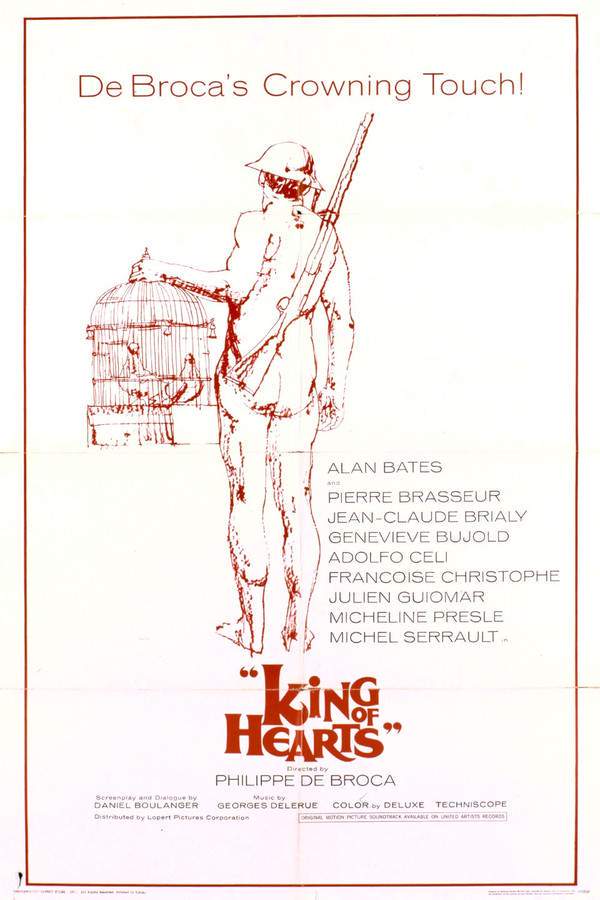
King of Hearts (re-release) (2003) movie poster

Plot Summary

King of Hearts (re-release) (2003) Plot Summary Explained

Release, runtime and language
2003 · 102 min · French
Loading streaming availability…
Directed by
Philippe de Broca
Starring
Alan Bates, Geneviève Bujold

During World War II, a bewildered Scottish soldier, Charles Plumpick, is mistakenly placed in command of a deserted French village inhabited by escaped asylum patients. Assuming the role of "King," he finds himself dealing with the eccentricities of his subjects while also facing the serious task of disarming a bomb. Amidst the absurdity, Plumpick must learn to adapt and find a surprising connection with the unconventional community under his charge.

On this page (6)
  1. 1 Where to watch
  2. 2 What happens: full plot
  3. 3 Plot questions answered
  4. 4 Movie threads
  5. 5 Movies like King of Hearts (re-release)
  6. 6 Every angle
Loading streaming availability…

Full plot summary · contains spoilers

What Happens in King of Hearts (re-release): Full Plot Summary

The whole story of King of Hearts (re-release) (2003) explained, from the opening scene to the final frame: every key event, every twist and what it all adds up to. Read it as a quick recap before the sequel, to check a scene you missed, or to finally understand what really happened.

In November 1918, as World War I draws to a close, the German army withdraws from Marville, a small town in France that they have held for most of the conflict. A courageous member of the French resistance discovers that a bomb has been planted by the Germans and will detonate at midnight. He quickly informs a nearby British regiment and warns the townspeople, prompting them to flee the area for their safety.

To resolve this dilemma, Colonel MacBibenbrook (played by Adolfo Celi) selects the gentle, poetry-loving Scotsman, Private Charles Plumpick, to infiltrate Marville and deactivate the explosive device. Upon his arrival, Charles finds himself pursued by the remaining German soldiers and seeks refuge in a local insane asylum. The inmates, believing Charles to be the “Le Roi de Coeur” (King of Hearts), embrace him with warmth and joy.

Amidst the chaos, Charles inadvertently knocks himself unconscious, leading the inmates to seize the opportunity to escape the asylum and explore the now-deserted town. They return to their former professions: one becomes a barber (Michel Serrault), another a general (Pierre Brasseur), while others take on roles like a bishop and a brothel madam (Micheline Presle). Policemen and soccer players intermingle, enjoying a sense of freedom.

Upon regaining consciousness, Charles is initially confused and fails to recognize that the eccentric townspeople he encounters are actually former asylum inmates. He attempts in vain to rally them in the search for the bomb, but they are more preoccupied with anointing him as their King of Hearts.

As the situation escalates, German soldiers return, but the inmates cleverly commandeer their tanks and chase the soldiers away. Although British Army Scotsmen arrive on the scene, they are bewildered by the surreal happenings and retreat to report back to their colonel.

Now embraced as the King of Hearts, Charles develops a strong affection for Coquelicot (played by Geneviève Bujold), a virgin from Madame Eglantine's brothel assigned to keep him company. He is particularly motivated to locate the bomb for her sake, yet, like the others, she chooses not to worry about the impending explosion.

Charles eventually discovers that the bomb is located within the town's clock tower. Just in the nick of time, he ascends the clock tower and successfully disarms the bomb at midnight. Grateful for their savior, the inmates decide to celebrate for three years. As excitement builds, Charles and Coquelicot prepare for a romantic encounter, but their moment is interrupted by the arrival of the British Army.

Unaware that the “citizens” welcoming them are actually the inmates, Colonel MacBibenbrook allows his men to join in the festivities, becoming smitten with Madame Eglantine in the process. The next morning, as the regiment prepares to depart, Coquelicot expresses her sorrow over Charles's imminent return to the battlefield. In a desperate bid to keep him in Marville, she and several other former inmates bind him, leading to a bittersweet moment as they sit on a balcony watching the soldiers.

The tranquility shatters when a German regiment unexpectedly enters the town, culminating in a fierce clash where both armies face devastating losses. Following the confrontation, the townspeople cautiously return to Marville, while the inmates, now fully aware of their return to the asylum, begin their journey back.

Charles, having been honored for his bravery and the defusal of the bomb, grapples with the weight of returning to combat. He longs for the whimsical camaraderie he experienced with the inmates. In a poignant conclusion, he sheds his military uniform and walks naked through the town back to the asylum, choosing to join his quirky companions as one of them.
Last updated: June 11, 2025 at 15:03

Was this helpful?

Plot questions answered

King of Hearts (re-release) Plot Explained: Your Questions Answered

The questions people ask most about King of Hearts (re-release) (2003): what happens in the confusing scenes, why the characters do what they do, the twists, hidden details and what the ending means. Each answer contains spoilers.

Q1

Why was Private Charles Plumpick chosen to disarm the bomb?

Colonel MacBibenbrook selected Charles for the mission because he was known as a gentle, poetry-loving Scotsman who disliked violence. The colonel believed his nonviolent nature made him the ideal candidate to infiltrate Marville and defuse the bomb without causing further conflict, contrasting with the aggressive approaches of typical soldiers.

Foreshadowing: Early on, Charles is characterized as someone who prefers poetry over warfare, establishing why he was uniquely suited for this delicate task.

  • charles plumpick
  • colonel macbibenbrook
  • bomb mission
  • poetry loving soldier
Q2

Why didn't the asylum inmates worry about the bomb?

The inmates simply did not perceive the bomb as a threat because they live in their own whimsical reality. Having escaped the asylum, they were absorbed in celebrating their newfound freedom and crowning Charles as King of Hearts, choosing to embrace joy rather than acknowledge the danger surrounding them.

Foreshadowing: From the moment they mistake Charles for their monarch, the inmates demonstrate their detachment from conventional concerns about danger or time.

  • asylum inmates
  • bomb threat
  • escaped patients
  • marville town
Q3

How did Charles figure out the bomb was in the clock tower?

Charles pieced together clues during his time in Marville, eventually deducing that the bomb was hidden in the town clock tower. His determination to find the bomb was driven by his love for Coquelicot and his desire to protect her, giving him the motivation to solve the mystery before midnight struck.

Foreshadowing: Charles's urgent search for the bomb throughout the film builds toward this revelation, with his love for Coquelicot providing emotional stakes.

  • bomb location
  • clock tower
  • midnight
  • coquelicot
Q4

Why did Charles choose to stay at the asylum instead of returning to the army?

After defusing the bomb and receiving medals for his bravery, Charles felt disconnected from the military world that had brought him to war. Through his experience with the inmates, he found genuine connection, purpose, and acceptance that he never experienced in his former life. Choosing to walk naked back to the asylum, he rejected the violence of war for the absurd but heartfelt community of the patients.

Foreshadowing: Charles's growing attachment to the inmates and his love for Coquelicot throughout the film foreshadow his eventual rejection of his old identity.

  • charles plumpick
  • asylum ending
  • military uniform
  • rejection of war
Q5

What does the title "King of Hearts" mean in the movie?

The inmates believe Charles is the return of "Le Roi de Coeur," a mythical figure from their collective memory. This title represents hope, joy, and liberation to them. By accepting the crown, Charles becomes their symbolic leader, someone who brings celebration and freedom rather than the oppression they experienced under authority.

Foreshadowing: The inmates' joyful celebration upon mistaking Charles for their king establishes the significance of this title from the beginning.

  • king of hearts
  • le roi de coeur
  • inmates
  • asylum
  • mythical figure
Q6

Why didn't the British army realize the townspeople were asylum inmates?

The British soldiers arrived to find a town full of people happily celebrating, with no indication they were former asylum patients. The inmates had taken over the townspeople's former roles, barber, general, bishop, brothel madam, and were functioning believably within those positions. Colonel MacBibenbrook simply assumed the situation was a successful celebration of the bomb being defused.

Foreshadowing: The inmates' takeover of various town professions earlier in the film explains why they could convincingly pose as ordinary citizens.

  • british army
  • colonel macbibenbrook
  • mistaken identity
  • marville citizens
Q7

What happened to Coquelicot after the bomb was defused?

Coquelicot was one of the former inmates working at Madame Eglantine's brothel. After Charles successfully disarmed the bomb, she expressed sorrow over his impending departure to the battlefield. In a desperate attempt to keep him in Marville, she and other inmates bound him to prevent his return to the army. Her fate after Charles chooses the asylum is left uncertain, though she clearly cared for him deeply.

Foreshadowing: Coquelicot's assigned role as Charles's companion establishes their emotional connection, which grows throughout the story.

  • coquelicot
  • madam eglantine
  • brothel
  • charles love interest
Q8

Why did the German soldiers return to Marville?

The German army returned to Marville after initially retreating, leading to the climactic battle with the British forces. This unexpected return transformed the whimsical celebration into tragedy, with both armies suffering devastating losses. The arrival represents the harsh reality of war interrupting the inmates' peaceful fantasy world.

Foreshadowing: The ongoing tension between German and British forces throughout the film sets up this inevitable confrontation.

  • german soldiers
  • battle
  • british army
  • marville clash
  • wwi
Q9

How did the asylum inmates capture the German tanks?

When German soldiers returned to Marville, the inmates, embracing their newfound freedom and whimsical confidence, somehow managed to commandeer the German tanks. The film presents this as part of the absurdist comedy, with the eccentric inmates successfully chasing away the soldiers using their own military equipment.

Foreshadowing: The inmates' carefree attitude toward authority and their joyful adoption of various roles foreshadows their bold action against the Germans.

  • inmates
  • german tanks
  • escaped patients
  • marville
  • comedic scene
Q10

What is the movie's message about sanity versus madness?

The film suggests that the asylum inmates, though labeled as insane, actually display more humanity, joy, and compassion than the soldiers engaged in warfare. By choosing the asylum over military life, Charles implies that true madness lies in war and violence, while the inmates' whimsical society represents a more genuine form of sanity.

Foreshadowing: Throughout the film, the contrast between the inmates' carefree celebration and the destructive war highlights this thematic message.

  • sanity
  • madness
  • war
  • asylum
  • anti war message
  • true insanity
Q11

Why did the inmates decide to celebrate for three years?

After Charles successfully disarms the bomb at midnight, the inmates decide to hold a festival in his honor for three years. This reflects their whimsical outlook on life, they celebrate wholeheartedly and without restraint, treating Charles's act of bravery as worthy of prolonged festivities rather than a simple night of rejoicing.

Foreshadowing: The inmates' general approach to life throughout the film prioritizes joy and celebration over practicality.

  • three years festival
  • celebration
  • inmates
  • charles bravery

Movie threads

More Movies Like King of Hearts (re-release), by Mood & Story

Curated lists built around what makes King of Hearts (re-release) tick: the same mood, the same kind of story or the same emotional payoff. Each list explains why these movies belong together.

Whimsical anti-war movies like King of Hearts (re-release)

Stories that use absurd humor and eccentric characters to critique the insanity of war. Looking for movies similar to King of Hearts (re-release)? This thread gathers films that share its unique blend of anti-war sentiment and whimsical humor. If you liked the eccentric characters and satirical take on sanity versus insanity in wartime, you'll find similar stories here.

  • whimsical
  • satirical
  • bittersweet
  • anti-war
  • absurd
  • melancholic
  • Tone: whimsical, satirical, melancholic
  • Pacing: steady, character-driven
Why these movies?

The story pattern: These stories typically unfold in a setting touched by war but removed from the front lines, focusing on characters who respond to violence with absurdity or create their own unconventional communities. The narrative uses contrast between dark themes and lighthearted delivery to deliver a poignant message.

Why they belong together: They are grouped together for their shared tonal approach: a whimsical, often bittersweet vibe used to explore the profound absurdity and tragedy of war. They balance humor with melancholy and feature characters who challenge conventional notions of sanity.

Movies about eccentric found families like King of Hearts (re-release)

Outsiders and misfits forming unexpected bonds and creating their own unique society. If you enjoyed the eccentric community in King of Hearts (re-release), this thread is for you. Discover more movies where quirky characters form a found family, offering stories about connection, acceptance, and the beauty of being different, often in unusual or isolated settings.

  • quirky
  • heartwarming
  • bittersweet
  • found family
  • eccentric
  • community
  • Tone: quirky, bittersweet, heartwarming
  • Pacing: steady
Why these movies?

The story pattern: The narrative pattern involves a protagonist, often feeling like an outsider themselves, entering a closed-off world populated by unique individuals. Through a series of interactions, they move from bewilderment to acceptance, ultimately finding a home and a new identity within this quirky group.

Why they belong together: These movies share a core theme of finding connection and family in the most unexpected places, celebrated through a tone that is both heartwarming and quirky. They focus on the dynamics of a specific, often isolated, community and the transformative journey of an outsider joining it.

If you liked this

Movies Like King of Hearts (re-release)

Similar movies to King of Hearts (re-release): the same genre, themes or kind of story. Each one comes with its own plot summary, timeline and ending explained.

Browse all movie summaries

Every angle

King of Hearts (re-release) (2003) Explained: Plot, Timeline & Characters

Everything about King of Hearts (re-release) in one place: what happens in the plot summary, the timeline in chronological order, the characters and meaning and a spoiler-free summary. What's After the Movie adds the cast, box office and post-credit scenes.

Coming soon on iOS and Android

The Plot Explained Movie Summary App

Plot summaries, endings explained and timelines on your phone. Catch up on any movie in minutes, save your favorites and never miss a twist again.

Be the first to know when we launch. Your email stays private, always.

Learn more about the app