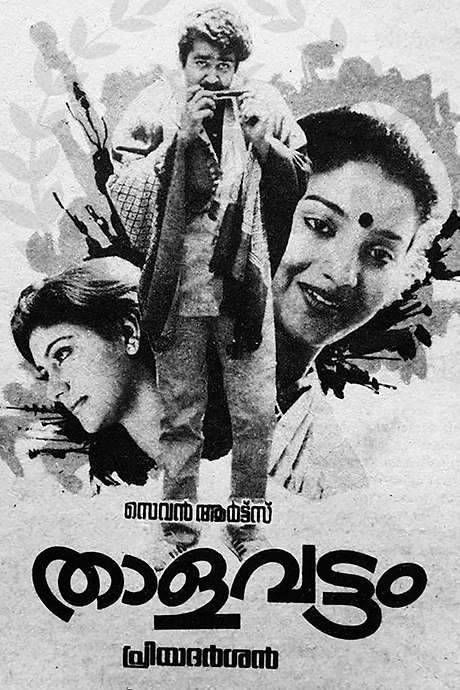
Venu Mohanlal is a factory worker who struggles to provide for his family. When he is dismissed from his job, he makes desperate attempts to reach the owner, Menon Thilakan, hoping for reinstatement. During these tense visits, Menon’s daughter, Saro Urvashi, is drawn to Venu's music and wit, and they eventually marry in a union aimed at lifting the family out of poverty,though the arrangement comes with a heavy secret.
Menon reveals to Venu that Saro is terminally ill with aplastic anaemia. Venu agrees to the marriage to save his family from destitution, but he soon discovers a genuine affection for Saro beyond obligation. The couple go on to have a daughter, Ammu Deepti Sanjeev Sivan, and for a time they build a life marked by love and resilience. Yet Saro’s condition deteriorates, and she passes away after a bone marrow transplant, leaving Venu to raise Ammu with memory as both a guide and a weight.
Years pass, and Venu has become a wealthy businessman, living with his teenage daughter Ammu, along with the support of close friends and well-wishers. He carries the quiet ache of Saro’s loss while shielding Ammu from the worst of the truth about her illness. When a young man named Hari arrives at his doorstep seeking employment, Venu sees in him a mirror of his own younger self—a hopeful, earnest spirit that moves Ammu. Ammu takes to Hari’s innocence and warmth, and Venu, recognizing the potential danger of history repeating itself, decides to take Hari in with careful, protective optimism, hoping he can become to Ammu what he was to Saro.
The story unfolds with a restrained, patient tone, emphasizing the costs of sacrifice, the gravity of family duty, and the ways love can both mend and complicate a life built on hard choices. It presents a quiet meditation on memory, responsibility, and the instinct to shield the next generation even when that protection comes with its own set of uncertainties.