Plot Explained Spoilers guaranteed!
Plot Explained

Browse by genre

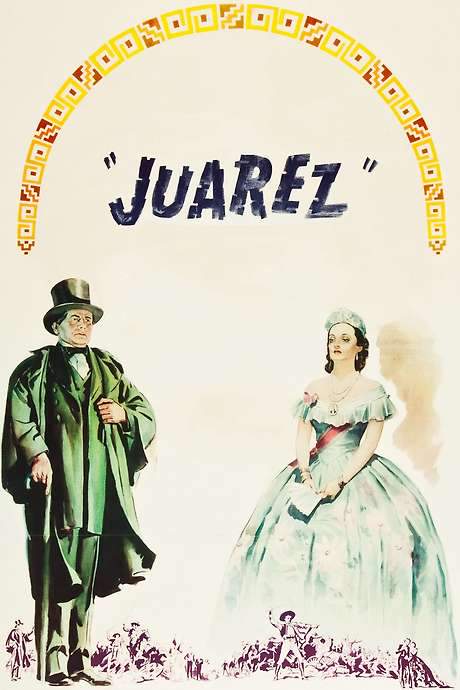
Juarez (1939) movie poster

Plot Summary

Juarez (1939) Plot Summary Explained

Release, runtime and language
1939 · 125 mins · English
Directed by
William Dieterle
Starring
Bette Davis, John Garfield, Paul Muni, Henry O'Neill, Claire Du Brey, Frank Reicher

Upon their arrival in Mexico, the newly‑crowned Emperor Maximilian and Empress Carlota confront a nation deeply supportive of President Benito Juárez and the ideals of democracy. The film chronicles this clash of imperial ambition with popular republican sentiment, highlighting the political turmoil of the era.

On this page (6)
  1. 1 Where to watch
  2. 2 What happens: full plot
  3. 3 Plot questions answered
  4. 4 Movie threads
  5. 5 Movies like Juarez
  6. 6 Every angle

Where to watch

Where to Watch Juarez (1939)

Where can you watch Juarez? Stream, rent or buy it in the US, including on Hoopla, Amazon Video and Apple TV Store: current JustWatch availability with up-to-date prices.

Streaming availability powered by JustWatch

Full plot summary · contains spoilers

What Happens in Juarez: Full Plot Summary

The whole story of Juarez (1939) explained, from the opening scene to the final frame: every key event, every twist and what it all adds up to. Read it as a quick recap before the sequel, to check a scene you missed, or to finally understand what really happened.

Set against the fraught backdrop of 1860s Mexico, this historical drama traces the long-running clash between Emperor Maximilian von Habsburg [Brian Aherne] and Benito Pablo Juárez [Paul Muni], a confrontation shaped by foreign intervention, shifting alliances, and the stubborn hope of a democratic future for the country.

When Napoleon III Napoleon III [Claude Rains] instruments a throne for Maximilian, the Austrian archduke arrives in Mexico along with his wife, Carlota of Belgium [Bette Davis], with expectations of establishing French influence by confiscating land returned to native communities and punishing the rebels under his command. The alliance tests loyalties, idealism, and the weight of imperial ambition as Maximilian must navigate a government that is not fully his own and a nation that is far from united.

Maximilian comes to a painful crossroads: he contemplates abdication, but Carlota stays by his side and fortifies his resolve, pushing him to persevere in a role that may betray his own conscience. The offer extended to Juárez, the democratically elected leader of Mexico, to serve as prime minister is flatly refused by Juárez, who remains steadfast in defending self-rule for the Mexican people. This rift deepens the struggle, pitting a crown against a republic and testing what Americans and Mexicans alike believe the future should look like (Monroe Doctrine).

As the Civil War in the United States winds down, the new federal posture in the Americas becomes a decisive factor. The United States warns Napoleon that it will enforce the Monroe Doctrine with military force if necessary, moving to arm Juárez's army in a bid to restore balance. Yet the French position holds on, even as the tide of aid shifts and the balance of power teeters on a knife-edge. The intrigue intensifies when Alejandro Uradi [Joseph Calleia], a political actor in Washington’s orbit, seizes the American ammunition that could have tipped the scales in Juárez’s favor, a move that complicates the already perilous chess match between empire, presidency, and insurgent forces.

Napoleon responds by ordering the evacuation of French troops from Mexico, a withdrawal that abandons Maximilian to his own devices and strips him of a crucial source of military strength. In the wake of this turning point, Carlota undertakes a perilous return to Paris to plead with Napoleon, only to unravel under the pressure of isolation and mounting pressure. The collapse of imperial protection prompts Juárez and his rebels to close in, and Maximilian and his loyalists are captured.

Despite negotiations that could have seen him freed, Maximilian chooses to remain with those who have stood by him. The moment comes when the court reads its verdict: he is tried, found guilty, and sentenced to death by firing squad, a somber end that reflects the heavy costs of imperial hubris and the stubborn pursuit of a dream that history ultimately redefines.

Last updated: February 24, 2026 at 09:27

Was this helpful?

Plot questions answered

Juarez Plot Explained: Your Questions Answered

The questions people ask most about Juarez (1939): what happens in the confusing scenes, why the characters do what they do, the twists, hidden details and what the ending means. Each answer contains spoilers.

Q1

Why did Maximilian agree to become Emperor of Mexico?

Maximilian was convinced by Napoleon III to take the throne as part of France's strategy to extend influence into Mexico. Despite warnings about the unstable political situation, Maximilian believed he could bring reform and stability to Mexico while satisfying Napoleon's imperial ambitions. He was also motivated by a genuine desire to help Mexico, though this idealism would prove fatal.

Foreshadowing: Earlier scenes establish Maximilian's idealistic nature and his willingness to take on challenging ventures.

  • maximilian
  • emperor mexico
  • napoleon iii
  • throne
  • austrian archduke
Q2

Why did Carlota urge Maximilian not to abdicate?

Carlota feared that abdication would mean political suicide for both of them and destroy everything they had built. She also believed that leaving would be humiliating and that they owed it to France and their own legacy to see the imperial project through. Her insistence was partly political pragmatism and partly her own determination to maintain their position.

Foreshadowing: Carlota's strong-willed personality is established early when she supports Maximilian's hardline policies against rebels.

  • carlota
  • abdication
  • maximilian
  • wife
  • belgium
Q3

Why did Juárez refuse Maximilian's offer to become prime minister?

Juárez refused because he believed deeply in democratic self-rule and could not accept a position that would make him complicit in a foreign-imposed monarchy. He insisted that the Mexican people should govern themselves rather than serve under an emperor they did not choose. His refusal represented his commitment to the republican ideals he had fought for.

Foreshadowing: From the beginning, Juárez is portrayed as unwavering in his defense of democracy and Mexican sovereignty.

  • juarez
  • prime minister
  • democracy
  • republic
  • self-rule
Q4

How did Alejandro Uradi seize the American ammunition?

Alejandro Uradi, described as a political actor in Washington's orbit, intercepted the ammunition shipment that the United States was sending to Juárez's forces. This act directly undermined American support for the republic and effectively strengthened Maximilian's imperial position by depriving Juárez of crucial military supplies.

Foreshadowing: The timeline establishes Uradi's role as working within Washington's political sphere, making his betrayal of Juárez's cause possible.

  • alejandro uradi
  • ammunition
  • washington
  • seize
  • us support
Q5

Why did Napoleon III withdraw French troops from Mexico?

Napoleon III ordered the evacuation because the United States, having concluded its Civil War, threatened to enforce the Monroe Doctrine by military force. The Monroe Doctrine opposed European colonization in the Americas. With the U.S. now able to intervene and with French resources stretched thin, Napoleon decided cutting losses was strategically necessary.

Foreshadowing: Earlier scenes show the U.S. warning Napoleon about Monroe Doctrine enforcement once the Civil War ended.

  • napoleon iii
  • french troops
  • evacuation
  • monroe doctrine
  • withdrawal
Q6

What happened to Carlota after she went to Paris?

Carlota traveled to Paris to personally plead with Napoleon III to continue supporting Maximilian's empire. When Napoleon refused to change his decision, the psychological toll combined with isolation and mounting pressure caused her to suffer a complete mental breakdown.

Foreshadowing: Carlota's determination to save the empire is evident in her decision to undertake the difficult journey despite growing tensions.

  • carlota
  • paris
  • breakdown
  • mental health
  • napoleon
Q7

Why did Maximilian choose to stay with his loyalists instead of accepting release?

Even when negotiations could have secured his freedom, Maximilian refused to abandon the soldiers and officers who had remained loyal to him throughout the campaign. His decision to stay reflected a strong sense of personal honor and responsibility toward those who had fought for the imperial cause, choosing solidarity over self-preservation.

Foreshadowing: Throughout the film, Maximilian is portrayed as someone who values loyalty and feels burdened by the lives dependent on him.

  • maximilian
  • loyalists
  • captivity
  • stay
  • honor
Q8

Why was Maximilian executed rather than simply exiled?

Maximilian was tried and executed because Juárez's government viewed him as a foreign invader who had imposed himself on Mexico through military force. Despite opportunities for negotiation, the republican authorities considered his presence a continuing threat to Mexico's sovereignty. The execution symbolized the definitive rejection of foreign rule and served as a warning against future interventions.

Foreshadowing: The film's tension between republican and imperial forces makes clear that Juárez's side viewed Maximilian as an illegitimate occupier, not a legitimate ruler.

  • maximilian
  • execution
  • trial
  • firing squad
  • queretaro
Q9

What triggered Maximilian's final defeat?

The combination of Napoleon's troop withdrawal, the loss of French military support, and the restored strength of Juárez's forces after receiving American aid led to Maximilian's capture. With no army to defend the empire and no foreign power willing to intervene, Maximilian's position became untenable.

Foreshadowing: The timeline shows the gradual erosion of Maximilian's power through each successive event: U.S. pressure, Uradi's sabotage, and finally France's withdrawal.

  • maximilian
  • defeat
  • capture
  • downfall
  • french withdrawal
Q10

How did the Monroe Doctrine influence the conflict in Mexico?

The Monroe Doctrine was a U.S. policy opposing European colonization or intervention in the Americas. Once the American Civil War ended, the United States threatened Napoleon III with military action to enforce it. This pressure convinced Napoleon to abandon Maximilian, fundamentally changing the balance of power and leading to the empire's collapse.

Foreshadowing: The U.S. position hardens visibly after the Civil War concludes, with explicit warnings directed at Napoleon.

  • monroe doctrine
  • united states
  • napoleon
  • europe
  • intervention

Movie threads

More Movies Like Juarez, by Mood & Story

Curated lists built around what makes Juarez tick: the same mood, the same kind of story or the same emotional payoff. Each list explains why these movies belong together.

Movies about idealist leaders facing tragic downfall like Juarez

Stories where noble ambitions are crushed by brutal political realities. If you were captivated by the tragic political conflict in Juarez, explore more movies where principled leaders and revolutionaries confront impossible choices, leading to bleak and heavy conclusions. These historical dramas and epics share a somber tone and high-stakes tension.

  • tragic downfall
  • political tension
  • grim
  • fateful
  • oppressive
  • melancholic
  • Tone: tense, bleak, tragic
  • Pacing: steady, deliberate
Why these movies?

The story pattern: The narrative pattern centers on a protagonist who enters a conflict with optimistic or righteous goals, only to be overwhelmed by a more powerful, cynical, or entrenched opposition. The journey is a descent from idealism to despair, culminating in a definitive and often personal defeat that underscores the cost of power.

Why they belong together: These films are grouped together because they share a core narrative of failed idealism against overwhelming force, creating a specific emotional arc of ascent followed by a crushing downfall. They consistently blend high-intensity political drama with a heavy, bleak emotional weight and a tense, steady pacing.

Sweeping political epic dramas with national crisis like Juarez

Epic stories of national identity forged in the fires of conflict and occupation. For viewers who enjoyed the grand scale and political turmoil of Juarez, this collection highlights epic historical dramas centered on revolutions and national identity crises. These films share a steady pace, high stakes, and a heavy emotional tone, portraying the fate of nations and their people.

  • political conflict
  • revolution
  • epic
  • national identity
  • grim
  • historical drama
  • Tone: tense, grim, somber
  • Pacing: steady, expansive
Why these movies?

The story pattern: These narratives unfold on an epic canvas, interweaving the fates of multiple characters—from rulers to common people—with the larger story of a nation in upheaval. The plot is driven by military and political conflict, exploring the moral ambiguities of power and the bittersweet or tragic outcomes of revolution.

Why they belong together: These movies are united by their epic scope, focus on historical political crises, and a consistently tense, grim atmosphere. They prioritize the depiction of a nation's struggle over individual heroism, resulting in a sobering and intellectually engaging viewing experience with moderate complexity and heavy emotional weight.

If you liked this

Movies Like Juarez

Similar movies to Juarez: the same genre, themes or kind of story. Each one comes with its own plot summary, timeline and ending explained.

Browse all movie summaries

Every angle

Juarez (1939) Explained: Plot, Timeline & Characters

Everything about Juarez in one place: what happens in the plot summary, the timeline in chronological order, the characters and meaning and a spoiler-free summary. What's After the Movie adds the cast, box office and post-credit scenes.

Coming soon on iOS and Android

The Plot Explained Movie Summary App

Plot summaries, endings explained and timelines on your phone. Catch up on any movie in minutes, save your favorites and never miss a twist again.

Be the first to know when we launch. Your email stays private, always.

Learn more about the app