Plot Explained Spoilers guaranteed!
Plot Explained

Browse by genre

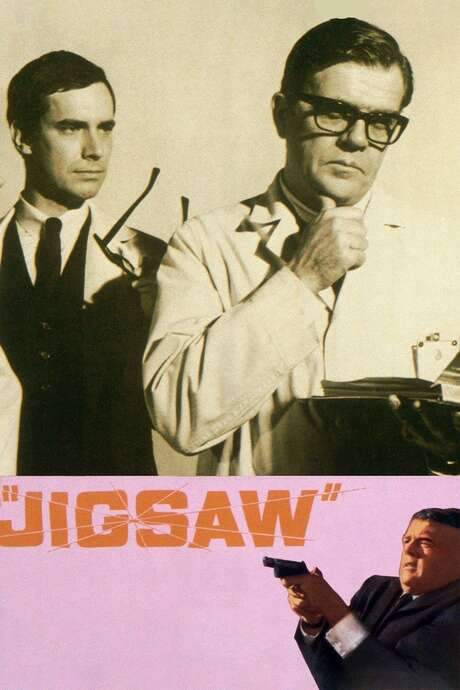
Jigsaw (1968) movie poster

Timeline

Jigsaw (1968) Timeline Explained – Every Event in Order

Release, runtime and language
1968 · 97 mins · English
Directed by
James Goldstone
Starring
Pat Hingle, Paul Stewart, Victor Jory, Bradford Dillman, Susanne Benton, Kent McCord

After inadvertently ingesting some sugar laced with LSD, a man wakes up with amnesia and in the middle of a murder plot.

On this page (5)
  1. 1 Events in order (12)
  2. 2 Timeline questions answered
  3. 3 Movie threads
  4. 4 Movies like Jigsaw
  5. 5 Every angle

12 events in order · contains spoilers

Jigsaw Timeline: Events in Chronological Order

Every key event of Jigsaw (1968) in order, scene by scene, with when and where it takes place. Use it to untangle flashbacks, time jumps and parallel storylines, to refresh your memory before the sequel or to find the exact scene you are thinking of.

  1. LSD-laced coffee triggers crisis

    Fields wakes up after someone slips sugar cubes laced with LSD into his coffee, instantly plunging him into confusion. The drug fog makes it hard to remember recent events and sets a dangerous, uncertain tone for the morning. This drug-induced onset marks the beginning of a spiraling mystery.

  2. Murder scene found in Fields' home

    Upon regaining consciousness, Fields discovers a woman drowned in his bathtub and flecks of blood on his hands and clothes. The grisly scene suggests his possible involvement, throwing him into a panic and a need to prove his innocence. The discovery kicks off the investigation, shadowed by his amnesia.

  3. Amnesia blocks memory

    Fields is plagued by memory loss, unable to recall what happened the night before or how the woman came to be in his bathroom. The lack of recall forces him to rely on others and to seek explanations for the strange sequence of events. His impaired memory becomes a central obstacle in solving the case.

  4. Fields hires a private detective

    Desperate for answers, Fields hires Arthur Belding, a private detective, to investigate the murder and sift through the evidence. Belding begins to unravel the mystery by tracking down witnesses and cross-checking clues that Fields cannot recall. The partnership marks a crucial shift from confusion to methodical inquiry.

    Where
    Fields's home
  5. Fields returns to the think tank

    Fields returns to his job at the scientific think tank, attempting to resume normal life while the investigation unfolds. The professional environment deepens the stakes, exposing potential motives and rivalries within the organization. The setting provides tension as colleagues become suspects and sources of information.

    Where
    Scientific think tank
  6. A woman claims to be Helen Atterbury

    A concerned woman approaches Fields, claiming to be his sweetheart, Helen Atterbury. Her assertion stirs up buried memories and introduces a personal dimension to the case. The encounter raises questions about who she is and what connections she might have to the victim.

  7. A rival colleague targets Fields’ job

    Fields’s colleague Lew Haley appears to be after his position at the think tank, adding professional rivalries to the murder mystery. The tension hints that motives may extend beyond personal history to professional ambition. Haley’s presence complicates loyalties and alliances.

  8. Dill and accomplice kidnap Belding

    A hippie named Dill and an accomplice kidnap Arthur Belding and attempt to drug him, turning the detective’s pursuit into a perilous game of cat and mouse. Belding manages to escape, but the assault escalates the danger surrounding Fields. The abduction broadens the network of antagonists involved in the case.

  9. Belding recovers with Sarah

    After escaping, Belding recuperates with his girlfriend Sarah, gaining renewed resolve to continue the investigation. Their alliance strengthens as they pool resources and follow new leads. The duo’s progress adds momentum to unravelling the murders.

  10. Arkroyd’s murder and Haley’s manipulation revealed

    Fields and Belding discover that Dr. Edward Arkroyd, the think tank’s head who had a romantic link to the victim, has also been murdered. They uncover that Haley is behind both killings, tying the personal and professional threads together. The revelation reframes the entire case and clarifies some of the competing motives.

    Where
    Think tank
  11. Confrontation between Fields and Haley

    A tense confrontation pits Fields against Haley as the truth comes to light. The clash exposes motives, loyalties, and hidden dangers, forcing Fields to confront the consequences of the case. The confrontation leaves the outcome uncertain and wound up in a precarious stalemate.

  12. The henchman arrival escalates danger

    An angry henchman, Roy Jenson, shows up, signaling that threats are far from over. His appearance adds a final layer of peril and ensures that the pursuit of truth remains a high-stakes battle. The scene closes on a note of imminent danger rather than closure.

Last updated: March 05, 2026 at 18:40

Was this helpful?

Timeline questions answered

Jigsaw Timeline Explained: Your Questions Answered

When does it happen, and why in that order? The questions people ask about the chronology of Jigsaw (1968): time jumps, flashbacks, cause and effect between scenes and the correct order of events, each answered with spoilers.

Q1

Why is Jonathan Fields suspected of murder?

Fields is suspected because he wakes up in his own apartment with a drowned woman in his bathtub and blood flecks on his hands, with no memory of the previous night due to the LSD he unknowingly ingested. The physical evidence at the scene directly implicates him, and his amnesia makes it impossible for him to prove his innocence immediately.

Foreshadowing: The LSD-laced coffee at the start establishes that someone deliberately drugged Fields to incapacitate him before the murder occurred.

  • framed
  • amnesia
  • LSD
  • murder suspect
  • blood on hands
Q2

Who killed the woman in Jonathan Fields' bathtub?

Lew Haley is revealed to be the mastermind behind both killings. He orchestrated the murder of the woman in Fields' apartment to frame him, using the LSD to disable Fields' ability to resist or remember the events. The investigation uncovers that Haley killed both the initial victim and Dr. Edward Arkroyd.

Foreshadowing: Early tension at the think tank between Fields and Haley hints at professional rivalry that motivates Haley's scheme.

  • bathtub murder
  • killer
  • lew haley
  • framed
Q3

Why does Lew Haley kill Dr. Arkroyd?

Haley kills Dr. Arkroyd, the head of the think tank, because Arkroyd had a romantic affair with the murder victim, creating a motive that Haley could exploit to eliminate him and further complicate the investigation. Haley's ambition extends beyond framing Fields, he seeks to remove anyone who might expose his own crimes or stand in his way at the think tank.

Foreshadowing: The revelation that Arkroyd had a romantic link to the victim provides the jealousy and motive connection Haley exploits.

  • lew haley
  • dr arkroyd
  • think tank
  • murder
  • ambition
Q4

What causes Jonathan Fields' amnesia?

Fields experiences amnesia because someone spiked his coffee with LSD-laced sugar cubes. The drug-induced fog clouds his memory of the previous night, making him unable to recall events leading up to discovering the body. This memory loss is central to the mystery, as it initially prevents him from defending himself.

Foreshadowing: The first timeline event explicitly shows the LSD-spiked coffee as the catalyst for the entire crisis.

  • amnesia
  • LSD
  • memory loss
  • drugged coffee
Q5

Why is Arthur Belding kidnapped?

Belding is kidnapped by a hippie named Dill and his accomplice because they want to silence the private detective who is actively investigating the murders. The kidnappers attempt to drug Belding, but he manages to escape, though the attack escalates the danger surrounding the case and signals that powerful forces want the investigation stopped.

Foreshadowing: The kidnapping occurs after Belding makes significant progress in tracing the clues, indicating his investigation threatens the real killer.

  • arthur belding
  • kidnapped
  • private detective
  • dill
Q6

What is the connection between the victim and Dr. Arkroyd?

The victim had a romantic affair with Dr. Edward Arkroyd, the head of the scientific think tank. This relationship becomes a key piece of evidence that Haley uses to frame Fields and later to murder Arkroyd, creating a web of jealousy and deceit that ties the personal and professional threads of the crime together.

Foreshadowing: Helen Atterbury's claim to be Fields' sweetheart introduces the theme of romantic entanglements among the think tank members.

  • victim
  • dr arkroyd
  • romantic affair
  • think tank
Q7

What happens during the confrontation between Fields and Haley?

The confrontation between Fields and Haley erupts when the truth about Haley's involvement in both murders is uncovered. During the tense showdown, motives, loyalties and hidden dangers are exposed. The confrontation leaves the outcome uncertain, ending in a precarious stalemate rather than resolution, as Haley's threats remain active.

Foreshadowing: Early workplace tension between Fields and Haley builds throughout the investigation, foreshadowing this climactic clash.

  • fields
  • haley
  • confrontation
  • showdown
  • truth
Q8

Who is Roy Jenson and what does he represent in the ending?

Roy Jenson is a henchman who arrives at the end of the movie, representing a new, unexpected threat that emerges after Haley's confrontation. His appearance signals that the danger is far from over and that other powerful interests are involved. This twists the ending from resolution into continued peril, leaving Fields facing uncertain odds.

Foreshadowing: The arrival of the henchman follows the confrontation, suggesting that higher powers were pulling strings behind Haley.

  • roy jenson
  • henchman
  • final threat
  • ending danger
Q9

Who is Helen Atterbury and what is her role?

Helen Atterbury is a woman who approaches Fields claiming to be his sweetheart, bringing both confidences and warnings about escalating danger surrounding him. Her appearance stirs buried memories in Fields and introduces a personal dimension to the case, though her true allegiances remain ambiguous throughout the investigation.

Foreshadowing: Her arrival at the think tank after the murder discovery adds another layer of suspicion to Fields' personal life.

  • helen atterbury
  • sweetheart
  • think tank
  • warnings
Q10

Why does the movie end with an ambiguous resolution?

The ending remains ambiguous because while Haley is confronted and exposed as the murderer, the sudden arrival of henchman Roy Jenson creates a new, unresolved threat. This leaves the final outcome uncertain, the truth is revealed, but consequences ripple outward with Fields facing more questions than answers and a lingering sense that deeper forces remain at play.

Foreshadowing: The meta notes establish that the narrative prioritizes suspense and psychological disorientation over clean resolution.

  • ambiguous ending
  • resolution
  • unresolved
  • climax

Movie threads

More Movies Like Jigsaw, by Mood & Story

Curated lists built around what makes Jigsaw tick: the same mood, the same kind of story or the same emotional payoff. Each list explains why these movies belong together.

Amnesiac mystery thrillers like Jigsaw

Protagonists who must solve a mystery with their own memories as the biggest clue. If you enjoyed the disorienting investigation in Jigsaw, you'll like these movies where protagonists with amnesia must piece together a crime, often fearing they are the culprit. Discover similar tense and paranoid mystery thrillers that use memory loss as a key narrative device.

  • disorienting
  • paranoid
  • investigative
  • unsettling
  • mysterious
  • psychological
  • Tone: tense, paranoid, mysterious
  • Pacing: steady, investigative
Why these movies?

The story pattern: The narrative typically begins with a character waking up with no memory, immediately thrust into a dangerous situation they don't understand. The plot unfolds as they follow clues that are as much about uncovering the facts of a crime as they are about recovering their own identity, often leading to shocking personal revelations.

Why they belong together: These films are grouped by their shared premise of an amnesiac protagonist, which creates a specific type of tension and viewer alignment. The experience is defined by a steady, investigative pace, a constant sense of paranoia, and a mystery where the protagonist's own past is the final puzzle box.

Psychedelic paranoid thrillers similar to Jigsaw

Stories where altered perceptions blur the line between reality and deadly conspiracy. Find movies like Jigsaw that explore the terrifying consequences of involuntary drug use. These thrillers use psychedelic experiences to create disorienting, tense, and unsettling narratives where characters grapple with paranoia and a reality they can no longer trust.

  • disorienting
  • paranoid
  • psychedelic
  • unsettling
  • anxious
  • mind-bending
  • Tone: tense, disorienting, unsettling
  • Pacing: steady, mind-bending
Why these movies?

The story pattern: The story often begins with an involuntary or accidental drug ingestion that triggers a break from reality. The protagonist is then caught in a web of events where hallucinations and genuine threats are indistinguishable, forcing them to navigate a conspiracy or crime while questioning their own sanity.

Why they belong together: These movies are united by their core theme of drug-induced psychological unraveling. They share a specific, disorienting vibe built on tense atmospheres, a steady pacing that mirrors a confused mental state, and a moderate complexity that keeps the audience guessing alongside the protagonist.

If you liked this

Movies Like Jigsaw

Similar movies to Jigsaw: the same genre, themes or kind of story. Each one comes with its own plot summary, timeline and ending explained.

Browse all movie summaries

Every angle

Jigsaw (1968) Explained: Plot, Timeline & Characters

Everything about Jigsaw in one place: what happens in the plot summary, the timeline in chronological order, the characters and meaning and a spoiler-free summary. What's After the Movie adds the cast, box office and post-credit scenes.

Coming soon on iOS and Android

The Plot Explained Movie Summary App

Plot summaries, endings explained and timelines on your phone. Catch up on any movie in minutes, save your favorites and never miss a twist again.

Be the first to know when we launch. Your email stays private, always.

Learn more about the app