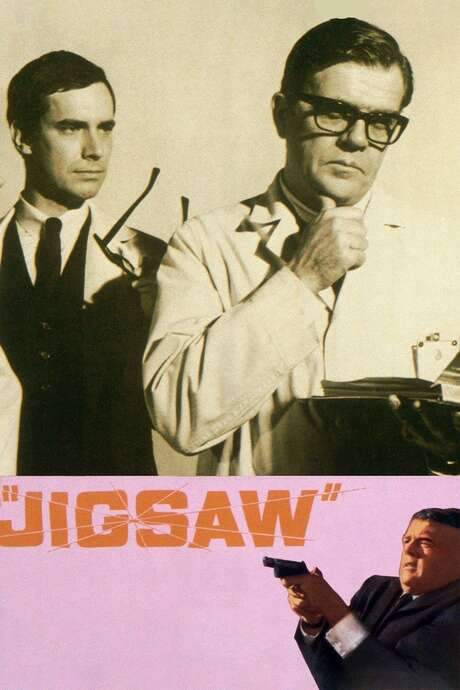
Jonathan Fields, Bradford Dillman, wakes after his coffee has been spiked with LSD and discovers a woman drowned in his bathtub, with flecks of blood on his hands. Amnesia clouds his memory, and with no clear way to piece together what happened, he hires a private detective to chase the truth. Arthur Belding, James Doohan, is brought in to untangle the tangled threads and navigate a maze of suspicion, where every clue seems to point in circles and every lead raises more questions than it answers.
Returning to his job at a scientific think tank, Fields meets a woman who claims to be his sweetheart. Helen Atterbury, Hope Lange, arrives with confidences and warnings that something dangerous is escalating around him. The tension at the workplace thickens as a rival colleague, Lew Haley, Pat Hingle, looms over Fields, casting suspicion and stirring resentment that threatens not only Fields’s career but his very safety. The atmosphere at the think tank crackles with insinuations, power plays, and fragile alliances, and every conversation seems to hint at a hidden motive behind the recent chaos.
Meanwhile, a hippie named Dill, Michael J. Pollard, and an accomplice abduct Belding in a bid to silence the investigation. The detective miraculously escapes and regroups with Sarah, Diana Hyland, his girlfriend, whose presence lends Fields a rare spark of trust and humanity in a case that keeps spiraling toward tragedy. With Sarah’s support, Fields begins to connect the dots between his memories and the mounting evidence, slowly painting a picture of a relationship that has spiraled into something deeply dangerous.
As the pieces start to fit, they uncover a chilling truth: Dr. Edward Arkroyd, Victor Jory, the head of the think tank who had been involved in a romantic affair with the victim, has himself been murdered. The investigation points to Haley as the mastermind behind both killings, exposing a web of ambition, jealousy, and deceit that binds the scientific community to dangerous secrets. A tense confrontation erupts between Fields and Haley, a clash fueled by anger, pride, and a fearsome desire to control the trajectory of everyone around them. The confrontation is only the beginning of a more violent reckoning, as an angry henchman, Roy Jenson, bursts onto the scene with a brutal edge that underscored how far people will go to protect their lies.
What follows is a slow-burning unraveling of loyalties, where memory becomes a weapon and every restored memory threatens to overturn the fragile balance of power at the think tank. Fields finds himself pulled between professional duty and personal loyalties, while Belding’s stubborn pursuit of the truth keeps pushing them toward dangerous revelations. The case widens beyond a single murder, hinting at covert relationships, professional rivalries, and a conspiracy that could shake the foundation of the entire institution. The narrative moves with methodical suspense, blending psychological tension with a noir-tinged atmosphere that emphasizes flaws, secrets, and the price of truth.
In the end, the story refuses to give a simple resolution. The truth about what happened in that apartment, who was truly in control, and how far people would go to protect their own interests is laid bare, but the consequences ripple outward, leaving Fields with more questions than answers and a sense that the deeper you dig, the more you realize how thin the line is between memory and manipulation. Through it all, the performances—especially Fields’s struggle with amnesia, the sharp dynamic with Arthur Belding, and the dangerous dance around Helen Atterbury and Lew Haley—build a tense, noir-tinged tapestry that lingers long after the final confrontation.