Plot Explained Spoilers guaranteed!
Plot Explained

Browse by genre

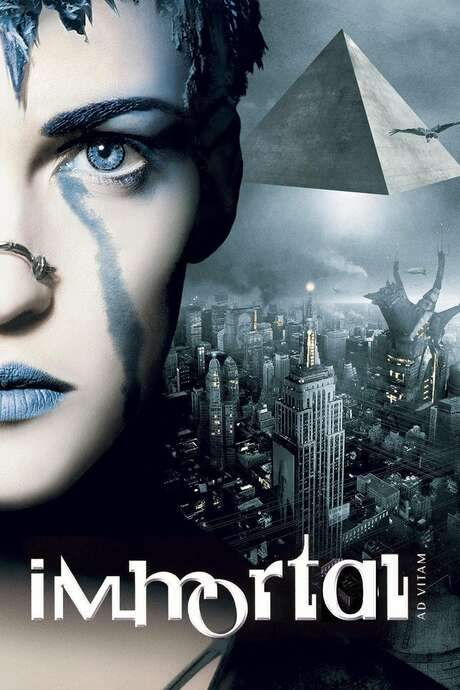
Immortal (2004) movie poster

Plot Summary

Immortal (2004) Plot Summary Explained

Release, runtime and language
2004 · 103 mins · French
Directed by
Enki Bilal
Starring
Charlotte Rampling, Thomas Kretschmann, Frédéric Pierrot, Jerry Di Giacomo, Joe Sheridan, Vanessa Hope

Set in a far‑future Earth ruled by ancient deities and genetically engineered humans, the fragile balance is shattered when a condemned god is sentenced to death. Determined to survive, he searches for a suitable human vessel and a woman capable of bearing his offspring, setting a perilous quest in motion.

On this page (5)
  1. 1 What happens: full plot
  2. 2 Plot questions answered
  3. 3 Movie threads
  4. 4 Movies like Immortal
  5. 5 Every angle

Full plot summary · contains spoilers

What Happens in Immortal: Full Plot Summary

The whole story of Immortal (2004) explained, from the opening scene to the final frame: every key event, every twist and what it all adds up to. Read it as a quick recap before the sequel, to check a scene you missed, or to finally understand what really happened.

In a late-21st-century New York City, genetically altered humans live side by side with aliens and other beings, yet the former dominate the latter and treat them as second-class citizens. Refugees arrive through the so‑called inclusion zone, a mysterious vortex that now envelops Central Park: it lets the newcomers exit but destroys anyone who tries to enter. Above the metropolis, a strange pyramid hovers, and inside it the gods of ancient Egypt debate Horus’s rebellious nature, ultimately deciding that he must be punished. They strip him of immortality and sentence him to death, but grant him seven days to “look upon his creation.” The gods reveal a perilous path to salvation: Horus must reincarnate in a new body by finding a compatible woman capable of bearing a god’s child—a feat that is incredibly rare.

In the city below, Jill, Linda Hardy, a blue-haired, otherworldly woman, is captured by agents of the powerful eugenics conglomerate that looms over government and commerce. She appears human but carries a lineage that marks her as different: her tears are blue, her skin is unusually pale, and her cells behave as if she’s only three months old, even though she seems fully grown. Unbeknownst to the scientists, Jill is a bioengineered being designed to enable a godly lineage, endowed with the rare talent to bear a god’s child, a trait she does not yet understand. The luminous Dr. Elma Turner, Charlotte Rampling, grows fascinated by Jill’s extraordinary physiology and becomes a crucial ally, helping orchestrate her escape.

Meanwhile, Horus Thomas M. Pollard begins his urgent search for a suitable vessel, aware that time is running short and that Jill’s unique gift may be her only chance at survival. Yet humankind has changed—genetically modified to resist his presence—and many would rather see the godly plan fail. Horus’s pursuit leads him to Nikopol, a political dissident who has spent decades in cryogenic stasis and who, by a chance mishap, escapes one year early from a collapsed cryo-prison. Nikopol’s body is unmodified, making him the perfect host for Horus to inhabit, though the transfer is far from seamless. The struggle between Horus and Nikopol within the same body is fierce, and the newly forged metal leg Nikopol uses—crafted from steel railway track—becomes a heavy, constant reminder of the god inside him.

Together, Horus in Nikopol’s body and Jill move through a city full of danger and intrigue, seeking a way to fulfill the god’s plan without damning Jill to a brutal fate or exposing them to the eye of the eugenics regime. Horus’s seduction of Jill, carried out through Nikopol’s body, triggers moral conflict for Nikopol, who begins to see sexual coercion as a form of violation, something he decries as unacceptable, even for a god. Horus, however, views his actions as a necessary means to an ultimate, divinely sanctioned end.

A relentless police inspector investigates a string of grisly killings: the victims are the remnants of Horus’s previous host bodies, torn from the inside as if by some unnatural force. Nikopol and Jill become suspects, weaving together a tense web of pursuit, romance, and survival as they try to stay one step ahead of both law enforcement and the eugenics corporation. In a climactic turn, Horus succeeds in impregnating Jill just as the clock runs out, and control of Nikopol’s body returns—with him gaining the ability to move his heavy metal leg on his own as a parting gift.

One year later, a now fully human Jill encounters Nikopol again in Paris, where she has a blue falcon baby of her own, a creature she affectionately labels as “cheeky.” She does not remember the rebel who once shared her life, but a spark lingers between them, suggesting that their paths may cross again. The final image lifts the gaze to the pyramid ship above the city, where Horus lies entombed in a ceremonial sarcophagus, a faint glimmer of light flashing in his eyes, a reminder that the gods’ meddling—and humanity’s struggle—continue beyond the frame.
Last updated: October 09, 2025 at 15:21

Was this helpful?

Plot questions answered

Immortal Plot Explained: Your Questions Answered

The questions people ask most about Immortal (2004): what happens in the confusing scenes, why the characters do what they do, the twists, hidden details and what the ending means. Each answer contains spoilers.

Q1

Why was Horus sentenced to death by the Egyptian gods?

Horus was punished for his rebellious nature against the other Egyptian gods. The divine council decided he must be executed, but they granted him seven days to "look upon his creation" as a final mercy. To survive, Horus must reincarnate by finding a mortal woman capable of bearing a god's child, which is an extremely rare feat.

Foreshadowing: The gods' earlier debate about Horus's rebellious nature establishes his defiance as the reason for his punishment.

  • horus
  • egyptian gods
  • punishment
  • reincarnation
  • death sentence
Q2

How does Horus inhabit Nikopol's body?

Horus possesses Nikopol after the political dissident escapes early from his cryogenic prison due to a mechanical accident. Nikopol's body is unmodified by genetic engineering, making it the perfect vessel for a god, most humans in this world have altered genetics that resist divine presence. The possession is violent and incomplete, with Horus and Nikopol constantly struggling for control.

Foreshadowing: The timeline notes that Nikopol escapes one year early, making him available precisely when Horus needs a host.

  • horus
  • nikopol
  • possession
  • host body
  • cryogenic
Q3

Why is Jill captured by the eugenics corporation?

Jill is captured because she is a bioengineered being designed to enable a godly lineage. Her unique physiology makes her capable of bearing a god's child, a talent so rare that Horus's survival depends on finding her. The eugenics corporation runs the government and conducts experiments on aliens and refugees, so they seize her for study despite not fully understanding her purpose.

Foreshadowing: Dr. Turner's fascination with Jill's cells being only three months old hints at her engineered origins designed for divine reproduction.

  • jill
  • eugenics
  • capture
  • bioengineered
  • fertility
Q4

Who is killing the former host bodies and why?

The inspector investigates killings where victims are torn from the inside, these are the remnants of Horus's previous host bodies. As Horus abandons each host to find a new one, the old bodies are destroyed, creating the gruesome murder scene that puts Nikopol and Jill under suspicion. The killings are a consequence of Horus's desperate search for survival through reincarnation.

Foreshadowing: The timeline establishes that Horus must find a compatible host, implying he has tried and failed multiple times before finding Nikopol.

  • host bodies
  • murders
  • inspector
  • killings
  • horus
Q5

Why does Horus need to impregnate Jill?

Horus must impregnate Jill because the gods declared that the only way to escape his death sentence is to reincarnate through a child born of a mortal woman capable of bearing a god's offspring. This is the divine punishment's loophole, the god can survive if he produces an heir before the seven-day deadline expires. Jill's engineered biology makes her one of the极少数 capable of this feat.

Foreshadowing: The gods explicitly state that finding a woman to bear his child is Horus's only path to survival.

  • horus
  • jill
  • impregnation
  • reincarnation
  • child
Q6

What happens to Horus after the seven-day deadline?

After Horus successfully impregnates Jill, he transfers control of Nikopol's body back to the human and grants him the ability to move his heavy metal leg on his own. Horus himself becomes entombed in a ceremonial sarcophagus aboard the pyramid ship. However, the final image shows a glimmer of light flickering in his eyes, suggesting his divine essence or power persists in some form.

Foreshadowing: The ticking clock throughout the story builds to this moment where either Horus survives through his child or dies.

  • horus
  • deadline
  • sarcophagus
  • pyramid
  • entombed
Q7

Why does Nikopol regain movement of his metal leg?

Horus grants Nikopol the ability to move his heavy metal leg as a parting gift after relinquishing control of the body. This metal leg, crafted from steel railway track, had been a constant physical burden throughout the story. The gift suggests Horus acknowledges the human's sacrifice in allowing the divine plan to proceed, and serves as a symbolic transfer of power from god to man.

Foreshadowing: The heavy metal leg is introduced early as a reminder of the god inside Nikopol, making its resolution thematically significant.

  • nikopol
  • metal leg
  • movement
  • horus
  • gift
Q8

What is the significance of Jill's blue falcon child?

Jill's baby is a blue falcon creature that she affectionately calls "cheeky," born from Horus's divine impregnation. One year later, Jill is now fully human and doesn't remember Nikopol, but the falcon child represents the successful result of Horus's quest for immortality through lineage. The creature bridges the divine and human worlds, symbolizing the god's continuation in a new form.

Foreshadowing: The entire plot revolves around Horus finding a way to perpetuate his godhood through offspring, making the falcon child the fulfillment of that quest.

  • jill
  • falcon
  • baby
  • child
  • offspring
Q9

What is the inclusion zone in the movie?

The inclusion zone is a mysterious vortex that envelops Central Park, serving as the gateway through which refugees and aliens arrive on Earth. The force field allows newcomers to exit into the city but destroys anyone who attempts to enter from the outside, creating a one-way flow of alien refugees into a world where genetically altered humans dominate.

Foreshadowing: The inclusion zone is established early as the mechanism for introducing alien presence into the human world.

  • inclusion zone
  • central park
  • refugees
  • aliens
  • vortex
Q10

Why doesn't Jill remember Nikopol one year later?

Jill's engineered biology causes her cells to rapidly adapt, which the scientists noted would eventually erase memories of her former self. This explains why she encounters Nikopol in Paris without recognizing him despite their intense shared experience. Her transformation into a fully human state came at the cost of her past identity, creating a bittersweet reunion.

Foreshadowing: The scientists warned that Jill's rapidly adapting cells would eventually erase her former self's memories.

  • jill
  • memory
  • nikopol
  • forgotten
  • transformation
Q11

Why does Nikopol object to Horus seducing Jill?

Nikopol views Horus's seduction of Jill through his body as a form of sexual coercion and violation, even though Horus sees it as a necessary means to a divinely sanctioned end. This creates intense moral conflict between the god and the human host. Nikopol's objection represents human ethics opposing divine utilitarianism, a god using a human as a puppet for reproduction against the natural order.

Foreshadowing: The tension between divine will and human morality runs throughout the story as Horus uses Nikopol's body to pursue his plan.

  • nikopol
  • horus
  • seduction
  • jill
  • objection
  • morals

Movie threads

More Movies Like Immortal, by Mood & Story

Curated lists built around what makes Immortal tick: the same mood, the same kind of story or the same emotional payoff. Each list explains why these movies belong together.

Bio-Mechanical Dystopias like Immortal

Futuristic worlds where technology and biology horrifically merge. If you liked the bio-engineered future of Immortal, explore more movies like it. This thread features similar sci-fi stories set in dystopian societies where genetic modification, body horror, and the ethics of playing god are central themes.

  • futuristic
  • oppressive
  • anxious
  • strange
  • melancholic
  • mysterious
  • Tone: dark, oppressive
  • Pacing: fast, intense
Why these movies?

The story pattern: Stories in this thread are defined by their world-building, where societal collapse or advanced technology has led to a grim fusion of biology and machinery. The plot often revolves around characters fighting for survival or identity within these dehumanizing systems, confronting the moral consequences of scientific overreach.

Why they belong together: Movies are grouped here because they share a distinct, oppressive atmosphere born from their bio-technological settings. They explore common themes of bodily autonomy, the ethics of creation, and the horror of a world where humanity has been fundamentally altered.

Bittersweet Sci-Fi Survival Journeys like Immortal

Perilous quests for survival in dark futures, ending with complex resolutions. Looking for movies with a similar survival quest to Immortal? This thread collects complex sci-fi adventures where characters face heavy ethical dilemmas and a fast-paced, high-intensity plot, culminating in a bittersweet or ambiguous conclusion.

  • anxious
  • melancholic
  • futuristic
  • tense
  • mysterious
  • grim
  • Tone: dark, bittersweet
  • Pacing: fast
Why these movies?

The story pattern: The narrative pattern follows a protagonist or group on a desperate, fast-paced mission against overwhelming odds. The journey is marked by sacrifice, moral compromise, and existential threats. The conclusion offers a fragile victory or survival, but at a significant cost, leaving a lasting emotional impact.

Why they belong together: These films are connected by their shared focus on a relentless survival arc, a dark and complex tone, and an emotionally heavy viewing experience that concludes on a bittersweet note. They appeal to viewers who enjoy high-intensity sci-fi with philosophical depth.

If you liked this

Movies Like Immortal

Similar movies to Immortal: the same genre, themes or kind of story. Each one comes with its own plot summary, timeline and ending explained.

Browse all movie summaries

Every angle

Immortal (2004) Explained: Plot, Timeline & Characters

Everything about Immortal in one place: what happens in the plot summary, the timeline in chronological order, the characters and meaning and a spoiler-free summary. What's After the Movie adds the cast, box office and post-credit scenes.

Coming soon on iOS and Android

The Plot Explained Movie Summary App

Plot summaries, endings explained and timelines on your phone. Catch up on any movie in minutes, save your favorites and never miss a twist again.

Be the first to know when we launch. Your email stays private, always.

Learn more about the app