


Plot Explained Spoilers guaranteed!
Plot Explained

Browse by genre

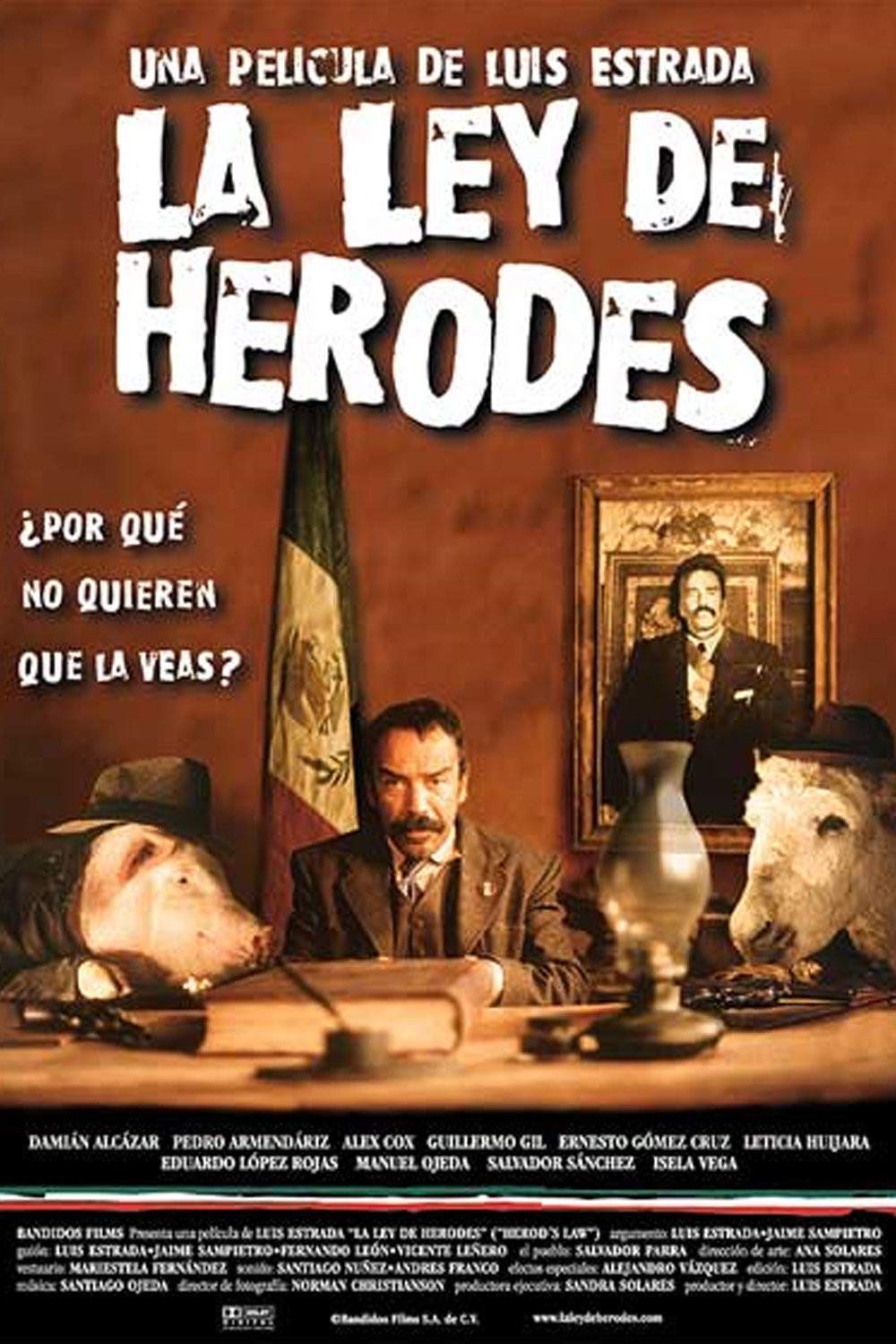
Herod's Law (2003) movie poster

Characters & Themes

Herod's Law (2003) Characters, Setting & Themes Explained

Release, runtime and language
2003 · 120 min · Spanish
JustWatch #33,740 4
Directed by
Luis Estrada

In 1940s Mexico, a small town repeatedly suffers the tragic assassinations of its mayors. Desperate for stability, the community turns to an unassuming janitor as their next leader. However, as he ascends to power, his initial idealism is tested, and he finds himself entangled in a web of corruption. He forms a dangerous alliance with ruthless schemers, opportunistic hypocrites, and criminal associates, threatening the very hope he initially represented.

On this page (7)
  1. 1 Where to watch
  2. 2 Characters explained (4)
  3. 3 Where & when it takes place
  4. 4 Themes & meaning (3)
  5. 5 Character & meaning questions
  6. 6 Movie threads
  7. 7 Every angle

Where to watch

Where to Watch Herod's Law (2003)

Where can you watch Herod's Law? Stream, rent or buy it in the US, including on Netflix and Netflix Standard: current JustWatch availability with up-to-date prices.

Streaming availability powered by JustWatch

4 main characters · contains spoilers

Herod's Law Characters Explained: Who Is Who

The main characters of Herod's Law (2003), heroes and villains: what drives them, how they change over the course of the story and what each of them reveals about the film's bigger ideas.

  • Juan Vargas

    Juan Vargas starts as an innocent head of a landfill, but quickly becomes embroiled in political corruption. His moral degradation leads him to exploit the law and leverage his newfound power for personal gain. Vargas's journey is a tragic depiction of how ambition can corrupt even the most well-meaning individuals.

    • 🚶‍♂️ Politician
    • 💼 Ambitious
    • 😈 Corrupted
  • Gloria

    Gloria is initially supportive of her husband's ambitions but becomes increasingly disillusioned as Vargas descends into corruption. Her eventual betrayal adds a personal layer of tragedy to Vargas's story, highlighting the emotional consequences of his choices. Gloria represents the toll that ambition and moral decay take on familial relationships.

    • 👩‍❤️‍👨 Wife
    • 😟 Concerned
    • 💔 Betrayed
  • Doña Lupe

    Doña Lupe is the enigmatic owner of the town's brothel, representing the intersection of power, corruption, and survival. With her shrewdness and resilience, she stands as a formidable challenge to Vargas's authority. Her willingness to engage in illicit dealings with Vargas illustrates the complex moral landscape of San Pedro.

    • 👵 Brothel Owner
    • 💪 Resilient
    • 😏 Manipulative
  • Carlos Pek

    Carlos Pek serves as Vargas's secretary and initial confidant, witnessing the moral decay of his boss. As Vargas becomes more tyrannical, Pek's horror reflects the impact of corruption on those around him. His character provides a contrast to Vargas and serves as a moral compass in a deteriorating system.

    • 🧑‍💼 Secretary
    • 😨 Witness
    • ⚖️ Conscience

Last updated: October 22, 2024 at 22:18

Was this helpful?

Setting

Where and When Does Herod's Law Take Place?

The setting of Herod's Law (2003): the year and time period, the places and locations, and how they shape the characters, the mood and the tension of the story.

Time period

1952

The events of the movie unfold during the tumultuous year of 1952, a time of political upheaval and social strife in Mexico. This period is characterized by significant corruption within local governments and the desperation of citizens. As the general elections approach, these elements converge, setting the stage for Vargas's rise and fall.

Location

San Pedro de los Saguaros

San Pedro de los Saguaros is a troubled city characterized by poverty and ignorance among its residents. It becomes a focal point for political corruption and the struggle for power, showcasing the harsh realities faced by its inhabitants. The town offers a vivid backdrop for the moral decline of its new municipal president, Juan Vargas.

  • 🏙️ City
  • 🌵 Mexico

Last updated: October 22, 2024 at 22:18

Was this helpful?

3 major themes

Herod's Law Meaning: Themes & Message Explained

What is Herod's Law (2003) really about? The emotional, social and philosophical themes the film keeps returning to, its symbolism and the message beneath the surface.

  • Corruption

    Corruption is a central theme of the movie, explored through Juan Vargas's transformation from an innocent figure to a corrupt official wielding power for personal gain. The film portrays how greed and moral decline can lead to devastating consequences for both the individual and the community. Vargas's journey highlights the pervasive nature of corrupt practices in politics.

  • Betrayal

    Betrayal emerges as a pivotal theme, as Vargas's personal and political relationships unravel. The ultimate betrayal by his wife Gloria, coupled with his ruthless actions against others, illustrates the tragic fallout of misplaced trust and moral erosion. This theme accentuates the emotional turmoil that accompanies Vargas's descent into tyranny.

  • Justice

    The struggle for justice is woven throughout the narrative, as Vargas initially seeks to position himself as a reformer but ultimately becomes an authoritarian figure. The film questions the true nature of justice within a corrupt system and challenges the audience to consider who the real heroes and villains are in the world of politics.

Last updated: October 22, 2024 at 22:18

Was this helpful?

Character & theme questions

Herod's Law Characters & Meaning: Your Questions Answered

The questions people ask about Herod's Law (2003): who the characters really are, their relationships, what the symbols mean, where it takes place and what the movie is really about. Each answer contains spoilers.

Q1

Where is the movie set?

The movie takes place in San Pedro de los Saguaros, a troubled Mexican town plagued by poverty and ignorance. This setting is central to the story as it represents the perfect breeding ground for political corruption and the struggle for power among its desperate inhabitants.

  • san pedro de los saguaros
  • setting
  • mexico
  • town
  • corruption
Q2

What time period does the movie depict?

The events unfold in 1952 Mexico, during a period of significant political upheaval and social strife. This era was marked by widespread corruption within local governments and growing desperation among citizens as general elections approached.

  • 1952
  • mexico
  • era
  • period
  • political context
  • elections
Q3

What is the main theme of the movie?

Corruption is the central theme, explored through Juan Vargas's transformation from an innocent landfill worker into a corrupt municipal president. The film illustrates how greed and moral decline lead to devastating consequences for both the individual and the community, showcasing the pervasive nature of political corruption.

  • corruption
  • politics
  • theme
  • Juan Vargas
  • moral decline
Q4

How does betrayal factor into the story?

Betrayal emerges as a pivotal theme when Vargas's wife Gloria turns against him after witnessing his descent into corruption. This personal betrayal, combined with Vargas's ruthless actions against others, illustrates the tragic fallout of misplaced trust and moral erosion within both personal and political relationships.

  • betrayal
  • Gloria
  • wife
  • trust
  • relationships
Q5

What does the movie say about justice?

The film questions the true nature of justice within a corrupt system. Vargas initially positions himself as a reformer but ultimately becomes an authoritarian figure, challenging the audience to consider who the real heroes and villains are in political environments where the lines between justice and tyranny blur.

  • justice
  • reform
  • authoritarian
  • politics
  • system
Q6

Who is Juan Vargas?

Juan Vargas is the protagonist who begins as an unassuming janitor and head of the town landfill. Rising to become municipal president, his journey depicts how ambition corrupts even well-meaning individuals, transforming him from a symbol of hope into a tyrannical figure wielding power for personal gain.

  • Juan Vargas
  • protagonist
  • mayor
  • municipal president
  • corruption
Q7

Who is Gloria and what is her role?

Gloria is Juan Vargas's wife who initially supports his political ambitions but becomes increasingly disillusioned as he descends into corruption. Her eventual betrayal represents the personal and emotional toll that ambition and moral decay take on familial relationships.

  • Gloria
  • wife
  • family
  • betrayal
  • disillusionment
Q8

Who is Doña Lupe in the story?

Doña Lupe is the owner of the town's brothel, representing the intersection of power, corruption, and survival in San Pedro de los Saguaros. Her shrewdness and resilience make her a formidable presence who engages in complex moral dealings with Vargas, illustrating the town's corrupt landscape.

  • Doña Lupe
  • brothel
  • power
  • corruption
  • survival
Q9

Who is Carlos Pek?

Carlos Pek serves as Vargas's secretary and initial confidant, witnessing his boss's moral decay firsthand. As Vargas becomes more tyrannical, Pek's horror reflects the impact of corruption on those around him, and he serves as a moral compass in a deteriorating political system.

  • Carlos Pek
  • secretary
  • witness
  • moral compass
  • confidant
Q10

Is this a comedy or drama?

The movie is classified as a Comedy, Crime, and Mystery, but the comedy manifests as dark, cynical humor rather than light entertainment. It functions as a satire that uses dark humor to expose the absurdity and tragedy of political corruption, resulting in a tone that is more bleak than comedic.

  • comedy
  • satire
  • dark humor
  • genre
  • tone
Q11

What is the movie's message about corruption?

The film delivers a bleak message that the cycle of corruption in small-town Mexican politics repeats endlessly. Despite Vargas's initial promise as a reformer, he becomes indistinguishable from the corrupt officials who came before him, suggesting systemic change may be impossible.

  • cycle
  • corruption
  • message
  • systemic
  • hope
  • ending

Movie threads

More Movies Like Herod's Law, by Mood & Story

Curated lists built around what makes Herod's Law tick: the same mood, the same kind of story or the same emotional payoff. Each list explains why these movies belong together.

Movies about political corruption and moral decay like Herod's Law

Stories where idealism is shattered by the brutal realities of authority. If you liked the cynical power struggle and tragic downfall in Herod's Law, explore more movies like it. This section features films about political corruption, the abuse of power, and the moral disintegration of idealistic characters in the face of systemic greed and violence.

  • corrupting
  • cynical
  • grim
  • fatalistic
  • oppressive
  • anxious
  • Tone: dark, cynical, bleak
  • Pacing: steady, methodical
Why these movies?

The story pattern: The typical narrative follows a protagonist entering a position of power with hopeful intentions, only to face overwhelming pressure, temptation, and violence from a corrupt establishment. Their principles are systematically eroded as they make compromises, form dangerous alliances, and ultimately become a perpetrator of the tyranny they once resisted.

Why they belong together: Movies are grouped here for their shared focus on the corrupting nature of power and their bleak, fatalistic tone. They share a heavy emotional weight, a steady pacing that builds dread, and a narrative structure centered on a protagonist's tragic moral collapse within a cynical world.

Dark political satires and cynical crime comedies like Herod's Law

Cynical journeys into violent, corrupt systems disguised as comedies. For viewers who appreciated the darkly humorous and satirical edge of Herod's Law, this section collects similar movies. Discover cynical comedies, political satires, and crime stories that blend brutal violence with a grim, fatalistic sense of humor about power and corruption.

  • satirical
  • cynical
  • brutal
  • anxious
  • grim
  • fatalistic
  • Tone: dark, satirical, tense
  • Pacing: steady, unfolding
Why these movies?

The story pattern: These stories often begin with a seemingly ordinary or comedic premise that quickly descends into violence and moral ambiguity. The narrative uses irony and bleak humor to expose the absurdity and horror of corrupt institutions, leading the protagonist—and the viewer—on a disorienting and anxious spiral downwards.

Why they belong together: These films are united by their unique blend of dark satire with grim, often violent, subject matter. They share a specific mood: an oppressive, anxious atmosphere punctuated by cynical humor, a steady pacing that builds dread, and a high-intensity portrayal of a world without moral redemption.

Every angle

Herod's Law (2003) Explained: Plot, Timeline & Characters

Everything about Herod's Law in one place: what happens in the plot summary, the timeline in chronological order, the characters and meaning and a spoiler-free summary. What's After the Movie adds the cast, box office and post-credit scenes.

Coming soon on iOS and Android

The Plot Explained Movie Summary App

Plot summaries, endings explained and timelines on your phone. Catch up on any movie in minutes, save your favorites and never miss a twist again.

Be the first to know when we launch. Your email stays private, always.

Learn more about the app