Plot Explained Spoilers guaranteed!
Plot Explained

Browse by genre

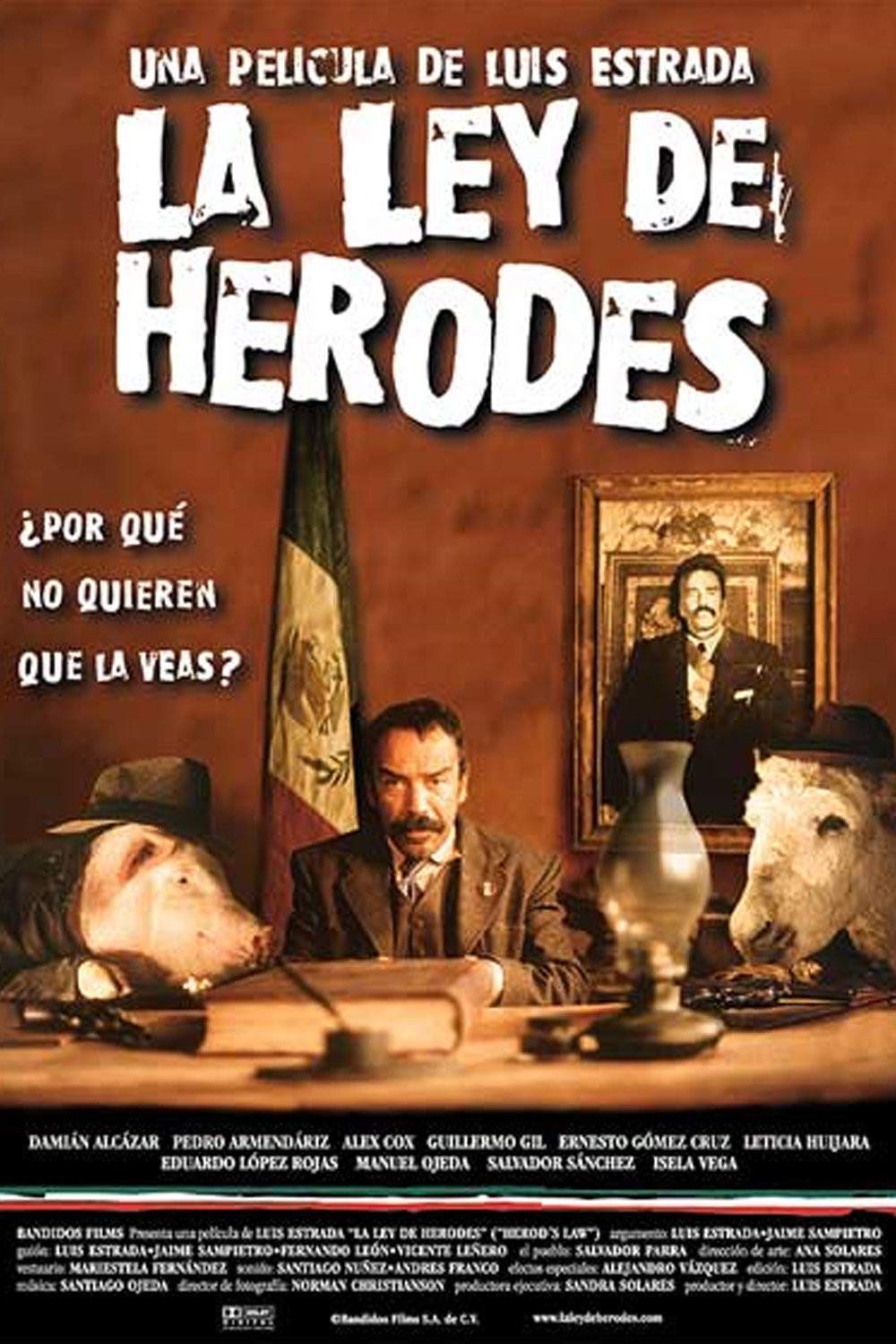
Herod's Law (2003) movie poster

Plot Summary

Herod's Law (2003) Plot Summary Explained

Release, runtime and language
2003 · 120 min · Spanish
Loading streaming availability…
Directed by
Luis Estrada

In 1940s Mexico, a small town repeatedly suffers the tragic assassinations of its mayors. Desperate for stability, the community turns to an unassuming janitor as their next leader. However, as he ascends to power, his initial idealism is tested, and he finds himself entangled in a web of corruption. He forms a dangerous alliance with ruthless schemers, opportunistic hypocrites, and criminal associates, threatening the very hope he initially represented.

On this page (5)
  1. 1 Where to watch
  2. 2 What happens: full plot
  3. 3 Plot questions answered
  4. 4 Movie threads
  5. 5 Every angle
Loading streaming availability…

Full plot summary · contains spoilers

What Happens in Herod's Law: Full Plot Summary

The whole story of Herod's Law (2003) explained, from the opening scene to the final frame: every key event, every twist and what it all adds up to. Read it as a quick recap before the sequel, to check a scene you missed, or to finally understand what really happened.

The story begins with a gripping scene where a desperate man hastily fills bags with cash as night falls, leaving a lifeless body in an office behind him. Soon, his reckoning arrives as a vengeful mob, fueled by anger, descends upon him, delivering a gruesome retribution with a machete.

With the chaos settling, it becomes apparent that the victim was the mayor of San Pedro de los Saguaros. In an effort to evade scrutiny ahead of the 1952 general elections, State Governor Sánchez orders Secretary López to seek a temporary replacement. López assigns the task to Ramírez, who suggests Juan Vargas, the ostensibly innocent head of a local landfill, for the position.

Overjoyed by this unforeseen opportunity, Vargas, alongside his wife Gloria, initially basks in their newfound fortune. However, their excitement quickly dims as they arrive in a San Pedro riddled with poverty and ignorance. Most residents, unable to articulate their frustrations in Spanish, remain silent observers of their hardships.

Despite Gloria's concerns, Vargas opts to stay in San Pedro and investigate the potential this new role offers. Under the guidance of his secretary Carlos Pek, he uncovers a history of corruption that has tainted previous administrations, meeting pivotal characters along the way, such as Doña Lupe, the mystifying owner of the town's brothel; the selfish Parish Priest Pérez; and Doctor Morales, a learned member of the opposition PAN.

As Vargas grapples with an empty municipal budget due to prior mismanagement, he travels to the state capital in hopes of appealing to López for additional funds. Unfortunately, his journey takes an unexpected turn when his car breaks down, leading him to encounter Robert Smith, an American who offers to pay him for services while using an alias. Though Vargas receives a copy of the Mexican Constitution and a revolver during a setback encounter with López, he feels undeterred.

As Vargas immerses himself in the intricacies of governance, he stumbles upon numerous constitutional loopholes ripe for exploitation, thereby extracting fines and taxes from those who dare challenge him. His initial attempts to shut down the scandalous brothel face resistance from Doña Lupe, who threatens him with a cleaver, sending Vargas fleeing in terror. This confrontation leaves him both shaken and motivated by the lure of financial gain. Later, when Doña Lupe proposes a profitable arrangement in exchange for his complicity in her illicit dealings, Vargas decides to give in to temptation, thereby paving the way for his impending corruption.

As time passes, Vargas's moral decline accelerates. He weaves an intricate web of lies and manipulates the law, imposing harsh taxes that burden the townspeople. To improve his standing, he introduces Robert Smith, an engineer tasked with modernizing the town through electric lighting, presenting it as a 50-50 partnership that coincidentally allows Vargas to accommodate Smith in his home.

Meanwhile, Doña Lupe's tolerance wanes as Vargas's requests for payment and favors grow increasingly outrageous. In retaliation, she hires a menacing enforcer who viciously assaults Vargas during a debt collection effort. Fueled by rage, Vargas seeks revenge that same night, ambushing both the enforcer and Doña Lupe, brutally killing them and disposing of their remains in a ravine. Unknown to him, he leaves behind his PRI pin, a damning clue of his involvement.

Upon realizing his pin is missing, Vargas panics and instructs Pek to launch an investigation to buy time. To divert suspicion from himself, he frames Filemón, the town's notorious drunkard, as the perpetrator, with Doctor Morales falsely claimed to be the mastermind. Morales is subsequently exiled, facing accusations related to local women.

During Vargas's journey to jail with "Filemón," he discovers the drunkard has found his pin near the ravine. Despite an earlier plan to bribe him with cash and liquor, Vargas heartlessly murders Filemón and discards his body by the roadside.

Returning home, Vargas is faced with a staggering piece of news: his wife has betrayed him with Smith. Enraged and hurt, he loses control, tying Gloria up and brutally assaulting her. This act sets the stage for his tyrannical rule, where he enforces draconian taxes and harsh penalties upon the townsfolk. Pek, horrified by Vargas's conduct, declares him "the worst municipal president this town has ever known," as fear grips the once-peaceful community.

Simultaneously, López arrives in town, looking for retribution after a failed attempt on a political rival, demanding Vargas relinquish the profits he accrued. In a confrontation at Vargas's home, he learns that Gloria has escaped to the United States with Smith, taking all their wealth with her. This triggers a downward spiral for Vargas, who, in a frenzy, kills López and his henchman Tiburón before facing an angry mob led by Father Pérez and Pek.

Just as Vargas's fate seems sealed at the hands of the mob, government officials arrive, chasing López and intervening just in time to rescue Vargas from certain death. In the aftermath, he manages to reinvent himself, portraying himself as the hero who brought justice to corrupt López. Ramírez finds comfort in his new position as the administrator at the landfill where Vargas once toiled. As a new mayor makes his entrance into San Pedro de los Saguaros, it becomes unmistakably clear that history is destined to repeat itself – echoing the very circumstances that brought Vargas and Gloria to this troubled town.
Last updated: November 22, 2024 at 14:22

Was this helpful?

Plot questions answered

Herod's Law Plot Explained: Your Questions Answered

The questions people ask most about Herod's Law (2003): what happens in the confusing scenes, why the characters do what they do, the twists, hidden details and what the ending means. Each answer contains spoilers.

Q1

Why was Juan Vargas chosen as mayor of San Pedro?

Juan Vargas was selected because the state government needed a temporary mayor ahead of the 1952 elections. Secretary López assigned Ramírez to find a replacement, and Ramírez suggested Vargas specifically because he was an unassuming janitor at the local landfill, someone seen as naive and easy to control. They assumed he would be a compliant figurehead with no political ambitions of his own.

Foreshadowing: The opening scene establishes that violence and corruption have already claimed one mayor's life, setting the stage for the search for a replacement.

  • Juan Vargas mayor appointment
  • San Pedro de los Saguaros
  • corrupt politics
Q2

Why does Vargas kill Doña Lupe and her enforcer?

Vargas kills Doña Lupe and her enforcer after Doña Lupe retaliates against his increasingly demanding requests for payment and favors. She sends a menacing enforcer to collect outstanding debts, and when the enforcer brutally assaults Vargas during a collection attempt, Vargas flies into a rage. That same night, he ambushes both the enforcer and Doña Lupe, killing them and disposing of their bodies in a ravine. The murder is impulsive rather than calculated, born from wounded pride and fear.

Foreshadowing: Earlier, Vargas is terrified when Doña Lupe threatens him with a cleaver after he tries to shut down her brothel, his fear and humiliation plant the seeds for his violent retaliation.

  • Doña Lupe murder
  • Vargas violence
  • enforcer killing
Q3

Why does Vargas frame Filemón and then kill him?

After killing Doña Lupe and her enforcer, Vargas realizes his PRI party pin is missing, the pin that could identify him as the killer. Panicking, he instructs his secretary Carlos Pek to launch an investigation to buy time. To redirect suspicion away from himself, he frames Filemón, the town's notorious drunkard, as the perpetrator and falsely claims Doctor Morales orchestrated the crime. Later, when Filemón reveals he found the missing pin near the ravine, Vargas murders him to eliminate the witness and keeps the body by the roadside.

Foreshadowing: Vargas's earlier instruction to Pek to investigate creates the machinery he later uses to frame an innocent man.

  • Filemón framing
  • pin evidence
  • Vargas cover-up
  • murder witness
Q4

Why does Vargas assault his wife Gloria?

Vargas attacks Gloria after discovering she has been having an affair with Robert Smith, the American engineer he brought to town for the electric lighting project. Enraged by the betrayal and humiliation, Vargas ties Gloria up and brutally assaults her. This violent act marks the final destruction of whatever humanitarian ideals he once held, cementing his transformation into a tyrannical ruler who now inflicts cruelty on those closest to him as well as his citizens.

Foreshadowing: Vargas's earlier willingness to exploit others for profit established his capacity for ruthless behavior, which now turns inward toward his own family.

  • Gloria affair
  • Vargas violence
  • Robert Smith relationship
  • domestic abuse
Q5

Why does Vargas kill Secretary López and Tiburón?

Secretary López arrives in San Pedro demanding that Vargas surrender the profits he has accumulated through corruption. López had previously sent Vargas to the town expecting him to be controllable, but now wants his cut. During a confrontation at Vargas's home, López threatens him and insists on taking the money. In the ensuing struggle, Vargas kills both López and his henchman Tiburón, eliminating the man who had originally placed him in power and now seeks to profit from his corruption.

Foreshadowing: Earlier, Vargas travels to the state capital to appeal to López for funds, establishing their relationship, and the expectation that López exploits the town for personal gain.

  • López killing
  • Tiburón murder
  • Vargas vs government
  • corruption consequences
Q6

How does Vargas escape the angry mob?

Vargas escapes death when government officials arrive in San Pedro de los Saguaros just as the mob led by Father Pérez and Pek is about to kill him. The officials were pursuing López (who had earlier tried to assassinate a political rival) and intervene to rescue Vargas from the lynching. This allows Vargas to survive and, remarkably, reinvent himself as a hero who brought justice to the corrupt López, despite his own extensive crimes.

Foreshadowing: The earlier mention of López's failed assassination attempt on a political rival explains why government officials were chasing him, making their arrival at precisely this moment credible.

  • mob escape
  • government intervention
  • Vargas survival
  • false hero narrative
Q7

What happens to Gloria and Robert Smith?

After Vargas brutalizes Gloria, she escapes to the United States with Robert Smith, taking all their accumulated wealth with her. When López arrives demanding Vargas's profits, he learns that Gloria has fled with everything, leaving Vargas with nothing. This loss compounds Vargas's rage and contributes to his decision to kill López and Tiburón in the confrontation that follows.

Foreshadowing: Vargas earlier introduced Smith as an engineer for the town's modernization, establishing their working relationship and creating the opportunity for the affair to develop.

  • Gloria escape
  • Robert Smith flee
  • affair consequences
  • wealth loss
Q8

Why does Vargas become corrupt?

Vargas's corruption develops gradually through a combination of factors: the town's extreme poverty leaves him with an empty municipal budget; he discovers constitutional loopholes that can be exploited for personal gain; and Doña Lupe offers him money in exchange for protecting her brothel. Initially threatened by Doña Lupe's cleaver, Vargas eventually succumbs to the temptation of easy money. Once he accepts the first bribe, each subsequent moral compromise becomes easier, leading to a downward spiral of exploitation, violence, and tyranny.

Foreshadowing: When Vargas attempts to shut down the brothel and is driven away by Doña Lupe with a cleaver, he leaves both shaken and intrigued by the potential for personal profit.

  • Vargas corruption
  • moral decline
  • bribe
  • exploitation
  • power abuse
Q9

What does the ending imply about the cycle of corruption?

The ending clearly implies that the cycle of corruption will repeat itself. A new mayor arrives in San Pedro de los Saguaros, and the final shot echoes the circumstances that brought Vargas to power, a seemingly ordinary man entering a town trapped in poverty and ignorance, vulnerable to the same systemic corruption. Additionally, Ramírez, who originally selected Vargas for his supposed innocence, now takes over as administrator of the landfill, suggesting the same power structures and opportunistic choices that enabled Vargas's rise remain intact.

Foreshadowing: The film opens with a mayor being killed and replaced, establishing from the start that violence and corruption are a repeating cycle in this town.

  • cycle of corruption
  • ending meaning
  • history repeats
  • new mayor
  • political system
Q10

What role does Doña Lupe play in Vargas's corruption?

Doña Lupe represents the entrenched local corruption that Vargas initially confronts but eventually joins. She owns the town's brothel and wields significant power through her threats and cleaver. When Vargas tries to shut down her business, she threatens him, driving him away. However, when she later offers him a profitable arrangement in exchange for his complicity, Vargas accepts, marking his first major moral compromise. Her demands for payment and favors only grow from there, escalating until violence becomes inevitable.

Foreshadowing: Vargas's initial attempt to shut down the brothel and his fearful retreat from Doña Lupe's cleaver establish the power dynamic that later corrupts him.

  • Doña Lupe brothel
  • corruption deal
  • local power structure
  • Vargas compromise
Q11

Why does Vargas bring Robert Smith to San Pedro?

Vargas brings Robert Smith to town as an engineer to modernize San Pedro with electric lighting. However, the partnership is presented as a 50-50 arrangement that conveniently allows Vargas to accommodate Smith in his home. This setup creates the opportunity for Smith to have an affair with Gloria while Vargas is preoccupied with his increasingly corrupt schemes. The electric lighting project represents Vargas's attempt to appear progressive while actually using public works for personal gain and convenience.

Foreshadowing: Earlier, Vargas's car breaks down during his trip to the state capital, leading to his encounter with Smith, who offers to pay him for services, establishing their initial transaction.

  • Robert Smith engineer
  • electric lighting
  • modernization
  • affair opportunity
Q12

Why does Vargas impose harsh taxes and penalties on the town?

After embracing corruption, Vargas imposes brutal taxes and harsh penalties on the townspeople to extract as much wealth as possible. He uses his knowledge of constitutional loopholes to justify these demands, burdening already impoverished citizens. His secretary Carlos Pek witnesses this transformation and eventually declares Vargas 'the worst municipal president this town has ever known.' The taxes represent Vargas's complete abandonment of any pretense of serving the public and his full commitment to personal enrichment through fear and exploitation.

Foreshadowing: Vargas's earlier journey to the state capital to appeal for funds establishes the town's desperate financial situation, which he later exploits rather than solves.

  • harsh taxes
  • exploitation
  • Vargas tyranny
  • citizens burden

Movie threads

More Movies Like Herod's Law, by Mood & Story

Curated lists built around what makes Herod's Law tick: the same mood, the same kind of story or the same emotional payoff. Each list explains why these movies belong together.

Movies about political corruption and moral decay like Herod's Law

Stories where idealism is shattered by the brutal realities of authority. If you liked the cynical power struggle and tragic downfall in Herod's Law, explore more movies like it. This section features films about political corruption, the abuse of power, and the moral disintegration of idealistic characters in the face of systemic greed and violence.

  • corrupting
  • cynical
  • grim
  • fatalistic
  • oppressive
  • anxious
  • Tone: dark, cynical, bleak
  • Pacing: steady, methodical
Why these movies?

The story pattern: The typical narrative follows a protagonist entering a position of power with hopeful intentions, only to face overwhelming pressure, temptation, and violence from a corrupt establishment. Their principles are systematically eroded as they make compromises, form dangerous alliances, and ultimately become a perpetrator of the tyranny they once resisted.

Why they belong together: Movies are grouped here for their shared focus on the corrupting nature of power and their bleak, fatalistic tone. They share a heavy emotional weight, a steady pacing that builds dread, and a narrative structure centered on a protagonist's tragic moral collapse within a cynical world.

Dark political satires and cynical crime comedies like Herod's Law

Cynical journeys into violent, corrupt systems disguised as comedies. For viewers who appreciated the darkly humorous and satirical edge of Herod's Law, this section collects similar movies. Discover cynical comedies, political satires, and crime stories that blend brutal violence with a grim, fatalistic sense of humor about power and corruption.

  • satirical
  • cynical
  • brutal
  • anxious
  • grim
  • fatalistic
  • Tone: dark, satirical, tense
  • Pacing: steady, unfolding
Why these movies?

The story pattern: These stories often begin with a seemingly ordinary or comedic premise that quickly descends into violence and moral ambiguity. The narrative uses irony and bleak humor to expose the absurdity and horror of corrupt institutions, leading the protagonist—and the viewer—on a disorienting and anxious spiral downwards.

Why they belong together: These films are united by their unique blend of dark satire with grim, often violent, subject matter. They share a specific mood: an oppressive, anxious atmosphere punctuated by cynical humor, a steady pacing that builds dread, and a high-intensity portrayal of a world without moral redemption.

Every angle

Herod's Law (2003) Explained: Plot, Timeline & Characters

Everything about Herod's Law in one place: what happens in the plot summary, the timeline in chronological order, the characters and meaning and a spoiler-free summary. What's After the Movie adds the cast, box office and post-credit scenes.

Coming soon on iOS and Android

The Plot Explained Movie Summary App

Plot summaries, endings explained and timelines on your phone. Catch up on any movie in minutes, save your favorites and never miss a twist again.

Be the first to know when we launch. Your email stays private, always.

Learn more about the app