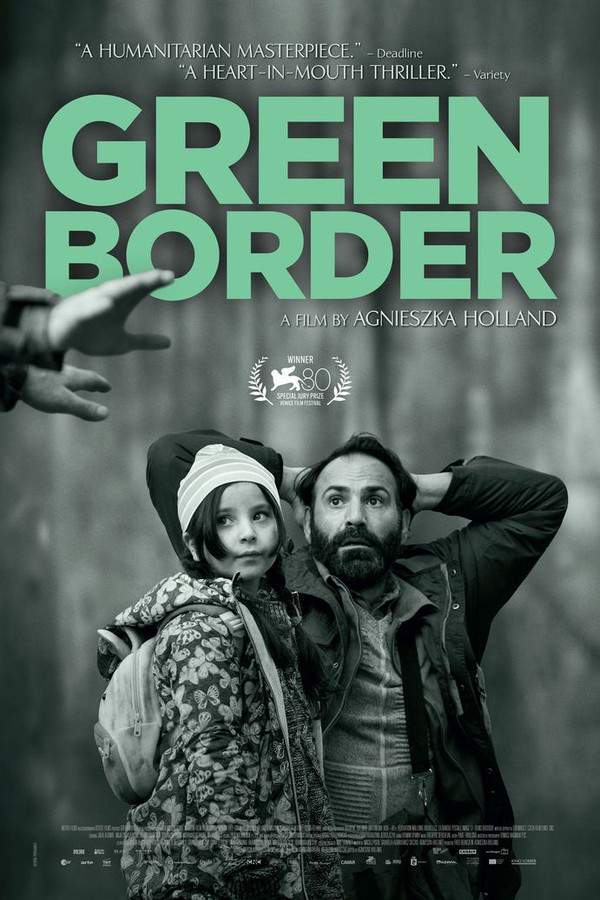
In 2021, a family seeking refuge from Syria—comprised of parents Bashir and Amina, along with their three children Nur, [Ghania], and an infant, alongside Bashir's grandfather Mohamed—arrives at an airport in Minsk, Belarus. Their objective is to traverse the open "green border" into Poland, continue through Germany, and ultimately reunite with a relative in Sweden. Accompanying them is Leïla, an English-speaking refugee from Afghanistan. However, upon reaching the Polish border, they are unexpectedly forced out of their transport van and must continue their journey on foot, venturing into the dense forest. The group's hopes are dashed when they are discovered by Polish authorities, who systematically return them through the barbed wire fence to Belarus. In a distressing incident, the Polish guards brutally throw a pregnant African refugee over the barbed wire, inflicting serious injury.
Meanwhile, Jan is a young member of the Polish border patrol, soon to become a father himself. Under orders from his commander, he and his colleagues are directed to return all migrants back to Belarus, as they are deemed merely pawns in the Belarusian dictator Alexander Lukashenko's attempts to destabilize the European Union by opening the border. The situation escalates when footage of the pregnant woman being violently thrown over the fence becomes public, putting Jan's wife Julia in a morally challenging position regarding her husband's role as a guard. While not on duty, Jan spends his time renovating an abandoned house, only to find that it has become a refuge for squatting migrants. One night while on patrol, he and a fellow guard discover the lifeless body of a pregnant refugee. Following orders to disregard the corpses of migrants at the border, they discard her body over the fence, leaving Jan deeply disturbed and grappling with an emotional crisis in his car.
As the refugees tread through the treacherous woods, a group of activists striving to assist migrants supplies them with clothing, food, water, and essential medical care. However, due to the stringent laws governing the exclusion zone and the risk of being charged with human trafficking, their ability to offer further assistance is severely limited. The family's plight intensifies as they are once again escorted back towards the Belarusian border, where police threaten to open fire. During the chaos, Nur and Leïla manage to escape into the cover of the woods.
In a nearby home, Julia, a widowed therapist, hears cries echoing from the forest. Upon investigating, she discovers Leïla and an unconscious Nur, both sinking into treacherous mud. Despite her urgent calls for help, Nur tragically slips beneath the surface and drowns. Following this harrowing event, Leïla is discharged from the hospital and subsequently detained by Polish authorities, leaving her fate uncertain. Stricken by trauma, Julia resolves to join the activists, fostering a determination to ensure no one is left behind again. During her mission, they encounter a Moroccan refugee stranded in the woods with an injured leg. Unable to transport him safely back, the group reluctantly leaves him overnight, but when Julia returns later, she finds that he has vanished and is arrested for entering the exclusion zone. After being released, Julia is unwavering in her commitment to never abandon anyone again. One of her patients, Bogdan, takes in several French-speaking teenage migrants from Africa, creating bonds with his own children over their shared love for music.
Meanwhile, the Syrian family, grappling with the heartbreaking loss of Nur, contact a human smuggler to hide them in the back of his truck. This risky maneuver brings them face-to-face with two Polish officers, including Jan. Upon inspecting the vehicle, he spots Bashir concealed in the back but chooses to turn a blind eye and allows them to continue their journey.
In the poignant epilogue, following the 2022 Russian invasion of Ukraine, the contrast is stark as Ukrainian refugees are welcomed into Poland with relative ease, highlighting the cruel treatment previously endured by other migrants at the Polish-Belarusian border. The narrative unfolds a tragic reflection on the human condition during times of crisis, illustrating the lengths families will go to for the hope of a better life.