
Ending Explained
Ghost Stories (2020) Ending Explained – Final Scene & Meaning
- Directed by
- Anurag Kashyap, Zoya Akhtar
- Starring
- Avinash Tiwary, Janhvi Kapoor, Mrunal Thakur, Pavail Gulati, Sobhita Dhulipala, Sukant Goel
Your fears will find you. An anthology of four short horror tales.
On this page (5)
Ending explained · contains spoilers
What Happens at the End of Ghost Stories?
How Ghost Stories (2020) ends, what the final scene means, which earlier moments set it up and how to read the ending if the film leaves it open. The full ending explained, with every spoiler.
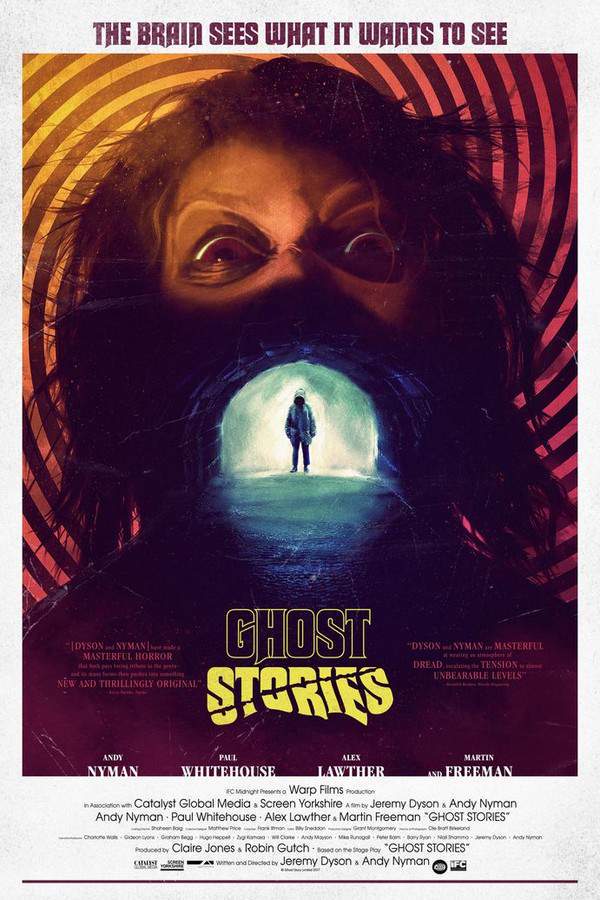
The ending of Ghost Stories delivers a harrowing twist that fundamentally recontextualizes the entire film, shifting the genre from paranormal investigation to a psychological study of guilt. After investigating three terrifying cases, Phillip Goodman confronts his idol, Charles Cameron, only to watch reality crumble around him. In a surreal transition, Cameron’s face morphs into that of Mike Priddle, one of the subjects Goodman interviewed, before the investigator is dragged back into the memory of a traumatic childhood incident. We learn that as a young man, Goodman stood by while bullies tormented a classmate named Desi Callahan, trapping him in a tunnel where he ultimately died of an asthma attack. Goodman never helped, never sought assistance, and never told anyone about the tragedy.
This repressed memory is the key to the film’s conclusion. The shocking reveal pulls back the curtain on Goodman's true reality: he is not a paranormal investigator at all, but a patient in a hospital bed, existing in a coma after a suicide attempt. The "ghosts" he encountered were merely the people in his immediate vicinity, woven into a narrative of supernatural horror by his subconscious. Tony Matthews, the first subject, is actually a hospital janitor; Simon Rifkind is a junior doctor; and Mike Priddle is the senior doctor overseeing his care. Even the disturbing image of Callahan’s corpse forcing a tube into Goodman's mouth is revealed to be a medical intervention—Callahan's finger is actually a breathing tube, and the "dead" boy is trying to save him, not hurt him.
Throughout the film, Goodman prides himself on his skepticism, repeating the mantra that "the brain sees what it wants to see." Ironically, he fails to realize that his own brain is constructing a safe narrative to shield him from his darkest secret. The three cases he investigates are manifestations of his specific guilts: Tony's regret over his relationship with his father mirrors Goodman's inability to connect with his own heritage, Simon's secret about his driving license reflects Goodman's hidden shame, and Mike's tragic family life highlights Goodman's own lonely existence. The clues were present all along, from the numbers of the tunnel appearing on the walls to the dripping sounds of hospital machinery disguised as environmental noise.
Ultimately, the film serves as a somber commentary on toxic masculinity and the dangerous inability of men to articulate their feelings. Each character Goodman encounters struggles to communicate, using aggression, awkwardness, or humor to mask their pain, reflecting Goodman's own emotional suffocation. The film suggests that his suicide attempt was the result of a lifetime of suppressing the truth about Callahan's death. By confronting his past, Goodman is forced to face the physical and psychological toll of his silence, leaving him trapped in a state of limbo, forever haunted by the one ghost he could never debunk: himself.
Last updated: March 30, 2026 at 17:17
The last 4 events
How Ghost Stories Ends: The Final Events in Order
The last events of Ghost Stories (2020) in chronological order, the run-up to the ending explained above. The complete timeline has all 15 events, scene by scene.
-
Ira's Wedding Night and the Ghost
Ira agrees to an arranged marriage with Dhruv, a handsome and wealthy man who dwells in a house his grandmother built. On their wedding night, Ira sees her husband seemingly talking to the grandmother, who died 20 years ago. Each night after that, the grandmother comes to bid Dhruv good night, and he seems to be the only one who can see her.
- When
- Wedding night and the nights that follow
- Where
- Dhruv's house
-
The Truth About the Grandmother's Tragic Fall
Despite being an adult, Dhruv enjoys playing peek-a-boo with his dead grandmother. Ira questions the maid Shanti and learns that Dhruv once accidentally pushed his grandmother down the stairs during their game, leaving her severely incapacitated and in terrible pain. Despite her suffering, the grandmother made it a point to visit Dhruv every night to wish him a good night, though the conversation ends before Ira learns how she passed away.
- Where
- Dhruv's house
-
Ira's Confrontation and Poisoning
One night, Ira grows tired of Dhruv's attachment to his dead grandmother and storms into her room, preserved as a shrine, screaming at her to leave them alone. The next day at breakfast, Shanti helps Ira stir her oatmeal, and midway through the meal Ira suffers severe stomach cramps. As Ira lies writhing in pain, Shanti reveals that the grandmother had begged her to end her pain, leading her to mix highly poisonous castor seeds into the grandmother's breakfast, implying she has now done the same to Ira.
- When
- One night, then the following morning at breakfast
- Where
- Dhruv's house
-
Ira Awakens in the Grandmother's World
Ira wakes up in a brightly lit room and sees the grandmother hovering over her. Confused, she asks how it is that she can now see the ghost, and the grandmother explains that she is in her world because Ira is now dead. Ira turns her head to see other human forms, which the grandmother identifies as others who, like Ira, did not believe in her presence.
- Where
- The grandmother's world
Ending questions answered
Ghost Stories Ending: Your Questions Answered
The questions people ask most about the ending of Ghost Stories (2020): what the final scene means, how the twist works, what happens to each character and how to read the ending. Each answer contains spoilers.
Q1 Why does Charles Cameron's face turn into Mike Priddle's at the end?
The transformation is a visual cue that Goodman's constructed reality is collapsing. Charles Cameron, the famed skeptic Goodman idolized, was never a real person visiting him but a composite figure built by his subconscious, and the morph into Mike Priddle reveals that the senior doctor is the true authority in the room, signaling that the paranormal investigation was always a hallucination.
Foreshadowing: Throughout the interviews, Cameron is presented as remote and almost mythical, never sharing concrete personal history the way the other subjects do.
- charles cameron
- mike priddle
- face morph
- hallucination
- reality collapse
Q2 What actually happened to Phillip Goodman?
The final reveal shows that Phillip Goodman is not a paranormal investigator at all but a patient lying in a hospital bed. He is in a coma following a suicide attempt, and the entire film has been his mind constructing a narrative of supernatural cases to avoid confronting a traumatic memory.
Foreshadowing: Goodman repeatedly claims he debunks ghosts by finding rational answers, yet he never once verifies his own surroundings or asks basic questions about how he arrived at Cameron's location.
- phillip goodman
- hospital
- coma
- suicide attempt
- twist ending
Q3 Who is Desi Callahan and why is he important to the ending?
Desi Callahan was a classmate of Goodman's who was bullied as a child and trapped in a tunnel where he died of an asthma attack. Goodman was present and watched it happen but did not intervene, report it, or ever speak about it, and this buried guilt is the psychological engine that drives both the suicide attempt and the hallucinated film.
Foreshadowing: The number 13, the same number associated with the tunnel where Callahan died, appears on hospital walls and doors throughout the film.
- desi callahan
- childhood trauma
- bullying
- asthma attack
- tunnel
- repressed memory
Q4 Who are Tony, Simon, and Mike in real life?
The three 'subjects' Goodman interviews are not paranormal witnesses but people in his hospital. Tony Matthews is a janitor at the facility, Simon Rifkind is a junior doctor, and Mike Priddle is the senior doctor overseeing Goodman's care, and their real-life details were rewoven by his mind into the three horror stories he investigates.
Foreshadowing: Each of the three men gives unusually sparse, awkward personal details that don't quite fit the supernatural claims they supposedly witnessed.
- tony matthews
- simon rifkind
- mike priddle
- hospital staff
- janitor
- doctor
Q5 Why does the dead boy try to force a tube into Goodman's mouth?
The image of Desi Callahan's corpse shoving a tube down Goodman's throat is the most jarring scene in the film, but in Goodman's real reality the 'tube' is a breathing apparatus being inserted by medical staff to keep him alive, and Callahan's 'attack' is actually a medical intervention reframed by his guilt as punishment.
Foreshadowing: Dripping sounds that play as atmospheric noise throughout the film are later revealed to be the rhythm of medical equipment beside his bed.
- breathing tube
- desi callahan
- medical intervention
- hallucination
- climax scene
Q6 What does 'the brain sees what it wants to see' mean by the end?
The phrase is Goodman's own skeptical mantra, repeated whenever he dismisses a paranormal claim, and it becomes deeply ironic at the end because his own brain has been constructing an elaborate supernatural world to protect him from unbearable guilt. The line essentially indicts him as the very kind of unhinged believer he claims to expose.
Foreshadowing: Goodman recites the phrase almost defensively in every case, never considering that it might apply to himself.
- brain sees what it wants to see
- mantra
- skepticism
- irony
- goodman
Q7 Why did Phillip Goodman try to kill himself?
Goodman's suicide attempt is presented as the result of a lifetime spent suppressing his role in Desi Callahan's death. Unable to confess, grieve, or process what he witnessed as a boy, the shame accumulated until he turned on himself, and the coma that follows becomes a metaphor for a mind trying to escape its own memory.
Foreshadowing: Goodman is visibly uncomfortable whenever a subject mentions a child or a death he cannot explain, flinching at details that echo Callahan.
- suicide attempt
- guilt
- shame
- repressed trauma
- goodman backstory
Q8 What do the tunnel numbers and hospital details mean in the ending?
Numbers like 13 and other visual references to the tunnel where Callahan died appear on walls, doors, and signage throughout the film, and once the hospital twist lands they are revealed to be fragments of real medical-department codes and room numbers that Goodman's subconscious repainted as clues to his childhood crime.
Foreshadowing: The number 13 shows up in otherwise unexplained places from the opening scenes onward, including on street signs and the doors in Cameron's location.
- number 13
- tunnel
- hidden clues
- hospital numbers
- foreshadowing
Q9 How do the three cases connect to Goodman's own guilt?
Each 'case' is a distorted mirror of a specific shame Goodman carries. Tony's regret over his absent father reflects Goodman's estrangement from his own background, Simon's secret about his driving license echoes the hidden truth Goodman is concealing, and Mike's failed family life mirrors Goodman's own loneliness, so every interview is really a disguised confession he is forcing himself to hear.
Foreshadowing: Goodman reacts emotionally to the personal details of each case far more than a detached skeptic would, especially when children or family failure are mentioned.
- tony
- simon
- mike
- mirror
- guilt
- three cases
Q10 Is Phillip Goodman alive or dead at the end of Ghost Stories?
Goodman is left in a state of limbo. He is technically alive in a hospital bed, but because he has finally been forced to confront the truth about Callahan, the protective hallucination collapses and he is left in a coma-like state, trapped between the life he tried to escape and the memory he can no longer repress.
Foreshadowing: The opening sequence frames Goodman as someone who has just woken from a nightmare, hinting that the entire film takes place in a sleep-like state.
- goodman fate
- ending meaning
- limbo
- coma
- alive or dead
Q11 What does the ending of Ghost Stories say about toxic masculinity?
The conclusion argues that toxic masculinity is not just a cultural pattern but a lethal one. Every man in the film, including Goodman, cannot say what he actually feels and instead expresses pain through aggression, deflection, or silence, and the ending suggests this inability to speak is what drove Goodman to attempt suicide and what keeps the other men frozen in their own private horrors.
Foreshadowing: All three 'witnesses' describe their trauma in clipped, defensive language and refuse to use the word 'scared' even when they clearly are.
- toxic masculinity
- emotional suppression
- men's mental health
- theme
- meaning
Q12 What is the 'one ghost Goodman could never debunk'?
The closing line about the ghost Goodman could never debunk refers to himself. The three external cases could always be rationalized as tricks of the mind, but Goodman's own suppressed guilt is the haunting he spent his whole career running from, and the ending makes clear that it is the only apparition he was never equipped to confront.
Foreshadowing: Goodman visibly avoids any interview that touches directly on a child being harmed, steering the conversation elsewhere.
- one ghost
- debunk
- self
- goodman
- final line
- meaning
If you liked this
Movies Like Ghost Stories
Similar movies to Ghost Stories: the same genre, themes or kind of story. Each one comes with its own plot summary, timeline and ending explained.



Every angle
Ghost Stories (2020) Explained: Plot, Ending, Timeline & Characters
Everything about Ghost Stories in one place: what happens in the plot summary, the timeline in chronological order, the characters and meaning, the ending explained and a spoiler-free summary. What's After the Movie adds the cast, box office and post-credit scenes.
- Ghost Stories Plot Summary What happens, from the first scene to the last, every twist included.
- Ghost Stories Timeline Every key event in chronological order, ideal for flashbacks and time jumps.
- Ghost Stories Characters & Themes Who is who, where it takes place and what the movie really means.
- Ghost Stories Spoiler-Free Summary What it is about and whether it is worth watching, without spoilers.
- Ghost Stories on What's After the Movie Cast and crew, box office, post-credit scenes and more.
Coming soon on iOS and Android
The Plot Explained Movie Summary App
Plot summaries, endings explained and timelines on your phone. Catch up on any movie in minutes, save your favorites and never miss a twist again.
Be the first to know when we launch. Your email stays private, always.
Learn more about the app