Plot Explained Spoilers guaranteed!
Plot Explained

Browse by genre

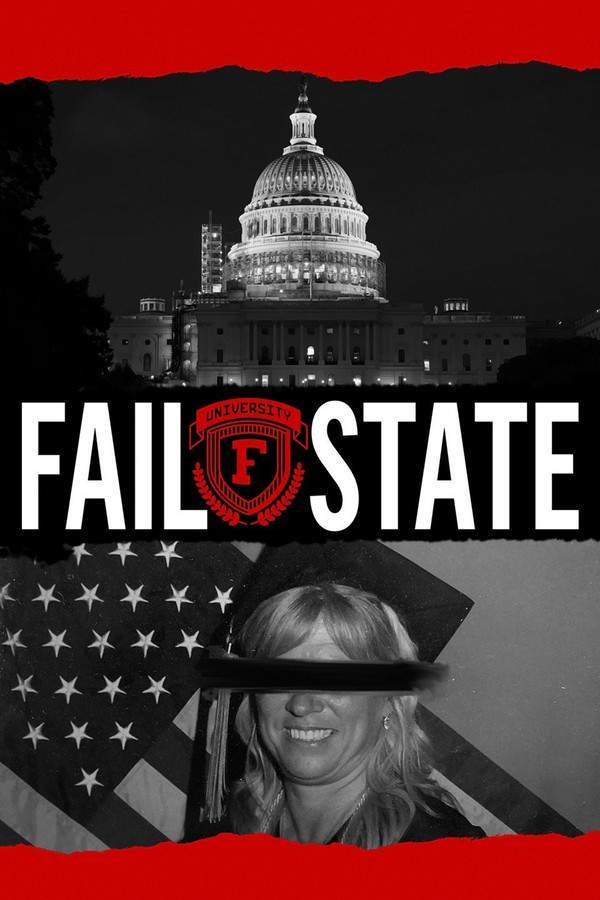
Fail State (2018) movie poster

Plot Summary

Fail State (2018) Plot Summary Explained

Release, runtime and language
2018 · 93 min · English
Echo score 60
Loading streaming availability…
Directed by
Alexander Shebanow
Starring
Gibson Frazier, David Halperin, Maxine Waters, Tom Harkin

Filmmaker Alexander Shebanow investigates the complexities of America's higher education system in this documentary. It exposes how decades of flawed policies in Washington D.C. have fostered a profitable for-profit college industry. The film highlights how these institutions often target vulnerable students, leaving many burdened with substantial debt and questioning the value of their education.

On this page (5)
  1. 1 Where to watch
  2. 2 What happens: full plot
  3. 3 Plot questions answered
  4. 4 Movie threads
  5. 5 Every angle
Loading streaming availability…

Full plot summary · contains spoilers

What Happens in Fail State: Full Plot Summary

The whole story of Fail State (2018) explained, from the opening scene to the final frame: every key event, every twist and what it all adds up to. Read it as a quick recap before the sequel, to check a scene you missed, or to finally understand what really happened.

Fail State is a comprehensive documentary that meticulously examines the evolving economics of higher education and the devastating ripple effects these changes have had on low-income and minority students. Through a series of detailed interviews, the film incorporates perspectives from academic experts, former college recruiters, and both current and former students. It also features insights from government officials, including figures such as Suzanne Mettler and F. King Alexander.

The narrative traces the root of the current crisis back to a pivotal decision made by Congress during the 1970s. During this era, the government shifted its strategy from providing direct financial aid to colleges to instead allocating grants and loans directly to students to cover their tuition. While this move was intended to provide students with more choice, it inadvertently created a market-based system that incentivized aggressive and often predatory recruiting schemes specifically designed to target vulnerable populations.

The film utilizes internal industry documents to expose the cold calculations of for-profit institutions. These records reveal that these schools deliberately sought out individuals who were "isolated" or suffered from "low self-esteem," making them easier targets for exploitation.

To provide a political context to these failures, the documentary features liberal lawmakers who fought against these harms, such as Congressperson Maxine Waters and Senator Tom Harkin. However, the film also offers a nuanced historical perspective, pointing out that in an earlier period, it was actually conservatives within the Reagan administration who were the first to sound the alarm regarding the abuses perpetrated by for-profit educational institutions.

Last updated: October 11, 2026 at 16:41

Was this helpful?

Plot questions answered

Fail State Plot Explained: Your Questions Answered

The questions people ask most about Fail State (2018): what happens in the confusing scenes, why the characters do what they do, the twists, hidden details and what the ending means. Each answer contains spoilers.

Q1

Why does the 1970s Congressional decision matter in Fail State?

The 1970s policy shift is the starting point of the entire crisis because Congress stopped sending aid directly to colleges and instead gave grants and loans to individual students. Fail State argues this single change converted higher education into a market where schools competed for tuition dollars rather than delivering educational quality. That competitive pressure is what later allowed for-profit colleges to flourish by prioritizing recruitment over outcomes.

  • 1970s policy shift
  • congressional funding change
  • higher education history
Q2

How did a market-based system in higher education enable for-profit college abuse?

Once funding followed the student instead of the institution, colleges were rewarded financially for enrolling as many students as possible. Fail State shows that for-profit schools turned enrollment into a revenue engine, hiring aggressive recruiters and designing programs around what could be sold rather than what students would learn. The market rewarded volume, not education, which is why vulnerable populations became the most profitable targets.

  • market-based system
  • for-profit colleges
  • enrollment-driven model
Q3

Why did for-profit colleges specifically target vulnerable students?

Internal industry documents featured in Fail State show that for-profit institutions calculated which students were easiest to recruit and least likely to question the process. People described as isolated or having low self-esteem were pursued because they were more likely to enroll, take on loans, and less likely to drop out before the school collected full tuition. The targeting was not accidental; it was a deliberate business strategy.

  • vulnerable students
  • predatory recruiting
  • low self-esteem
  • isolated individuals
Q4

What do the internal documents in Fail State reveal about for-profit college recruiting?

The documentary presents internal for-profit college records that explicitly identify isolated individuals and those with low self-esteem as ideal recruitment targets. These documents demonstrate that exploitation was not the result of rogue employees but was built into the institutional strategy. The evidence turns what could be dismissed as anecdote into a documented pattern of calculated harm.

  • internal documents
  • for-profit recruiting evidence
  • documentary evidence
Q5

Why did the Reagan administration warn about for-profit colleges?

Fail State highlights that Reagan-era conservatives were among the first in government to identify abuses by for-profit educational institutions, an unusual position for that political era. Their early warnings show that concern about predatory recruiting crossed party lines well before the modern crisis became widely discussed. The film uses this history to argue that the harm was recognized decades ago but was never fully addressed.

Foreshadowing: Conservative warnings in the 1980s foreshadowed the later scandals and liberal-led reform efforts described in the film.

  • Reagan administration
  • conservative warnings
  • for-profit oversight history
Q6

How did Maxine Waters and Tom Harkin try to protect students from for-profit schools?

Rep. Maxine Waters and Senator Tom Harkin used their positions in Congress to push for oversight and regulation of for-profit institutions. Fail State frames their advocacy as a sustained liberal effort to rein in recruiting abuses and hold schools accountable. The film contrasts their later reform work with the earlier Reagan-era conservative concerns to show the issue was bipartisan in diagnosis if not in response.

  • Maxine Waters
  • Tom Harkin
  • congressional reform
  • student protections
Q7

Why are so many students left with debt but no degree after attending for-profit colleges?

Fail State explains that for-profit colleges made more money from enrolled students than from graduates, so there was little financial incentive to ensure students completed their programs. Many of these schools closed abruptly, lost accreditation, or left students with credits that did not transfer. The result was students carrying lifelong loan debt for credentials that often had little value in the job market.

  • student debt
  • for-profit college outcomes
  • degree completion
  • loan burden
Q8

How did for-profit college recruiters actually operate according to the documentary?

Former recruiters interviewed in Fail State describe being trained and pressured to meet aggressive enrollment quotas, often using scripted emotional appeals to keep potential students on the phone. They describe a system where pushing vulnerable people toward enrollment was rewarded, not penalized. These insider accounts reveal that the predatory behavior was a daily operational practice, not an aberration.

  • for-profit recruiters
  • enrollment quotas
  • insider accounts
  • recruiting tactics
Q9

What role does Suzanne Mettler play in Fail State?

Suzanne Mettler appears as a political science expert who traces how decades of federal policy decisions reshaped higher education in ways that harmed vulnerable students. Her analysis connects the 1970s funding shift to the modern for-profit crisis, providing the scholarly framework the documentary builds its argument around. She is one of several expert voices the film uses to give institutional weight to its claims.

  • Suzanne Mettler
  • political science
  • higher education analysis
  • expert testimony
Q10

How does Fail State connect 1970s policy to today's student debt crisis?

The documentary draws a direct line from the 1970s decision to fund students rather than institutions to the rise of recruitment-driven for-profit colleges and the resulting debt burden on low-income and minority students. By weaving together policy history, insider testimony, and student stories, the film argues the current crisis is not an accident but the predictable outcome of structural choices. That causal chain is the central argument of the entire film.

  • policy to crisis
  • student debt causes
  • structural failure
  • higher education timeline
Q11

Why does Fail State include so many different interview perspectives?

The documentary draws on experts, former recruiters, current and former students, and government officials to show the crisis from every level of the system. This range of voices is meant to demonstrate that the problem is structural rather than the result of any one bad actor. By layering these perspectives, Fail State builds a case that accountability has to extend across policy, industry, and oversight failures.

  • documentary interviews
  • multiple perspectives
  • structural failure
  • investigative scope
Q12

What does F. King Alexander bring to the documentary's argument?

F. King Alexander appears as a former government official who discusses how policy decisions and weak oversight allowed for-profit abuses to continue for decades. His perspective adds an insider view of how regulators and institutions interacted and where accountability broke down. The film uses his testimony alongside academic experts to show that those inside the system recognized the harm long before reforms were attempted.

  • F. King Alexander
  • government oversight
  • regulatory failure
  • institutional accountability

Movie threads

More Movies Like Fail State, by Mood & Story

Curated lists built around what makes Fail State tick: the same mood, the same kind of story or the same emotional payoff. Each list explains why these movies belong together.

Investigative exposé documentaries like Fail State

Methodical deep-dives that piece together evidence to expose systemic corruption and quiet failure. If you liked Fail State's patient, evidence-driven exposure of systemic failure, these documentaries share that investigative spirit. Movies like Fail State in this thread use testimony, archival research, and careful pacing to reveal how powerful institutions quietly damage ordinary people. Expect sober tone, steady pacing, and an ending that leaves you disturbed rather than comforted.

  • investigative
  • outraged
  • sobering
  • civic
  • evidence-driven
  • thoughtful
  • Tone: dark, outraged, somber
  • Pacing: methodical, steady, evidence-driven
Why these movies?

The story pattern: Stories in this thread unfold like legal cases or long-form journalism on screen, building a case through expert interviews, leaked documents, and historical context. They often move from a single human story outward to the systemic machinery that enabled the harm, then backward to show how policy decisions made the exploitation possible. The revelations escalate rather than the visuals, and the most disturbing moments tend to be quiet admissions on camera rather than dramatic confrontations.

Why they belong together: These documentaries share methodical, journalistic pacing and a commitment to verifiable truth over narrative flourish. They prioritize institutional critique, civic stakes, and emotional weight produced by implication rather than direct dramatization. Movies grouped here leave the viewer with righteous anger, unfinished questions, and a sense that the system itself is the antagonist.

Institutional exploitation and betrayal stories like Fail State

Stories that reveal how powerful systems quietly target the people least able to fight back. If you liked Fail State and its portrait of predatory for-profit colleges targeting vulnerable students, you'll connect with this thread. Movies like Fail State gathered here expose how institutions and industries profit from harming people who cannot easily resist, from financial scams and predatory lending to corporate cover-ups and policy failures. Expect heavy emotional weight and an ambiguous or somber ending.

  • exploitation
  • systemic failure
  • outraged
  • vulnerable
  • civic
  • moral reckoning
  • Tone: dark, somber, outraged
  • Pacing: measured, steady, escalating
Why these movies?

The story pattern: Narratives in this thread typically follow vulnerable subjects drawn into systems that promise help or opportunity, then reveal those systems as designed to extract value rather than deliver it. The arc moves from individual stories to the policy, profit motive, or bureaucratic indifference that made the harm possible. Endings tend to be somber, ambiguous, or bittersweet: hard-won awareness rather than triumphant justice, leaving the audience to carry the outrage forward.

Why they belong together: These films share a dark, serious tone, heavy emotional stakes, and a focus on systemic critique over individual heroism. They give the viewer no easy villain to defeat and no clear resolution, instead implicating entire industries or political ecosystems. The shared mood is civic grief: a sober look at how ordinary people pay the price for profitable, protected failures of policy and conscience.

Every angle

Fail State (2018) Explained: Plot, Timeline & Characters

Everything about Fail State in one place: what happens in the plot summary, the timeline in chronological order, the characters and meaning and a spoiler-free summary. What's After the Movie adds the cast, box office and post-credit scenes.

Coming soon on iOS and Android

The Plot Explained Movie Summary App

Plot summaries, endings explained and timelines on your phone. Catch up on any movie in minutes, save your favorites and never miss a twist again.

Be the first to know when we launch. Your email stays private, always.

Learn more about the app