Plot Explained Spoilers guaranteed!
Plot Explained

Browse by genre

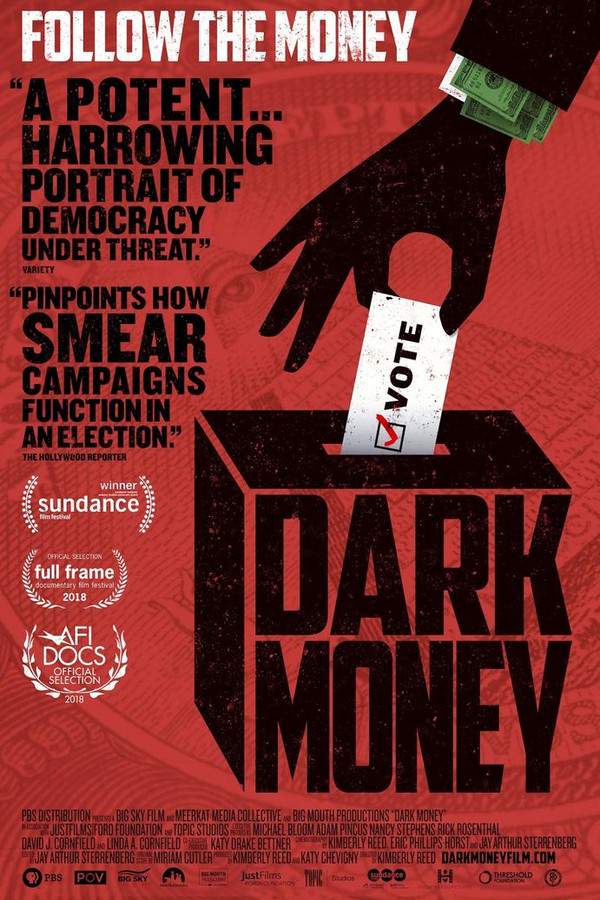
Dark Money (2018) movie poster

Plot Summary

Dark Money (2018) Plot Summary Explained

Release, runtime and language
2018 · 99 min · English
Echo score 76
Loading streaming availability…
Directed by
Kimberly Reed

A journalist investigates a network of anonymous money influencing politics in Montana. Following the Citizens United Supreme Court decision, the reporter uncovers how untraceable corporate funds are flooding into elections, creating a system where fairness is undermined and the foundations of democracy are threatened. The film explores the troubling consequences of this influx of dark money and its impact on American elections.

On this page (6)
  1. 1 Where to watch
  2. 2 What happens: full plot
  3. 3 Plot questions answered
  4. 4 Movie threads
  5. 5 Movies like Dark Money
  6. 6 Every angle
Loading streaming availability…

Full plot summary · contains spoilers

What Happens in Dark Money: Full Plot Summary

The whole story of Dark Money (2018) explained, from the opening scene to the final frame: every key event, every twist and what it all adds up to. Read it as a quick recap before the sequel, to check a scene you missed, or to finally understand what really happened.

Dark Money serves as a detailed exploration and critical analysis of the pervasive influence that corporate funding exerts over contemporary American politics. To illustrate this complex issue, the documentary utilizes the state of Montana as its primary case study, diving deep into the state's turbulent history with corporate interests.

The narrative begins by examining the historical precedent set by the Anaconda Copper Mining Company. The film reveals how the immense power of mining corporations allowed them to manipulate state legislators into relaxing critical mining regulations. This corporate greed led to a devastating environmental catastrophe in Butte, Montana—the repercussions of which continue to plague the region to this day. In a direct response to this corruption, Montana took a stand in 1912 by banning corporate campaign financing within its state politics.

However, this era of protection was disrupted by the landmark Citizens United v. FEC Supreme Court decision. This ruling effectively reopened the doors for corporate interests and "big money" to flood back into Montana's political landscape, mirroring a growing and alarming national trend. The documentary meticulously traces the legal battles led by Steve Bullock, who served as the Montana Attorney General and later as Governor. Bullock sought to find relief from campaign finance abuses during a period when the Federal Election Commission (FEC) had reached a standstill. This paralysis was attributed to the appointment of three new Republican members, led by Don McGahn, who systematically blocked the enforcement of FEC regulations.

A pivotal turning point occurred in 2015 when Montana fought to reassert its campaign finance sovereignty. This was achieved through the passage of the Montana Disclose Act, a piece of legislation designed to strip away the "dark" nature of political influence by requiring the full disclosure of contributors' names.

A central figure throughout the film is John S. Adams of the Montana Free Press. As an investigative journalist, Adams has spent years "following the money" to uncover the hidden gears of state politics. His reporting is highlighted extensively, covering various topics such as:

The role of the American Tradition Partnership* (previously the Western Tradition Partnership) in shaping state election laws.

The illegal political maneuvers of a "right to work" PAC* operating within Montana.

While the film focuses heavily on Adams's journalistic journey, it also integrates interviews with other prominent political figures in Montana and activists dedicated to limiting the power of dark money.

The motivation behind the project is explained by director Kimberly Reed, who believes that the key to understanding any public issue is to identify the forces guiding it. As Reed explains:

> “The first thing you have to look at is the money that’s fueling that issue. Just by following that money, you can tell a lot about the powers-that-be behind it.”

Last updated: October 11, 2026 at 16:42

Was this helpful?

Plot questions answered

Dark Money Plot Explained: Your Questions Answered

The questions people ask most about Dark Money (2018): what happens in the confusing scenes, why the characters do what they do, the twists, hidden details and what the ending means. Each answer contains spoilers.

Q1

How did Citizens United affect Montana's century-old campaign finance ban?

The 2010 Supreme Court decision in Citizens United v. FEC effectively nullified Montana's 1912 ban on corporate campaign financing, ruling that such restrictions violated constitutional free speech protections. The ruling reopened the floodgates for corporate money to pour back into Montana politics, undoing nearly a century of state-level protection and setting off a wave of dark money spending that the documentary investigates.

Foreshadowing: The 1912 ban, enacted after the Anaconda Copper era, was set up as the very safeguard that Citizens United would later dismantle.

  • citizens united
  • montana ban
  • supreme court
  • corporate spending
  • campaign finance
Q2

What does the Montana Disclose Act actually require?

Passed in 2015, the Montana Disclose Act requires full disclosure of the names of all contributors funding political campaigns in the state. By stripping away the anonymity that makes spending 'dark,' the law allows voters and journalists to see exactly who is paying to influence Montana elections. It represents Montana's attempt to reassert campaign finance sovereignty in the wake of Citizens United.

Foreshadowing: The push for transparency echoes Montana's original impulse in 1912 to defend its democracy from corporate power.

  • montana disclose act
  • 2015
  • donor disclosure
  • campaign transparency
  • dark money
Q3

Why was the FEC unable to enforce campaign finance laws?

The Federal Election Commission was effectively paralyzed after three new Republican commissioners, led by Don McGahn, were appointed to the agency. With these additions, a majority of commissioners systematically blocked enforcement of FEC regulations, creating a deadlock that left campaign finance abuses largely unchecked across the country. The FEC's standstill was one of the key conditions that allowed dark money to flourish after Citizens United.

Foreshadowing: The FEC's gridlock foreshadows the broader pattern of regulatory bodies being neutralized when corporate interests gain political leverage.

  • fec
  • federal election commission
  • don mcgahn
  • enforcement
  • republican commissioners
  • gridlock
Q4

Why did Montana ban corporate campaign financing in 1912?

Montana's 1912 ban was a direct response to decades of manipulation by the Anaconda Copper Mining Company, which had used its wealth to pressure state legislators into relaxing mining regulations and prioritizing corporate profit over public welfare. The resulting environmental catastrophe in Butte, Montana, exposed the cost of letting corporations dominate state politics. Outraged voters and reformers pushed through one of the nation's earliest bans on corporate campaign financing to protect democracy from the same kind of influence.

Foreshadowing: The Anaconda era's environmental destruction becomes the moral justification for the 1912 ban, a ban the film later shows being undone.

  • 1912 ban
  • corporate campaign financing
  • anaconda copper
  • montana history
  • campaign finance reform
Q5

What did John S. Adams uncover about American Tradition Partnership?

John S. Adams of the Montana Free Press investigated how the American Tradition Partnership, formerly known as Western Tradition Partnership, channeled undisclosed corporate money into Montana elections to influence state election laws. His reporting traced the organization's funding back to hidden donors and exposed how it operated in the shadows to shape legislation favorable to its backers. Adams's journalism became central to the documentary's argument that dark money had re-infiltrated Montana politics.

  • john adams
  • american tradition partnership
  • western tradition partnership
  • undisclosed donors
  • investigative journalism
Q6

What did the 'right to work' PAC scandal reveal about dark money in Montana?

Adams's reporting exposed a 'right to work' Political Action Committee operating in Montana that had engaged in illegal political activities and violated campaign finance laws to push its agenda. The scandal demonstrated that dark money was not just flowing through national organizations but had penetrated deep into state-level politics, using shadowy PACs to advance policy goals while hiding their funding sources from voters.

  • right to work
  • pac scandal
  • illegal activities
  • montana politics
  • campaign finance violations
Q7

Why did Steve Bullock fight dark money as Attorney General?

As Montana Attorney General, Steve Bullock sought legal relief from the wave of undisclosed corporate spending that Citizens United had unleashed on his state. With the FEC paralyzed at the federal level, Bullock argued that Montana had the right to enforce its own campaign finance laws and protect its elections from outside money. His anti-corruption fight elevated his political profile and ultimately helped carry him to the governorship, where he continued the battle.

  • steve bullock
  • attorney general
  • montana
  • dark money
  • governor
Q8

Why does Dark Money focus on Montana instead of national politics?

Montana serves as a microcosm of the larger American dark money problem because it has one of the longest histories of corporate campaign finance abuse, the nation's earliest state ban on corporate financing, and a recent legislative victory in the 2015 Disclose Act. By tracing the same pattern of corporate influence from the Anaconda era to the present, the film argues that what happened in Montana reflects what is happening across the country. Montana's story makes an abstract national crisis concrete and traceable.

  • montana
  • case study
  • microcosm
  • corporate influence
  • national politics
Q9

How did the Anaconda Copper Mining Company shape Montana politics?

The Anaconda Copper Mining Company used its immense wealth to dominate Montana state politics in the early 1900s, pressuring legislators to relax mining regulations and prioritize corporate profit over environmental and public interests. This unchecked influence led directly to the devastating environmental catastrophe in Butte, Montana, the effects of which still linger today. The Anaconda era became the cautionary example that motivated Montana's 1912 ban on corporate campaign financing.

  • anaconda copper
  • butte montana
  • mining regulations
  • environmental catastrophe
  • corporate corruption
Q10

What does director Kimberly Reed mean by 'follow the money'?

Director Kimberly Reed explains that to understand any public issue, you first have to identify the financial forces fueling it, because the money trail reveals who truly holds power behind the politics. As she puts it in the film, 'just by following that money, you can tell a lot about the powers-that-be behind it.' This philosophy drives the documentary's structure, using investigative journalism to trace dark money from anonymous donors to specific political outcomes.

  • kimberly reed
  • follow the money
  • dark money
  • financial influence
  • documentary thesis
Q11

Is dark money still a problem after the Montana Disclose Act?

The Montana Disclose Act represents a partial victory for transparency within the state, but the broader dark money problem remains unresolved nationally. Citizens United still allows unlimited corporate spending at the federal level and in states without equivalent disclosure laws, so anonymous money continues to influence American elections. The film uses Montana's partial success to argue that reform works, while warning that the fight is far from over.

  • dark money
  • montana disclose act
  • citizens united
  • national problem
  • campaign finance reform

Movie threads

More Movies Like Dark Money, by Mood & Story

Curated lists built around what makes Dark Money tick: the same mood, the same kind of story or the same emotional payoff. Each list explains why these movies belong together.

Investigative exposé documentaries like Dark Money (2018)

Crusading reporters methodically unravel hidden systems of power, corruption, and complicity. Searching for movies like Dark Money? These investigative documentaries and political exposés share the same methodical, follow-the-money energy that uncovers corruption and hidden systems of power. From corporate malfeasance to government cover-ups, each film digs deep into uncomfortable truths through patient reporting and accumulating evidence. Perfect for fans of Dark Money craving more thought-provoking political cinema.

  • investigative
  • exposé
  • follow the money
  • journalism
  • corruption
  • civic-minded
  • Tone: investigative, dark, exposing
  • Pacing: steady, methodical, evidence-driven
Why these movies?

The story pattern: These stories typically follow a determined journalist or investigator whose initial thread pulls a much larger tapestry into view. Scenes alternate between reportorial persistence, archival context, interviews with insiders, and reveals that each new fact confirms the worst suspicions. The emotional arc builds as a slow, steady accumulation of outrage, often ending not with a tidy resolution but with a call to awareness or a partial reform.

Why they belong together: They share a procedural, evidence-first storytelling rhythm, a willingness to dwell in dense information without dumbing it down, and a tone that treats viewer intelligence and civic responsibility as givens. Pacing tends to be steady rather than flashy, intensity is medium but emotionally heavy, and the experience leaves viewers informed, unsettled, and ready to talk about it.

Political alarm documentaries like Dark Money (2018)

Civic-minded stories sounding the alarm on eroding institutions and compromised elections. Movies like Dark Money explore the uncomfortable reality of democracy under threat from corporate money and institutional capture. These civic-minded documentaries and political dramas tackle campaign finance, regulatory corruption, and the slow erosion of public trust. If Dark Money's heavy emotional weight and unsettling tone resonated, these similar films will keep you thinking long after the credits roll.

  • democracy in danger
  • civic-minded
  • unsettling
  • thought-provoking
  • institutional decay
  • heavy stakes
  • Tone: unsettling, dark, civic-minded
  • Pacing: steady, building quiet dread
Why these movies?

The story pattern: These narratives frame democratic structures not as abstractions but as fragile, contested things that can be quietly captured by those with resources. A small, contained case (a state, a court ruling, a single donor network) becomes a window onto a national or systemic crisis. Heroes are usually civic actors, journalists, or reformers whose partial victories underline how much remains to be salvaged.

Why they belong together: They share an unsettling, dark register and a heavy emotional weight driven by existential rather than personal stakes. Pacing leans steady so the structural picture can take shape, tone is consistently dark, and endings lean toward mixed or unsettled outcomes rather than triumph. The mood is civic-minded and thought-provoking rather than escapist.

If you liked this

Movies Like Dark Money

Similar movies to Dark Money: the same genre, themes or kind of story. Each one comes with its own plot summary, timeline and ending explained.

Browse all movie summaries

Every angle

Dark Money (2018) Explained: Plot, Timeline & Characters

Everything about Dark Money in one place: what happens in the plot summary, the timeline in chronological order, the characters and meaning and a spoiler-free summary. What's After the Movie adds the cast, box office and post-credit scenes.

Coming soon on iOS and Android

The Plot Explained Movie Summary App

Plot summaries, endings explained and timelines on your phone. Catch up on any movie in minutes, save your favorites and never miss a twist again.

Be the first to know when we launch. Your email stays private, always.

Learn more about the app