Plot Explained Spoilers guaranteed!
Plot Explained

Browse by genre

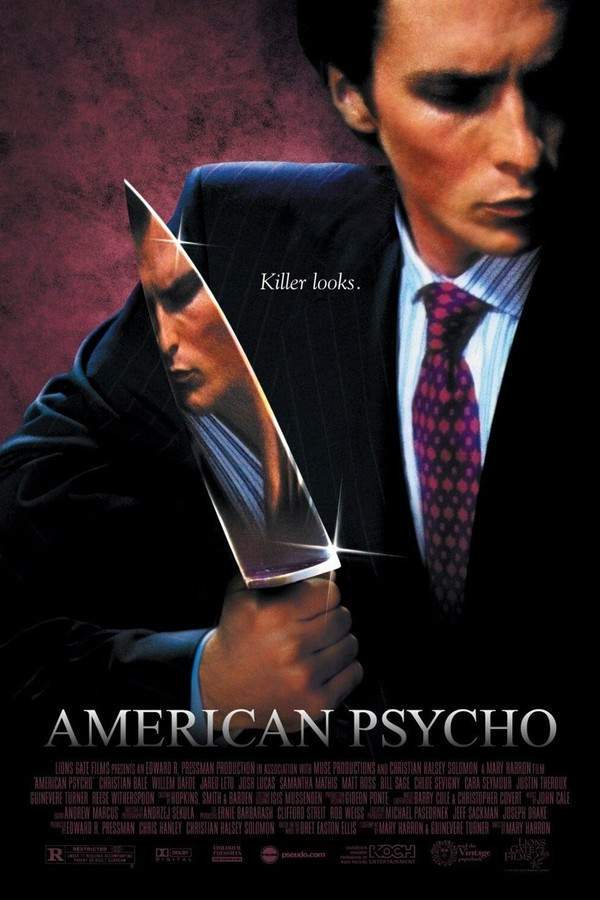
American Psycho (2000) movie poster

Plot Summary

American Psycho (2000) Plot Summary Explained

Release, runtime and language
2000 · 102 min · English
JustWatch #286 91
Directed by
Mary Harron
Starring
Christian Bale
Budget
$7M

In 1987 Manhattan, Patrick Bateman, a wealthy investment banker, leads a seemingly perfect life. However, beneath the facade of charm and success lies a terrifying secret – he is a serial killer. As Bateman struggles to reconcile his two identities, a complex web of relationships with his fiancée, colleagues, and acquaintances becomes increasingly dangerous, blurring the lines between reality and delusion.

On this page (6)
  1. 1 Where to watch
  2. 2 What happens: full plot
  3. 3 Plot questions answered
  4. 4 Movie threads
  5. 5 Movies like American Psycho
  6. 6 Every angle

Where to watch

Where to Watch American Psycho (2000)

Where can you watch American Psycho? Stream, rent or buy it in the US, including on Amazon Prime Video, Hulu and Peacock Premium: current JustWatch availability with up-to-date prices.

Streaming availability powered by JustWatch

Full plot summary · contains spoilers

What Happens in American Psycho: Full Plot Summary

The whole story of American Psycho (2000) explained, from the opening scene to the final frame: every key event, every twist and what it all adds up to. Read it as a quick recap before the sequel, to check a scene you missed, or to finally understand what really happened.

In 1987, the affluent New York investment banker Patrick Bateman leads a life defined by extravagant dinners at fashionable restaurants and maintaining his polished facade for his fiancée Evelyn and his circle of wealthy yet superficial acquaintances, whom he largely detests. Bateman details the ostentatious aspects of his lifestyle, including his rigid daily regimen of exercise and grooming. He passionately describes his eclectic music collection, featuring artists like Huey Lewis and the News, Phil Collins, and Whitney Houston. His obsession with wealth is further highlighted by his taste for high-end designer wear and his opulent apartment.

While Bateman engages in an affair with Evelyn's friend Courtney (portrayed by Samantha Mathis), Evelyn herself is reciprocating with Bateman's colleague Timothy (played by Justin Theroux). This tangled web of infidelity extends to Courtney, who is betrothed to Bateman's other coworker Luis Carruthers (who exhibits mildly homosexual tendencies). Bateman and his cohorts revel in their vanity as they flaunt their business cards. This vanity reaches a deadly peak when Bateman, fueled by jealousy over coworker Paul Allen's (depicted by Jared Leto) superior business card, commits the heinous act of murdering a homeless individual along with the man's dog.

At a Christmas gathering, the stage is set for a grim plot as Bateman arranges to dine with Paul, who mistakes him for another coworker, Marcus Halberstram (Anthony Lemke). Once Paul is intoxicated, Bateman lures him back to his apartment, where he shares an interpretation of "Hip to Be Square" before brutally murdering him with an ax, wearing a raincoat to shield himself from the splatter of blood. After disposing of Paul's body, Bateman visits Paul's apartment to fabricate a story that he has relocated to London.

Later, Bateman is confronted by private detective Donald Kimball (Willem Dafoe) in his office regarding Paul’s disappearance. That evening, he invites two prostitutes—Christie (Cara Seymour) and Sabrina (Krista Sutton)—to his apartment, where he discusses how the band Genesis evolved from progressive rock to pop with their album Duke. Subsequently, he violently assaults the prostitutes, ensuring that he introduces himself as Paul Allen.

The next day, Bateman encounters Luis Carruthers, who reveals his new business card, which triggers a violent reaction from Bateman. However, in a twist of fate, Luis misinterprets Bateman's aggressive demeanor as a proposal of love, leaving Bateman disgusted and fleeing. Following the murder of a model, he invites his secretary Jean (Chloë Sevigny) to his apartment under the pretense of drinks, where he holds a nail gun to her head but dismisses her when receiving a call from Evelyn.

Bateman has a violent threesome with his friend Elizabeth (Guinevere Turner) and Christie at Paul's now-vacant apartment. The encounter turns deadly when he kills Elizabeth mid-act, leading the terrified Christie to run for her life, only to be met with Bateman's wrath as he drops a chainsaw on her from above.

The relationship with Evelyn crumbles as Bateman stumbles upon a stray kitten while using an ATM, which commands him to "feed me a stray cat." He contemplates shooting the cat, but after a woman intervenes, he shoots her instead and lets the cat flee. Bateman sparks a police chase, obliterating police cars in a fit of rage. In an act of desperation, he enters a wrong office building, resulting in the murder of a security guard and a janitor. Bateman frantically leaves a confession on his lawyer Harold’s (Stephen Bogaert) answering machine.

The following day unveils Bateman’s paranoia when he discovers Paul's apartment is vacant, completely devoid of any sign of his atrocities. As Bateman prepares for a meeting with his colleagues, Jean uncovers explicit drawings of murder and torture in his journal. During a chance meeting at a restaurant, Bateman attempts to confess his crimes to Harold, who dismisses the phone message as a joke, convinced that he had dined with Paul days earlier.

Ultimately, Bateman confronts a chilling reality. In a haunting voice-over, he recognizes that his department of sins has no reckoning, and that his whispered confessions amount to nothing more than an illusion of guilt: "This confession has meant nothing."
Last updated: November 08, 2024 at 00:46

Was this helpful?

Plot questions answered

American Psycho Plot Explained: Your Questions Answered

The questions people ask most about American Psycho (2000): what happens in the confusing scenes, why the characters do what they do, the twists, hidden details and what the ending means. Each answer contains spoilers.

Q1

Why does Patrick Bateman kill Paul Allen?

Bateman kills Paul Allen primarily because of his obsession with status and the jealousy he feels over Paul's superior business card. The murder is a culmination of Bateman's rage toward his colleagues, whom he despises for their superficiality, combined with his need to assert power and control. The Christmas dinner provides the opportunity, he gets Paul intoxicated, lures him to his apartment, and kills him with an ax while discussing 'Hip to Be Square,' treating the murder as a twisted performance.

Foreshadowing: Earlier, Bateman's violent jealousy over Paul Allen's business card is established when he murders a homeless man and his dog in a fit of rage over the perceived slight.

  • paul allen
  • murder
  • jealousy
  • business card
  • christmas
Q2

Why is Paul's apartment empty when Bateman returns?

The empty apartment is the central ambiguity of the film. When Bateman returns to Paul's apartment, he finds it completely vacant, no bodies, no blood, no evidence of his crime. This creates uncertainty about whether the murders actually occurred or if they were delusional fantasies. The film deliberately leaves this unresolved, suggesting either that Bateman's memory is unreliable or that the empty apartment represents his psychological break from reality.

Foreshadowing: The question is planted earlier through the private detective's investigation, which yields no body and no evidence of a crime.

  • paul allen apartment
  • empty
  • ambiguity
  • reality
Q3

Why doesn't Harold believe Bateman's confession?

Harold, Bateman's lawyer, dismisses the confession as a joke because he recently dined with Paul Allen in London, whom Bateman claims to have murdered. This creates a contradiction that makes Bateman's confession seem implausible. However, the film leaves ambiguous whether Harold actually saw Paul, whether Paul truly exists, or whether this is another manifestation of Bateman's distorted perception of reality. Harold's dismissal reinforces Bateman's realization that his confessions will never result in consequences.

Foreshadowing: Bateman previously fabricated a story about Paul moving to London after disposing of the body, which now backfires when Harold references this supposed relocation.

  • harold
  • confession
  • lawyer
  • paul allen
  • belief
Q4

What does the ATM scene with the cat mean?

While using an ATM, Bateman encounters a stray kitten. In a moment of complete disconnection from reality, he interprets the situation as the cat commanding him to 'feed me a stray cat.' When a woman intervenes to help the cat, Bateman shoots her instead, then lets the cat go free. This scene illustrates Bateman's total breakdown of moral reasoning, his violence is completely arbitrary and disconnected from any rational motive, showing how his psychopathy has consumed his ability to function in reality.

Foreshadowing: Earlier scenes establish Bateman's random violence against homeless people and animals, building to this extreme detachment from reality.

  • atm
  • cat
  • shooting
  • violence
  • breakdown
Q5

Why does Luis think Bateman is in love with him?

After Bateman attacks Luis Carruthers in a violent rage triggered by Luis's new business card, Luis completely misinterprets Bateman's aggressive behavior as a romantic advance. This absurd misunderstanding highlights the superficiality and distortion of communication among Bateman's social circle. Luis's misinterpretation disgusts Bateman, who flees the scene. The moment underscores how disconnected the characters are from genuine human interaction, with even violence being recontextualized through the lens of their shallow worldview.

Foreshadowing: Earlier scenes establish that Luis exhibits mildly homosexual tendencies, setting up his tendency to see romantic interest where none exists.

  • luis
  • carruthers
  • misunderstanding
  • business card
  • confusion
Q6

Why does Bateman attack the prostitutes?

Bateman invites two prostitutes, Christie and Sabrina, to his apartment and, after discussing Genesis's musical evolution from progressive rock to pop, violently assaults them. He introduces himself as Paul Allen during the attack, using his colleague's identity as a mask for his violence. This scene demonstrates Bateman's pattern of blending his alternate identities with his violent impulses, and his need to deflect his true self while committing acts of aggression.

Foreshadowing: This scene follows Bateman's confrontation with detective Kimball about Paul's disappearance, increasing his psychological strain and need for release.

  • prostitutes
  • christie
  • sabrina
  • attack
  • paul allen identity
Q7

Why does Bateman try to confess his crimes?

Throughout the film, Bateman attempts to confess multiple times, to his lawyer Harold and on an answering machine, but these confessions are dismissed as jokes or misunderstandings. His attempts at confession seem to stem from a desperate need for acknowledgment or consequences, yet they consistently fail. By the end, Bateman realizes that his whispered confessions 'have meant nothing,' highlighting the central theme that his crimes may never be reconciled or punished, whether due to his unreliability or society's inability to perceive him as capable of such acts.

Foreshadowing: The pattern of failed confession begins early with his violent acts becoming increasingly reckless, as if seeking some form of consequence or recognition.

  • confession
  • crimes
  • harold
  • accountability
Q8

Is Patrick Bateman's narration reliable?

The film deliberately creates ambiguity about whether Bateman's narration reflects real events or his distorted fantasies. The lack of evidence for his crimes, particularly the empty apartment, suggests his violent acts may be imaginary. However, the film presents both possibilities without confirming either. The unreliable narration serves the thematic purpose of exploring how someone like Bateman could exist within superficial society without detection, while also questioning whether his violence is real or a product of his disintegrating mind.

Foreshadowing: Early scenes establish Bateman's obsession with superficial details and his ability to present a perfect facade, setting up the possibility that his violent interior is equally fabricated.

  • unreliable narrator
  • delusion
  • reality
  • psychosis
Q9

Why does Bateman kill the homeless man and his dog?

Bateman's first murder is triggered by jealousy over coworker Paul Allen's superior business card. Fueled by rage over this perceived status offense, Bateman escalates from his normal contempt for the homeless to extreme violence, killing a homeless man and his dog. This murder marks his transition from having violent thoughts to acting on them, establishing his psychopathic willingness to kill over trivial grievances and setting the precedent for his subsequent murders.

Foreshadowing: The scene establishes Bateman's obsession with business cards and status symbols as a recurring trigger for his violence.

  • homeless man
  • dog
  • murder
  • business card
  • jealousy
Q10

What does the ending of American Psycho mean?

The ending reveals Bateman's chilling realization that he will face no consequences for his crimes. After his confession is dismissed as a joke and he discovers Paul's empty apartment, Bateman delivers a voice-over acknowledging that his 'confession has meant nothing' and that there will be no reckoning for his actions. This ambiguous conclusion suggests Bateman will continue his double life indefinitely, or perhaps that his crimes were never real, a choice the film refuses to resolve.

Foreshadowing: The ending is foreshadowed by Harold's dismissal of the confession and the complete absence of evidence for any of Bateman's crimes.

  • ending
  • consequence
  • confession
  • ambiguity
  • no justice
Q11

Why does detective Kimball investigate Bateman?

Private detective Donald Kimball confronts Bateman about Paul Allen's disappearance, showing that the authorities are at least initially tracking Paul's absence. However, Kimball's investigation seems to go nowhere, and Bateman is never arrested or seriously implicated. The detective's failure to connect Bateman to the disappearance, combined with Harold's claim to have dined with Paul, suggests either that Bateman's crimes are not discoverable or that the investigation itself is part of the film's unreliable reality.

Foreshadowing: The confrontation establishes that Paul is officially missing, raising the stakes for Bateman's potential exposure.

  • detective kimball
  • investigation
  • paul allen
  • missing
Q12

Why does Bateman kill Elizabeth and drop the chainsaw on Christie?

During a threesome with Elizabeth and Christie at Paul's vacant apartment, Bateman suddenly kills Elizabeth mid-act. Christie escapes in terror, but Bateman pursues her and drops a chainsaw from above, killing her as she runs. This scene demonstrates Bateman's complete lack of remorse and his escalation to increasingly brutal methods. The randomness of killing Elizabeth, a supposed friend, during an intimate act shows how violence has become unmoored from any rational motive in his mind.

Foreshadowing: Earlier scenes establish Bateman's escalating violence and his willingness to kill intimate partners.

  • elizabeth
  • christie
  • chainsaw
  • murder
  • threesome

Movie threads

More Movies Like American Psycho, by Mood & Story

Curated lists built around what makes American Psycho tick: the same mood, the same kind of story or the same emotional payoff. Each list explains why these movies belong together.

Unreliable narrator psychological thrillers like American Psycho

Stories where the line between reality and delusion is dangerously blurred. If you enjoyed the ambiguous reality of American Psycho, explore more movies with unreliable narrators. These films feature protagonists whose perceptions are untrustworthy, creating disorienting and psychologically complex stories where the truth is up for debate.

  • unreliable narrator
  • psychological
  • disorienting
  • paranoid
  • mind-bending
  • ambiguous
  • Tone: dark, paranoid, disorienting
  • Pacing: variable, often fast-paced with psychological twists
Why these movies?

The story pattern: The narrative is driven by a protagonist whose account of events is suspect, often due to mental illness, trauma, or deception. The plot deliberately obscures objective reality, leading to twists and revelations that reframe the entire story. The central conflict is often internal, a battle for sanity or truth within the character's own mind.

Why they belong together: Movies in this thread are grouped by their shared use of an unreliable point-of-view. They create a cohesive experience of psychological unease and intellectual engagement, as the audience is actively involved in piecing together the puzzle of what truly happened.

Dark satires of social decay like American Psycho

Bleak and brutal critiques of modern society's obsessions and emptiness. Find movies similar to American Psycho that blend brutal social commentary with a dark tone. These films satirize societal obsessions like consumerism and status, often through a lens of violence or existential dread, for a sharp and unsettling viewing experience.

  • satirical
  • dark comedy
  • cynical
  • unsettling
  • social commentary
  • critique
  • Tone: dark, satirical, cynical
  • Pacing: fast, sharp, and cutting
Why these movies?

The story pattern: The narrative follows characters who are deeply embedded in a flawed social system, such as corporate culture or extreme materialism. Their journeys often highlight the absurdity and moral bankruptcy of their world, sometimes leading to violent or self-destructive outcomes. The plot serves as a vehicle for critique rather than a traditionally heroic arc.

Why they belong together: These movies are united by their tone and thematic focus: a combination of dark satire aimed at social structures and a generally pessimistic view of humanity within those structures. They share a cohesive vibe of intelligent cynicism and critique.

If you liked this

Movies Like American Psycho

Similar movies to American Psycho: the same genre, themes or kind of story. Each one comes with its own plot summary, timeline and ending explained.

Browse all movie summaries

Every angle

American Psycho (2000) Explained: Plot, Timeline & Characters

Everything about American Psycho in one place: what happens in the plot summary, the timeline in chronological order, the characters and meaning and a spoiler-free summary. What's After the Movie adds the cast, box office and post-credit scenes.

Coming soon on iOS and Android

The Plot Explained Movie Summary App

Plot summaries, endings explained and timelines on your phone. Catch up on any movie in minutes, save your favorites and never miss a twist again.

Be the first to know when we launch. Your email stays private, always.

Learn more about the app