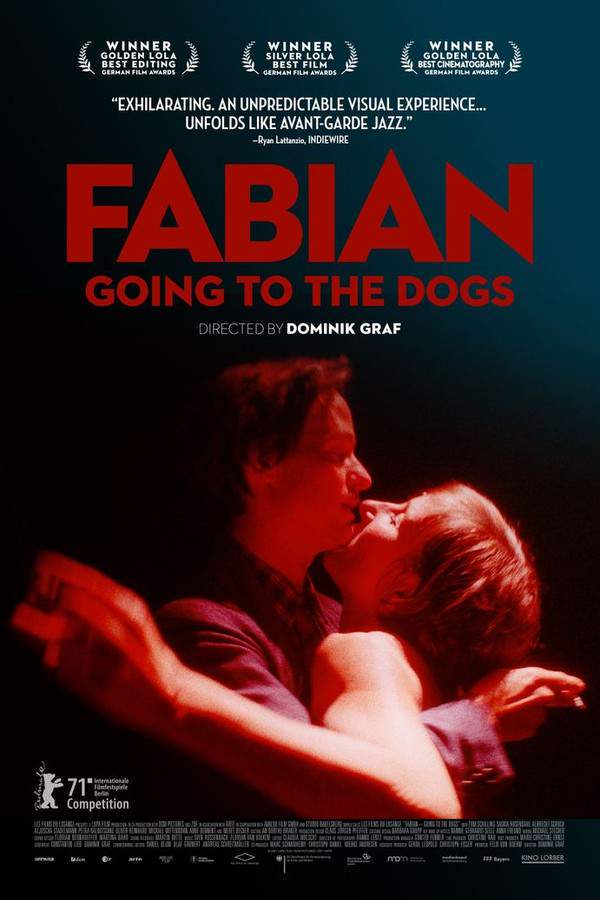
Fabian: Going to the Dogs

Fabian: Going to the Dogs

JustWatch#14,1855

Year: 2022

Runtime: 176 min

Language: German

Director: Dominik Graf

Echo Score: 75

Budget: $178

DramaRomance

In 1930s Berlin, Jakob Fabian lives a life of pleasure and cynicism until he meets Cornelia, a woman who inspires hope within his skeptical nature. As their relationship deepens, Fabian is forced to confront his own troubled past and the growing turmoil of a Germany struggling with widespread unemployment and social unrest. He must navigate a world on the brink of collapse and re-evaluate his place within it.

Where to Watch Fabian: Going to the Dogs?

Find where to stream, rent, or buy Fabian: Going to the Dogs (2022) in the US with current JustWatch availability, up-to-date pricing, and platform listings for subscription, rental, and digital purchase options.

Warning: spoilers below!

Haven’t seen Fabian: Going to the Dogs yet? This summary contains major spoilers. Bookmark the page, watch the movie, and come back for the full breakdown. If you're ready, scroll on and relive the story!

Fabian: Going to the Dogs (2022) – Full Plot Summary & Ending Explained

Read the complete plot breakdown of Fabian: Going to the Dogs (2022), including all key story events, major twists, and the ending explained in detail. Discover what really happened, and what it all means.

In the lively nightlife of 1931 Berlin, Jakob Fabian (Tom Schilling), a disenchanted copywriter for a cigarette company, longs to escape the monotony of his role and fulfill his dreams of becoming a writer. Among his companions is his hedonistic best friend, Stephan Labude (Albrecht Schuch), who aspires to achieve academic tenure. Their friendship thrives amidst excursions to nightclubs and brothels, yet both men grapple with the shadows of their pasts—Fabian haunted by his experiences during World War I, which fill him with a heavy sense of despair regarding love and life, rendering them almost meaningless.

One night, fate intervenes when Jakob encounters Cornelia (Saskia Rosendahl), a youthful aspiring actress, in an underground club. Their lives entwine, but Cornelia holds back, unsure of their relationship’s potential for endurance. As they bond, the trio of Fabian, Cornelia, and Labude share carefree afternoons, including a lakeside swim that unveils Jakob’s insecurities—his inability to swim a poignant reminder of his vulnerabilities.

As economic turbulence grips Germany, unemployment soars, and Fabian faces the harsh reality of being laid off from his job. In stark contrast, Cornelia’s career begins to flourish, entrenching her in the charms of Makart (Aljoscha Stadelmann), an older, established producer who tempts her to compromise her artistic passions. Despite Jakob’s protests against her decisions, Cornelia assures him of their shared future. However, she mysteriously disappears the following morning, shattering Fabian’s heart.

In the meantime, Labude submits his thesis to Berlin University with hopes for acceptance, battling tensions with Weckherlin (the chancellor’s assistant). The rising influence of the Nazi Party complicates their lives, culminating in Labude’s arrest due to his communist views and activism. After a concerning period, his father manages to secure his release through bail.

In a touching twist of fate, Jakob finds himself at a film studio where Cornelia auditions for a significant role. Her heart-wrenching performance—a plea to reconnect with Jakob—captivates Makart and other producers, securing her a leading position and reminding her of their enduring love.

When Jakob and Cornelia finally meet at the café, his icy demeanor and accusations of unfaithfulness lead to a heartbreaking confrontation. Despite initial resistance, they eventually reconcile, reaffirming their commitment against the backdrop of a tumultuous era. However, as Labude goes missing, a frantic search ensues, ultimately leading to a tragic reunion at a nude art studio, where Labude’s self-destructive habits have taken a severe toll. The situation turns dire when Fabian learns of Labude’s demise, a self-inflicted gunshot wound, more agony heaped upon grievous loss as he reads Labude’s suicide note—a heartbreaking lament of lost aspirations, with Labude urging him to “live a better life.”

In the wake of this tragedy, Fabian’s anger erupts during a confrontation with the university chancellor, who had actually approved Labude’s thesis, revealing the unfortunate timing of their issues. Overcome with grief, Jakob is compelled to leave Berlin, returning to Dresden, where he struggles to cope with the loss of his friend.

As the weeks pass, memories of Labude and Cornelia haunt him, and he soon discovers a magazine showcasing Cornelia’s ascent to stardom. Reaching out, they share a conversation that oscillates between somber reflections and light-hearted hopes for the future, leading to plans for a reunion in Berlin.

While preparing for their meeting, memories flood back as he strolls through Dresden, only to be interrupted by scenes of carefree youth mirrored in three boys playing by the lake. As he nears the train station, he sees a boy on the verge of jumping from a bridge. With no thought for his safety, Jakob rushes to the boy, but as he tries to intervene, he is swept away by the current, fighting futilely against nature’s overpowering force.

Meanwhile, Cornelia waits at their arranged spot in Berlin, blissfully unaware of the ultimate sacrifice Jakob has made while striving to save another, leaving behind a poignant story steeped in tragedy.
Last updated: November 18, 2024 at 21:21

Was this helpful?

Fabian: Going to the Dogs (2022) Plot Questions Answered – Summary FAQ

Explore frequently asked questions about Fabian: Going to the Dogs (2022) with spoiler-rich answers covering the full plot summary, major story beats, character motivations, hidden details, and ending meaning. This movie summary FAQ helps explain confusing scenes, plot twists, and narrative decisions in clear, searchable detail.

Q1

Why does Cornelia disappear after getting involved with Makart?

A.

Cornelia disappears because she accepts Makart's offer to advance her acting career, which requires her to compromise her artistic principles. While she assures Jakob of their shared future, she leaves without explanation, likely due to the guilt of choosing ambition over their relationship. Her disappearance sets up the emotional conflict that drives much of the film's second half.

Earlier, Makart is described as tempting Cornelia to compromise her artistic passions, hinting at the moral dilemma that leads to her departure.

corneliamakartdisappearanceactresscareer
Q2

Why does Stephan Labude kill himself?

A.

Labude's suicide results from the cumulative toll of his academic struggles, political persecution, and self-destructive habits. After being arrested for his communist views and experiencing the humiliation of relying on his father's bail, he falls into despair. His suicide note lamenting lost aspirations and urging Jakob to 'live a better life' reveals his belief that his dreams have been crushed beyond recovery.

The lakeside scene hints at Labude's vulnerability, and his arrest creates mounting pressure that eventually overwhelms him.

labudesuicidedeathacademiccommunistnote
Q3

How does Jakob Fabian die at the end?

A.

Jakob drowns while trying to save a young boy from jumping off a bridge in Dresden. When he rushes to intervene, the current sweeps him away and he futilely fights against nature's overpowering force. His death is a tragic sacrifice, he dies while attempting to rescue another, just as Cornelia waits for their reunion in Berlin.

Earlier, Jakob's inability to swim at the lake foreshadows his vulnerability to water, and his traumatic WWI memories establish his pattern of rushing into dangerous situations.

jakobdeathdrowningbridgesacrificerescue
Q4

Why does Jakob leave Berlin after Labude's death?

A.

Jakob leaves Berlin because he is overwhelmed by grief and trauma after discovering Labude's suicide. His confrontation with the university chancellor, where he learns Labude's thesis was actually approved, adds another layer of tragedy, he realizes his friend died without knowing success was within reach. Unable to cope with these losses, Jakob retreats to Dresden.

The buildup of losses, Cornelia's disappearance, job loss, Labude's arrest, creates the emotional breaking point that forces his departure.

jakobberlindresdendeparturegrieflabude
Q5

What is the significance of Jakob not being able to swim?

A.

Jakob's inability to swim serves as a metaphor for his sense of vulnerability and inadequacy beneath his cynical exterior. The scene where he struggles in the water while Cornelia and Labude swim freely exposes his deep-seated insecurities. This vulnerability ultimately becomes tragically literal at the film's end when he drowns attempting to save another.

The lakeside scene directly foreshadows his death by water, and his war trauma establishes his pattern of feeling powerless.

swimswimmingvulnerabilitylakewaterinsecurity
Q6

What does Labude's suicide note say?

A.

Labude's suicide note is described as a heartbreaking lament of lost aspirations. In it, he expresses regret for his failed dreams and urges Jakob to 'live a better life.' The note underscores the theme of shattered ambitions and serves as Labude's final plea to his friend to find meaning he himself could not achieve.

Labude's earlier struggles with academia and his fear of failure hint at the despair that would culminate in his final message.

labudesuicide noteaspirationsmessagebetter life
Q7

Why is Stephan Labude arrested by the Nazis?

A.

Labude is arrested because of his communist views and political activism during a period of rising Nazi influence in Germany. His academic pursuits and political beliefs put him at odds with the increasingly powerful Nazi Party, leading to his detention. His father eventually secures his release through bail, but the experience leaves a lasting mark on him.

The timeline explicitly notes rising political tensions and the Nazi Party's growing influence as a backdrop to all characters' struggles.

labudearrestcommunismNazisactivismpolitical
Q8

What happens to Labude's thesis after his death?

A.

After Labude's death, Jakob confronts the university chancellor in grief, only to learn that Labude's thesis had actually been approved. This revelation adds tragic irony to Labude's suicide, he died without knowing his academic work had been accepted, making his death even more senseless and heartbreaking.

Labude's submission of his thesis and his tensions with Weckherlin establish the academic stakes that make this revelation devastating.

labudethesisuniversityapprovalacademicchancellor
Q9

Why does Cornelia choose Makart over Jakob initially?

A.

Cornelia chooses Makart, an established producer, because he offers her a chance at professional success in her acting career during a time of economic crisis. While she loves Jakob, the temptation of security and artistic opportunity in a unstable world leads her to compromise. Her later heartfelt audition for a role, where she pleads to reconnect with Jakob, shows her true feelings prevail.

The tension between Cornelia's career ambitions and her relationship with Jakob is established early, with Makart explicitly tempting her to compromise her passions.

corneliamakartproducercareerambitionacting
Q10

How does the rise of the Nazi Party impact the main characters?

A.

The Nazi Party's rise creates an atmosphere of increasing political oppression that directly threatens Labude through arrest and persecution, reflecting the broader societal collapse described in the film. The political turmoil amplifies the characters' personal crises, economic instability leads to Jakob's job loss, while the chaos enables moral compromises. The constant sense of foreboding underscores the tragic fates of all three central characters.

The meta notes explicitly state the Nazi rise creates a 'constant sense of foreboding and high emotional stakes' throughout the narrative.

nazipoliticaloppressiongermany1930ssocietal collapse
Q11

Why does Cornelia's audition remind her of Jakob?

A.

Cornelia's audition reminds her of Jakob because she performs a heartfelt plea to reconnect with a lost lover. This emotional performance, which secures her the leading role, reveals that despite her earlier disappearance, her feelings for Jakob remain strong. It catalyzes their eventual reconciliation at the café.

Her choice to perform such a piece suggests her unresolved feelings for Jakob were always present beneath her career-focused decisions.

corneliaauditionfilm studioroleloveperformance
Q12

How does Jakob's WWI experience affect his worldview?

A.

Jakob's experiences during World War I leave him with a heavy sense of despair that makes life and love feel almost meaningless. His cynicism and hedonistic lifestyle stem from trauma that renders him unable to fully commit emotionally. This psychological wound explains his vulnerability and ultimately influences his willingness to sacrifice himself for a stranger.

The summary explicitly connects his war trauma to his cynical outlook, establishing the psychological foundation for his tragic end.

jakobworld war itraumawwidespairveteran
Mobile App Preview

Coming soon on iOS and Android

The Plot Explained Mobile App

From blockbusters to hidden gems - dive into movie stories anytime, anywhere. Save your favorites, discover plots faster, and never miss a twist again.

Sign up to be the first to know when we launch. Your email stays private, always.

Explore Movie Threads

Discover curated groups of movies connected by mood, themes, and story style. Browse collections built around emotion, atmosphere, and narrative focus to easily find films that match what you feel like watching right now.

Doomed Romances in a Crumbling World like in Fabian: Going to the Dogs

Love stories that bloom beautifully but inevitably wilt under the weight of societal collapse.Discover movies like Fabian: Going to the Dogs that explore love stories set against the backdrop of societal decay. These films feature passionate but ultimately doomed romances, where the characters' personal hopes are crushed by forces larger than themselves, resulting in a deeply melancholic and tragic viewing experience.

tragicromanticmelancholicdespairingnostalgicsomberdisillusioned

Narrative Summary

The narrative typically follows characters who find a profound, life-changing connection just as the world around them begins to fracture. Their love offers a temporary escape or a new sense of purpose, but the encroaching political turmoil, war, or social decay inevitably intrudes, testing their bond and leading to a heartbreaking separation or loss.

Why These Movies?

These films are grouped by their shared focus on the intersection of intimate romance and historical catastrophe. They deliver a specific emotional blend of romantic hope crushed by overwhelming despair, creating a powerful and somber experience centered on the fragility of love and happiness in turbulent times.

Melancholic Portraits of Social Decay like in Fabian: Going to the Dogs

Character studies of individuals navigating the moral and economic ruin of their society.If you liked the somber atmosphere of Fabian: Going to the Dogs, explore these similar movies about social decay. These dramas depict the lives of ordinary people caught in eras of profound upheaval, emphasizing the heavy emotional toll and moral ambiguity of living through a society's downfall.

melancholicanxiousdespairingsomberdisillusionednostalgictragic

Narrative Summary

Stories in this thread are often episodic and character-driven, following protagonists as they witness and are personally affected by rising unemployment, political extremism, and the erosion of social norms. The plot is less about a single goal and more about documenting the psychological and emotional impact of a world losing its way, often culminating in a sense of profound loss or tragic finality.

Why These Movies?

These movies are united by a shared, oppressive mood of melancholy and impending doom, rooted in a specific historical or speculative setting. They prioritize atmosphere and emotional weight over fast-paced action, offering a steady, contemplative, and intensely sad look at the human condition during times of crisis.

Unlock the Full Story of Fabian: Going to the Dogs

Don't stop at just watching - explore Fabian: Going to the Dogs in full detail. From the complete plot summary and scene-by-scene timeline to character breakdowns, thematic analysis, and a deep dive into the ending - every page helps you truly understand what Fabian: Going to the Dogs is all about. Plus, discover what's next after the movie.

Fabian: Going to the Dogs Timeline

Track the full timeline of Fabian: Going to the Dogs with every major event arranged chronologically. Perfect for decoding non-linear storytelling, flashbacks, or parallel narratives with a clear scene-by-scene breakdown.

Fabian: Going to the Dogs Timeline

Characters, Settings & Themes in Fabian: Going to the Dogs

Discover the characters, locations, and core themes that shape Fabian: Going to the Dogs. Get insights into symbolic elements, setting significance, and deeper narrative meaning - ideal for thematic analysis and movie breakdowns.

Characters, Settings & Themes in Fabian: Going to the Dogs

Fabian: Going to the Dogs Spoiler-Free Summary

Get a quick, spoiler-free overview of Fabian: Going to the Dogs that covers the main plot points and key details without revealing any major twists or spoilers. Perfect for those who want to know what to expect before diving in.

Fabian: Going to the Dogs Spoiler-Free Summary

More About Fabian: Going to the Dogs

Visit What's After the Movie to explore more about Fabian: Going to the Dogs: box office results, cast and crew info, production details, post-credit scenes, and external links - all in one place for movie fans and researchers.

More About Fabian: Going to the Dogs