Plot Explained Spoilers guaranteed!
Plot Explained

Browse by genre

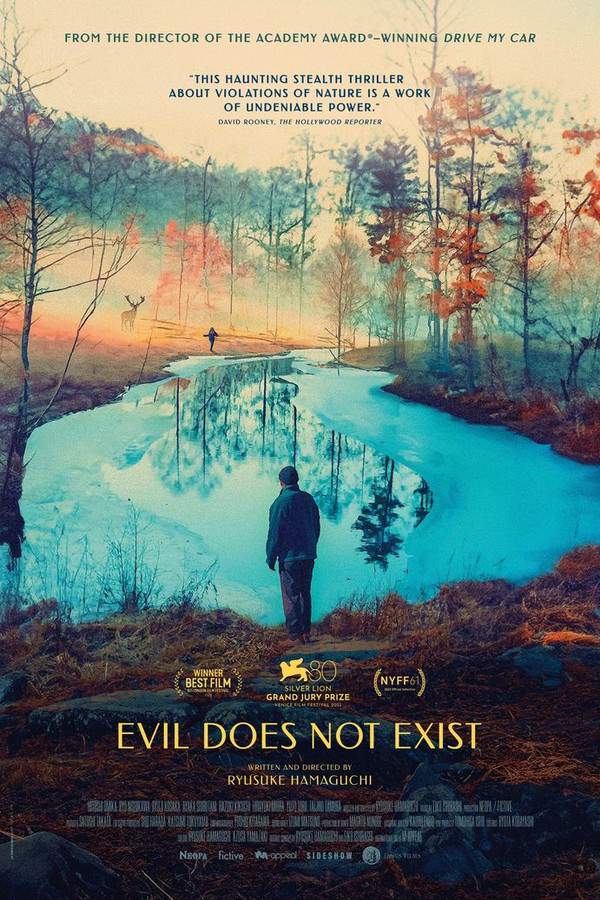
Evil Does Not Exist (2024) movie poster

Ending Explained

Evil Does Not Exist (2024) Ending Explained – Final Scene & Meaning

Release, runtime and language
2024 · 1 h 46 m · Japanese
Echo score 77
Loading streaming availability…
Directed by
Ryûsuke Hamaguchi
Starring
Hazuki Kikuchi, Hiroyuki Miura, Ayaka Shibutani, Hitoshi Omika, Rei Nishikawa, Ryûji Kosaka

Takumi and his daughter Hana live a peaceful life in the mountain village of Mizubiki, providing Tokyo with water, wood, and wasabi. Their tranquil existence is threatened when a luxurious glamping resort is planned for the area, potentially disrupting the natural beauty and serenity of their home.

On this page (8)
  1. 1 Where to watch
  2. 2 What happens at the end
  3. 3 Final events in order
  4. 4 Ending questions answered
  5. 5 Movie threads
  6. 6 Movies like Evil Does Not Exist
  7. 7 Categories
  8. 8 Every angle
Loading streaming availability…

Ending explained · contains spoilers

What Happens at the End of Evil Does Not Exist?

How Evil Does Not Exist (2024) ends, what the final scene means, which earlier moments set it up and how to read the ending if the film leaves it open. The full ending explained, with every spoiler.

In the final moments of Evil Does Not Exist, Takumi is overwhelmed with grief and despair after discovering Hana's lifeless body in the woods. The scene's disjointed imagery, with Hana and the deer appearing as if from a different time, suggests a dreamlike reflection on the tragic events and Takumi’s memories. His grief is so intense that he chooses to walk into the darkness of the forest, perhaps symbolizing his desire to escape the pain or join Hana in death. Meanwhile, Takahashi, who has been a symbol of outside influence and capitalist intrusion into the village, is shown to be physically and emotionally overwhelmed—he collapses and appears defeated, recognizing that his presence and the destruction caused by outside forces have contributed to Hana’s death.

The ending underscores the movie’s core message: that the village and its inhabitants embody a natural harmony untouched by evil, with their strength lying in their resilience and unity. The villagers live without pretense or malice, and their rejection of the destructive greed represented by Takahashi and his company highlights the importance of respecting nature and community. The scene’s tragic conclusion suggests that the real evil is not an active force, but the destructive tendencies of capitalism and ignorance that threaten to destroy the fragile balance of life. Ultimately, Takumi’s act of carrying Hana’s body into the woods symbolizes his loss of hope and his attempt to retreat into the natural world, possibly as a final act of resistance or surrender to the uncontrollable forces that have led to his daughter’s death. The film leaves a haunting impression that true evil does not lie in intentional malice, but in the disruption of harmony and respect for life, which the villagers consciously preserve.

Last updated: June 25, 2025 at 09:02

Was this helpful?

The last 4 events

How Evil Does Not Exist Ends: The Final Events in Order

The last events of Evil Does Not Exist (2024) in chronological order, the run-up to the ending explained above. The complete timeline has all 14 events, scene by scene.

Open the full timeline
  1. A Moment of Instinct

    As Takahashi instinctively moves to help the deer, Takumi reacts fiercely, tackling Takahashi to the ground. In this shocking moment, the grave truth is revealed: Hana is indeed lifeless, starkly emphasizing the dangers they have faced.

    Where
    Moonlit Field
  2. Heartbroken Escape

    Grief-stricken, Takumi gathers his daughter’s body, making a frantic escape into the dark forest. The shadows engulf him as he realizes the tragic outcome of their search, marking a heart-wrenching moment in his life.

    Where
    Mizubiki Forest
  3. Takahashi's Struggle

    As Takumi rushes into the depths of the forest, Takahashi struggles to rise from the ground. The treacherous terrain seems to conspire against him, leaving him grappling with the heavy implications of the tragic events that have unfolded.

    Where
    Moonlit Field
  4. Fate's Relentless Grasp

    With the village now shrouded in sorrow, the relentless shadows surround Takahashi, echoing only the sounds of fading footsteps and labored breaths. The desperate search ends in heartbreak, illustrating the merciless hand of fate.

    Where
    Mizubiki Forest

Ending questions answered

Evil Does Not Exist Ending: Your Questions Answered

The questions people ask most about the ending of Evil Does Not Exist (2024): what the final scene means, how the twist works, what happens to each character and how to read the ending. Each answer contains spoilers.

Q1

Why does Takumi walk into the forest at the end?

Takumi walks into the darkness of the forest after discovering Hana's lifeless body because his grief is overwhelming. The act symbolizes his desire to escape the unbearable pain of loss or perhaps to join his daughter in death. It represents his complete loss of hope and his attempt to retreat into the natural world, surrendering to the uncontrollable forces that led to Hana's death.

Foreshadowing: Earlier scenes show Takumi's deep connection to the forest and his protective nature toward Hana, making his retreat into the woods a tragic fulfillment of that bond.

  • takumi
  • forest
  • death
  • grief
  • hana
Q2

What happens to Hana in the movie?

Hana dies in the woods before the final scene. Takumi discovers her lifeless body, and the disjointed imagery suggests she may have been killed by the deer that appears in the final moments. The dreamlike quality of the scene, where Hana and the deer appear as if from a different time, leaves some ambiguity about whether this is a literal death or a symbolic representation.

Foreshadowing: The film hints at the fragility of life in the village through its close observation of nature and the delicate balance between humans and the environment.

  • hana
  • death
  • deer
  • forest
  • body
Q3

Why does Takahashi collapse at the end?

Takahashi collapses both physically and emotionally, overwhelmed by the realization that his presence and the development project have contributed to Hana's death. As the symbol of outside capitalist intrusion into the village, his collapse represents the defeat of destructive greed. He recognizes that the harm caused by prioritizing profit over nature has resulted in an irreversible tragedy.

Foreshadowing: Throughout the film, Takahashi struggles with the villagers' resistance and gradually understands the consequences of his company's plans for the community.

  • takahashi
  • collapse
  • developer
  • guilt
  • capitalism
Q4

What does the ending of the movie mean?

The ending conveys that true evil lies not in intentional malice but in the disruption of harmony and respect for life. The village represents natural balance untouched by evil, while the destructive tendencies of capitalism and ignorance threaten this balance. Takumi's final act symbolizes both the devastating cost of that disruption and a desperate retreat into nature as the only remaining response.

Foreshadowing: The film's consistent focus on the villagers' harmonious relationship with nature establishes the thematic foundation for this interpretation.

  • meaning
  • theme
  • evil
  • nature
  • harmony
Q5

Why is the final scene shown in a dreamlike way?

The disjointed, dreamlike imagery in the final moments reflects Takumi's psychological state of extreme grief and trauma. The appearance of Hana and the deer as if from a different time suggests the scene is partly a memory or mental projection rather than pure reality. This stylistic choice emphasizes the surreal quality of loss and how grief can blur the line between memory and present moment.

Foreshadowing: The film's slow, atmospheric pacing and long takes create an increasingly surreal atmosphere as the story progresses toward its tragic conclusion.

  • dreamlike
  • surreal
  • grief
  • memory
  • imagery
Q6

What is the "evil" referenced in the movie's title?

The "evil" in "Evil Does Not Exist" is not a literal villain or supernatural force. Instead, the film argues that genuine evil comes from destructive human tendencies, particularly capitalist greed and ignorance, that disrupt the natural harmony of communities and nature. The villagers themselves embody no malice; the real threat is the unconscious harm caused by those prioritizing profit over living ecosystems.

Foreshadowing: The conflict between the villagers and developers establishes early on that the threat is systemic rather than personal.

  • evil
  • title
  • meaning
  • capitalism
  • greed
Q7

Does Takumi die at the end of the movie?

The film leaves Takumi's fate ambiguous. He walks into the darkness of the forest carrying Hana's body, but whether he dies is not explicitly shown. The ending suggests he may be surrendering to the forest as a final act, whether that means suicide, becoming lost, or simply disappearing into nature is left open to interpretation.

Foreshadowing: The film's ambiguous, contemplative style consistently avoids clear resolutions, making this uncertainty intentional.

  • takumi
  • death
  • forest
  • fate
  • ambiguous
Q8

What happens to Takahashi after Hana's death?

After Hana's death, Takahashi is left stranded in the village, physically and emotionally defeated. He collapses in a state of shock, symbolizing the complete failure of his corporate mission. The ending shows him as a broken man, recognizing that his actions have caused irreversible damage, though he is not killed or explicitly punished, his punishment is psychological.

Foreshadowing: Takahashi's gradual shift from confident developer to conflicted figure throughout the film builds to this moment of complete breakdown.

  • takahashi
  • shock
  • defeat
  • corporate
  • left-behind
Q9

Why does Takumi carry Hana into the woods?

Takumi carries Hana's body into the woods as a final act of love and grief. This act symbolizes his inability to let go, his attempt to return her to nature, and his own desire to retreat from a world that has caused him unbearable pain. It represents both surrender to uncontrollable forces and perhaps an act of resistance, choosing nature over the corrupted human world that caused her death.

Foreshadowing: Takumi's deep connection to the forest and his role as a provider of natural resources to Tokyo establish his belief in the supremacy of nature over human civilization.

  • hana
  • body
  • forest
  • woods
  • carrying
Q10

What happens to the village after the ending?

The film does not explicitly show the village's future, but the ending suggests the community remains in its state of natural harmony despite the tragedy. The villagers' rejection of the developers has succeeded in stopping the glamping resort. However, the cost of that victory is devastating, Hana's death and Takumi's departure leave the community forever changed, highlighting the real evil of progress that destroys rather than protects.

Foreshadowing: The villagers' unity and resistance throughout the film establish that they will continue to preserve their harmony, though the human cost is irreversible.

  • village
  • future
  • community
  • harmony
  • developers

Movie threads

More Movies Like Evil Does Not Exist, by Mood & Story

Curated lists built around what makes Evil Does Not Exist tick: the same mood, the same kind of story or the same emotional payoff. Each list explains why these movies belong together.

Slow burn ecological tragedies like Evil Does Not Exist

Stories where encroaching modernity leads to irreversible environmental and personal ruin. If you liked the environmental tension and tragic outcome of Evil Does Not Exist, explore these movies where the fight to protect nature leads to deep personal loss and bleak reflections on human impact.

  • nature-driven
  • somber
  • unsettling
  • grief-stricken
  • tense
  • melancholic
  • Tone: bleak, melancholic, tense
  • Pacing: slow, deliberate, atmospheric
Why these movies?

The story pattern: Narratives in this thread typically follow a linear path from tranquility to crisis. A community or individual living in harmony with nature faces an external threat, often corporate or industrial. The conflict escalates slowly, with the focus on atmospheric dread rather than action, leading to an ending that underscores the fragility of both the environment and human life.

Why they belong together: Movies are grouped here for their shared focus on environmental themes, their slow-burn pacing that builds palpable tension, and their ultimate trajectory toward tragedy. They share a heavy emotional weight and a bleak tone, creating a cohesive experience of loss and ecological warning.

Quiet stories of paternal grief like in Evil Does Not Exist

Intimate portraits of a father's world shattered by profound loss. For viewers moved by the father's heartbreaking journey in Evil Does Not Exist, this collection features similar movies focused on quiet, heavy dramas about fathers coping with profound loss and tragedy.

  • somber
  • grief-stricken
  • melancholic
  • quiet
  • heartbreaking
  • introspective
  • Tone: somber, bleak, grief-stricken
  • Pacing: slow, contemplative, character-driven
Why these movies?

The story pattern: The narrative pattern revolves around a central, traumatic event that redefines a father's existence. The story delves into the aftermath, exploring his internal struggle, isolation, and attempts to cope or find meaning. The pacing is often slow and contemplative, emphasizing emotional depth over plot mechanics, and endings are typically unresolved or bleak, reflecting the permanence of the loss.

Why they belong together: These films are united by their primary focus on the emotional arc of a grieving father. They share a heavy emotional weight, a slow, introspective pacing, and a somber, often bleak tone. The experience is defined by a profound sense of sadness and a deep dive into a character's emotional core.

If you liked this

Movies Like Evil Does Not Exist

Similar movies to Evil Does Not Exist: the same genre, themes or kind of story. Each one comes with its own plot summary, timeline and ending explained.

Browse all movie summaries

Categories

Movie Lists Featuring Evil Does Not Exist

Evil Does Not Exist appears in these hand-built movie categories. Each one groups movies by a specific mood, theme or story type, with their plot summaries and endings explained.

View all movie categories

Every angle

Evil Does Not Exist (2024) Explained: Plot, Ending, Timeline & Characters

Everything about Evil Does Not Exist in one place: what happens in the plot summary, the timeline in chronological order, the characters and meaning, the ending explained and a spoiler-free summary. What's After the Movie adds the cast, box office and post-credit scenes.

Coming soon on iOS and Android

The Plot Explained Movie Summary App

Plot summaries, endings explained and timelines on your phone. Catch up on any movie in minutes, save your favorites and never miss a twist again.

Be the first to know when we launch. Your email stays private, always.

Learn more about the app