Plot Explained Spoilers guaranteed!
Plot Explained

Browse by genre

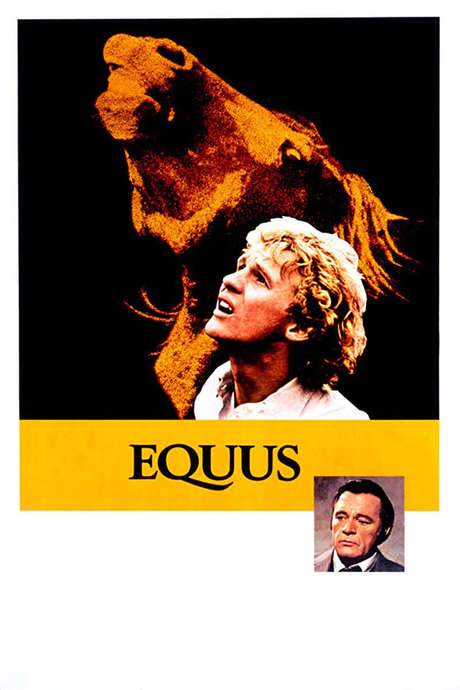
Equus (1977) movie poster

Timeline

Equus (1977) Timeline Explained – Every Event in Order

Release, runtime and language
1977 · 137 mins · English
Loading streaming availability…
Directed by
Sidney Lumet
Starring
Colin Blakely, Eileen Atkins, Joan Plowright, Harry Andrews, Kate Reid, Jenny Agutter

A psychiatrist, Martin Dysart, is called to investigate the horrific blinding of six horses with a metal spike in a Hampshire stable. The crime was committed by Alan Strang, an unassuming seventeen‑year‑old stable‑boy, the only son of a domineering yet timid father and a genteel, devout mother. As Dysart delves into Alan’s psyche, he confronts the boy’s deep‑seated demons and, in the process, is forced to examine his own suppressed doubts and the limits of his profession.

On this page (7)
  1. 1 Where to watch
  2. 2 Events in order (12)
  3. 3 Timeline questions answered
  4. 4 The book behind the movie
  5. 5 Movie threads
  6. 6 Movies like Equus
  7. 7 Every angle
Loading streaming availability…

12 events in order · contains spoilers

Equus Timeline: Events in Chronological Order

Every key event of Equus (1977) in order, scene by scene, with when and where it takes place. Use it to untangle flashbacks, time jumps and parallel storylines, to refresh your memory before the sequel or to find the exact scene you are thinking of.

  1. Alan blinds six horses; Dysart is summoned to treat him

    Alan Strang blinds six horses with a sickle, shocking spectators and the hospital staff. Magistrate Hesther Salomon then asks her platonic friend Martin Dysart to treat the troubled boy. Dysart accepts, sensing a chance to understand the price of healing.

    When
    immediately after the incident
    Where
    Hampshire, England
  2. Dysart meets Frank and Dora Strang

    Dysart visits the Strang family home to meet Frank and Dora and to glean the family dynamics behind Alan's actions. He begins to understand how religious and secular forces shape the boy's worldview. The meeting launches the therapy process that will follow.

    When
    soon after the initial meeting
    Where
    Strang family home
  3. Dora explains her beliefs and discipline

    Dora describes her Christian fundamentalist upbringing and her view that God watches all. She taught Alan basics about sex and morality, but he later replaces her with his own deity, Equus. The clash between her teachings and Alan's inner god becomes a central theme in Dysart's sessions.

    When
    during early sessions
    Where
    Strang family home
  4. Frank reveals his late night observation and ritual

    Frank tells Dysart that he saw Alan late at night in his room haltered and flagellating himself while chanting a chain of Biblical names that ends with Equus. He remarks on the disturbing ritual and the impact on his son. The confession deepens Dysart's sense that Alan's passion has become dangerous.

    When
    early in treatment
    Where
    Strang home
  5. Alan's earliest memory of Trojan

    Alan recounts his earliest memory of a horse named Trojan when he was six. He recalls a man approaching on horseback and the horse speaking to him, declaring that Equus is the true name of all horses. The memory blends thrill with fear and foreshadows the boy's fixation.

    When
    when he was six
  6. Stable manager explains Jill's influence

    The stable manager explains that Alan secured his job through another employee named Jill, who is currently on medical leave due to injuries she indirectly caused. The revelation hints at Jill's influence over Alan and the unstable context of the stables. Dysart begins to map the web of relationships around the boy.

    When
    early in process
    Where
    Stable
  7. Alan confesses nocturnal horse riding and Equus worship

    Alan admits to secretly riding horses at night nude, chanting prayers to Equus until he reaches orgasm and then caressing them. Dysart senses a fierce pagan passion behind the boy's actions, contrasting with his own sterile life. The confession marks a turning point in the therapist's view of Alan's humanity and danger.

    When
    during therapy
    Where
    Stables at night
  8. Dysart's envy and nightmare sequences

    Dysart confesses that he envies Alan's passionate paganism and that his own life feels emotionally numb. He experiences troubling dreams of ritual slaughter in Homeric Greece while wearing the Mask of Agamemnon. The dreams blur the line between clinical distance and personal fantasy.

    When
    in therapy and at night
    Where
    Dysart's mind / dreams
  9. Cinema visit and the forbidden encounter

    One evening Jill persuades Alan to attend a pornographic film at a local cinema, where he unexpectedly encounters his father and is forced to leave. The encounter exposes the collision of family authority with forbidden desire. The incident deepens Alan's sense of exposure and guilt.

    When
    one evening
    Where
    Local cinema
  10. Jill's sexual advance and Alan's refusal

    Back at the stables, Jill removes her clothing and offers Alan sex, but he cannot perform. She is compassionate but ultimately tells him to leave, leaving him naked and humiliated. The scene crystallizes the conflict between burgeoning sexual longing and strict moral codes.

    When
    that same night
    Where
    Stables
  11. The equine act of blinding

    Tormented by Equus and his own inner turmoil, Alan blinds the horses in the stable yard. The act is the culmination of his indulgence and fear, and it triggers Dysart's crisis about what healing really costs. The community is left to confront the consequences.

    When
    that night
    Where
    Stable yard
  12. Dysart's dilemma about healing

    Dysart is left unsettled by the possibility that curing Alan might strip away his painful passion, potentially leaving the boy—and himself—emotionally neutered. He weighs the moral cost of therapy against the harm of not healing. The film closes with a quiet meditation on what it means to truly heal.

    When
    post blinding
    Where
    Dysart's office / home

Last updated: October 09, 2025 at 09:23

Was this helpful?

Timeline questions answered

Equus Timeline Explained: Your Questions Answered

When does it happen, and why in that order? The questions people ask about the chronology of Equus (1977): time jumps, flashbacks, cause and effect between scenes and the correct order of events, each answered with spoilers.

Q1

Why did Alan Strang blind the horses with a sickle?

Alan blinded the six horses in a state of extreme religious and sexual turmoil. After failing to have sex with Jill and being overwhelmed by guilt that Equus (his horse-god) sees all and is jealous, he reacted violently against the source of his passion. The act was a simultaneous expression of worship and destruction, blinding the horses that had become his gods while naked and in a state of religious ecstasy.

Foreshadowing: Earlier, Alan reveals he would ride horses nude while chanting prayers to Equus until he reached orgasm, treating the act as a sacred ritual.

  • alan strang
  • horse blinding
  • equus
  • sickle
  • 原因
  • 动机
Q2

What is Equus in the movie?

Equus is the name Alan gave to the god he created, incarnated in horses. As a child, he replaced his mother's Christian deity with this horse-god after a transformative early memory where a man on a horse named Trojan told him that Equus is the true name of all horses. Alan worshipped Equus through secret nocturnal rituals involving nude riding and chanting, treating the horses as divine beings worthy of reverence and prayer.

Foreshadowing: Frank reveals he witnessed Alan late at night chanting Biblical names culminating in 'Equus' while flagellating himself, showing the religious intensity of the boy's devotion.

  • equus god
  • horse worship
  • alan strang
  • religion
  • paganism
Q3

What happened at the cinema that triggered Alan?

Jill persuaded Alan to go to a pornographic film at a local cinema, where he was horrified to discover his own father, Frank Strang, watching it. Frank forced Alan to leave immediately, exposing the hypocrisy of his strict household and deepening Alan's guilt and sense of being watched by a judgmental force. This encounter intensified his religious conflict and contributed to his later breakdown.

Foreshadowing: Dora had taught Alan that God sees all, and he had internalized this surveillance as a judgmental force that would punish his secret sins.

  • cinema
  • porn film
  • father
  • frank strang
  • jill
  • guilt
Q4

Why couldn't Alan have sex with Jill?

When Jill stripped and offered herself to Alan at the stables, he was unable to perform sexually despite wanting to. This failure stemmed from his rigid moral conditioning, his mother Dora had taught him that sex is shameful and that God watches all sin. Additionally, his entire sexual expression had become channeled through his religious worship of Equus, making normal sexual intimacy psychologically impossible for him.

Foreshadowing: Alan had only experienced sexual release through his Equus rituals with horses, making conventional sex feel wrong and disconnected from his spiritual practice.

  • alan strang
  • jill
  • sexual dysfunction
  • impotence
  • religion
Q5

What is the meaning of Dysart's nightmare about the Mask of Agamemnon?

Dysart experiences recurring nightmares of ritualistically slaughtering children in ancient Greece while wearing the Mask of Agamemnon, a gold death mask from Mycenae. This dream represents his suppressed violent impulses and guilt about his role as a healer. The mask symbolizes the roles society forces him to play, he dresses as a healer by day but imagines himself a sacrificer. The dream reveals his deeper identification with Alan than he admits, seeing his therapeutic work as potentially destructive rather than purely healing.

Foreshadowing: Dysart's initial interest in Alan seems unusual for a professional, he explicitly seeks to understand the 'price of healing' rather than simply curing.

  • dysart
  • nightmare
  • mask of agamemnon
  • agamemnon
  • greece
  • dream meaning
Q6

Why does Dysart envy Alan despite his crime?

Dysart envies Alan because the boy possesses something he has lost: genuine, intense passion. Though Alan's passion manifests dangerously, it is raw and authentic, rooted in religious ecstasy and profound feeling. In contrast, Dysart describes his own life as emotionally empty; he has ceased physical intimacy with his wife and feels spiritually dead. He sees curing Alan as potentially stripping away this passionate spirit, leaving the boy 'emotionally neutered' like himself, a outcome he finds morally troubling rather than celebratory.

Foreshadowing: Dysart immediately senses a 'chance to understand the price of healing' when summoned to Alan's case, suggesting he views it as personally relevant.

  • dysart
  • envy
  • passion
  • emotion
  • curing
  • healing
  • Alan strang
Q7

What did Alan do with the horses at night?

Alan secretly took horses from the stables at night and rode them nude while chanting prayers to Equus. He continued until he reached a sexual climax, after which he would carress the horses lovingly. This was his central form of worship, a sacred ritual combining physical sensation, religious devotion, and sexual release that he experienced as communicating directly with his god.

Foreshadowing: Frank reveals he caught Alan performing a different ritual at night, haltered and flagellating himself while chanting Biblical names, showing the evolution of Alan's religious practices.

  • night riding
  • nude
  • horses
  • ritual
  • worship
  • equus
Q8

What was Alan's earliest memory with the horse Trojan?

When Alan was six years old, a man approached him on a horse named Trojan. The man took Alan up on the horse, which the boy found thrilling. Most significantly, Alan recalls the horse 'speaking' to him, declaring that Equus is the true name of all horses. This childhood experience became the foundation of his entire religious system, transforming horses from animals into divine beings worthy of worship.

Foreshadowing: This memory directly establishes the origin of Alan's Equus worship and explains why he specifically chose horses as his gods.

  • trojan
  • childhood memory
  • horse
  • origin
  • equus worship
Q9

What did Dora teach Alan about sex and God?

Dora Strang, a Christian fundamentalist, taught her son the basics of sex within a framework of shame and sin, along with the belief that God sees all and watches for moral transgressions. This created in Alan a profound sense of being constantly observed and judged by a divine authority. He later rejected her Christian God but replaced it with Equus, a god of his own creation who also sees all and demands worship, maintaining the same judgmental, surveillance-based religious framework.

Foreshadowing: Alan's later torment about Equus watching him directly mirrors his mother's teaching about God's constant observation.

  • dora strang
  • sex education
  • christianity
  • god
  • religion
  • mother
Q10

What does the ending mean, will Alan be cured?

The film ends with Dysart facing a moral dilemma: he can treat Alan and relieve his pain, but doing so would likely remove the boy's passionate spirit, leaving him emotionally numb like Dysart himself. The final meditation suggests that curing Alan might mean 'neutering' his capacity for intense feeling, potentially healing his illness but destroying the very thing that made him feel anything at all. Whether Alan is ultimately cured remains ambiguous; the focus is on Dysart's recognition of the tragic cost of emotional normalization.

  • ending
  • cure
  • healing
  • dysart
  • dilemma
  • emotionally neutered
  • Alan strang

Movie threads

More Movies Like Equus, by Mood & Story

Curated lists built around what makes Equus tick: the same mood, the same kind of story or the same emotional payoff. Each list explains why these movies belong together.

Unsettling psychological explorations like Equus

Stories that methodically dissect trauma and reveal disturbing truths. If you liked Equus, explore more movies that delve into severe psychological trauma and disturbing truths. This collection features films with a steady, investigative pace, dark themes, and a heavy emotional weight, perfect for viewers seeking cerebral and unsettling dramas about the human mind.

  • unsettling
  • disturbing
  • cerebral
  • claustrophobic
  • troubled
  • melancholic
  • Tone: dark, unsettling, cerebral
  • Pacing: steady, methodical
Why these movies?

The story pattern: These narratives often follow a procedural structure, such as a therapist's investigation or a character's self-examination, to uncover the roots of a profound psychological disturbance. The journey typically forces both the protagonist and the viewer to confront uncomfortable truths about passion, sanity, and societal norms.

Why they belong together: Movies in this thread are grouped by their shared focus on psychological dissection, a dark and intense tone, and a steady, methodical pacing that amplifies unease. They all deal with heavy themes of mental illness, repressed desires, and the ethical ambiguities of 'normalcy'.

Heavy therapy-room dramas like Equus

Intense character studies where therapy unlocks profound personal crises. Find movies similar to Equus that focus on the intense relationship between a psychiatrist and a patient. These films are character-driven dramas with a steady pace, high emotional weight, and dark tones, exploring how therapy sessions unravel complex psychological traumas.

  • claustrophobic
  • reflective
  • troubled
  • cerebral
  • intense
  • melancholic
  • Tone: dark, reflective, melancholic
  • Pacing: steady, dialogue-driven
Why these movies?

The story pattern: The plot is driven by dialogue and revelation within a therapeutic context. As the patient's history is uncovered, the therapist is often compelled to confront their own existential doubts and professional limitations, creating a dual character arc. The story builds towards a climax that questions the very nature of cure and passion.

Why they belong together: These movies share the specific narrative framework of therapy as a catalyst, a claustrophobic and dialogue-heavy focus, and a bittersweet or bleak emotional resolution. They are united by their exploration of how uncovering one person's pain forces a reckoning with another's.

If you liked this

Movies Like Equus

Similar movies to Equus: the same genre, themes or kind of story. Each one comes with its own plot summary, timeline and ending explained.

Browse all movie summaries

Every angle

Equus (1977) Explained: Plot, Timeline & Characters

Everything about Equus in one place: what happens in the plot summary, the timeline in chronological order, the characters and meaning and a spoiler-free summary. What's After the Movie adds the cast, box office and post-credit scenes.

Coming soon on iOS and Android

The Plot Explained Movie Summary App

Plot summaries, endings explained and timelines on your phone. Catch up on any movie in minutes, save your favorites and never miss a twist again.

Be the first to know when we launch. Your email stays private, always.

Learn more about the app