Year: 1977
Runtime: 137 mins
Language: English
Director: Sidney Lumet
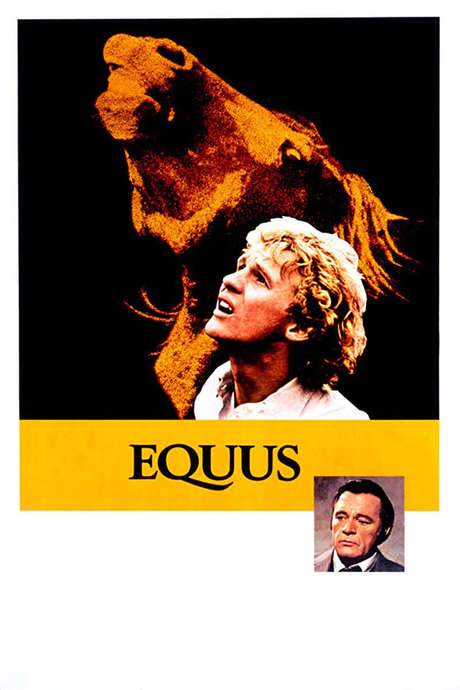
A psychiatrist, Martin Dysart, is called to investigate the horrific blinding of six horses with a metal spike in a Hampshire stable. The crime was committed by Alan Strang, an unassuming seventeen‑year‑old stable‑boy, the only son of a domineering yet timid father and a genteel, devout mother. As Dysart delves into Alan’s psyche, he confronts the boy’s deep‑seated demons and, in the process, is forced to examine his own suppressed doubts and the limits of his profession.
Warning: spoilers below!
Haven’t seen Equus yet? This summary contains major spoilers. Bookmark the page, watch the movie, and come back for the full breakdown. If you're ready, scroll on and relive the story!
Read the complete plot breakdown of Equus (1977), including all key story events, major twists, and the ending explained in detail. Discover what really happened—and what it all means.
Hesther Salomon, Eileen Atkins a magistrate, asks her platonic friend Martin Dysart, Richard Burton a disillusioned psychiatrist who works with disturbed teenagers at a hospital in Hampshire, England, to treat a 17-year-old stable boy named Alan Strang, Peter Firth after he blinded six horses with a sickle.
With Alan only singing TV commercial jingles, Martin goes to see the boy’s parents, Frank Strang, Colin Blakely and Dora Strang, Joan Plowright, the non-religious father and his Christian fundamentalist wife. Dora had taught her son the basics of sex and that God sees all, but the withdrawn Alan replaced his mother’s deity with a god he called Equus, incarnated in horses.
Frank Strang discloses to Martin that he witnessed Alan late at night in his room, haltered and flagellating himself, as he chanted a series of names in Biblical genealogy-fashion which culminated in the name Equus as he climaxed.
Martin begins winning the respect and confidence of Alan, who shares his earliest memory of a horse from when he was six and a man approached him on a horse named Trojan. The man took Alan up on Trojan, which the boy found thrilling, but his parents reacted negatively and injured him taking him off the horse. Martin also meets the stable manager, who reveals Alan secured his job through another employee, Jill. Devastated at the horses’ injuries she indirectly caused, Jill has taken medical leave.
Eventually, Alan admits to Martin that he would secretly take horses away from the stables at night to ride them nude, chanting prayers to Equus until he reached orgasm, after which he caressed them lovingly.
Martin envies the boy’s passionate paganism, in comparison to his own empty life, where he has ceased intimacies with his wife and is plagued by nightmares of ritualistically slaughtering children in Homer’s Greece, wearing the Mask of Agamemnon.
Given an aspirin serving as a placebo “truth drug”, Alan further reveals that one evening Jill tempted him to go to a pornographic film at a local cinema, where he was shocked to see his father, who forced him to leave. After Alan went back with Jill to the stables, she stripped and offered him sex but he was unable to perform and, although she was sympathetic, told her to leave. Naked, and tormented that Equus sees all and is a jealous god, he blinded the horses.
Martin is left troubled by the fact that he can treat Alan to take away his pain but in the process will deprive the boy of his passion, leaving him as emotionally neutered as Martin himself.
Last Updated: October 09, 2025 at 09:23
Discover curated groups of movies connected by mood, themes, and story style. Browse collections built around emotion, atmosphere, and narrative focus to easily find films that match what you feel like watching right now.
Stories that methodically dissect trauma and reveal disturbing truths.If you liked Equus, explore more movies that delve into severe psychological trauma and disturbing truths. This collection features films with a steady, investigative pace, dark themes, and a heavy emotional weight, perfect for viewers seeking cerebral and unsettling dramas about the human mind.
These narratives often follow a procedural structure, such as a therapist's investigation or a character's self-examination, to uncover the roots of a profound psychological disturbance. The journey typically forces both the protagonist and the viewer to confront uncomfortable truths about passion, sanity, and societal norms.
Movies in this thread are grouped by their shared focus on psychological dissection, a dark and intense tone, and a steady, methodical pacing that amplifies unease. They all deal with heavy themes of mental illness, repressed desires, and the ethical ambiguities of 'normalcy'.
Intense character studies where therapy unlocks profound personal crises.Find movies similar to Equus that focus on the intense relationship between a psychiatrist and a patient. These films are character-driven dramas with a steady pace, high emotional weight, and dark tones, exploring how therapy sessions unravel complex psychological traumas.
The plot is driven by dialogue and revelation within a therapeutic context. As the patient's history is uncovered, the therapist is often compelled to confront their own existential doubts and professional limitations, creating a dual character arc. The story builds towards a climax that questions the very nature of cure and passion.
These movies share the specific narrative framework of therapy as a catalyst, a claustrophobic and dialogue-heavy focus, and a bittersweet or bleak emotional resolution. They are united by their exploration of how uncovering one person's pain forces a reckoning with another's.
Don't stop at just watching — explore Equus in full detail. From the complete plot summary and scene-by-scene timeline to character breakdowns, thematic analysis, and a deep dive into the ending — every page helps you truly understand what Equus is all about. Plus, discover what's next after the movie.
Track the full timeline of Equus with every major event arranged chronologically. Perfect for decoding non-linear storytelling, flashbacks, or parallel narratives with a clear scene-by-scene breakdown.
Discover the characters, locations, and core themes that shape Equus. Get insights into symbolic elements, setting significance, and deeper narrative meaning — ideal for thematic analysis and movie breakdowns.
Get a quick, spoiler-free overview of Equus that covers the main plot points and key details without revealing any major twists or spoilers. Perfect for those who want to know what to expect before diving in.
Visit What's After the Movie to explore more about Equus: box office results, cast and crew info, production details, post-credit scenes, and external links — all in one place for movie fans and researchers.
Discover movies like Equus that share similar genres, themes, and storytelling elements. Whether you’re drawn to the atmosphere, character arcs, or plot structure, these curated recommendations will help you explore more films you’ll love.
Equus (1977) Scene-by-Scene Movie Timeline
Equus (1977) Movie Characters, Themes & Settings
Equus (1977) Spoiler-Free Summary & Key Flow
Movies Like Equus – Similar Titles You’ll Enjoy
Horse Girl (2020) Film Overview & Timeline
The Turin Horse (2012) Full Summary & Key Details
The Horse Boy (2009) Spoiler-Packed Plot Recap
The Horse Whisperer (1998) Film Overview & Timeline
Horsemen (2009) Ending Explained & Film Insights
Shock to the System (2006) Film Overview & Timeline
The Horse and the Stag (2018) Plot Summary & Ending Explained
Calm with Horses (2019) Ending Explained & Film Insights
All the Pretty Little Horses (2020) Plot Summary & Ending Explained
Sylvester (1985) Detailed Story Recap
Horsepower (2021) Complete Plot Breakdown
Horse Brothers (2022) Film Overview & Timeline
Dark Horse (1992) Plot Summary & Ending Explained
Woman, Woman (1979) Plot Summary & Ending Explained
Animale (2025) Full Movie Breakdown