




















Plot Explained Spoilers guaranteed!
Plot Explained

Browse by genre

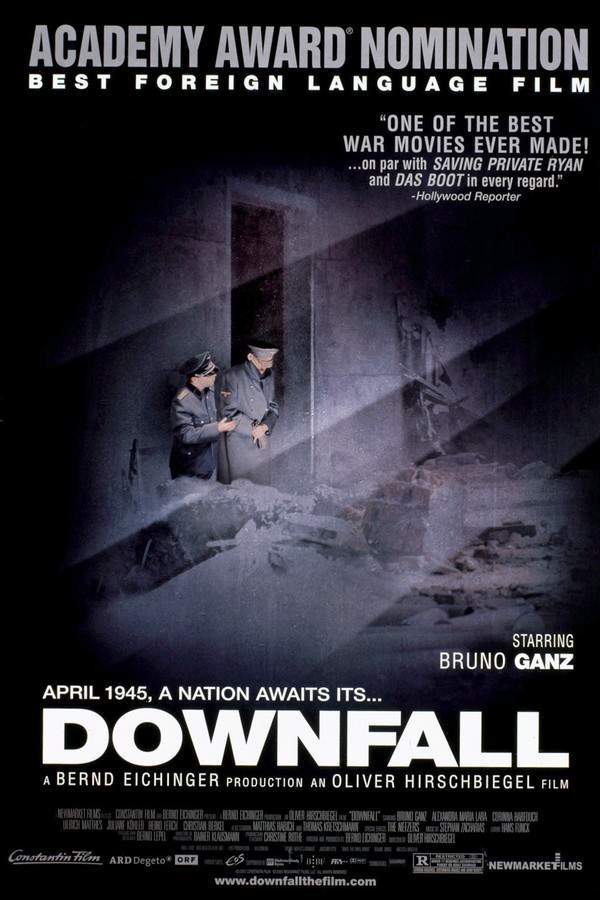
Downfall (2005) movie poster

Timeline

Downfall (2005) Timeline Explained – Every Event in Order

Release, runtime and language
2005 · 156 min · German
JustWatch #982 7
Directed by
Oliver Hirschbiegel
Starring
Bruno Ganz, Alexandra Maria Lara, Ulrich Matthes, Juliane Köhler, Corinna Harfouch

In the final days of World War II, as Germany faces imminent defeat, Traudl Junge, a young woman and Hitler’s personal secretary, finds herself trapped in his Berlin bunker. She witnesses the dictator's increasingly erratic behavior and the crumbling of his regime. Surrounded by Eva Braun and other high-ranking Nazi officials, she observes their confrontation with the inevitable collapse of the Third Reich and the desperate measures taken as the world outside closes in.

On this page (6)
  1. 1 Where to watch
  2. 2 Events in order (15)
  3. 3 Timeline questions answered
  4. 4 The book behind the movie
  5. 5 Movie threads
  6. 6 Every angle

Where to watch

Where to Watch Downfall (2005)

Where can you watch Downfall? Stream, rent or buy it in the US, including on Amazon Prime Video, Fawesome and Hoopla: current JustWatch availability with up-to-date prices.

Streaming availability powered by JustWatch

15 events in order · contains spoilers

Downfall Timeline: Events in Chronological Order

Every key event of Downfall (2005) in order, scene by scene, with when and where it takes place. Use it to untangle flashbacks, time jumps and parallel storylines, to refresh your memory before the sequel or to find the exact scene you are thinking of.

  1. Hitler hires Traudl Junge as personal secretary

    In November 1942, Adolf Hitler interviews several young women for the position of personal secretary and selects Traudl Junge. She enters the inner circle and begins handling his daily schedule and correspondence. The moment marks Junge’s rise to become a central voice in the film’s narration.

    When
    November 1942
    Where
    Berlin
  2. Battle of Berlin begins; Berlin comes under fire

    On 20 April 1945, Red Army artillery opens the assault on Berlin as the city braces for its final stand. Himmler attempts to persuade Hitler to flee, while Fegelein also tries to influence him but fails. Ernst-Günther Schenck remains in Berlin to safeguard civilians, defying the chaos around him.

    When
    20 April 1945
    Where
    Berlin
  3. Hitler forbids retreat and orders a counter-attack

    In the Führerbunker, Hitler refuses permission for a retreat by the 9th Army and presses for a counter-attack by Steiner’s units and Wenck’s 12th Army. He also publicly honors Peter Kranz for destroying enemy tanks, elevating him above his own generals. The moment underscores the surreal persistence of his stubborn resolve.

    When
    April 1945
    Where
    Führerbunker
  4. Speer argues against scorched-earth policy

    Albert Speer visits the bunker to push a plan that would preserve Germany’s infrastructure. Hitler insists on a scorched-earth stance, arguing that the German people deserve death. The clash reveals the widening rift between pragmatic governance and total war ideology.

    When
    April 1945
    Where
    Führerbunker
  5. Eva Braun hosts a party interrupted by artillery

    Eva Braun holds a party in the Reich Chancellery, oblivious to the collapsing situation around them. Artillery fire soon interrupts the gathering, interrupting any sense of celebration. She also refuses Fegelein’s pleas to flee Berlin with him.

    When
    April 1945
    Where
    Reich Chancellery
  6. Weidling is summoned and promoted

    General Helmuth Weidling learns he’s been sentenced to death for moving his command post, but he reports to the Führerbunker to clear his name. Impressed by his action, Hitler promotes him to commander of Berlin’s defense. The move centralizes the city’s remaining defenses under a trusted hand.

    When
    April 1945
    Where
    Führerbunker
  7. Hitler denounces his generals and admits defeat

    Hitler learns Steiner’s weakened forces did not counter-attack as ordered and erupts in a furious tirade against his generals. He openly acknowledges the war is lost and vows to commit suicide rather than surrender or abandon Berlin. The confession marks a turning point in the bunker’s already doomed atmosphere.

    When
    April 1945
    Where
    Führerbunker
  8. Goebbels argues cynically about the fate of the German people

    Propaganda Minister Goebbels presses Mohnke to stop sending inexperienced troops into combat, but he signals there is little hope. He dismisses any notion of mercy and asserts that the German people, having proved weaker than their enemies, deserve their fate. The exchange showcases the collapse of morale at the top.

    When
    April 1945
    Where
    Führerbunker
  9. Göring’s bid for power is rejected; arrest ordered

    Hitler receives a telegram from Reichsmarschall Göring requesting delegated state leadership in Hitler’s absence. In response, Hitler orders Göring’s arrest for treason. The moment demonstrates how far the inner circle had fractured.

    When
    April 1945
    Where
    Führerbunker
  10. Speer admits defying scorched-earth; dismissed

    Albert Speer visits one last time and admits he defied the scorched-earth order. Hitler dismisses him, not for punishment but with a clear sense of personal betrayal. The moment underscores the isolation and paranoia inside the bunker.

    When
    April 1945
    Where
    Führerbunker
  11. Himmler’s secret negotiations with the Allies exposed

    Hitler learns of Heinrich Himmler’s secret negotiations with the Allies and reacts with fury. He orders Himmler’s execution as a traitor, further deteriorating the diplomatic options for the regime. Berlin’s world is shrinking to the bunker’s claustrophobic walls.

    When
    April 1945
    Where
    Berlin
  12. Fegelein is executed for desertion

    Fegelein’s plans to desert Berlin are discovered and he is executed on Hitler’s orders, despite Eva Braun’s pleas. The incident highlights the regime’s resolve to purge even intimate circles of dissent. The brutal act contrasts with the personal relationships still present in the bunker.

    When
    April 1945
    Where
    Führerbunker
  13. Hitler’s last will and marriage to Eva Braun

    Hitler dictates his last will and testament to Traudl Junge, then marries Eva Braun in an early morning ceremony. The rituals underscore a yearning for normalcy even as the collapse accelerates. The duo’s actions crystallize the endgame of his rule.

    When
    April 29-30, 1945
    Where
    Führerbunker
  14. Suicide, poison and cremation in the bunker

    Hitler tests poison on his dog Blondi before taking his own life with Eva Braun. The couple’s bodies are carried out for cremation in the Chancellery garden, sealing the final, ritual acts of the regime. The scene marks the irreversible end of the Nazi leadership’s power.

    When
    April 30, 1945
    Where
    Führerbunker/Chancellery garden
  15. Endgame deaths, fallout, and escapes

    In the final hours, Krebs fails to negotiate a ceasefire and Burgdorf takes his own life. Magda Goebbels poisons her six children. Walther Hewel also commits suicide in the bunker. Amid the chaos, Traudl Junge escapes the bunker and is later joined by Peter Kranz.

    When
    April–May 1945
    Where
    Berlin

Last updated: October 10, 2025 at 16:05

Was this helpful?

Timeline questions answered

Downfall Timeline Explained: Your Questions Answered

When does it happen, and why in that order? The questions people ask about the chronology of Downfall (2005): time jumps, flashbacks, cause and effect between scenes and the correct order of events, each answered with spoilers.

Q1

Why was Heinrich Himmler executed in the bunker?

Hitler ordered Himmler’s execution after discovering his secret negotiations with the Allies. Himmler, who was Reichsführer-SS, had attempted to negotiate a separate peace with Western powers behind Hitler’s back, betraying the regime’s leader. When Hitler learned of these covert contacts, he considered it an act of treason and signed Himmler’s death warrant.

Foreshadowing: Earlier in the film, Himmler attempts to persuade Hitler to flee Berlin, setting up his later betrayal.

  • heinrich himmler
  • execution
  • treason
  • allies negotiation
  • ss
Q2

Why was Hermann Fegelein executed?

Fegelein was executed for attempting to desert Berlin. As Eva Braun’s brother-in-law and a high-ranking SS officer, he had been trying to flee the capital as the Soviet forces closed in. When his desertion plans were discovered, Hitler authorized his execution despite Eva Braun’s pleas for mercy.

Foreshadowing: Earlier, Fegelein joins Himmler in trying to persuade Hitler to flee, establishing his willingness to abandon the bunker.

  • hermann fegelein
  • desertion
  • execution
  • ss
  • eva braun
Q3

Why did Hitler choose to commit suicide instead of surrendering?

After learning that Steiner’s counter-attack had failed and accepting that the war was lost, Hitler declared he would never surrender or be captured. He stated he would rather commit suicide. This decision was reinforced by his belief that the German people had ‘earned their fate’ and did not deserve to be saved, combined with his refusal to face the humiliation of capture.

Foreshadowing: Hitler’s earlier rant denouncing his generals for failing him directly foreshadows his complete psychological collapse.

  • hitler suicide
  • surrender
  • bunker
  • defeat
  • adolf hitler
Q4

Why did Magda Goebbels poison her children?

Magda Goebbels believed it was preferable for her children to die rather than live in a world without National Socialism and under Allied occupation. She was convinced that without Hitler and the regime, life would be unbearable for her family, so she murdered all six children with cyanide before the couple took their own lives.

Foreshadowing: Goebbels earlier asserts that the German people deserve their fate for being weaker than their enemies, revealing his family’s ideological convictions.

  • magda goebbels
  • children
  • cyanide
  • suicide
  • Nazi ideology
Q5

Why was Albert Speer dismissed but not punished for defying Hitler?

Hitler dismissed Speer when the architect admitted he had deliberately disobeyed the scorched-earth order, refusing to destroy Germany’s infrastructure. Rather than executing Speer for treason, Hitler simply chose to sever ties with him. This unusual mercy likely stemmed from their long personal friendship and Hitler’s belief that Speer acted out of genuine concern for Germany rather than betrayal.

Foreshadowing: The earlier confrontation between Speer and Hitler about the scorched-earth policy establishes their ideological clash and Speer’s moral courage.

  • albert speer
  • scorched earth
  • dismissed
  • infrastructure
  • hitler
Q6

Why did Hitler promote General Weidling to Berlin’s defense commander?

Weidling was summoned to the Führerbunker after learning he had been sentenced to death for allegedly relocating his command post. Rather than fleeing, he presented himself to face the charges and clear his name. Hitler was impressed by his sense of duty and loyalty in coming forward, so he not only pardoned Weidling but promoted him to command Berlin’s defense.

Foreshadowing: Weidling’s decision to face Hitler rather than desert reflects the complex loyalty dynamics among military officers in the bunker.

  • helmuth weidling
  • promotion
  • defense
  • berlin
  • hitler
Q7

Why did Hitler test poison on his dog Blondi before suicide?

Hitler tested poison on his German shepherd Blondi to ensure the cyanide capsules would work effectively for his own suicide. He wanted to confirm the poison’s lethality before using it on himself and Eva Braun. After the dog died, Hitler proceeded with his plan.

Foreshadowing: Earlier scenes showing Hitler’s affection for Blondi make this moment particularly grim, as he sacrifices his beloved pet for a practical test.

  • blondi
  • dog
  • poison test
  • cyanide
  • hitler
Q8

Why was Hermann Göring arrested for treason?

Hitler ordered Göring’s arrest after receiving a telegram from the Reichsmarschall requesting that Hitler delegate leadership to him during the crisis. Hitler interpreted this as an attempt to seize power while he was still alive, viewing it as an act of treason and disloyalty from within his inner circle.

Foreshadowing: Göring’s telegram arrived amid the broader collapse of loyalty in the bunker, as various officials began planning for after Hitler’s death.

  • hermann goring
  • arrest
  • treason
  • telegram
  • reichsmarschall
Q9

Why did Eva Braun refuse to leave Berlin with Fegelein?

Eva Braun chose to remain in Berlin despite Fegelein’s pleas for her to flee with him. Her decision was rooted in unwavering loyalty to Hitler and her belief that she should stay with him until the end. She hosted a party in the Reich Chancellery even as artillery fire interrupted the celebrations, demonstrating her refusal to acknowledge the collapsing situation.

Foreshadowing: Earlier scenes showing her close relationship with Hitler establish her dedication to staying by his side.

  • eva braun
  • berlin
  • stay
  • fegelein
  • hitler
Q10

How did Traudl Junge and Peter Kranz manage to escape the bunker?

Traudl Junge escaped the Führerbunker during the final chaos as the remaining occupants attempted to break out. Peter Kranz, the only surviving member of his unit whose parents had been executed, joined her during the escape. They were among the very few who managed to flee the collapsing bunker complex as Soviet forces completed their capture of Berlin.

Foreshadowing: The film’s opening establishes Traudl as the narrator, and her survival is framed as exceptional given the mass death around her.

  • traudl junge
  • peter kranz
  • escape
  • bunker
  • survival
Q11

Why did General Krebs’ ceasefire negotiation with the Soviets fail?

General Hans Krebs attempted to negotiate a ceasefire with Soviet Colonel General Vasily Chuikov, but Chuikov insisted on unconditional surrender. Because Hitler had forbidden any surrender and the Nazi leadership was either dead or in hiding, Krebs had no authority to meet the Soviet terms. The negotiation collapsed, leading Krebs to take his own life.

Foreshadowing: Earlier scenes establish the Nazi leadership’s absolute refusal to surrender, making any negotiation impossible.

  • hans krebs
  • ceasefire
  • vasily chuikov
  • unconditional surrender
  • red army
Q12

When did Hitler first publicly acknowledge the war was lost?

Hitler first publicly acknowledged the war was lost during his furious tirade against his generals after learning that Steiner’s forces had failed to mount the counter-attack he had ordered. This was the first time he openly admitted defeat, even though he had already privately accepted it. The outburst marked a psychological turning point, leading directly to his decision to commit suicide.

Foreshadowing: His earlier refusal to allow the 9th Army to retreat demonstrates his denial, making this public admission even more significant.

  • hitler
  • war lost
  • steiner
  • defeat
  • generals
Q13

Why were Peter Kranz’s parents executed?

Peter Kranz was a young tank destroyer fighter who was praised by Hitler for his bravery. After the bunker fell, Peter learned that his parents had been executed, likely as part of the Nazi regime’s practice of holding families of deserters or those who failed in their duty accountable. His father had earlier pleaded in vain for permission to desert, highlighting the regime’s brutal enforcement of loyalty.

Foreshadowing: The earlier scene where Peter’s father pleads for desertion establishes the family’s precarious position within the regime’s ideological framework.

  • peter kranz
  • parents
  • execution
  • desertion
  • family

Movie threads

More Movies Like Downfall, by Mood & Story

Curated lists built around what makes Downfall tick: the same mood, the same kind of story or the same emotional payoff. Each list explains why these movies belong together.

Claustrophobic bunker dramas like Downfall

Tense stories of characters trapped as their world collapses around them. If you liked the intense, confined setting of Downfall, explore other movies like it that trap their characters in bunkers, fortresses, or safe houses during moments of extreme crisis. These similar war dramas and historical thrillers capture the same feeling of a world shrinking under immense pressure.

  • claustrophobic
  • tense
  • oppressive
  • desperate
  • historical
  • doomed
  • Tone: bleak, tense, oppressive
  • Pacing: steady, deliberate
Why these movies?

The story pattern: These narratives typically unfold within a single, restricted location, charting the psychological and moral decay of a group facing an inevitable external threat. The plot is driven by internal conflict, desperate decision-making, and the grim acceptance of a doomed fate.

Why they belong together: They share a powerful sense of physical and psychological confinement, using a limited setting to create unbearable tension and focus on character dynamics under extreme duress. The experience is defined by a palpable feeling of entrapment and impending doom.


Historical portraits of downfall like in Downfall

Unflinching historical accounts of powerful figures facing catastrophic collapse. For viewers who appreciated Downfall's stark depiction of a regime's collapse, this thread gathers movies with a similar focus on historical accountability and the downfall of powerful figures. These films share a bleak, reflective tone and a heavy emotional weight, much like watching the end of the Third Reich.

  • somber
  • grim
  • historical
  • reflective
  • morose
  • tragic
  • Tone: bleak, somber, grim
  • Pacing: steady, march toward inevitability
Why these movies?

The story pattern: The narrative pattern follows a linear, often chronological descent from a position of power into chaos and ruin. The focus is less on action and more on observation, documenting the denial, desperation, and final moments of those who wielded authority, revealing the fragility of their constructed reality.

Why they belong together: They are grouped by their shared commitment to portraying historical tragedy with unblinking realism, exploring themes of moral bankruptcy, the consequences of absolute power, and the grim inevitability of collapse for systems built on oppression and lies.

Every angle

Downfall (2005) Explained: Plot, Timeline & Characters

Everything about Downfall in one place: what happens in the plot summary, the timeline in chronological order, the characters and meaning and a spoiler-free summary. What's After the Movie adds the cast, box office and post-credit scenes.

Coming soon on iOS and Android

The Plot Explained Movie Summary App

Plot summaries, endings explained and timelines on your phone. Catch up on any movie in minutes, save your favorites and never miss a twist again.

Be the first to know when we launch. Your email stays private, always.

Learn more about the app