


Plot Explained Spoilers guaranteed!
Plot Explained

Browse by genre

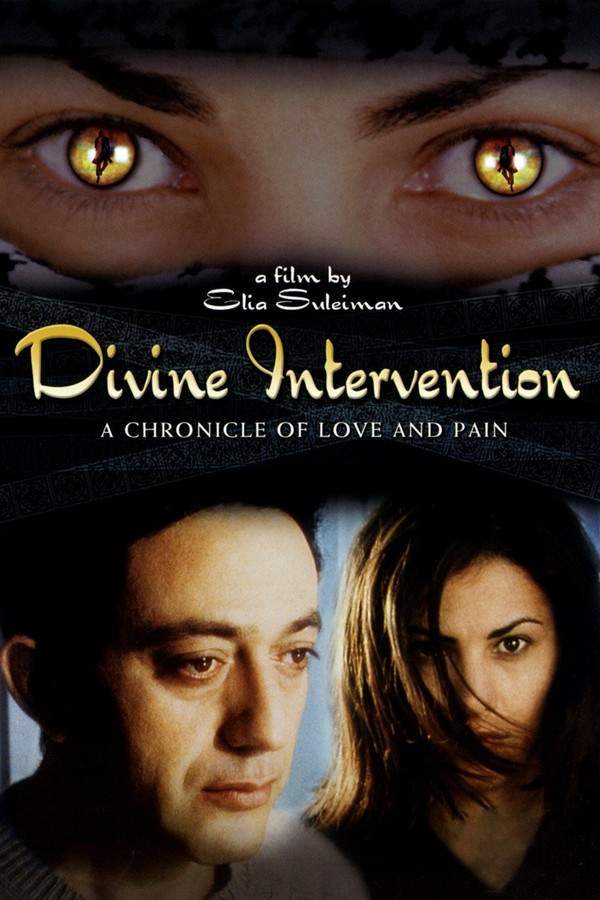
Divine Intervention (2003) movie poster

Timeline

Divine Intervention (2003) Timeline Explained – Every Event in Order

Release, runtime and language
2003 · 92 min · Arabic
Directed by
Elia Suleiman

Amidst the turmoil of war, an Israeli checkpoint becomes the unexpected setting for a poignant love story. Elia and Manal, individuals from vastly different backgrounds, find their lives intertwined as they experience the harsh realities of the conflict firsthand. Their connection offers a brief moment of solace and a glimmer of hope, highlighting the shared humanity that persists even in the midst of devastation.

On this page (6)
  1. 1 Where to watch
  2. 2 Events in order (12)
  3. 3 Timeline questions answered
  4. 4 Movie threads
  5. 5 Movies like Divine Intervention
  6. 6 Every angle

Where to watch

Where to Watch Divine Intervention (2003)

Where can you watch Divine Intervention? Stream, rent or buy it in the US, including on Chai Flicks and Kanopy: current JustWatch availability with up-to-date prices.

Streaming availability powered by JustWatch

12 events in order · contains spoilers

Divine Intervention Timeline: Events in Chronological Order

Every key event of Divine Intervention (2003) in order, scene by scene, with when and where it takes place. Use it to untangle flashbacks, time jumps and parallel storylines, to refresh your memory before the sequel or to find the exact scene you are thinking of.

  1. Life in Ramallah and the family dynamics

    The film opens by focusing on life in Ramallah, centering on E.S.'s father and the neighbors who swirl around him. We see disputes, the presence of Israeli police at the edges, and items seemingly seized by settlers, painting a world oppressed by occupation. The atmosphere is observational, with small tensions building among residents as they go about their day.

    When
    Opening sequence
    Where
    Ramallah
  2. The Father curses familiar faces while driving

    The Father curses familiar faces as he drives through Ramallah's streets, an act that reveals a heavier weariness under occupation. The mundane drive becomes a canvas for memory, frustration, and the politics of daily life. The scene underscores how routine moments are tinted by conflict.

    When
    Daytime
    Where
    Ramallah
  3. Neighbors clash over small matters

    A sequence of petty disputes among neighbors unfolds, highlighting the fragility of community under stress. The bickering serves as a quiet counterpoint to the larger geopolitical forces at play. Behind each quarrel you sense the undercurrent of fear, suspicion, and survival.

    When
    Daytime
    Where
    Ramallah
  4. E.S.'s father falls ill and is hospitalized

    Suddenly, E.S.'s father becomes ill and is admitted to a hospital in Ramallah, shifting the focus toward his son’s responsibility. The family anxiously navigates the medical system while under the gaze of checkpoints and power structures. This illness marks a pivot toward the second part of the film and E.S.'s journeys between Nazareth and Ramallah.

    When
    Mid-film
    Where
    Ramallah hospital
  5. E.S. crosses the Nazareth–Ramallah border to visit his father

    With his father ill, E.S. must travel between Nazareth and Ramallah, crossing the border as he moves between home and hospital. The border checkpoint becomes a liminal space where movement is negotiated and watched. The act of crossing foregrounds the political reality that structures ordinary visits.

    When
    Daytime
    Where
    Border checkpoint (Nazareth–Ramallah)
  6. The Palestinian couple meets at the border

    A Palestinian couple encounters each other at the border checkpoint, beginning a clandestine pattern of meetings that thread through the film. Their car conversations unfold under the watchful eyes of guards and cameras, illustrating the texture of daily life under occupation. The meetings weave romance into a landscape shaped by restriction.

    When
    Daytime
    Where
    Border checkpoint
  7. Tourist asks directions; prisoner shown

    A tourist asks an Israeli policeman for directions, and the officer sifts through his van to produce a blindfolded Palestinian prisoner from the back. The prisoner offers three possible routes, offering a dark moment of how authority and spectacle intersect. The scene exposes the surreal, coercive logic that governs mobility.

    When
    Daytime
    Where
    Border checkpoint
  8. Balloon crossing near the checkpoint

    The couple is in the car again when the man inflates a red balloon bearing Yasser Arafat's face and releases it toward the checkpoint. A soldier nearly shoots it, but a comrade intervenes, allowing the couple to slip through. The balloon drifts across Jerusalem and settles near the Dome of the Rock, turning a small act into a symbol-laden moment.

    When
    Daytime
    Where
    Border checkpoint to Jerusalem
  9. Night drive and the ongoing border life

    Later that night, the couple shares a quiet car ride, continuing their furtive exchanges away from the public gaze. The intimate moment sits against the backdrop of occupation, suggesting both tenderness and danger in their relationship. The checkpoint remains a constant presence in their lives.

    When
    Night
    Where
    Nazareth–Ramallah border vicinity
  10. Morning military dance and counterpoint

    The next morning, five Israeli men rehearse an elaborate, dance-like firing drill directed by a choreographer-officer. When a real Palestinian woman wearing a target's guise appears, the drill escalates into violence as bullets gather and form a crown of thorns. She rises, uses symbols of Palestine to strike back, and defeats all but the officer, challenging the illusion of control.

    When
    Morning
    Where
    Israeli training area near border
  11. Supernatural resilience and helicopter confrontation

    In a surreal turn, the woman demonstrates extraordinary power, disarming the bullets midflight and causing them to fall. She destroys a hovering helicopter with a shield bearing the image of Palestine, as the choreographer looks on with helpless awe. The sequence blends mythic resistance with the film's stark critique of violence.

    When
    After dawn
    Where
    Border area; helicopter base
  12. Ending scene: dinner in a pressure cooker

    The film closes with E.S. and his mother watching their dinner cook in a pressure cooker, a stark domestic image that contrasts with the earlier chaos. The quiet moment hints at endurance and the persistence of ordinary life beneath occupation. It leaves the viewer with a meditation on memory, resilience, and the cost of surveillance.

    When
    Ending
    Where
    Nazareth home

Last updated: November 22, 2025 at 15:57

Was this helpful?

Timeline questions answered

Divine Intervention Timeline Explained: Your Questions Answered

When does it happen, and why in that order? The questions people ask about the chronology of Divine Intervention (2003): time jumps, flashbacks, cause and effect between scenes and the correct order of events, each answered with spoilers.

Q1

What does the opening scene with Santa Claus fleeing children signify?

The opening scene in Nazareth shows Santa Claus wounded and fleeing from children beside a ruined Franciscan chapel on Mount Fear. This surreal image establishes the film's blending of the mundane and the mythic, setting a tone where joy and danger coexist. It functions as an allegorical introduction to a land where even symbols of Western celebration are under siege, immediately communicating the fractured reality of occupied territory.

Foreshadowing: The scene establishes the film's pattern of juxtaposing everyday life with surreal, symbolic imagery.

  • santa claus
  • opening scene
  • symbolism
  • allegorical image
  • mount fear
Q2

Why does E.S. travel between Nazareth and Ramallah?

E.S. travels from Nazareth to Ramallah to visit his father, who has suddenly fallen ill and been hospitalized. The journey requires crossing the border checkpoint, which becomes a central motif of the film. This medical emergency forces E.S. to navigate the restrictions of movement imposed by the occupation, transforming a personal family crisis into a political statement about the difficulties of ordinary travel under military control.

Foreshadowing: E.S.'s repeated crossings set up the later checkpoint encounters with the Palestinian couple.

  • es
  • father
  • hospital
  • border crossing
  • nazareth
  • ramallah
Q3

What is the significance of the red balloon with Yasser Arafat's face?

When E.S. inflates a red balloon bearing Yasser Arafat's face near the checkpoint, it becomes an act of quiet protest. An Israeli soldier moves to shoot the balloon, but another soldier stops him, and in the resulting distraction, the couple slips through the checkpoint. The balloon then drifts over Jerusalem and settles against the Dome of the Rock, transforming a simple object into a symbol of Palestinian identity and resilience that transcends the barriers meant to contain it.

Foreshadowing: The balloon's journey over Jerusalem foreshadows the film's thematic focus on Palestinian presence in contested spaces.

  • balloon
  • yasser arafat
  • checkpoint
  • protest
  • dome of the rock
  • jerusalem
Q4

What does the surreal scene with the Palestinian woman defeating soldiers mean?

The sequence shows five Israeli soldiers performing a choreographed firing drill with a target resembling a Palestinian woman. When a real Palestinian woman appears, she lifts the bullets from the air, forms them into a crown of thorns, and uses crescent-shaped stars and rocks to defeat all but the choreographer-officer. She then destroys a helicopter with a shield bearing Palestine's form. This allegorical scene represents the resilience and supernatural power of Palestinian resistance, turning victims into mythic figures capable of defying military force.

Foreshadowing: The scene reflects the film's theme of ordinary people possessing hidden strength against oppression.

  • palestinian woman
  • surreal scene
  • resistance
  • allegory
  • bullets
  • helicopter
Q5

Why does the Israeli policeman show a blindfolded prisoner to a tourist seeking directions?

A tourist asks an Israeli policeman for directions, but instead of helping, the officer produces a blindfolded Palestinian prisoner from his van. The prisoner then offers three different routes. This chilling vignette exposes how ordinary interactions become entangled with humiliation and control. It illustrates how the presence of prisoners is used as a tool of intimidation and how authority exploits spectacle to reinforce power dynamics at the checkpoint.

Foreshadowing: This scene establishes the checkpoint as a space where human dignity is systematically undermined.

  • tourist
  • prisoner
  • checkpoint
  • humiliation
  • israeli police
  • directions
Q6

What is the meaning of the ending scene with the pressure cooker?

The film closes with E.S. and his mother quietly watching dinner simmer in a pressure cooker, a domestic ritual that contrasts sharply with the earlier chaos and surreal violence. This ending emphasizes endurance and the persistence of ordinary life beneath occupation. The pressure cooker becomes a symbol of controlled heat and contained tension, reflecting how Palestinian daily life continues despite the pressure of military rule. The quiet moment offers no political resolution but affirms the resilience of family and tradition.

Foreshadowing: The domestic scene contrasts with the earlier border crossings, suggesting that home is both refuge and prison.

  • ending
  • pressure cooker
  • domestic scene
  • endurance
  • family
  • nazareth home
Q7

Why do the Palestinian couple keep meeting at the border checkpoint?

The couple meets repeatedly at the border checkpoint between Nazareth and Ramallah because movement restrictions force their clandestine romance into public, monitored spaces. Their car becomes a private refuge in full view of guards and cameras. These meetings illustrate how the occupation shapes even intimate relationships, requiring lovers to conduct their meetings in the liminal, watched space of the checkpoint. The border becomes both obstacle and meeting place, transforming political restriction into the backdrop for connection.

Foreshadowing: The couple's meetings parallel E.S.'s own crossings to visit his father, creating thematic echoes.

  • couple
  • checkpoint
  • romance
  • border
  • clandestine meetings
  • restricted movement
Q8

How does the film portray daily life under military occupation?

The film depicts occupation through observational vignettes of ordinary moments: driving through familiar streets, bickering neighbors, disputes over small matters, and the constant presence of Israeli police and settlers. Rather than focusing on dramatic violence, it shows how occupation seeps into every aspect of routine, the checkpoints that control movement, the seizures of Palestinian spaces, and the psychological weight of living under surveillance. This mosaic structure emphasizes that occupation is not exceptional but a sustained condition shaping the texture of everyday existence.

Foreshadowing: The early scenes of neighborly friction and the father's curses set up the pervasive atmosphere of controlled existence.

  • occupation
  • daily life
  • observational
  • vignettes
  • checkpoints
  • surveillance
  • routine
Q9

Why does the film include surreal, allegorical sequences?

The film alternates between stark realism and surreal sequences, like the Palestinian woman defeating soldiers, because the director uses this contrast to express what realistic dialogue cannot. The occupation's logic is already so absurd that only fantastical imagery can adequately represent it. These mythic moments give voice to suppressed anger and resistance, turning the oppressed into powerful figures. The surreal sequences function as emotional and political release within a film where speech is scarce and visual symbols carry the weight of meaning.

Foreshadowing: The opening Santa Claus scene establishes this pattern of grounding mythic imagery in realistic settings.

  • surreal
  • allegory
  • symbolism
  • fantasy
  • resistance
  • magical realism
  • mythical
Q10

What does the balloon resting against the Dome of the Rock symbolize?

After floating over Jerusalem, the balloon with Arafat's face comes to rest against the Dome of the Rock, a sacred Islamic site on the Temple Mount. This moment transforms a small act of protest into a symbol of Palestinian presence and claim to Jerusalem. The Dome represents both religious significance and political aspiration, making the balloon's journey a silent assertion of identity that travels across barriers to reach the heart of the contested city.

Foreshadowing: The balloon's flight connects the checkpoint's political reality to Jerusalem's sacred geography.

  • dome of the rock
  • jerusalem
  • balloon
  • symbol
  • palestinian identity
  • sacred site

Movie threads

More Movies Like Divine Intervention, by Mood & Story

Curated lists built around what makes Divine Intervention tick: the same mood, the same kind of story or the same emotional payoff. Each list explains why these movies belong together.

Movies About Subtle Resistance Like Divine Intervention

Stories where characters find subtle, often surreal ways to defy an oppressive system. This collection features films like Divine Intervention, where characters navigate oppressive regimes and military occupations. If you liked the poignant, symbolic defiance in Divine Intervention, you'll find similar stories of quiet resilience and surreal protest in these movies.

  • oppressive
  • somber
  • defiant
  • symbolic
  • meditative
  • restrained
  • Tone: melancholic, defiant
  • Pacing: slow, observational
Why these movies?

The story pattern: Narratives in this thread often unfold through observational vignettes, focusing on the everyday lives of individuals under systemic pressure. The central conflict is the struggle to maintain one's spirit and identity against dehumanizing forces, with resolution often found in small, personal acts of rebellion rather than large-scale victories.

Why they belong together: These films are grouped together because they share a specific tone of melancholic defiance and a focus on the psychological impact of political conflict. They use restrained pacing, heavy emotional weight, and often surreal or symbolic imagery to convey their themes, creating a powerful and reflective viewing experience.

Slice-of-Life War Dramas Like Divine Intervention

Intimate stories that focus on the quiet, human moments within larger political turmoil. Explore movies like Divine Intervention that portray the everyday lives of people living in conflict zones. If you appreciated the observational, vignette-style look at love and life under occupation, you'll find similar melancholic and meditative stories here.

  • observational
  • somber
  • meditative
  • quiet
  • everyday life
  • humanistic
  • Tone: melancholic, observational, somber
  • Pacing: slow, meditative
Why these movies?

The story pattern: These stories are typically structured as a series of interconnected vignettes or a slowly unfolding observation of daily routines. The narrative journey is emotional rather than plot-heavy, building a cumulative portrait of life constrained by external forces, where small human connections become acts of profound significance.

Why they belong together: These movies share a distinct vibe: a slow, observational pace, a melancholic and somber tone, and a focus on the heavy emotional weight of everyday existence within a larger crisis. They prioritize mood and atmosphere over conventional plot, creating a meditative and deeply humanistic experience.

If you liked this

Movies Like Divine Intervention

Similar movies to Divine Intervention: the same genre, themes or kind of story. Each one comes with its own plot summary, timeline and ending explained.

Browse all movie summaries

Every angle

Divine Intervention (2003) Explained: Plot, Timeline & Characters

Everything about Divine Intervention in one place: what happens in the plot summary, the timeline in chronological order, the characters and meaning and a spoiler-free summary. What's After the Movie adds the cast, box office and post-credit scenes.

Coming soon on iOS and Android

The Plot Explained Movie Summary App

Plot summaries, endings explained and timelines on your phone. Catch up on any movie in minutes, save your favorites and never miss a twist again.

Be the first to know when we launch. Your email stays private, always.

Learn more about the app