Plot Explained Spoilers guaranteed!
Plot Explained

Browse by genre

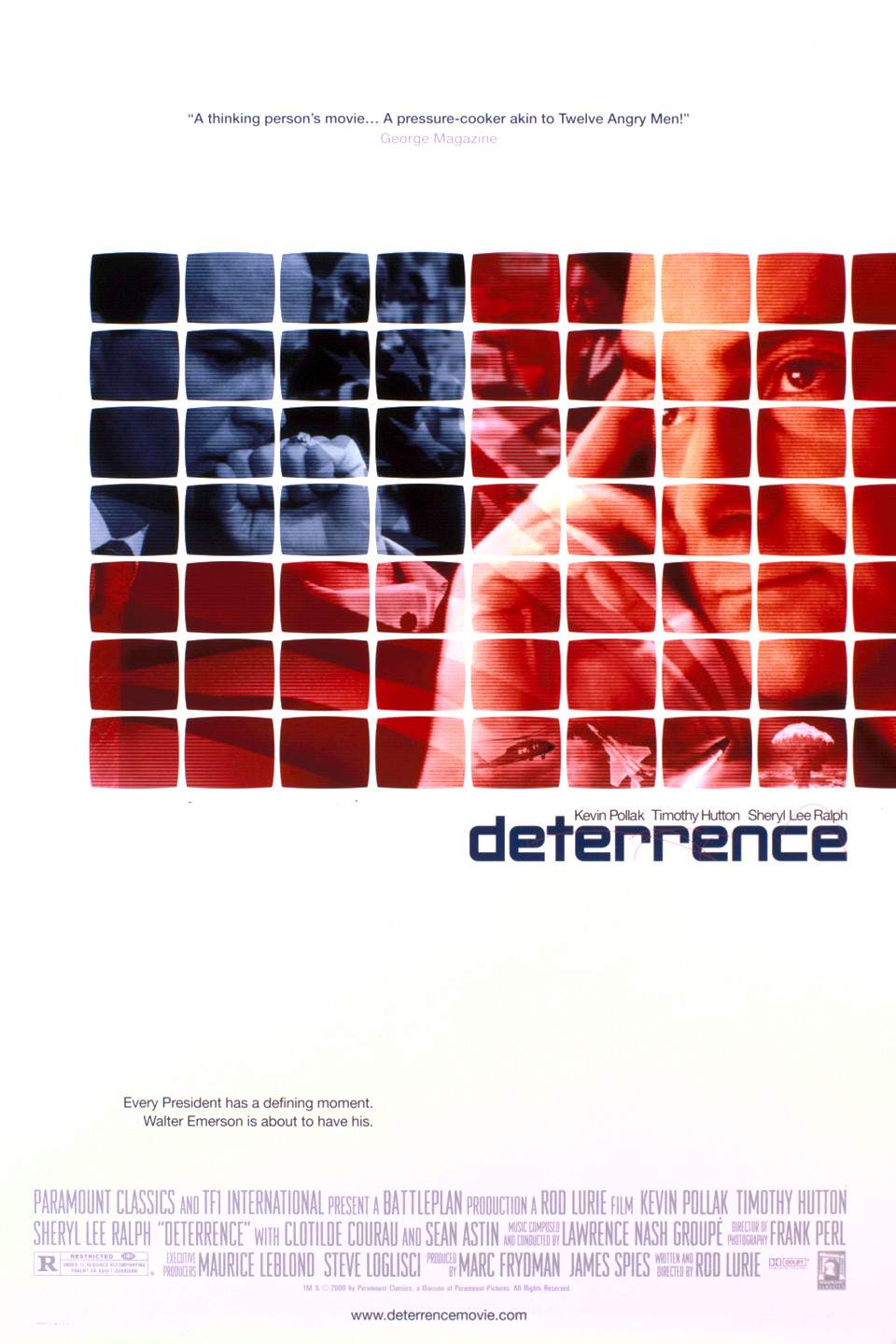
Deterrence (2000) movie poster

Timeline

Deterrence (2000) Timeline Explained – Every Event in Order

Release, runtime and language
2000 · 104 min · English
Loading streaming availability…
Directed by
Rod Lurie
Budget
$800K

During a political campaign, the President of the United States and his staff find themselves unexpectedly stranded at a roadside diner. While awaiting further instructions, they receive alarming news: Iraq has invaded Kuwait, resulting in the deaths of numerous American soldiers. The situation escalates rapidly, forcing them to confront a crisis while far from Washington.

On this page (6)
  1. 1 Where to watch
  2. 2 Events in order (14)
  3. 3 Timeline questions answered
  4. 4 Movie threads
  5. 5 Movies like Deterrence
  6. 6 Every angle
Loading streaming availability…

14 events in order · contains spoilers

Deterrence Timeline: Events in Chronological Order

Every key event of Deterrence (2000) in order, scene by scene, with when and where it takes place. Use it to untangle flashbacks, time jumps and parallel storylines, to refresh your memory before the sequel or to find the exact scene you are thinking of.

  1. Blizzard traps the presidential entourage in a Colorado diner

    During a freak spring blizzard, President Walter Emerson, his White House team, security detail, and a TV crew become stranded in a remote Aztec, Colorado diner. They greet local civilians—Harvey, Katie, Ralph, and the Woods—while the storm cuts off contact with the outside world. The gathering shifts from campaign chatter to crisis management as weather isolates them and the clock starts ticking.

    When
    Spring 2008
    Where
    Aztec, Colorado
  2. Iraq invades Kuwait; UN peacekeepers casualties

    News arrives that Iraq has invaded Kuwait on orders from Uday Hussein, shocking the region and the U.S. government. The invasion is linked to the deaths of UN peacekeepers largely staffed by U.S. forces, intensifying the crisis. The diners absorb the news as a new existential threat emerges on the world stage.

    When
    Spring 2008
    Where
    Kuwait
  3. Emerson broadcasts a nuclear ultimatum from the diner

    Emerson issues a worldwide ultimatum: Hussein must surrender at the Iraqi embassy within 90 minutes or a nuclear strike on Baghdad will proceed. The speech shocks his staff and the civilians, who had not anticipated such drastic measures. Emerson defends the move by arguing a nuclear show of force is necessary to defend a threatened ally and show U.S. resolve.

    When
    Spring 2008
    Where
    Diner, Aztec, Colorado
  4. UN envoy questions Emerson’s legitimacy and resolve

    The Iraqi envoy at the United Nations refuses to back down, citing Emerson’s status as a non-elected leader and his Jewish faith as reasons why he is not to be taken seriously. Negotiations grow heated as diplomats push for de-escalation. Emerson, Redford, and Thompson coordinate with the NSC and Joint Chiefs to map out potential nuclear options.

    When
    Spring 2008
    Where
    United Nations
  5. Crisis leadership drums up nuclear options with top military brass

    Emerson, Redford, and Thompson rally with the NSC and Joint Chiefs by phone to plan for possible nuclear action. Lines connect the diner, the White House, and various secure channels as the crisis tightens. The civilian observers sense the gravity of the potential path ahead.

    When
    Spring 2008
    Where
    Diner/White House Crisis Center
  6. Iraq threatens missiles; France’s role is exposed

    Hussein threatens to launch black-market missiles at U.S. and NATO targets. It is revealed that France supplied these weapons, a shocking revelation that strains alliances. Emerson privately probes the French leader about the deal but withholds those details from his advisers.

    When
    Spring 2008
    Where
    Iraq/France
  7. Civilians weigh in as the crisis deepens

    Harvey, Katie, and the Woods oppose using nuclear force, while Ralph insists he could rally support if Emerson acts. Emerson’s wife also disagrees with the plan, and several aides express doubt. Despite the mounting opposition, Emerson remains resolute about pursuing the strike.

    When
    Spring 2008
    Where
    Diner, Aztec, Colorado
  8. B-2 order to cross Iraq’s airspace escalates tensions

    With time running short, Emerson orders a B-2 bomber to cross Iraq’s airspace to execute the strike. The Iraqi envoy warns that such an action would constitute an act of war. Tension surges as both sides prepare for possible wide-scale conflict.

    When
    Spring 2008
    Where
    Over Iraq
  9. Captain Coddington is killed; Harvey is shot by Secret Service

    Harvey fatally shoots Captain Coddington, the officer carrying the nuclear football. Secret Service agents retaliate, killing Harvey and devastating Katie. Emerson mourns Coddington’s sacrifice even as the crisis hurtles toward its climax.

    When
    Spring 2008
    Where
    Diner, Aztec, Colorado
  10. Nuclear codes are secured; Admiral Miller resigns

    Emerson obtains the nuclear launch codes by phone from the Joint Chiefs, but Admiral Miller resigns in protest of the plan. The military leadership fractures as civilian authority presses forward. The countdown toward potential nuclear action continues despite political dissent.

    When
    Spring 2008
    Where
    Washington, D.C.
  11. Emerson authorizes the strike; B-2 heads to Baghdad

    Emerson formally authorizes the nuclear strike and speaks to the crew of the B-2 bomber en route to Baghdad. The attack proceeds, and the world watches as Baghdad is targeted. The action triggers immediate retaliation from Iraq and a broader war dynamic.

    When
    Spring 2008
    Where
    Over Iraq/Baghdad
  12. Baghdad destroyed; most missiles fail to detonate

    The 100-megaton strike obliterates Baghdad, while NATO missile defenses shoot down the majority of Iraq’s retaliatory missiles. A few missiles land on targets, but their warheads do not detonate as anticipated. Baghdad remains the sole major city destroyed in the chaos.

    When
    Spring 2008
    Where
    Baghdad, Iraq
  13. Snow clears; Emerson reveals the truth behind the crisis

    As the storm subsides, Emerson delivers a global TV address revealing that the U.S. government secretly sold faulty nuclear weapons to Iraq via France to preempt an independent Iraqi arsenal. He defends the display as a deterrent and a test of resolve. Privately, he forecasts that the move will pressure China and North Korea to concede the Second Korean War soon.

    When
    After the snowstorm
    Where
    Global broadcast
  14. Emerson plans to withdraw from the campaign

    Just before leaving the diner, Emerson reveals his intention to withdraw from the presidential race and serve out the remainder of his predecessor’s term. He argues that the crisis demands a different kind of leadership for the future, leaving his political ambitions behind. The moment reframes the narrative from a campaign to a controversial legacy.

    When
    Post-crisis
    Where
    Diner, Aztec, Colorado

Last updated: November 22, 2025 at 15:58

Was this helpful?

Timeline questions answered

Deterrence Timeline Explained: Your Questions Answered

When does it happen, and why in that order? The questions people ask about the chronology of Deterrence (2000): time jumps, flashbacks, cause and effect between scenes and the correct order of events, each answered with spoilers.

Q1

Why did President Emerson issue a nuclear ultimatum to Iraq?

Emerson issued the ultimatum because Iraq had invaded Kuwait and killed American soldiers in a UN peacekeeping mission. He argued that with American forces already engaged in the Second Korean War and Iraq threatening a key U.S. ally, a nuclear strike would reassert American supremacy and halt the Iraqi advance. The 90-minute deadline was meant to force Saddam Hussein to surrender at the Iraqi embassy.

Foreshadowing: Earlier in the film, Emerson's campaign team notes his reputation for taking bold, unconventional positions on foreign policy.

  • nuclear ultimatum
  • saddam hussein
  • kuwait invasion
  • iraq war
  • baghdad strike
Q2

How did President Emerson become president?

Walter Emerson was appointed Vice President by his predecessor and then assumed the presidency just four months before the events of the film when the previous president died. This made him an unelected leader, which the Iraqi UN envoy later used to question his legitimacy and authority to issue nuclear threats.

Foreshadowing: The film establishes early on that Emerson's rapid rise to power is unusual and politically fragile.

  • walter emerson
  • vice president
  • presidential succession
  • unelected president
Q3

Why did Harvey shoot Captain Coddington in the diner?

Harvey, the diner's chef and owner, shot Captain Coddington, who carried the nuclear football containing launch codes, because he was fundamentally opposed to the use of nuclear weapons. Harvey believed that authorizing a nuclear strike on Baghdad would cause unacceptable civilian casualties and lead to catastrophic global consequences. His act was an attempt to prevent the president from executing the strike.

Foreshadowing: Earlier, Harvey openly voiced his opposition to nuclear weapons along with Katie and the Woods couple, making his eventual action predictable.

  • harvey
  • coddington
  • nuclear football
  • shot
  • opposition to nuclear weapons
Q4

What was the secret US plan involving Iraq's nuclear weapons?

The U.S. government had secretly facilitated the transfer of nuclear weapons to Iraq via France, with the explicit intent of sabotaging those weapons to prevent Iraq from ever acquiring a truly independent nuclear arsenal. This was a hidden government scheme to control Iraq's capabilities while appearing to supply them. Emerson later revealed this to justify the nuclear strike as both a deterrent and a test of U.S. resolve.

Foreshadowing: The film hints at a hidden agenda when Emerson privately speaks with the French president but withholds the conversation from his advisers.

  • nuclear weapons
  • france
  • iraq
  • sabotage
  • secret plan
  • deterrence policy
Q5

Why did President Emerson decide to withdraw from the presidential campaign?

Emerson decided to step away from the campaign and serve out the remainder of his predecessor's term because he believed the country needed different leadership after the crisis. Despite believing his actions were necessary to defend the nation, he felt the controversial and dangerous choices made during the nuclear standoff meant he should not continue pursuing the presidency. He wanted someone else to lead the country forward.

Foreshadowing: Emerson's resolute but isolated decision-making throughout the crisis foreshadows his willingness to make unpopular choices for what he perceives as the greater good.

  • withdraw
  • campaign
  • resign
  • presidential race
  • leadership
Q6

What was the Second Korean War mentioned in the film?

The Second Korean War was an ongoing broader conflict involving American forces that Emerson referenced to explain why the U.S. military was already heavily stretched. He used this to justify his nuclear stance, arguing that a show of force would not only stop Iraq but also compel China and North Korea to concede the war within months. The conflict was part of the strategic backdrop that made Emerson believe a decisive nuclear demonstration was necessary.

Foreshadowing: Emerson's mentions of the Second Korean War establish the context of global instability driving his aggressive foreign policy stance.

  • second korean war
  • china
  • north korea
  • military conflict
  • escalation
Q7

Why was France involved in supplying nuclear weapons to Iraq?

France had supplied Iraq with black-market nuclear missiles through a covert deal. When Emerson privately confronted the French president about this, the French leader was blunt and seemingly nonchalant about the catastrophe unfolding. France's role as a supposed ally supplying weapons to a potential adversary shocked the crisis team and added to the political complexity of the situation.

Foreshadowing: The revelation about France's involvement comes after Iraq threatens to use missiles that clearly exceed their known domestic capabilities.

  • france
  • iraq
  • nuclear missiles
  • black market
  • weapons deal
  • alliance
Q8

What happened to Iraq's retaliatory missiles after the nuclear strike?

After Baghdad was destroyed by the 100-megaton nuclear strike, Iraq launched retaliatory missiles at U.S. and NATO targets. However, NATO missile defenses successfully shot down most of the incoming missiles. Additionally, several missiles that landed on targets failed to detonate as expected. Baghdad remained the sole major city destroyed, while most of Iraq's retaliation was ineffective.

Foreshadowing: The film builds tension around Iraq's missile threats, particularly against the NORAD command center in Colorado, making the ultimate outcome somewhat surprising.

  • retaliation
  • missiles
  • nato
  • baghdad
  • defense systems
  • detonation failure
Q9

Why did Admiral Miller resign during the crisis?

Admiral Miller, a senior military officer and vocal critic of Emerson's nuclear plan, resigned in protest after Emerson obtained the nuclear launch codes and proceeded with the strike authorization. His resignation reflected the fracturing military leadership and the deep disagreement within the president's own command structure over the decision to use nuclear weapons.

Foreshadowing: Miller had been a consistent voice of opposition throughout the crisis coordination calls, making his departure logically consistent with his character.

  • admiral miller
  • resign
  • military leadership
  • joint chiefs
  • protest
  • nuclear strike
Q10

Why did the civilians in the diner oppose the nuclear strike?

Harvey, Katie, and the Woods couple opposed the nuclear strike because they were deeply concerned about civilian casualties and the long-term consequences of using nuclear weapons. They represented moral opposition to killing potentially thousands of innocent people in Baghdad. Ralph, however, argued that decisive military action would win political support. Emerson's wife also expressed opposition by phone.

Foreshadowing: The civilians' earlier conversations about the stakes of the crisis and their fear during the ultimatum announcement foreshadow their vocal opposition.

  • civilians
  • opposition
  • civilian casualties
  • moral dilemma
  • harvey
  • katie
Q11

Why did the Iraqi UN envoy question President Emerson's authority?

The Iraqi UN envoy refused to take Emerson seriously because he was not elected to the presidency, he had only been appointed vice president and then succeeded to the office after the previous president's death. The envoy also referenced Emerson's Jewish faith in an anti-Semitic manner to further dismiss his authority. These attacks on Emerson's legitimacy were part of the diplomatic standoff.

Foreshadowing: The envoy's challenges to Emerson's authority highlight the political vulnerability of Emerson's sudden rise to power.

  • un envoy
  • legitimacy
  • elected president
  • authority
  • diplomacy
  • saddam hussein
Q12

How did the blizzard affect the crisis management?

The freak spring blizzard trapped President Emerson and his entourage in a remote Colorado diner, cutting them off from Washington and forcing them to manage a global nuclear crisis from an ordinary roadside restaurant. The isolation created intense pressure and forced quick decision-making with limited resources, while the TV crew documented everything in real time, making the crisis uniquely public and immediate.

Foreshadowing: The film opens with the blizzard setting up the isolated, pressure-cooker environment that defines the entire crisis.

  • blizzard
  • aztec colorado
  • isolation
  • trapped
  • diner
  • communication cut off

Movie threads

More Movies Like Deterrence, by Mood & Story

Curated lists built around what makes Deterrence tick: the same mood, the same kind of story or the same emotional payoff. Each list explains why these movies belong together.

Confined political thrillers like Deterrence

World-changing decisions made under pressure in a single, claustrophobic location. If you enjoyed the pressure-cooker tension of Deterrence, this list features movies like it where a single location becomes the center of a global crisis. Discover similar high-stakes political thrillers focused on presidential leadership, ethics of power, and real-time decision-making.

  • claustrophobic
  • anxious
  • suspenseful
  • high-stakes
  • morally complex
  • tense
  • Tone: tense, oppressive, morally ambiguous
  • Pacing: fast, real-time
Why these movies?

The story pattern: The narrative unfolds in real-time, often in a single, ordinary location that becomes the unlikely command center for a geopolitical crisis. Characters, typically leaders or experts, are stripped of their usual resources and must confront an escalating threat with limited information, leading to intense debates and morally fraught choices.

Why they belong together: Movies are grouped here by their shared central premise: a high-level political or military crisis contained within a micro-setting. This creates a unique, intense viewing experience defined by its claustrophobic atmosphere, relentless pacing, and focus on the psychological weight of command.
Movies with heavy moral choices like Deterrence

Stories where unbearable choices must be made under a ticking clock. For viewers who liked the ethical conflict in Deterrence, this collection gathers movies with similar heavy moral dilemmas. Explore stories about impossible choices, the consequences of power, and bittersweet endings that leave a lasting impact.

  • morally ambiguous
  • somber
  • anxious
  • suspenseful
  • heavy
  • ethically complex
  • Tone: tense, somber, morally ambiguous
  • Pacing: fast, urgent
Why these movies?

The story pattern: A sudden, severe threat forces protagonists to weigh catastrophic outcomes against each other. The plot is driven by a deadline or ultimatum, leading to a climax where a traumatic decision is made. The aftermath is often bittersweet or bleak, emphasizing the human cost and moral sacrifice.

Why they belong together: These films are united by their exploration of torturous decision-making under extreme duress. They share a heavy emotional weight, a tense and fast-paced structure, and an ending that resonates with the grim reality of the choices made, rather than a clean resolution.

If you liked this

Movies Like Deterrence

Similar movies to Deterrence: the same genre, themes or kind of story. Each one comes with its own plot summary, timeline and ending explained.

Browse all movie summaries

Every angle

Deterrence (2000) Explained: Plot, Timeline & Characters

Everything about Deterrence in one place: what happens in the plot summary, the timeline in chronological order, the characters and meaning and a spoiler-free summary. What's After the Movie adds the cast, box office and post-credit scenes.

Coming soon on iOS and Android

The Plot Explained Movie Summary App

Plot summaries, endings explained and timelines on your phone. Catch up on any movie in minutes, save your favorites and never miss a twist again.

Be the first to know when we launch. Your email stays private, always.

Learn more about the app